Tag: global

  • Stock Market Capitalization by Country from 2000 to 2016

    The total stock market capitalization by country gives some insight but it is also data that is a bit muddy. The data doesn’t tell you how the economies of the countries are doing as there is quite a bit of room for misinterpreting the data.

    Apple, Alphabet, Intel, 3M, Abbvie… all are included in the USA market capitalization but much of their sales, earnings and employment are overseas. And USA companies have done very well in global markets so the USA totals are not just an indication how the USA has performed but includes great gains made by profiting from global growth. Also you may be surprised to learn that 26% of USA equities are owned by investors outside the USA.
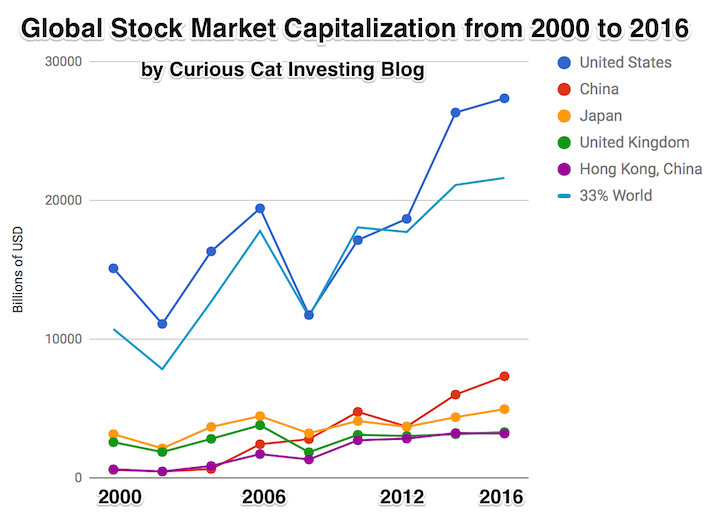
    chart of top 5 counties by stock market capitalization (2000 to 2016)
    The chart shows the top countries based on stock market capitalization, with data from 2000 to 2016. The chart was created by Curious Cat Investing and Economics Blog may be used with attribution. Data from the World Bank.

    It is important to keep in mind the data is shown in current USA dollars, so large swings in exchange rates can have a large impact.

    China’s performance has been remarkable. China also shows some of the challenges in collecting this data. I am fairly certain Alibaba (BABA), one of the 10 most valuable companies in the world and a Chinese company has the stock issued in the USA (even this is confusing as it is a complex arrangement but the only publicly traded stock is traded in the USA). And many other Chinese companies are traded this way and therefore are not included in the Chinese total value. In addition Hong Kong is part of China but also separate. The data is reported separately by the world bank and I include them that way in the charts.

    As with so much recent economic data China’s performance here is remarkable. China grew from 1.8% of world capitalization in 2000 to 6.9% in 2012 and 11.2% in 2016. Adding Hong Kong to China’s totals shows 3.7% in 2000 with growth to to 12.2% in 2012 and 16.2% in 2016. If you look at my post global stock market capitalization from 2000 to 2012 you will see significantly different historical data for Hong Kong. Collecting this data is much more complex than people realize and data determinations can change over the years resulting in changes in historical data.

    The chart shows the 1/3 of the total global market capitalization in order to have the chart display look better (and it also makes it easier to compare the USA performance to the total global performance). The USA market capitalization was at 46.9% of the global market cap in 2000 and fell to 31.6% in 2000 before rising to 42% in 2016. This shows that the USA has largely held its own globally as measured by market cap. This may not seem impressive but when you consider that China has grown from 3.7% to 16.2% you can see that for the market cap outside of China the USA has actually gained quite a bit of ground. This is the result of what I mentioned before – how well USA companies have done at capture global markets (especially in high technology areas with very high profits and therefore very high market caps).


    (more…)

  • Economic Competition and Supply Chains

    We have written about the massive changes in manufacturing globally over the last few decades. As we have shown, the data shows that the USA remained the largest manufacturer until 2010 when China finally took over as the largest.

    The massive declines in manufacturing employment were global. It led many to believe jobs were moving from the USA to China but much more accurately jobs were being eliminated everywhere. China lost more manufacturing jobs than the USA during the 1990s and early 2000s.

    The manufacturing job losses have been caused by productivity improvements. And those productivity improvements have provided us much cheaper access to manufacturing goods. That continued downward pressure on prices has been a big factor in the drastic decline in inflation. The threat of excessive inflation, which was so feared in the 1980s, has been replaced by the opposite problem – the threat of deflation.

    One aspect of the productivity improvement has been the global supply chains that have allowed companies to increase efficiency. The requirements of managing global supply chains are extremely complex and likely would not be possible without software to aid in the complex task.

    In his book, The Great Convergence, Richard Baldwin discussed how important the decline in shipping costs had in the economics of the last 50 years (we wrote about this book in: Historical Global Economic Data and Current Issues for Globalization). Those declines in prices, aided by other factors, increased the importance of supply chains.

    The last few decades have also seen dramatic changes in supply chains due to the internet. The time from manufacture to consumer has been shaved by direct shipment to consumers and nearly direct shipment to consumers via companies such as Amazon. Again software plays a central role in tying the manufacturing floor to a nearly instantaneous status of incoming orders from end users. Or in the case of software and entertainment, companies like Apple and Netflix have replaced the entire supply chain of manufacturing physical goods (DVDs, CDs…) with software.

    These changes in addition to increasing efficiency are again decreasing jobs by increasing the efficiency of the economy. These changes cause harm to those that are being squeezed (both employees and companies) while the economy overall gets more goods at lower prices to consumers.

  • Historical Global Economic Data and Current Issues for Globalization

    The Great Convergence by Richard Baldwin makes some interesting points about “globalization.” I actually find the long term history the most interesting aspect. It is very easy for people today to forget the recently rich “West” has not always been so dominant.

    China and India/Pakistan accounted for 73% of the world manufacturing output in 1750. They continued to account for over half of global output even as later as 1830. By 1913, however, their share had dropped to 7.5%.

    That shows how quickly things changed. The industrialization of Europe and the USA was an incredibly powerful global economic force. The rapid economic gains of Japan, Korea, Singapore, China and India in the last 50 years should be understood in the context of the last 200 years not just the last 100 years.

    A central point Richard advocates for in the book is realizing that the current conditions are different from the conditions in which traditional economic theory (including comparative advantage) hold. The reasoning and argument for this claim are a bit too complex to make sensibly in this post but the book does that fairly well (not convincingly in my opinion, but enough to make the argument that we can’t assume traditional economic theory for international trade is completely valid given the current conditions).

    Freer trade does allow all nations to gain by “doing what they do best and importing the rest.” But the fact is that TPP is much more like the soccer coach training the other team. TPP will make it easier to move advance know-how to low-wage nations – an outcome that is not covered by Adam Smith’s reasoning.”

    I don’t expect this blog post to convince people. I don’t even think his book will. But he makes a case that is worth listen to. And I believe he is onto something. I have for years been seeing the strains of “comparative advantage” in our current world economy. That doesn’t mean I am not mainly a fan of freer trade. I am. I don’t think complex trade deals such as TPP are the right move. And I do think more care needs to be taken to consider current economic conditions and factor that into our trade policies.

    Richard Baldwin uses 3 costs and the economic consequences of those changing over time to show globalizations history, where we are today and where we are going.

    The cost of moving goods came down first, followed by the cost of moving ideas. The third constraint, the cost of moving people, has yet to be relaxed.

    It isn’t very easy to follow but the book provides lots of explanation for the dramatic consequences of these costs changing over time.

    Highly skilled labor presents an attractive combination of low mobility and high spillovers. This combination is one of the reasons that almost all governments believe that subsidizing technical education is one of the best ways to promote their nation’s industrial competitiveness.

    One of his themes is that mobility of labor is still fairly costly. It isn’t easy to move people from one place to another. Though he does discuss how alternatives that are similar to this (for example telepresence and remote controlled robots to allow a highly technical person to operate remotely) without actually do moving the person are going to have huge economic consequences.

    The “high spillovers” are the positive externalities that spin off of a highly knowledgable workforce.

    (more…)

  • Foreign Ownership of USA Stocks Reached 26% in 2015

    The report, The Dwindling Taxable Share Of U.S. Corporate Stock, from the Brookings Institution Tax Policy Center includes some amazing data.

    Graph showing the percent of foreign, tax-free and taxable holdings of USA stocks over time

    In 1965 foreign ownership of USA stocks totaled about 2%, in 1990 it had risen to 10% and by 2015 to 26%. That the foreign ownership is so high surprised me. Holdings in retirement accounts (defined benefit accounts, IRAs etc.) was under 10% in 1965, rose to over 30% in 1990 and to about 40% in 2015. The holdings in retirement accounts doesn’t really surprise me.

    The combination of these factors (and a few others) has decreased the holding of USA stocks that are taxable in the USA from 84% in 1965 to 24% in 2015. From the report

    We treated foreigners as nontaxable as their income from stock generally is not subject to U.S.tax — or subject to just a little tax. Their stock gains almost always are exempt from taxation.Their dividends are subject to a 30 percent U.S.withholding tax for portfolio investments, which is typically reduced, by treaty, to 15 percent…

    As with much economic data it isn’t an easy matter to determine what values to use in order to get figures such as “foreign ownership.” Still this is very interesting data, and as the report suggests further research in this area would be useful.

    Related: There is No Such Thing as “True Unemployment Rate”The 20 Most Valuable Companies in the World – February 2016 (top 10 all based in the USA)Why China’s Economic Data is QuestionableData provides an imperfect proxy for reality (we often forget the proxy nature of data)

  • Nomadic Businesses in the Internet Age

    Once upon a time in a land not so far away, if you wanted to start a business, you had to choose a city in which to settle–not just for the business but for yourself. A lot of thought went into figuring out where to set up your new company’s home base. Delaware and Nevada, for example, have been popular choices because of its business friendly regulations and corporate tax laws. Once you got your central location up and running you could think about expanding to multiple locations or turning your company into a franchise.

    Those days are over. Sure, there are some who prefer to build businesses traditionally, but today thanks to advancements in technology and the rise of the internet and the ability to receive and send money online, even internationally, people can start a company anywhere and operate it from anywhere else (provided local incorporation laws do not require a specific length of time spent on site).

    Migrants have long moved to a new country for work, and then transferred funds home. This has been nearly completely those migrating from poor countries (or poor areas in the countries) to rich countries. Now individuals from rich countries are taking advantage of low cost countries to lower their living expenses while running most of your day to day from…just about anywhere.

    Businesses Can’t Really Be Nomadic, Can They?
    It’s true: not every business is suited to a nomadic lifestyle. Independent retail shops, for example: though it is possible to oversee basic operations from wherever you are, until you have a full support staff you are going to be needed onsite. Local service businesses that specialize in trades like contracting, plumbing, electrics, etc. Those are difficult to operate via telecommute. Most other companies, however, can be adapted to a global marketplace and base of operations fairly easily.

    I traveled for 4 years in SE Asia while operating my business. During that time my brother took a year to travel around the world with his family while running his business. He visited clients during his travels which took him through Brazil, Turkey, South Africa, India, Singapore, Australia and more. We met up for a week in Bali. There are challenges but there are great rewards also for businesses that allow you to travel while you work.

    Rice field filled with water
    Rice field opposite our bungalow in Ubud, Bali.

    Which Businesses Are Best Suited to the Nomadic Lifestyle?
    As previously stated, if you work hard enough at building your company and support team, you can run just about any sort of business from anywhere. That said, there are some companies and business types that lend themselves more easily to the nomadic lifestyle.

    Chris Guillebeau covers a few of these businesses and the entrepreneurs who started them in his book, The $100 Startup. One entrepreneur, for example, runs a linguistics and translation business internationally. He loves languages and loves teaching so he moves from country to country, learning the local languages and then teaching them to tourists and expatriates who choose to move there. Guillebeau himself has turned his book into a tour, a conference (The World Domination Summit) and a series of Unconventional Guides. He travels all over the world and writes from wherever he happens to be at the time.

    (more…)

  • International Migrants: Economics and Banking

    In 2013, international migrants sent $413 billion home to families and friends — three times more than the total of global foreign aid (about $135 billion). This money, known as remittances, makes a significant difference in the lives of those receiving it and plays a major role in the economies of many countries.

    India received $72 billion and Egypt $18 billion in 2013.

    I liked an interesting point he made. These remittences often include business advice to those relatives in the home country.

    This is a great talk if you are interested in economics and global development. It is very important to understand the issues we face in helping billions living in poverty. As he says regulation of small remittences must be reduced. Policies forced by countries like the USA have damaged poor people’s lives worldwide with extremely onerous regulation.

    Web site of the speaker: Dilip Ratha

    Related: International Development Fair: The Human FactorCreating a World Without PovertySupporting Virtual WorkersSolar Power Market Solutions For Hundreds of Millions Without Electricity

  • All-weather Portfolio

    Brett Arends writes about the investment portfolio he uses?

    what is in this all-weather portfolio?

    It’s 10% each in the following 10 asset classes:

    • U.S. “Minimum Volatility” stocks
    • International Developed “Minimum Volatility” stocks
    • Emerging Markets “Minimum Volatility” stocks
    • Global natural-resource stocks
    • US Real Estate Investment Trusts
    • International Real Estate Investment Trusts
    • 30-Year Zero Coupon Treasury bonds
    • 30-Year TIPS
    • Global bonds
    • 2-Year Treasury bonds (cash equivalent)

    This is another interesting portfolio choice. I have discussed my thoughts on portfolio choices several times. This one is again a bit bond heavy for my tastes. I like the global nature of this one. I like real estate focus – though as mentioned in previous articles how people factor in their personal real estate (home and investments) needs to be considered.

    Related: Cockroach PortfolioLazy Golfer PortfolioInvestment Risk Matters Most as Part of a Portfolio, Rather than in IsolationLooking for Dividend Stocks in the Current Extremely Low Interest Rate Environment

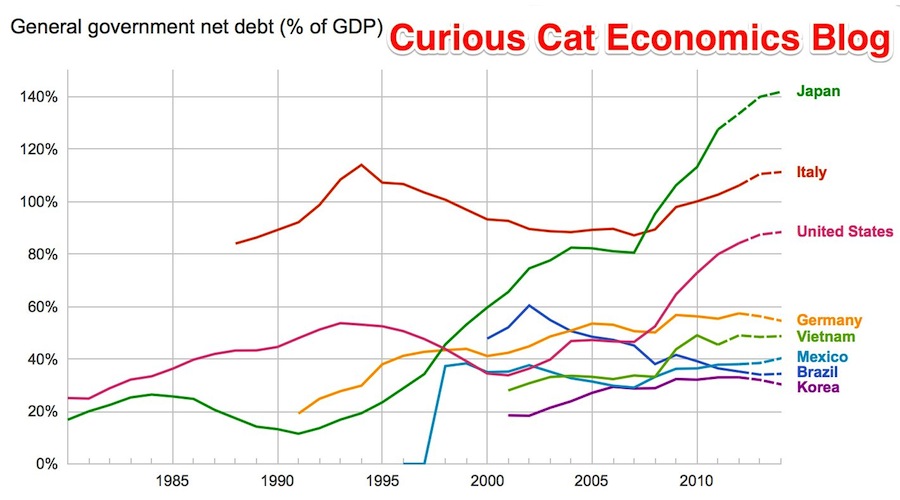
  • Chart of Net Government Debt from 1980 to 2013 by Country

    chart of Government debt from 1980 to 2013

    The data, from IMF, does not include China or India.

    The chart shows data for net debt (gross debt reduced by certain assets: gold, currency deposits, debt securities etc.).

    Bloomberg converted [broken link was removed] the data to look at debt load per person (looking at gross debt – estimated for 2014). Japan has ill-fortune to lead in this statistic with $99,725 in debt per person (242% of GDP), Ireland is in second with $60, 356 (121% of GDP). USA 3rd $58,604 (107%). Singapore 4th $56,980 (106%). Italy 6th $46,757 (133%). UK 9th $38,939 (95%). Greece 12th $38,444 (174%). Germany 14th $35,881 (78%). Malaysia 32nd $6,106 (57%). China 48th $1,489 (21%). India 53rd $946 (68%). Indonesia 54th $919 (27%).

    I think the gross debt numbers can be more misleading than net debt figures. I believe Singapore has very large assets so that the “net” debt is very small (or non-existent). Japan is 242% in gross debt to GDP but 142% of net debt (which is still huge but obviously much lower). The USA in contrast has gross debt at 107% with a net debt of 88%.

    Related: Government Debt as Percent of GDP 1998-2010 for OECDGross Government Debt as Percentage of GDP 1990-2009: USA, Japan, Germany, ChinaChart of Largest Petroleum Consuming Countries from 1980 to 2010Top Countries For Renewable Energy Capacity

  • Global Stock Market Capitalization from 2000 to 2012

    Looking at stock market capitalization by country gives some insight into how countries, and stocks, are doing. Looking at the total market capitalization by country doesn’t equate to the stock holdings by individuals in a country or the value of companies doing work in a specific country. Some countries (UK and Hong Kong, for example) have more capitalization based there than would be indicated by the size of their economy.

    It is important to keep in mind the data is in current USA dollars, so big swings in exchange rates can have a big impact (and can cause swings to be exacerbated when they move in tandem with stock market movements – if for example the market declines by 15% and the currency declines by 10% against the US dollar those factors combine to move the result down).

    Chart of stock market capitalization from 2000 to 2012 for USA, China, Japan, UK and world
    The chart shows the top four countries based on stock market capitalization, with data from 200 to 2012. The chart created by Curious Cat Investing and Economics Blog may be used with attribution. Data from the World Bank.

    As with so much recent economic data China’s performance here is remarkable. China grew from 1.8% of world capitalization in 2000 to 6.9% in 2012. And Hong Kong’s data is reported separately, as it normally is with global data sets. Adding Hong Kong to China’s totals would give 3.7% in 2000 with growth to to 8.9% in 2012 (Hong Kong stayed very stable – 1.9% in 2000, 2% in 2012). China alone (without HK) is very slightly ahead of Japan.

    The first chart shows the largest 4 market capitalizations (2012: USA $18.6 trillion, China and Japan at $3.7 trillion and UK at $3 trillion). Obviously the dominance of the USA in this metric is quite impressive the next 7 countries added together don’t quite reach the USA’s stock market capitalization. I also including the data showing the global stock market capitalization divided by 3 (I just divide it by three to have the chart be more usable – it lets us see the overall global fluctuations but doesn’t cram all the other data in the lower third of the chart).

    Canada is the 5th country by market capitalization (shown on the next chart) with $2 trillion. From 2000 to 2012 China’s market capitalization increased by $3.1 trillion. The USA increased by $3.6 trillion from a much larger starting point. China increased by 536% while the USA was up 23.5%. The world stock market capitalization increased 65% from 2000 to 2012.

    Related: Stock Market Capitalization by Country from 1990 to 2010Government Debt as Percent of GDP 1998-2010Manufacturing Output by Country 1999-2011: China, USA, Japan, Germany

    (more…)