Tag: government

  • Extremely Poor Broadband for the USA

    The USA has extremely poor broadband service (compared to other rich countries). It is slow and expensive. Those that support economic policies more in line with the USA than other nations have a great deal of explaining to do about why the options are so bad. It is similar to the broken health care system.

    Those that support politicians leading to this state for broadband say they support “free markets.” In actuality, they support anti-competitive practices by extremely large companies (oligopolistic behavior). Free market theory (the original form) requires that no individual company can dictate to the market. You have free competition – no barrier to entry, no restraint on entry, customers can buy where they want… But the politicians we elect instead support policies and practices that restrain free trade and prohibit good solutions in order to benefit those that pay the politicians well. And then we vote for those politicians.

    Those wanting the anti-competitive markets have won in our political system. The main thing I wish was clearer was that we stop pretending these people have some capitalist leaning. They are anti-capitalist. If they want to support the policies they do I wish they would be required by the voters to at least be honest. Unfortunately the voters elect them with their dis-honest representations. If the politicians were honest they would have a more difficult time being elected (because voters want to pretend they like capitalism even while voting for politicians that just seek to give special benefits to those that pay the politicians. And then the politicians claim to support markets, and business and consumers when really they just favor making anti-market legislation and regulation to favor their contributors. As long as we vote for people that claim to support capitalism but undermine it at every step to help their friends we do deserve to suffer. I just wish we could convince enough of our fellow citizens that flashy propaganda and repeating lies over and over isn’t the same as facts and truth.

    1Gbps fiber for $70—in America? Yup.

    Where I live in Chicago, Comcast’s 105Mbps service goes for a whopping $199.95 (“premium installation” and cable modem not included). Which is why it was so refreshing to see the scrappy California ISP Sonic.net this week roll out its new 1Gbps, fiber-to-the-home service… for $69.99 a month.

    Given the anti-competitive policies in the USA, if they have much success they will probably just be bought (or maybe as others suggest fought in other anti-competitive ways, but buyouts are normally easiest for actually strong competitor) to allow anti-competitive pricing and service to continue. The only real hope is someone with actual power sees it in their interest to fight against the entrenched interests. Google is the best hope I think. It isn’t that Google has nearly as much political power as those interests but they are smart and have the advantage of just having to expose the anti-competitive behavior and apply pressure.

    The narrative the politicians and voters say they support is capitalism. But the reality is just those with the gold make the rules. But when this is made obvious and continually pressed by someone with power, clout, intelligence and political savvy it makes politicians and regulators hesitant to continue business as usual. Normally they just delay for a few months and then continue the corrupt practices. Google, plus others, plus lots of individual interest can fight that off – but it takes perseverance.

    Related: USA Broadband is Slow. Really Slow.Plugging America’s Broadband GapEliminate Your Phone BillNet Neutrality: This is serious

  • I Strongly Support Elizabeth Warren and the Consumer Financial Protection Bureau

    I strongly support Elizabeth Warren and strongly support her for to head the Consumer Financial Protection Bureau. She would do a great deal to improve the economy of the USA. And she would do a great deal to improve the life of tens or hundreds of millions of people. We have allowed a few people to bribe our elected officials to distort markets to damage hundreds of millions and provide huge gains for a few. We need to support capitalism not crooked elites breaking capitalism to favor their allies at the expense of the economy and those who want to benefit from free markets. It is very difficult to impede the greed fueled distortions that politicians put in place to break free markets and provide huge benefits to those who pay them. Elizabeth Warren is one of the few that is knowledgeable and skillful enough to reduce the damage those people cause the economy and everyone else.

    Why I Support Elizabeth Warren and the CFPB

    To simplify, government’s retreat from principled and thoughtful regulation licensed investment banks, credit agencies, insurance companies, and Wall Street gurus to put greed above reason. We permitted them to persuade ordinary citizens (and pension funds and homeowners) that securitized instruments, of similar efficacy to carney-sold patent medicines, were worth buying. We also allowed them to sell the idea that wishing could repeal the law that what goes up must come down.

    Nobody is entirely innocent; money’s promise is for most of us a siren’s call. And, as a nation, we’ve willfully scanted education in civic and financial literacy in schools at all levels. So guilt is not worth focusing on. We need instead a future practice of clear rules and tough oversight. And we need to remind ourselves that Adam Smith’s concept of an invisible hand did not contemplate that hand’s picking the pockets of the people whose individual decisions and actions, if the market works perfectly, let supply match demand.

    There are few political appointments I care much about. They normally are so co-opted even if they have good ideas they can’t get anything done. Don Berwick is a great person to have lead health care reform. The system is so messed up I am skeptical he can actually get much done, but I also strongly support him.

    Elizabeth Warren is excellent and wise enough to actually accomplish things even with those who will attempt to thwart and improvements in the financial system that move forward capitalism at the expense of a few nobles that are protected by political allies. I have no doubt those in power will still thwart most efforts to stop politically sanctioned distortion of markets to enrich a few people that then pay a portion of their gains to the politicians that let them ruin free markets for their own huge personal gains.

    Very few political appointees make much difference. If Elizabeth Warren gets this position she will have a good chance and making a huge difference o the quality of life for hundreds of millions of people and the economy overall. That is true even though she will have to continually fight those politicians seeking to protect the anti-competitive benefits they have lavished upon those that pay them to enact policies that benefit them at the expense of everyone else.

    Related: If you Can’t Explain it, You Can’t Sell ItMiddle Class Families from 1970-2005 (webcast of Elizabeth Warren)What the Financial Sector Did to UsPoliticians Again Raising Taxes On Your Children

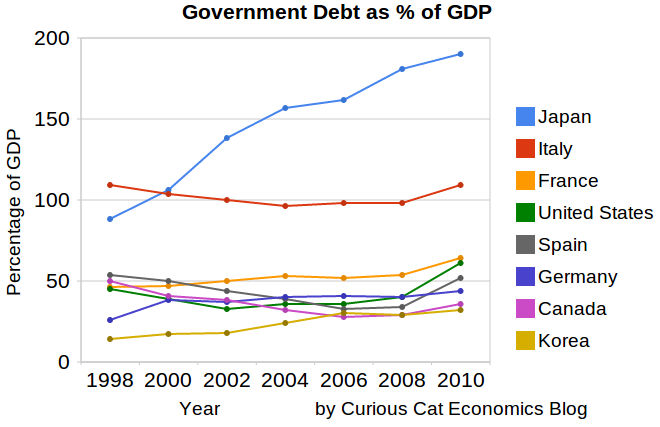
  • Government Debt as Percent of GDP 1998-2010 for OECD

    This chart shows government debt as a percent of GDP based on OECD data. The chart is limited to central government debt issuance and excludes therefore state and local government debt and social security funds.

    Economic data is always a bit tricky to understand. It makes some sense that excluding social security would reduce the USA debt percentage a bit. But these debt as a percentage of GDP are lower than other sources show. There are obviously many tricks that can be used to hide debt and my guess is the main thing going on with this data is OECD intentionally trying to make things look as good as possible.

    Still looking at historical trends in data is useful. And I believe looking at data from various sources is wise. There has been a dramatic increase from 2008-2010. The USA is up from 41% of GDP to 61%. Spain is up from 34% to 52% (but given all the concern with Spain this doesn’t seem to indicate the real debt problems they have.

    Japan and France don’t have 2010 data, so I used a rough estimate of my own based on 2009 data. Greece has been over 100% since 1998 and now stands at 148%, 2nd worst (to Japan) for any OECD country (Europe, North America, Japan and Korea), Italy is 3rd. Ireland is at 61% (up from 28% in 2008). The UK is at 86%, up from 61%.

    Related: Government Debt as Percentage of GDP 1990-2009: USA, Japan, Germany, China… (based on IMF data)Government Debt as Percentage of GDP 1990-2008Government Debt Compared to GDP 1990-2007Top 15 Manufacturing Countries in 2009

  • Banks Hoping they Paid Politicians Enough to Protect Billions in Excessive Fees

    USA consumers pay huge fees on debit cards not found in most other rich countries. Other countries provide debit cards with much cheaper fees than USA banks mandate now given their anti-competitive oligopolistic pricing power. I haven’t seen anyone (that isn’t in the pay of banks) arguing for keeping excessive fees in place. But there are lots of people being paid by the banks (including most likely, “your” representative).

    Banks want a favor — at your expense

    The big banks are pressing Congress for a favor that will cost the average American household $230 a year. The bankers argue that the favor is needed to support small community banks. But since the lion’s share of the favor will be collected by just four banks, it might be cheaper to subsidize community banks with a check direct from the Treasury.

    David Frum, special assistant to President George Bush, is exactly right.

    Banks charge an average of about 1% on debit card transactions. In Australia, where swipe fees are regulated, banks charge half as much — and still earn a profit.

    [banks] are lobbying hard to repeal the cap on debit card fees in advance of the July date when Dodd-Frank goes into effect… Congress is not swayed by arguments. It is swayed by clout — and on this issue, it is the banks who have the clout.

    Based on that experiment, economist Robert Shapiro of Sonecon estimates that about 56% of the value of reduced swipe fees will reach the final consumer. That’s the basis for his calculation of savings of $230 per household. That’s also the basis for his further calculation that reduced swipe fees will translate into a one-time gain of 250,000 new jobs.
    The new Republican House majority appropriately mistrusts government regulation. But if the financial crisis taught us anything, it should have taught that financial regulation is different from other forms of regulation. Invisible charges imposed by a financial cartel is not my idea of a free market.

    The caps were part of the huge bailout taxpayers gave banks and were meant to be a partial watering down of a few of the smaller favors their bought and paid for politicians had given them over the years (as “punishment” for their misdeeds).
    (more…)

  • Dishonest and Dangerous State Budgets

    Bill Gates is really doing some great stuff the last few years. He takes a look at the enormous problem with state government’s failure do deal with the very long term health care failure in the USA (this has been going on for the last few decades) and the financial games them play. His Twitter quote is: Enron would blush at the financial untruth State governments engage in.

    I have written about these problems before, including in: USA State Governments Have $1,000,000,000,000 in Unfunded Retirement Obligations. One small (compared to the problem for the whole country) He notes is that California has a $62.5 billion health care liability and $3 billion set aside for it.

    We have been doing a very bad job of electing people to honest manage budgets. We, or our children and grandchildren are going to pay for those failures. The longer we fail to elect people that will deal with the real decisions that need to be made for government spending and taxing the greater those bills for our mistakes will be.

    Related: Are Municipal Bonds Safe?USA Heath Care System Needs ReformUSA Spends Record $2.5 Trillion, $8,086 per person 17.6% of GDP on Health Care in 2009The USA Pays Double for Worse Health ResultsThe Long-Term USA Federal Budget Outlook

  • Are Municiple Bonds Safe?

    Municipal bonds seem safe. But the incredible long period of irresponsible spending and taking on long term liabilities (pensions, health care costs, infrastructure to maintain) and low taxes and selling off future income streams (to consume today) leaves those bonds with questionable financial backing in many locations. Municipal bond investments should be examined more closely today in light of the problems in the market.

    Video shows the State Budgets: The Day of Reckoning by 60 minutes.

    Wave of Muni Defaults to Spur Layoffs, Social Unrest: Whitney

    Responding to the uproar over her “60 Minutes” interview broadcast on CBS Sunday night, Whitney defended her prediction that at least 50 to 100 cities and towns could default on their debt as states and the federal government cut back on financial support.

    Muni experts, including an analyst from Standard & Poor’s, dismissed her predictions, saying the numbers don’t add up.

    “States clearly have been funding municipal governments—for now up to 40 percent of their total expenditures,” she explained. “As the states become more compromised from a fiscal standpoint, that funding is going to end.”

    Whitney added that it’s way too soon to see muni bonds as a buying opportunity. But she said that can change quickly.

    “When you start to see the first major defaults in this area [the states and cities], when you see more defaults and indiscriminate selling—if you do your research now and figure out who’s protected where and which revenues are protected, there will be great buying opportunities,” Whitney said.

    “People are complacent about these defaults. The news about all this isn’t out there yet,” Whitney went on to say. “And only when it is out there, then there will be a buying opportunity [for munis].”

    Related: USA State Governments Have $1,000,000,000,000 in Unfunded Retirement ObligationsNY State Raises Pension Age to Save $48 BillionWhat the Bailout and Stimulus Are and Are Notposts on bonds

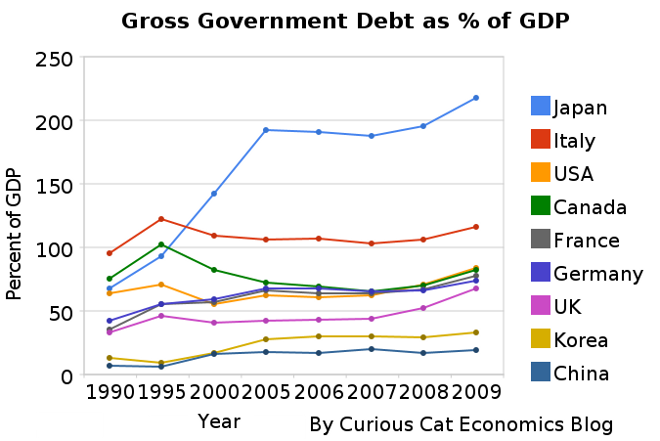
  • Government Debt as Percentage of GDP 1990-2009: USA, Japan, Germany, China…

    The world today has a much different economic landscape than just 20 years ago. China’s amazing economic growth is likely the biggest story. But the overwhelming success of many other countries is also a huge story. Today it is not the developing world that has governments spending taxes they promise their grandchildren will pay, but instead the richest countries on earth that choose to spend today and pay tomorrow. While “developing” countries have well balanced government budgets overall.

    graph showing government debt as percentage of GDPThe chart shows gross government debt as percentage GDP from 1990-2009. By Curious Cat Investing and Economics Blog, Creative Commons Attribution. Data source: IMF

    ___________________________

    There are plenty of reasons to question this data but I think it gives a decent overall picture of where things stand. It may seem like government debt should be an easy figure to know but even just agreeing what would be the most reasonable figure for one country is very difficult, comparing between countries gets even more difficult and the political pressures to reduces how bad the data looks encourages countries to try and make the figures look as good as they can.

    The poster child for irresponsible spending is Japan which has gross government debt of 218% of GDP (Japan’s 2009 figure is an IMF estimate). Greece is at 115%. Gross debt is not the only important figure. Government debt held within the country is much less damaging than debt held by those outside the country. Japan holds a large portion of its own debt. If foreigners own your debt then debt payments you make each year are paid outside your country and it is in essence a tax of a portion of your economic production that must be paid. If the debt is internal it mean taxpayers have to support bond holders each year (but at least when those bondholders spend the money it stays within your economy).
    (more…)

  • Homes for Half Price to Teachers, Law Enforcement and Emergency Workers

    Law enforcement officers, pre-Kindergarten through 12th grade teachers and firefighters/emergency medical technicians can contribute to community revitalization while becoming homeowners through HUD’s Good Neighbor Next Door Sales Program. HUD (United States Department of Housing and Urban Development) offers a substantial incentive in the form of a discount of 50% from the list price of the home. In return you must commit to live in the property for 36 months as your sole residence.

    Eligible Single Family homes located in revitalization areas (there are hundreds of revitalization areas across the country. HUD is always working with localities to designate new areas) are listed exclusively for sales through the Good Neighbor Next Door Sales program. Properties are available for purchase through the program for five days.

    Check the listings for your state. Follow the instructions to submit your interest in purchasing a specific home. If more than one person submits on a single home a selection will be made by random lottery. You must meet the requirements for a law enforcement officer, teacher, firefighter or emergency medical technician and comply with HUD’s regulations for the program.

    HUD requires that you sign a second mortgage and note for the discount amount. No interest or payments are required on this “silent second” provided that you fulfill the three-year occupancy requirement.

    Related: Fixed Mortgage Rates Reach New LowYour Home as an Investmentarticles on home ownership

  • More than half of the USA Federal Government Debt Held in USA Again

    U.S. Investors Regain Majority Holding of Treasuries

    For the first time since the start of the financial crisis in August 2007, U.S. investors own more Treasuries than foreign holders.

    Mutual funds, households and banks have boosted the domestic share of the $8.18 trillion in tradable U.S. debt to 50.2 percent as of May, according to the most recent Treasury Department data.

    The biggest jump in demand this year among domestic buyers of Treasuries has been commercial lenders. Bank holdings of Treasury and agency securities increased 5 percent to $1.57 trillion last month, according to the latest data available from the Fed.

    The Fed’s decision to hold its target for the overnight lending rate at a record low has made it possible for banks to borrow at near-zero interest rates to finance purchases of longer-term and higher-yielding Treasuries while lending less.

    I must say, unless you are getting special government interest free loans to invest in treasuries (like those that caused the credit crisis are) it seems crazy to me to invest at these low rates. In retirement, it probably does make sense to have some just as a diversification measure but other than that I would certainly reduce my holdings from what they would have been 10 years ago.

    If politicians or the fed would just give special favors to me to borrow billions and essentially 0% and then lend it back for more I would take that deal.

    But if I am not granted the welfare Chase, Goldman Sachs, Citibank and the rest are (with huge amounts of free money and bailouts if their bets fail) buying extremely low yield government debt is not an investment I want. I don’t think betting on deflation is not a bet I want to take. Inflation seems a bigger risk to me. But people get to make their own decisions, and we will see which investors are right.

    Related: Paying Back Direct Cash from Taxpayers Does not Excuse Bank MisdeedsCan Bankers Avoid Taking Responsibility Again?What the Financial Sector Did to Us

  • Greenspan Says Congress Should Let Tax Cuts Expire

    Alan Greenspan made several huge errors while chairman of the Federal Reserve. Failing to deal with the massive risk taking and fraud by the member banks of the Federal Reserve was one. And supporting tax cuts for a country that was hugely in debt (while current deficits were still huge was another. Yes anyone can claim (and he did) future surpluses, but there had yet to be a single year of surplus, and obviously we would have been in deficit even before the tax cuts put us much much further in debt, history has shown .

    But Greenspan said government estimates project more than enough surplus funds to pay off the debt and reduce taxes too.

    That is either amazingly bad economic forecasting or a lie. My guess is he knew this wasn’t true. Which would make it a lie. If he really was that out of touch with economic reality, we have to question why we ever thought he had insight into the economy.

    Greenspan Says Congress Should Let Tax Cuts Expire

    WOODRUFF: On those tax cuts, they are due to expire at the end of this year. Should they be extended? What should Congress do?

    GREENSPAN: I should say they should follow the law and let them lapse.

    WOODRUFF: Meaning what happens?

    GREENSPAN: Taxes go up. The problem is, unless we start to come to grips with this long-term outlook, we are going to have major problems. I think we misunderstand the momentum of this deficit going forward.

    Related: Estate Tax Repeal (2006)Charge My Government to My Kids (2007)USA Federal Debt Now $516,348 Per Household

    Accepting that, I don’t agree with those that vilify his performance. He was Fed chairman from 1987-2006. He made some very bad decisions that cost people dearly. But it isn’t very surprising someone in such power for so long would make some very bad and costly decisions. My guess is he caved to pressure from political allies that reminded him how the current President Bush’s father blamed Greenspan’s decisions for his losing the Presidency. And so Greenspan was trying to do what he could to do what the then President Bush wanted. Not a very honorable explanation but people often do not make the most honorable choices.

    In 2003 he publicly disagreed with the wisdom of additional cuts:

    Alan Greenspan, the Federal Reserve chairman, today rebutted many of President Bush’s arguments in favor of big new tax cuts, saying that the economy probably does not need any short-term stimulus and warning that budget deficits could spiral out of control.

    Politicians, eager to give favors, at the expense of the future, went ahead and passed more tax cuts – weakening the country for their (and their political allies) short term benefit.

    Related: Estate Tax Repeal (2006)Charge My Government to My Kids (2007)USA Federal Debt Now $516,348 Per Household

    Greenspan’s thoughts on the economy, from his July 16th 2010 interview:
    (more…)