Tag: green

  • Solar Energy Capacity Continues to Grow Rapidly (Chart of Data by Country)

    Solar energy capacity has been growing amazingly quickly the last few years. Part of the reason for this is the starting point was so low, making it easy to have large gains.
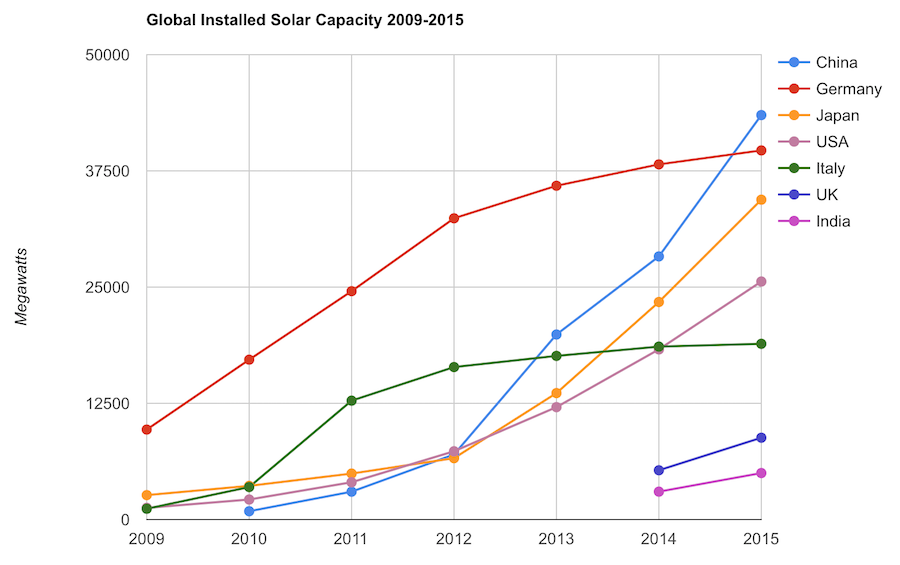
    Chart of solar pv capacity by country 2009 to 2015
    Chart by Curious Cat Economics Blog using data from the International Energy Agency (IEA) and the US Department of Energy. Chart may be used with attribution as specified here.

    The 2014 and 2015 data on this chart is from IAE report for total installed photovoltaic (PV) solar capacity. See previous post on chart of Solar Energy Capacity by Country from 2009 to 2013. Different data sources for different year (and/or countries in the same year) is not ideal but for the purposes of this data in this post is sufficient.

    Installed PV capacity is even more questionable that much other economic data. Economic data are always approximations of reality but with PV you have additional questions. The same plant located outside London or Rome have different capability to produce (and there are many factors that contribute not just the most obvious such as how much sun shines in a particular geography). Installed PV data is based on the capability of the equipment regardless of the solar potential of the location.

    So even with the same investment it is likely Italy gets more production than Germany. The IAE report attempted to determine what was the likely ability of the solar PV capacity to produce for each country as a percentage of total electricity needs. They estimate Italy has the largest percentage of electricity needs capable of being produced by installed PV systems at 8%, with Greece at 7.4% and Germany at 7.1%. Japan is ranked 5th at just under 4%, UK is 12th at 2.5%, China is 22nd at 1%, India 24th and the USA 25th at close to .9%. They estimate the total global percentage at 1.3%.

    These figures also show the huge power needs of China and the USA. Even with huge investments in Solar they us so much electricity that it is slow to make large gains in the percentage of total power generated by solar.

    In the USA in 2013 solar energy capacity was under 1% USA total electrical capacity. In 2013 hydropower was 6.8%, wind was 5.3% and biomass was 1.3%. The increase in solar capacity should continue to grow rapidly and is making significant contributions to the macroeconomic energy picture (even if it doesn’t appear dramatic).

    Related: Chart of Global Wind Energy Capacity by Country from 2005 to 2015Leasing or Purchasing a Solar Energy System For Your HouseNuclear Power Generation by Country from 1985-2010Manufacturing Output by Country 1999-2011: China, USA, Japan, Germany
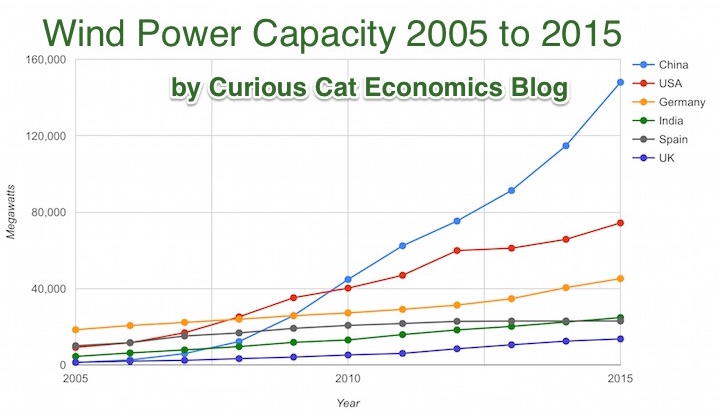
  • Chart of Global Wind Energy Capacity by Country from 2005 to 2015

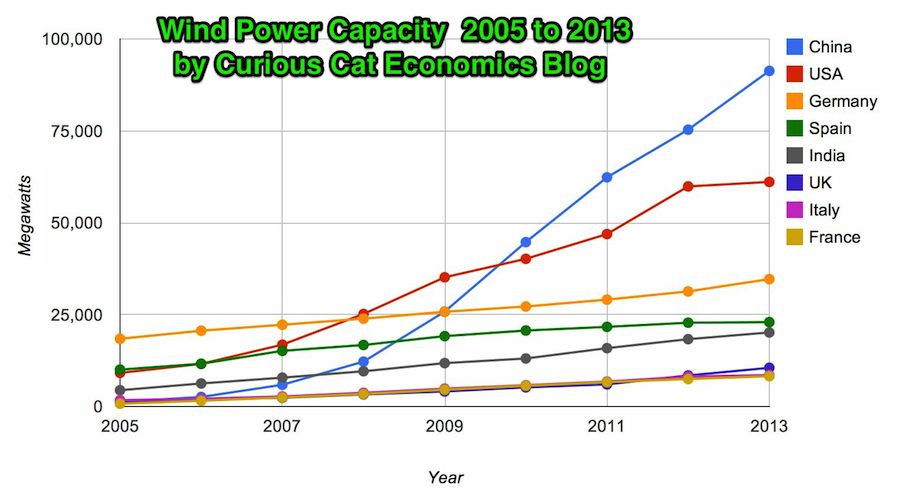
    chart of wind power capacity by country from 2005 to 2015 for top 7 countries
    Chart by Curious Cat Economics Blog using data from the Wind Energy Association, data for 2014 and 2015. Chart may be used with attribution as specified here.

    After a slowing of additional capacity added in 2013, both 2014 and 2015 saw a bit of a rebound in additions to global wind energy capacity. In 2013 capacity increased only 13% while in both 2014 and 2015 it increased 17%. Still 17% is less than any year in the last 10, except 2013.

    At the end of 2013 China had 29% of global capacity (after being responsible for adding 62% of all the capacity added in 2013). In 2005 China had 2% of global wind energy capacity.

    At the end of 2015 China accounted for 34% of global capacity, the only country in the top 8 increasing their share of global capacity. The USA now has 17% of capacity. Germany has 10%.

    Europe moved first in adding large scale wind energy capacity but has added capacity very slowly in the last 5 years. Germany had 31% of global capacity in 2005. Spain had 17% in 2005 and now has just 5% (during that time Spain has more than doubled their wind energy capacity).

    The 6 countries shown on the chart account for 76% of total wind energy capacity globally. From 2005 to 2015 those 8 countries have accounted for between 74 and 77% of total capacity – which is amazingly consistent.

    Wind power now accounts for approximately 4 to 5% of total electricity used.

    Related: Chart of Global Wind Energy Capacity by Country 2005 to 2013Solar Energy Capacity by Country (2005 to 2013)Nuclear Power Generation by Country from 1985-2010Chart of Largest Petroleum Consuming Countries from 1980 to 2010

  • Solar Energy Capacity by Country

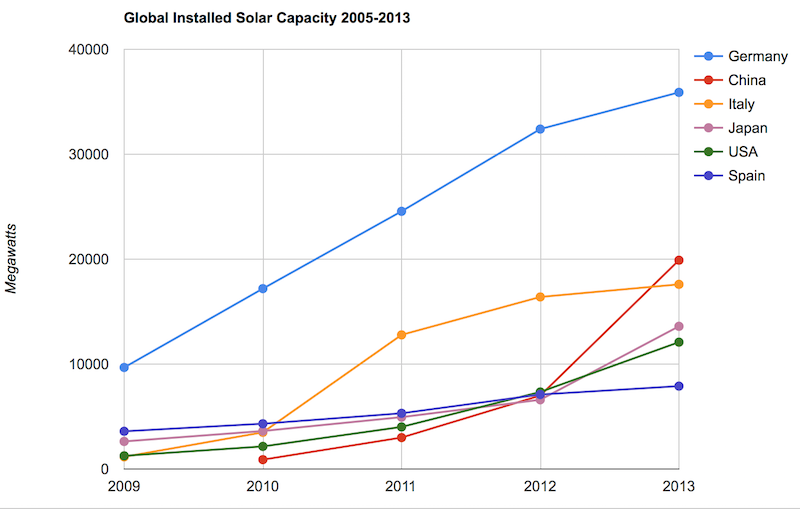
    Solar energy capacity has been growing amazingly quickly the last few years. Part of the reason for this is the starting point was so low, making it easy to have large gains.

    Chart of global solar energy capacity by country 2009 to 2013
    Chart by Curious Cat Economics Blog using data from the US Department of Energy. Chart may be used with attribution as specified here.

    As with so many macro economic measures China has made enormous investments in solar energy the last few years. China’s increase in 2013 was larger than the USA’s total capacity at the end of 2013. Since solar energy use on a large scale is still small investments are quickly ramping up. Europe was a few years ahead of others putting countries like Germany, Spain and Italy far in the lead. China, the USA and Japan have been investing huge amounts the last few years and will likely leave those other than Germany (which already has such a large capacity) far behind very shortly.

    In the USA, even after growing 60% in 2008, 53% in 2009, 71% in 2010, 86% in 2011, 83% in 2012 and 64% in 2013 solar energy capacity only totaled 1% of USA total electrical capacity. In 2013 hydropower was 6.8%, wind was 5.3% and biomass was 1.3%. The increase in solar capacity should continue to grow rapidly and is starting to make significant contributions to the macroeconomic energy picture.

    When you look at total electricity generation solar only represented .5% (compared to 6.6% for hydropower 4.1% for wind and 1.5% for biomass).

    USA data based on only solar capacity that is connected to the grid (and my guess would be that is the measure used in other countries too). Data is largely from that Department of energy report, with historical data for other countries pulled from previous editions.

    The US Energy Information Agency (USEIA) expects the USA to add (net) 9,841 MW of wind capacity; 4,318 MW of natural gas capacity and 2,235 MW of solar in 2015. In 2015 they also predict a net decline of 12,922 MW of coal capacity. They also share that nuclear plants and natural gas combined-cycle generators having utilization factors 3 to 5 times those of wind and solar generators, which means capacity measures are significantly different from actually produced electricity measures.

    The USEIA has predicted “global solar PV capacity seen rising from 98 GW in 2012 to 308 GW in 2018.” They predicted in 2018 China would have the most solar PV capacity followed by Germany, Japan and the USA.

    The Solar Energy Industries Association (USA) states that 5,000 MW of solar capacity was added in the USA in 2013 and 7,000 MW in 2014. They forecast 8,000 MW to be added in 2015 and 12,000 MW in 2016.

    Related: Solar Direct Investing BondsChart of Global Wind Energy Capacity by Country 2005 to 2013Leasing or Purchasing a Solar Energy System For Your HouseNuclear Power Generation by Country from 1985-2010Google Invests $168 million in Largest Solar Tower Power Project (2011)Molten Salt Solar Reactor Approved by California (2010)15 Photovoltaics Solar Power Innovations (2008)

  • Chart of Global Wind Energy Capacity by Country 2005 to 2013

    chart of Wind power capacity by country 2005 to 2013
    Chart by Curious Cat Economics Blog using data from the Wind Energy Association. Chart may be used with attribution as specified here.

    In 2013 the addition to wind power capacity slowed a great deal in most countries. Globally capacity was increased just 13% (the increases in order since 2006: 26%, 27%, 29%, 32%, 25%, 19% and again 19% in 2012). China alone was responsible for adding 16,000 megawatts of the 25,838 total added globally in 2013.

    At the end of 2013 China had 29% of global capacity (after being responsible for adding 62% of all the capacity added in 2013). In 2005 China had 2% of global wind energy capacity.

    The 8 countries shown on the chart account for 81% of total wind energy capacity globally. From 2005 to 2013 those 8 countries have accounted for between 79 and 82% of total capacity – which is amazingly consistent.

    Wind power now accounts for approximately 4% of total electricity used.

    Related: Chart of Global Wind Energy Capacity by Country 2005 to 2012In 2010 Global Wind Energy Capacity Exceeded 2.5% of Global Electricity NeedsGlobal Trends in Renewable Energy InvestmentNuclear Power Generation by Country from 1985-2010

    (more…)

  • Chart of Global Wind Energy Capacity by Country 2005 to 2012

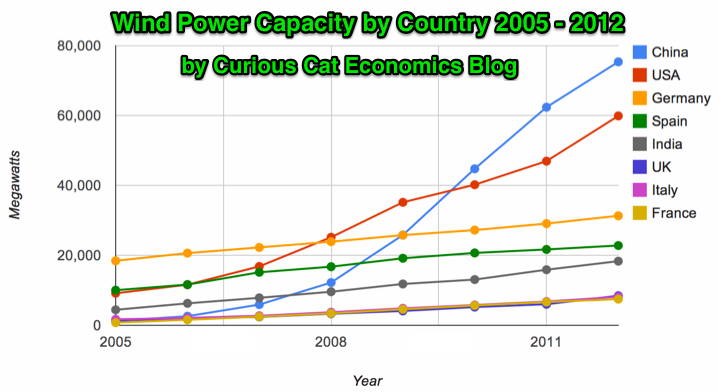
    Global wind power capacity has increased 391% from 2005 to 2012. The capacity has grown to over 3% of global electricity needs.

    chart of global wind power capacity by country from 2005 to 2012
    Chart by Curious Cat Economics Blog using data from the Wind Energy Association. Chart may be used with attribution as specified here.

    The 8 countries shown on the chart account for 82% of total wind energy capacity globally. From 2005 to 2012 those 8 countries have accounted for between 79 and 82% of total capacity – which is amazingly consistent.

    Japan and Brazil are 13th and 15th in wind energy capacity in 2012 (both with just over one third of France’s capacity). Japan has increased capacity only 97% from 2005 to 2012 and just 13% from 2010 to 2012. Globally wind energy capacity increased 41% from 2010 to 2012. The leading 8 countries increased by 43% collectively lead by China increasing by 68% and the USA up by 49%. Germany added only 15% from 2010 through 2012 and Spain just 10%.

    Brazil has been adding capacity quickly – up 170% from 2010 through 2012, by far the largest increase for a county with significant wind energy capacity. Mexico, 24th in 2012, is another country I would expect to grow above the global rate in the next 10 years (I also expect Brazil, India and Japan to do so).

    In 2005 China accounted for 2% of wind energy capacity globally they accounted for 30% in 2012. The USA went from 15% to 24%, Germany from 31% to 12%, Spain from 17% to 9% and India from 8% to 7%.

    Related: Global Wind Energy Capacity Exceeds 2.5% of Global Electricity Needs (2011)Nuclear Power Generation by Country from 1985-2010Chart of Wind Power Generation Capacity Globally 2005 to 2012 (through June)

  • Global Trends in Renewable Energy Investment

    Global Trends in Renewable Energy Investment 2012

    in 2011, global investment in the renewable energy sector hit another record, up 17% to $257 billion. This was a six fold increase on the 2004 figure and 93% higher than the total in 2007.

    renewable power (excluding large hydro) accounted for 44% of new generation
    capacity added worldwide in 2011, up from 34% in 2010 [and 10% in 2004]. The $237 billion invested in building these green power plants compares with $223 billion of net new expenditure annually on building additional fossil-fuelled power plants globally last year.

    Current predictions are that total installed capacity in non-hydro renewable power will rise ninefold to 2.5Tw by 2030, with investment in assets rising from $225 billion in 2011 to $395 billion-a-year by 2020 and $460 billion-a-year by 2030

    Total investment in solar in 2011 increased 52% to $147 billion, driven by a drop of 50% in photovoltaic module prices. Investment in wind dropped 12% to $84 billion, while onshore wind turbine prices fell between 5 and 10%. Biomass and waste to energy was the 3rd largest renewable sector at $11 billion in investments (down 12% from 2010).

    USA investment surged 51% to $51 billion just behind China at $52 billion (China increased investment in renewable energy by 17% from 2010). German investment dropped 12% to $31 billion.

    In 2011 renewable energy power capacity (excluding large hydropower), as a percentage of total system capacity, reached 9%, up from 4% in 2004. Total renewable energy generation (excluding large hydro) reached 6%, up from 4% in 2004.

    Related: Top Countries For Renewable Energy CapacityWind Energy Capacity Exceeds 2.5% of Global Electricity NeedsLeasing or Purchasing a Solar Energy System For Your Home

  • Solar Power Market Solutions For Hundreds of Millions Without Electricity

    400 million people in India and 1.2 billion people worldwide do not have electric power at home. Mera Gao Power provides a wonderful market solution. Mera Gao Power can install solar power systems at a low cost that can be paid back in just 2 years by charging only 50 cents a month to users (for 7 hours of electricity a day). So they provide funding (through investors and grants) and recoup the investment quickly by providing a valuable service at a price users can afford.

    Four solar panels are sufficient to power an entire village of 100 households with quality light and mobile charging. These panels are installed on the roofs of existing households, thus eliminating the need for land. Since power is generated during the day and used at night they use batteries to store the power.

    By utilizing LED lights, MGP’s micro grid design is ultra energy efficient. This is the key to reducing power generation and storage equipment. Each household is provided with two or four LED lights.

    Mera Gao Power received funding from USAID Development Innovation Ventures. The video presents their innovation for a village-level solar micro grid to electrify rural Uttar Pradesh for a White House meeting.

    Related: Appropriate Technology: Solar Water Heaters in Poor Cairo NeighborhoodsTop Countries For Renewable Energy CapacityWater Pump Merry-go-RoundLetting Children Learn, Hole in the Wall ComputersHomemade Windmills for ElectricityWater and Electricity for All

  • Leasing or Purchasing a Solar Energy System For Your House

    The economics of solar energy make sense today. The main stumbling block is financing the initial purchase (for homeowners, businesses or utilities). For new power generation solar is economically competitive in many locations today and prices continue to decline. One aspect that has harmed financing is the historical depreciation has been high (assuming a short lifespan of solar panels) but the panels now have much longer lifespans, meaning that when computing the return of solar investments you can expect a longer payback period. Combine that with falling prices and the economic case is great.

    For a homeowner there is still the problem of financing what could be a $30,000 installation. Of course, the extremely low interest rates help here. First you have low cost capital (when calculating your return). Second, your alternative yields are very low (so it isn’t like you would earn 8% on your money just buying a CD). But for those that don’t want to take on the loan many companies are being formed to work on the financing for you (they deal with financing and then sell you the electricity they generate with panels on your home). It is a good business model I think. I personally think you are better off cutting out the intermediary and financing it yourself, but if you don’t want to, you can get cheaper electricity and help the environment.

    In the USA there is a 30% federal tax credit for solar installation. Several states also offer tax credits for solar installation. There are also incentives in many other countries including Japan, Germany, Spain, Italy…

    Where the U.S. Solar Industry Is Shining

    The residential market for solar is still nascent, with less than 0.1 percent of U.S. homes outfitted with panels. That number could climb to 2.4 percent by 2020, estimates Bloomberg New Energy Finance. Prices for solar cells fell 51 percent in 2011, to 88¢ a watt, according to data compiled by Bloomberg.

    Developers in the U.S. added 449.2 megawatts of solar-generating capacity in the third quarter of 2011, the latest data available, up 140 percent from the same quarter a year earlier.

    SunRun hires local companies in 10 states to install solar arrays on customers’ roofs. The company charges clients for the electricity they generate— at monthly rates as much as 15 percent below those of regular utilities. Jurich says she expects SunRun to have a presence in 15 to 20 states within five years.

    I own JinkoSolar stock which manufactures solar panels. This is based on the belief that solar has reached a point where it is a good way to generate electricity and we have huge needs for electrical power generation world wide.

    Related: Top Countries For Renewable Energy CapacityGlobal Wind Energy Capacity Exceeds 2.5% of Global Electricity NeedsSolar Energy: Economics, Government and TechnologyOil Consumption by Country 1990-2009

    (more…)

  • Global Wind Energy Capacity Exceeds 2.5% of Global Electricity Needs

    chart showing installed wind energy capacity by Country from 2005-2011Chart by Curious Cat Economics Blog using data from the Wind Energy Association. 2011 data is for the capacity on June 30, 2011. Chart may be used with attribution as specified here.

    _________________________

    In 2007 wind energy capacity reached 1% of global electricity needs. In just 4 years wind energy capacity has grown to reach 2.5% of global electricity demand. And by the end of 2011 it will be close to 3%.

    By the end of 2011 globally wind energy capacity will exceed 240,000 MW of capacity. As of June 30, 2011 capacity stood at 215,000. And at the end of 2010 it was 196,000.

    As the chart shows Chinese wind energy capacity has been exploding. From the end of 2005 through the end of 2011 they increased capacity by over 3,400%. Global capacity increased by 233% in that period. The 8 countries shown in the chart made up 79% of wind energy capacity in 2005 and 82% at the end of 2010. So obviously many of other countries are managing to add capacity nearly as quickly as the leading countries.

    USA capacity grew 339% from 2005 through 2010 (far below China but above the global increase). Germany and Spain were leaders in building capacity early; from 2005 to 2010 Germany only increased 48% and Spain just 106%. Japan is an obvious omission from this list; given the size of their economy. Obviously they have relied heavily on nuclear energy. It will be interesting to see if Japan attempts to add significant wind and solar energy capacity in the near future.

    Related: Nuclear Power Production by Country from 1985-2009Top Countries For Renewable Energy CapacityWind Power Capacity Up 170% Worldwide from 2005-2009USA Wind Power Installed Capacity 1981 to 2005Oil Consumption by Country 1990-2009

  • Top Countries For Renewable Energy Capacity

    I believe it is wise from an environmental and economic viewpoint to invest in renewable energy projects. I believe the costs of fossil fuel based energy will continue to increase. Renewable energy is continuing to improve and when considering the negative externalities caused by oil, gas and coal and the continuing improvement in wind, solar and geothermal generation investment in renewable energy are going to payoff well for countries.

    Top countries for installed renewable energy capacity
    Rank Country Capacity (GigaWatts)
    1 China 103.4
    2 USA 58.0
    3 Germany 48.9
    4 Spain 27.8
    5 Japan 26.0
    6 India 18.7
    7 Italy 16.7
    8 Brazil 13.8
    9 France 9.6

    The largest increases in renewable energy capacity by country from 2005 to 2010 are: China (up 106%), South Korea (up 88%), Turkey (up 85%), Germany (up 67%), Italy and Japan (up 45%). All the data is from the Pew Clean Engery Program report: Who’s Winning the Clean Energy Race? (pdf).

    In 2010, [China] accounted for almost 50 percent of global clean energy superpower. The nation’s all manufacturing of solar modules and wind ascendance has been steady and steep. In turbines. China’s installation of less than 1 GW of 2005, China attracted less than $3 billion worth of private investments in clean energy. In 2009, solar energy capacity demonstrates that most of its production is for export markets. In contrast, 17 GW of wind energy was installed in China in 2010 helping the nation move quickly toward its 2020 target for installing 150 GW of wind. In fact, China accounted for 47 percent of all wind energy investments globally, with $45 billion tallied. Similarly, China led the world in asset financing, with $47.3 billion in private investments directed toward installation of clean energy generating capacity.

    India is poised to take a leadership role in the solar sector, with a target of deploying 20 GW by 2020. In 2010, the country set about getting its National Solar Mission in place by permitting 0.5 GW worth of large solar thermal capacity and a modest 150 MW worth of photovoltaic (PV) solar.

    My guess is that the stimulus packages in several countries contributed greatly to the increases (notably Germany and Italy targeted green investments – as did China to some extent, in Wind Energy). Spain took a hit as debt levels caused the government to cut spending. I would imagine this is likely to happen in Italy (and was expected to happen in Germany – the extent of decreases is less certain after the earthquake in Japan).

    Related: Chart of oil consumption by country from 1990-2009Wind Power Capacity Up 170% Worldwide from 2005-2009Japan to Add Personal Solar Subsidies (2008)Chart of Top Nuclear Power Generating Countries from 1985 to 2009Wind Power has the Potential to Produce 20% of Electricity Supply by 2030

    (more…)