Tag: India

  • Global Wind Energy Capacity Exceeds 2.5% of Global Electricity Needs

    chart showing installed wind energy capacity by Country from 2005-2011Chart by Curious Cat Economics Blog using data from the Wind Energy Association. 2011 data is for the capacity on June 30, 2011. Chart may be used with attribution as specified here.

    _________________________

    In 2007 wind energy capacity reached 1% of global electricity needs. In just 4 years wind energy capacity has grown to reach 2.5% of global electricity demand. And by the end of 2011 it will be close to 3%.

    By the end of 2011 globally wind energy capacity will exceed 240,000 MW of capacity. As of June 30, 2011 capacity stood at 215,000. And at the end of 2010 it was 196,000.

    As the chart shows Chinese wind energy capacity has been exploding. From the end of 2005 through the end of 2011 they increased capacity by over 3,400%. Global capacity increased by 233% in that period. The 8 countries shown in the chart made up 79% of wind energy capacity in 2005 and 82% at the end of 2010. So obviously many of other countries are managing to add capacity nearly as quickly as the leading countries.

    USA capacity grew 339% from 2005 through 2010 (far below China but above the global increase). Germany and Spain were leaders in building capacity early; from 2005 to 2010 Germany only increased 48% and Spain just 106%. Japan is an obvious omission from this list; given the size of their economy. Obviously they have relied heavily on nuclear energy. It will be interesting to see if Japan attempts to add significant wind and solar energy capacity in the near future.

    Related: Nuclear Power Production by Country from 1985-2009Top Countries For Renewable Energy CapacityWind Power Capacity Up 170% Worldwide from 2005-2009USA Wind Power Installed Capacity 1981 to 2005Oil Consumption by Country 1990-2009

  • Chart of Largest Petroleum Consuming Countries from 1980 to 2010

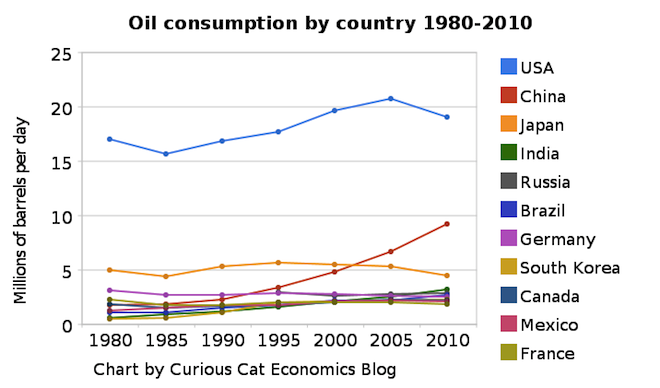
    chart of petroleum consumption by country 1980-2010
    Chart of petroleum consumption by country 1980-2010 by the Curious Cat Investing and Economics Blog. The chart may be used with attribution.

    The USA remains, by a huge margin, the largest consumer of petroleum products (motor gasoline, jet fuel, liquefied petroleum gases, residential fuel oil…) using 22% of the total (with about 4.5% of the population). From 1980 to 2010 the global consumption increased 38% to 87 million barrels a day.

    From 1980 to 2010 USA consumption increased 12% (so less than global consumption). Meanwhile, Germany, Japan and France decreased petroleum use by 19%, 17% and 10% respectively. Many countries have very low use in 1980 and have grown their economies dramatically over this period and increased petroleum use dramatically also: India up 433%, China up 411%, South Korea up 360%.

    Africa, in total, used 3.3 million barrels a day in 2010, up 120% from 1980. Africa used 73% of what Japan used in 2010 and 17% of what the USA used and 50% more than Canada. The data shows no sign of declining petroleum consumption on a global basis. The USA uses as much as China, India, Brazil and Africa combined. I believe, in 2015 those countries (by which I mean all the countries in Africa too, not that Africa is a country, which of course it is not) will use more than the USA (and likely show significant growth from 2010 levels).

    Data is from the US Energy Information Agency.

    Related: Oil Production by Country 1999-2009Top Countries For Renewable Energy CapacityChart of Nuclear Power Production by Country from 1985-2009Increasing USA Foreign Oil Dependence In The Last 40 years

  • Top Countries For Renewable Energy Capacity

    I believe it is wise from an environmental and economic viewpoint to invest in renewable energy projects. I believe the costs of fossil fuel based energy will continue to increase. Renewable energy is continuing to improve and when considering the negative externalities caused by oil, gas and coal and the continuing improvement in wind, solar and geothermal generation investment in renewable energy are going to payoff well for countries.

    Top countries for installed renewable energy capacity
    Rank Country Capacity (GigaWatts)
    1 China 103.4
    2 USA 58.0
    3 Germany 48.9
    4 Spain 27.8
    5 Japan 26.0
    6 India 18.7
    7 Italy 16.7
    8 Brazil 13.8
    9 France 9.6

    The largest increases in renewable energy capacity by country from 2005 to 2010 are: China (up 106%), South Korea (up 88%), Turkey (up 85%), Germany (up 67%), Italy and Japan (up 45%). All the data is from the Pew Clean Engery Program report: Who’s Winning the Clean Energy Race? (pdf).

    In 2010, [China] accounted for almost 50 percent of global clean energy superpower. The nation’s all manufacturing of solar modules and wind ascendance has been steady and steep. In turbines. China’s installation of less than 1 GW of 2005, China attracted less than $3 billion worth of private investments in clean energy. In 2009, solar energy capacity demonstrates that most of its production is for export markets. In contrast, 17 GW of wind energy was installed in China in 2010 helping the nation move quickly toward its 2020 target for installing 150 GW of wind. In fact, China accounted for 47 percent of all wind energy investments globally, with $45 billion tallied. Similarly, China led the world in asset financing, with $47.3 billion in private investments directed toward installation of clean energy generating capacity.

    India is poised to take a leadership role in the solar sector, with a target of deploying 20 GW by 2020. In 2010, the country set about getting its National Solar Mission in place by permitting 0.5 GW worth of large solar thermal capacity and a modest 150 MW worth of photovoltaic (PV) solar.

    My guess is that the stimulus packages in several countries contributed greatly to the increases (notably Germany and Italy targeted green investments – as did China to some extent, in Wind Energy). Spain took a hit as debt levels caused the government to cut spending. I would imagine this is likely to happen in Italy (and was expected to happen in Germany – the extent of decreases is less certain after the earthquake in Japan).

    Related: Chart of oil consumption by country from 1990-2009Wind Power Capacity Up 170% Worldwide from 2005-2009Japan to Add Personal Solar Subsidies (2008)Chart of Top Nuclear Power Generating Countries from 1985 to 2009Wind Power has the Potential to Produce 20% of Electricity Supply by 2030

    (more…)

  • Manufacturing Output as a Percent of GDP by Country

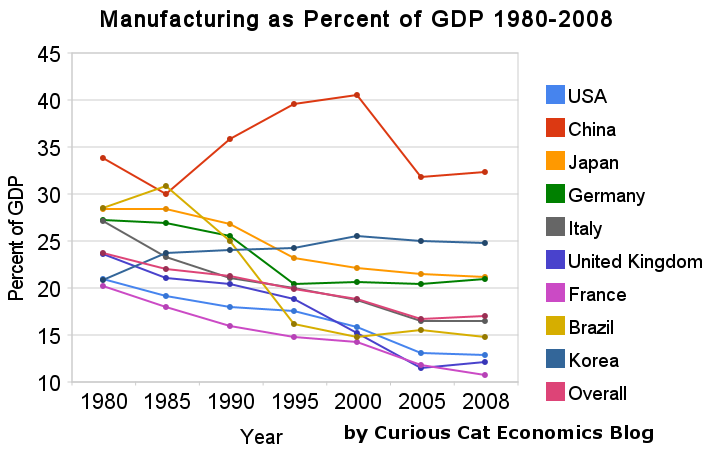
    In previous posts I have shown data for global manufacturing output by country. One of the things those posts have showed is that manufacturing output in China is growing tremendously, but it is also growing in the United States. The chart below shows manufacturing production by country as a percent of GDP. China dominates again, with over 30% of the GDP from manufacturing.

    chart of manufacturing output as percent of gdp by country 1980-2008

    Chart showing manufacturing output, as percent of GDP, by country was created by the Curious Cat Economics Blog based on UN data* (based on current USA dollars). You may use the chart with attribution.

    For the 14 biggest manufacturing countries in 2008, the overall manufacturing GDP percentage was 23.7% of GDP in 1980 and dropped to 17% in 2008. I left India (15% in 1980, 15% in 2008), Mexico (20%, 18%), Canada (17%, 13%), Spain (25%, 14%) and Russia (21% in 1990 [it was part of USSR in 1980], 15%) off the chart.

    Over the last few decades Korea, and to some extent China, are the only countries that have increased the percent of GDP from manufacturing. China has not only grown manufacturing activity tremendously but also other areas of the economy (construction, mining, information technology). The countries with the largest manufacturing portions of their economies in 2008 were: China 32%, South Korea 25%, Japan and Germany at 21%. The next highest is Mexico at 18% which declined slightly over the last 15 years (with NAFTA in place). Globally, while manufacturing has grown, other areas of economic activity have been growing faster than manufacturing.

    The manufacturing share of the USA economy dropped from 21% in 1980 to 18% in 1990, 16% in 2000 and 13% in 2008. Still as previous posts show the USA manufacturing output has grown substantially: over 300% since 1980, and 175% since 1990. The proportion of manufacturing output by the USA (for the top 14 manufacturers) has declined from 31% in 1980, 28% in 1990, 32% in 2000 to 24% in 2008. The proportion of USA manufacturing has declined from 33% in 1980, 29% in 1990, 36% in 2000 to 30% in 2008. While manufacturing output has grown in the USA it has done so more slowly than the economy overall.

    Related: The Relative Economic Position of the USA is Likely to DeclineManufacturing Data, Accuracy QuestionsTop 12 Manufacturing Countries in 2007Manufacturing Employment Data: 1979 to 2007USA Manufacturing Output Continues to Increase (over the long term)

    * I made edits to the 1980 Brazil manufacturing data and 1980, 1985 and 2008 China manufacturing data because the UN data only showed manufacturing data combined with mining and utility data. And I am using older UN data that had manufacturing separated from mining and utility figures for China in the other years.

  • India Grew GDP 8.6% in First Quarter

    While Europe’s financial crisis continues India grew GDP by 8.6% in the first 3 months of 2010. China continues to grow quickly as do many emerging countries, including Brazil. India’s Q4 GDP grows at 8.6% y-o-y

    The 8.6 percent expansion in the fourth quarter of the fiscal year 2009/10 was broadly in line with a median forecast of 8.7 percent in a Reuters poll and lifted the annual average growth rate for the full fiscal year to a slightly better-than-expected 7.4 percent.

    India’s economy had grown 6.7 percent in 2008/09, and the Jan-March 2009/10 growth rate matches the revised data for the second quarter of 2009/10.

    Manufacturing output grew 16.3 percent on year in the quarter as consumers bought more cars and other goods, while farm output grew an annual 0.7 percent helped by a good winter harvest. The government expects the economy to grow 8.5 percent in the current fiscal year that started on April 1 on the prospects of a better farm output and a global recovery

    The farm sector, which forms nearly 17 percent of the economy but is dependent on monsoon rains, is expected to do well in 2011 as the weather office has predicted a normal monsoon for the country. Prime Minister Manmohan Singh last week said an annual economic growth rate of 10 percent is needed in the medium term to address the problems of poverty and malnutrition.

    Even as Singh aims for high economic growth, inflation has come to haunt his government and appears to be undermining its support base. Wholesale prices, the most closely watched inflation gauge in India, rose 9.59 percent in April from a year earlier amid the government officials claim that headline inflation had peaked.

    Headline inflation numbers have been consistently higher than the official forecasts. The wholesale price inflation vaulted above the RBI’s end-March 2010 inflation forecast of 8.5 percent in January and crossed the 10-percent mark in February.

    Although food price inflation has eased from its peak of 20 percent in December, it is still above 16 percent. Rising cost pressures are also dragging down the pace of manufacturing growth, as evidenced by a second-straight monthly decline in the HSBC Market Purchasing Managers’ Index in April. The rapid acceleration in the world’s second-fastest growing major economy after China is boosting consumer demand far ahead of what can be met by existing supply capacity.

    The economies of India, China, Brazil, Mexico, Thailand, Vietnam… are still a fairly small fraction of global GDP but their share continues to grown. And the next few years look to continue this trend. Keys to how quickly they grow their share of global GDP are avoiding bubbles (which then burst), avoiding excessive government debt, continuing to build strong infrastructure for continued development and to what extent growth slows in Europe, USA and Japan due to the credit crisis and excessive consumer and government debt.

    The emerging economies have done a good job avoiding the credit crisis failures visited by the large banks on the wealthiest economies but the dangers of slipping up are large and costly. The largest economies have lots of wealth even after allowing bankers and wall street to siphon off huge amounts for themselves. Less wealth economies will suffer much more than the wealthiest countries if they fall prey to the same political and economic failings. And those special interest (crony capitalism) favors are no less (I would say even more, in fact) likely in those countries than they are in the richest countries.

    Related: The Relative Economic Position of the USA is Likely to DeclineEasiest Countries for Doing Business 2008Why Investing is Safer Overseas

  • Hans Rosling Data on Economic Development and Health Results

    Hans Rosling uses his fascinating data-bubble software to burst myths about the developing world. Look for new analysis on China and the post-bailout world, mixed with classic data shows.

    “The worldview students have corresponds to reality the year their teachers were born”

    The software he uses, the very cool Gapminder world, developed by his son and bought by Google is available online.

    He also correctly congratulates the USA for providing free data it has collected worldwide, for decades, on world health. And correctly criticizes the World Bank for selling the data they compile using taxpayer funds.

    Related: Data Visualization Health Care ExampleEconomic Measurement Issues Arising from GlobalizationMillennium Development GoalsGovernment Debt Compared to GDP 1990-2007

  • Economics Analysis of Why Delhi’s Buses are so Deadly

    Why delhi’s buses are so deadly: an economic analysis

    At least 115 people were killed by Blueline buses in 2008. The Blueline’s grim numbers stem entirely from two perverse economic incentives: the driver’s salary is wholly dependant on how many fares he picks up, and each bus is in direct competition with every other bus on the route.

    Which is why the last thing a Blueline driver ever wants to do is come to a stop. Every move he makes is done with the intent of keeping the bus in motion: slowing just enough so debarking passengers can jump off, then picking up speed as the new passengers run alongside the bus, swinging themselves up and in as the conductor screams at them to hurry.

    But with an estimated 2,200 Blueline buses careening across Delhi on any given day, it’s no wonder the newspaper reports are almost identical every day. After an accident, the driver tries to flee, an angry mob beats him, the police impound the bus, the driver is thrown in jail, the owner of the bus is not mentioned. Sometimes the driver escapes, in which case the mob finds its release in setting fire to the bus.

    This is a good example of looking at problems economically. It also shows the problem with failure to regulate. I am perfectly happy to live with regulation that removes the economic pressure to risk human life.

    Related: Failing Infrastructure in the USAInternational Development Fair: The Human FactorChina May Take Car Sales Lead from USA in 2009

  • China May Take Car Sales Lead from USA in 2009

    China’s economy continues to grow quickly. It looks as though that, along with the slump in US car sales, likely will lead to China taking the world sales lead for cars (I would imagine for the first time ever the USA has not held this title). China 2009 Vehicle Sales May Rise 28% on Stimulus:

    Full-year sales may reach as high as 12 million vehicles, Chen Bin, chief director of the industry coordination department at the National Development and Reform Commission, said today at a conference in Tianjin. U.S. sales will likely be around 10.5 million, according to both General Motors Co. and Ford Motor Co.

    China has boosted auto sales this year through tax cuts and subsidies as a part of a wider 4 trillion yuan ($586 billion) stimulus that has shielded the country from the worst of the global recession. U.S. sales have slumped 28 percent, pushing the old GM and Chrysler LLC into bankruptcy. Last year’s total was 13.2 million, compared with 9.4 million in China.

    Partially due to the strong internal Chinese demand (and partially due to Chinese regulation) India actually exports more cars than China. 5 times as many cars are purchased in China as are bought in India.

    Indian Car Exports Beat China’s

    [In India] Total exports, including vans, sport-utility vehicles and trucks, rose 18 percent to 229,809.

    In contrast, China’s exports slumped 60 percent to 164,800 between January and July, according to government data. Vehicles produced in Thailand for export declined 43 percent to 263,768, according to the Thai Automotive Club.

    South Korean exports dropped 31 percent to 1.12 million units, according to the Korea Automobile Manufacturers Association. Japan, the world’s largest automobile producer and exporter, shipped 1.77 million cars, trucks and buses.

    Related: The Relative Economic Position of the USA is Likely to DeclineManufacturing Cars in the USARodgers on the US and Chinese Economies

  • Oil Consumption by Country in 2007

    The largest oil consuming countries (and EU), in millions of barrels per day for 2007. China increased use by 1 billion barrels a day, the USA and Europe decreased use by 100 million barrels a day from our post last year on Oil Consumption by Country.

    Country consumption % of oil used % of population % of World GDP % of oil used in 2006
    USA 20.7 24.3 4.5 21.0 25.9
    European Union 14.4 16.9 7.4 21.9 18.1
    China 7.9 9.2 19.9 10.8 8.6
    Japan 5.0 5.8 1.8 6.5 6.7
    India 2.7 3.1 17.3 4.5 3.0
    Russia 2.7 3.1 2.0 3.1 3.6
    Germany 2.5 2.8 1.2 4.2 3.3
    Brazil 2.4 2.7 2.9 2.8 2.6
    Canada 2.4 2.7 0.4 1.9 2.9
    Mexico 2.1 2.4 1.6 2.0 2.6
    South Korea 2.1 2.4 0.7 1.8 2.7

    Data is from CIA World Factbook 2009 (downloaded August 2009). GDP calculated using purchasing power parity from 2008 fact book with estimated 2007 data.

    Related: Government Debt as a Percentage of GDPGlobal Manufacturing Production by CountryManufacturing Contracting Globally (March 2009)

  • The Relative Economic Position of the USA is Likely to Decline

    The economic clout of the USA has been huge since the end of World War II. The relative position has been decreasing recently with the rise of not only Europe and Japan but Korea, China, India, Brazil and many more. This means the risks to the USA of failing to deal with perennial problems (the most costly but not most effective health care system, spending beyond our means, weak diplomacy, excessive legal costs, poor management practices…) is higher today than it has been.

    Fareed Zakaria’s Post American World is a good explanation of some of the current global economic forces in play. He comes to the same conclusion I do that the USA is still in the strongest position today. But the world is changing and the relative position of the United States is declining. The new world requires working with others and the USA needs to adjust to this reality. Too many think the USA can continue to act as though the rest of the world must comply with the wishes of the USA.

    Foreign students and immigrants account for 50 percent of the science researchers in the country and, in 2006, received 40 percent of the doctorates in science and engineering and 65 percent fo the doctorates in computer science. by 2010, foreign students will get more than 50 percent of all Ph.D’s awarded in every subject in the United States. I n the sciences, that figure will be closer to 75 percent. Half of all Silicon Valley start-ups have one founder who is an immigrant or first-generation American.

    The litigation system is now routinely referred to as a huge cost of doing business, but no one dares propose any reform of it. Our mortgage deduction for housing costs a staggering $80 billion a year, and we are told it is crucial to support home ownership. Except that Margaret Thatcher eliminated it in Britain, and yet that country has the same rate of home ownership as the United States. We rarely look around and notice other options and alternatives, convinced that “we’re number one.”

    America has become a nation consumed by anxiety, worried about terrorist and rouge nations, Muslims and Mexicans, foreign companies and free trade, immigrants and international organizations. The strongest nation in the history of the world now sees itself as besieged by forces beyond its control.

    The book focuses quite a bit on the USA, China and India and provides good overviews of the economic strength and weaknesses of those countries. The USA is in a leadership position but the future requires an understanding that others deserve to be treated as partners not allies to be dictated to. If not they will just partially disengage with the USA and create stronger relationships with others. That would not be in the interests of the USA.

    Related: Best Research University Rankings (2008)Dr. Deming’s 7 Deadly Diseases of Western ManagementScience leadership and economic growthEasiest Countries for Doing Business (2008)Top 12 Manufacturing Countries in 2007Why America Needs an Economic StrategyCountry H-index Rank for Science PublicationsUSA Spent $2.2 Trillion, 16.2% of GDP, on Health Care in 2007