Tag: international trade

  • Nomadic Businesses in the Internet Age

    Once upon a time in a land not so far away, if you wanted to start a business, you had to choose a city in which to settle–not just for the business but for yourself. A lot of thought went into figuring out where to set up your new company’s home base. Delaware and Nevada, for example, have been popular choices because of its business friendly regulations and corporate tax laws. Once you got your central location up and running you could think about expanding to multiple locations or turning your company into a franchise.

    Those days are over. Sure, there are some who prefer to build businesses traditionally, but today thanks to advancements in technology and the rise of the internet and the ability to receive and send money online, even internationally, people can start a company anywhere and operate it from anywhere else (provided local incorporation laws do not require a specific length of time spent on site).

    Migrants have long moved to a new country for work, and then transferred funds home. This has been nearly completely those migrating from poor countries (or poor areas in the countries) to rich countries. Now individuals from rich countries are taking advantage of low cost countries to lower their living expenses while running most of your day to day from…just about anywhere.

    Businesses Can’t Really Be Nomadic, Can They?
    It’s true: not every business is suited to a nomadic lifestyle. Independent retail shops, for example: though it is possible to oversee basic operations from wherever you are, until you have a full support staff you are going to be needed onsite. Local service businesses that specialize in trades like contracting, plumbing, electrics, etc. Those are difficult to operate via telecommute. Most other companies, however, can be adapted to a global marketplace and base of operations fairly easily.

    I traveled for 4 years in SE Asia while operating my business. During that time my brother took a year to travel around the world with his family while running his business. He visited clients during his travels which took him through Brazil, Turkey, South Africa, India, Singapore, Australia and more. We met up for a week in Bali. There are challenges but there are great rewards also for businesses that allow you to travel while you work.
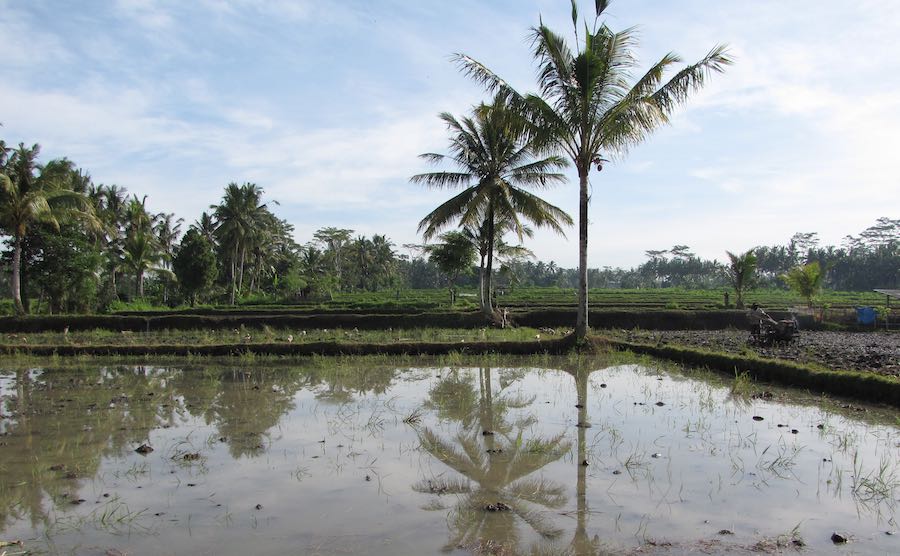
    Rice field filled with water
    Rice field opposite our bungalow in Ubud, Bali.

    Which Businesses Are Best Suited to the Nomadic Lifestyle?
    As previously stated, if you work hard enough at building your company and support team, you can run just about any sort of business from anywhere. That said, there are some companies and business types that lend themselves more easily to the nomadic lifestyle.

    Chris Guillebeau covers a few of these businesses and the entrepreneurs who started them in his book, The $100 Startup. One entrepreneur, for example, runs a linguistics and translation business internationally. He loves languages and loves teaching so he moves from country to country, learning the local languages and then teaching them to tourists and expatriates who choose to move there. Guillebeau himself has turned his book into a tour, a conference (The World Domination Summit) and a series of Unconventional Guides. He travels all over the world and writes from wherever he happens to be at the time.

    (more…)

  • Global Workplace

    The world has become very interconnected. This is no surprise, the evidence is all around us and continues to increase. What this actually means though is more complex than it appears.

    One area this impacts greatly is the workplace. More and more people are working internationally. This continues to largely be either through large multinationals or cheap labor that is imported to do largely unskilled or minimally skilled labor.

    There is also a continuing increase in skilled and educated labor working overseas for other than huge multi-nationals. The infrastructure to support this is often not in place. The current structure (visas etc.) support the two modes mentioned above.

    But I see an increasing number of opportunities for countries that encourage entrepreneurship and high skill jobs. I relocated to Malaysia and in doing so did a bit of research. It is difficult to get a long term visa in most countries without a full time job (and given the complexity of hiring foreign workers this often means dealing with companies that do a lot of it – in the 2 categories mentioned above).

    Career prospects are enhanced with international experience. One way to get a jump start on your career is international education. This has been popular for a long time but is becoming more and more popular. Students studying in London can get the benefits of international experience (unless they are from England, obviously) and enjoy the great city of London and accessible travel to Europe.

    The importance is to truly gain an international perspective. Those in the USA have the greatest problem as knowledge workers in most other countries are much more aware of the global economy. Europe is an easy way to get started and is packed with lot of great schools and processes in place to make it easy to become a student.

    As I mentioned in a previous post, I believe the most important factor for a career is finding something you love to do, but within those possibilities it is nice to know the payoff of different college degrees.

    Those that see Asia as the economic engine for the next 50 years might well be tempted to look at attending school there. There are plenty of options though it may take a bit more work on your part to make it happen. I think attending at least some portion of college internationally is a great idea as is getting international work experience early in your career.

    Related: How to Balance the Benefits of Foreign Workers and the Potential Damage to Citizen’s Job ProspectsLeading Economic Freedom: Hong Kong, Singapore, New Zealand, Switzerland

  • The Growing Market for International Travel for Medical Care

    Medical “tourism” is a potentially huge market. The size of the market is greatly aided by the extremely expensive and broken USA health care system. Even while the standard rich country provides the same, or better, results than the USA for half the cost they are not doing well either (so the USA is very bad compared to pretty bad results for rich countries on average).

    Medical tourism is on of the most attractive economic growth areas. However the competition is fairly high as the attractiveness of building such an industry is well known. Countries that have very good potential are: Thailand, Mexico, Malaysia, Singapore (for high end solutions), Costa Rica, India, Philippines and Panama. India has some great advantages but they have a deeply ingrained and extremely unhelpful bureaucracy. It seems to me that that creates a burden that likely means India can’t complete with the others effectively.

    Even for the simplest aspect – visas for those seeking to bring income into the country as medical tourists I don’t have confidence India can do well.

    Cayman to Singapore Gain as Rules Stump Clinics: Corporate India

    India, which offers the world’s biggest savings for U.S. medical tourists, is losing clients to Singapore and Thailand as visa rules and greater awareness of drug-resistant germs that spread from the South Asian nation scare away patients. Government neglect means India may fail to tap the $40 billion market that’s expanding 25 percent a year, said Josef Woodman, founder of the guidebook “Patients Beyond Borders.”

    “They’ve done everything to ruin our prospects of becoming a tourism center,” Reddy said. “I once said India should become the global health-care destination–now I’m swallowing those words. It could grow 10-fold in the next five years, if only the government would facilitate it, the way others have.”

    India continues to be held back economically (across the entire economy not just in health care) by ineffective and burdensome regulation and government inefficiency.

    The USA actually has a portion of the medical tourism market – those that have no concern about price (royalty, trust fund babies, movie stars etc.). Those with any concern about price can find the same level of care in Singapore, Japan, France, etc. at a fraction of the price.

    I believe 2 or 3 countries in South East Asia will do very well with international medical care. The extent to which Thailand, Philippines, Singapore and Malaysia (and potentially others) do in this field could greatly impact their economic success. There is a great potential for Singapore and Malaysia to cooperate in this area (in Malaysia’s Iskandar region, which borders Singapore).

    Related: Traveling To Avoid USA Health Care Costs
    Traveling for Health Care (2007)Leading Countries for Economic Freedom: Hong Kong, Singapore, New Zealand…