The Curious Cat Investing, Economics and Personal Finance Carnival is published twice each month. We find useful recent personal finance, investing and economics blog posts and articles to share with you.
- 2 Billionaire Brothers’ Insider Buying At Colfax by Zack Miller – “[In] the Danaher Business System… management believes its found a demonstrable, repeatable recipe for success, and it drives both culture and process at the company and its acquisitions. DBS is a form of Japanese kaizen, comprising 4 components: 1) People 2) Plans 3) Processes 4) Performance” [I own Danaher and have it in my 12 stocks for 10 year portfolio – John, my management blog focuses on such management systems]
- Apple’s Impossibly Good Quarter by John Hunter – “You can’t grow quarterly sales from $26.7 billion to $46.3 billion. $26 million to $46 million, fine that is possible, billions however – not possible. Except Apple did. You can’t grow a $6 billion quarterly profit to $13 billion in 1 year. Except Apple did. You can’t generate a cash flow of $17.5 billion in a quarter. Except Apple did. You can’t have a stockpile of $100 billion in cash. Except Apple does. These figures would not have been seen as unlikely just 3 years ago. They were impossible. But Apple achieved them.”
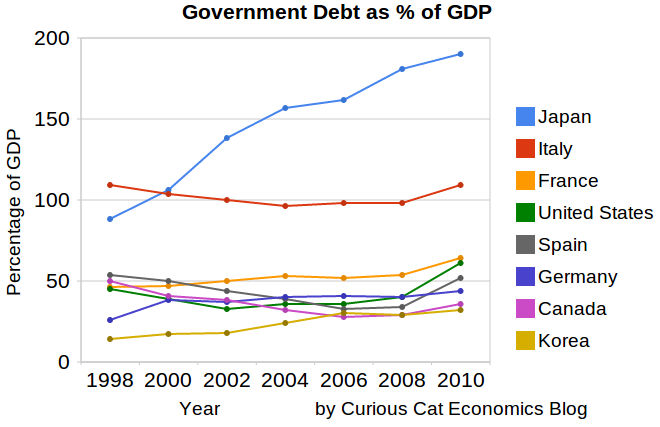
- How to Save the Euro by George Soros – “the cuts in government expenditures that Germany wants to impose on other countries will push Europe into a deflationary debt trap. Reducing budget deficits will put both wages and profits under downward pressure, the economies will contract, and tax revenues will fall. So the debt burden, which is a ratio of the accumulated debt to the GDP, will actually rise, requiring further budget cuts, setting in motion a vicious circle.”
- Japan’s Trade Figures: Some Perspective by Eamonn Fingleton – “In a typical maneuver, goods might be shipped to China via Hong Kong. The goods are exported from Japan at heavily discounted prices and a Hong Kong subsidiary takes a huge profit in selling to China. Such profits constitute hidden export revenues that are not caught in the visible trade numbers. The maneuver makes sense because Japan’s corporate tax rate is one of the world’s highest.” [This is one, of many things, that make economic data difficult to rely on – you have to pay close attention to the details – John]
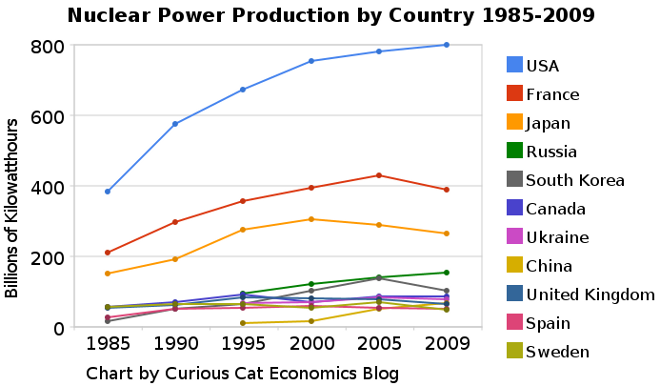 The chart shows the leading nuclear power producing countries from 1985-2009. The chart created by Curious Cat Investing and Economics Blog
 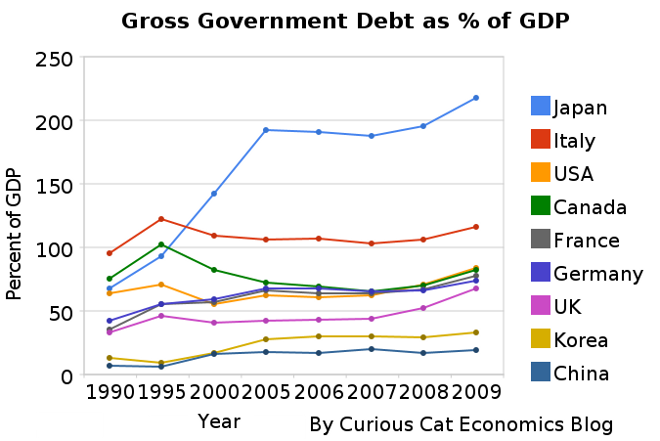 The chart shows gross government debt as percentage GDP from 1990-2009. By Curious Cat Investing and Economics Blog,