Tag: Personal finance

  • Credit Card Debt and Delinquencies Decline

    The credit card delinquency rate (borrowers 90 days or more delinquent on one or more of their credit cards) dropped to 1.10% percent in the third quarter of 2009, down 6 basis points from the previous quarter. Year over year, credit card delinquencies remained essentially flat from 1.09% in the third quarter of 2008.

    Credit card delinquency was highest in Nevada (1.98%), Florida (1.47%) and Arizona (1.35%). Credit card delinquency rates were lowest in North Dakota (0.66%), South Dakota (0.70%) and Alaska (0.73%).

    Average credit card borrower debt decreased to $5,612 from the previous quarter’s $5,719, and $5,710 for the third quarter of 2008.

    “At end of the 2001 recession, the national bankcard delinquency rate had increased to a high of 1.69% as that recession came to a close (in November of 2001),” said Ezra Becker, with Transunion.

    The slight declines in credit card debt are an encouraging sign that more people are taking the right action to eliminate their credit card debt.

    Related: USA Consumers Paying Down DebtConsumer Debt Down Over $100 Billion So Far in 2009Families Should not Finance Everyday Purchases on CreditSome Movement on Regulating Credit Cards Companies

  • If you Can’t Explain it, You Can’t Sell It

    Over the last few years Elizabeth Warren has become one of my favorite leaders. She is a leader in economic thought, ethical society and the law (she is a law professor at Harvard Law School). Far too many on Wall Street, Washington and in C-suites are leading us down a very bad path. She is a voice we need to heed.

    If you can’t explain it, you can’t sell it

    “We need a new model: If you can’t explain it, you can’t sell it,”

    The 1966 high school debate champion of Oklahoma may get what she wants. The House of Representatives will vote in December on her idea. She suggested a Financial Product Safety Commission in a 2007 article in the magazine Democracy [Unsafe at Any Rate]. President Barack Obama proposed it to Congress in June as the Consumer Financial Protection Agency.

    Warren won’t discuss whether she may be a candidate to lead the authority, which would have the power to regulate $13.7 trillion of debt products. A Warren nomination would tell banks that Obama is determined to force reduced checking-account fees and limit lender claims in mortgage advertising, among other measures the industry opposes, said Thomas Cooley, dean of New York University’s Stern School of Business.

    In her role overseeing the TARP, Warren has been critical of the administration, accusing the Treasury Department of undervaluing the stock warrants that were supposed to compensate taxpayers when banks repay their bailouts. A lack of transparency about how TARP functions “erodes the very confidence” it was to restore, her committee said in a report.

    I hope she can take her attempts to reduce political favors being granted huge financial institutions and those institution be forced to follow sensible rules to protect individuals and our economy. With a few more people like there we will have a much better chance of a positive economic future.

    Related: Bogle on the Retirement CrisisBankruptcies Among Seniors SoaringDon’t Let the Credit Card Companies Play You for a Foolhttp://investing.curiouscatblog.net/2009/04/08/the-best-way-to-rob-a-bank-is-as-an-executive-at-one/

  • 30 Year Fixed Rate Mortgage Rates Remain Low

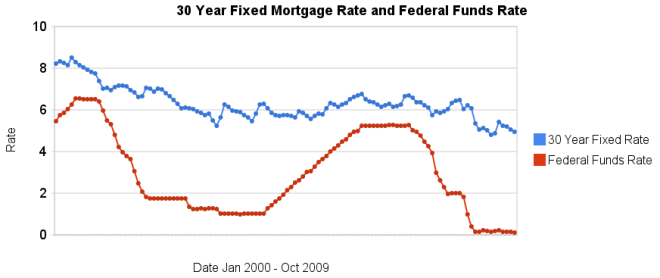
    30 year fixed mortgage rates have declined a bit over the last few months and remain at very low levels.

    30 year fixed mortgage rate chart 2000-2009

    The poor economy, Unemployment Rate Reached 10.2%, has the Fed continuing massive intervention into the economy. The Fed is keeping the fed funds rate at close to 0% (.12% in October). They also continue to hold massive amounts of long term government and mortgage debt (in order to suppress interest rates on long term bonds – by reducing the supply of such bonds in the market).

    I can’t see how lending US dollars, over the long term, at 5%, makes any sense. I would much rather borrow at those rates than lend. If you have not refinanced yet, doing so now may well make sense. And if you are looking at a new real estate purchase, financing a 30 year mortgage sure is attractive at rates close to 5%.

    Related: historical comparison of 30 year fixed mortgage rates and the federal funds rateLowest 30 Year Fixed Mortgage Rates in 37 YearsJumbo v. Regular Fixed Mortgage Rates: by Credit ScoreWhat are mortgage definitionsIgnorance of Many Mortgage Holders

    For more data, see graphs of the federal funds rate versus mortgage rates for 1980-1999. Source data: federal funds rates30 year mortgage rates

  • Bad Phone Fees

    Many people notice the ludicrous phone fees the phone companies charge. Some are indeed passed on taxes and fees imposed by government (though phone companies seem to love adding on fees and saying or implying they are government taxes when that is not completely clear). I got rid of my land line phone for Vonage, years ago. Vonage started to add on all sorts of fees so I dropped it and went with Ooma (free after the initial purchase $203 for me).

    Ooma has now decided they need to change $12/year in fees (very reasonable I think). But they are not going to charge those, like me, that bought before this change (it has been 100% free for me for the last year). Great service (and a huge contrast to the attitude of typical phone companies looking to gouge everyone they can).

    I also use and recommend Google Voice. They have to deal with another form of government approved fees for local phone companies. Some are using traffic pumping and high charges to gouge Google. I am glad Google is taking on these pumpers.

    Related: Sex, conference calls, and outdated FCC rulesTelephone SavingsPaying for Over-spending$8,000 Per Gallon Ink

  • USA Heath Care System Needs Reform

    There are several factors that need to be addressed relating to the broken health care system in the USA.

    1) It is bankrupting the government
    2) It is severely handicapping business that must pay for the expensive and poorly performing system
    3) It is bankrupting individuals (Employees Face Soaring Health Insurance Costs)
    4) It is hampering economic freedom due to the model that ties health care to employment. If I want to go start my own small business, I not only have to worry about all the risks of running a business I have to risk my heath coverage (coverage is expensive and if you get sick you can be dropped, or rates increased so dramatically that they are not affordable – hardly insurance when you are dropped when you need it).
    5) social inequity – no other rich country denies basic health care to everyone
    6) the results are poor to mediocre (at by far the highest cost of any country)

    The idea that a system that is far more expensive than any in the world and performs, at best, in the middle of the pack of rich countries while creating huge economic and human hardships should not be reformed is crazy. Unless you believe the USA is just incapable of performing even at a mediocre level in health care, for some reason, you have to believe they current performance needs to be dramatically improved.

    Now there may well be disagreement about which failures are most important. Some may not care about the huge competitive disadvantage companies are put in by the current broken system. Others may not care that millions don’t have basic coverage. Others may not care that sick people go bankrupt. Others may not care that the heath results are mediocre at best – that tens of millions have much less healthy lives than they would. Others may like that they make a great deal of money from the current system. Others may like that they personally get good health care. So in what ways the broken system in place now needs to be fixed is open for debate.

    The long term result is very simple to see. The current system is very broken and will not work. Different people suffer differently depending on what solution is adopted. My desire would be to reduce spending on hugely expensive miracle cures (especially for terminal ill patients) and increase spending dramatically on preventative and healthy living (versus spending on managing sickness) but I can see that such a solution is not at all popular. So we are not going to adopt that part of what I would like to see.

    But I have no doubt the system will be dramatically reformed. Because if not the economic costs will destroy the economic future of the country. I don’t believe tens of millions without health care will drive action – we have seen that we are perfectly willing to allow that to continue. If the economic costs (say reducing the economic benefit to every person in the USA by $5,000 a year) just stayed at that level, it seems those that are benefiting from the current system are able to hold off improvement. But that figure is increasing each and every year. Eventually the costs grow too large and too many people will demand the broken system be improved.

  • Micro-credit Research

    I really like micro-credit as a tool to improve the lives of those willing to put in the effort to build a successful business. I do worry however, that the actual success is less than what is hoped. The idea is so appealing but objective results are not as obvious (for one thing the results, do not seem to be available). I want to find research that indicates what will make micro-credit most effective at improving the economic well being of people. Small change by Drake Bennett

    two new research papers suggest that microcredit is not nearly the powerful tool it has been made out to be. The papers, by leading development economists affiliated with MIT’s Jameel Poverty Action Lab, have not yet been published, but they are already being called the most thorough, careful studies yet done on the topic. What they find is that, by most measures, microcredit does not offer a way out of poverty. It helps a few of the more entrepreneurial poor to start up businesses, and at the margins it may boost the profits of existing microenterprises, but that doesn’t translate into gains for the borrowers, as measured by indicators like income, spending, health, or education.

    They created their controlled experiment by altering the algorithm the bank used to evaluate creditworthiness so that some borderline applicants were randomly denied loans while other otherwise identical applicants had loans approved.

    Working with a microcredit bank in India that was looking to expand in the city of Hyderabad, the researchers did find some small positive effects. Borrowers who already had a business did see some increase in profit. Households without businesses that the researchers judged more predisposed to start one were found to cut back on spending, suggesting they were saving to augment their loan for a capital business expense like a pushcart or a sewing machine.

    Overall the article suggests that the data is hard to get. The time of the studies may be too short to see improvement. And the gains seen are small. I do believe we are in danger of creating problems with the rapid expansion of micro-credit. I can understand why, the situation is desperate for billions of people still. And we do not have many good methods for improving economic conditions for the world’s poor. I still strongly support micro-credit but I worry, especially if interest rates are high, that it may not help. We need to study what is working and adopt methods that will bring about improved results.

    Related: Creating a World Without PovertyCapitalism from the Ground UpMicroFinance Currency Risk2006 Nobel Peace Prize to Grameen Bank Founder
  • Actually Free Credit Report

    Viewing your credit report is an important step to financial security. You should review your credit reports annually (at least) to correct and any errors. Also doing so can be a tool to help you spot identity theft.

    The real free credit report site, annualcreditreport.com, is provided by government regulation (so those that don’t believe in regulation would rather use one of the sites advertising “free” credit reports). But I suggest using the government provided reports and I would suggest spreading the requests out during the year (you get 3 a year, 1 from each of the nationwide consumer credit reporting companies).

    The site also has a large frequently asked question section including:

    How do I request a “fraud alert” be placed on my file?
    You have the right to ask that nationwide consumer credit reporting companies place “fraud alerts” in your file to let potential creditors and others know that you may be a victim of identity theft. A fraud alert can make it more difficult for someone to get credit in your name because it tells creditors to follow certain procedures to protect you. It also may delay your ability to obtain credit. You may place a fraud alert in your file by calling just one of the three nationwide consumer credit reporting companies. As soon as that agency processes your fraud alert, it will notify the other two, which then also must place fraud alerts in your file.

    Where can I find out more about credit reports, my rights as a consumer, the Fair Credit Reporting Act and the FACT Act?
    Please visit www.ftc.gov/credit

    Related: Credit Card TipsPersonal Finance Basics: Long-term Care InsuranceFinancial Planning Made Easy

  • Nouriel Roubini Believes Stock Market has Risen too Far, too Fast

    Nouriel Roubini is still worried about the US economy, though he does believe we are coming to the end of the severe recession we have been in.

    I believe, that if you were worried about your portfolio being overweighted in stocks late last year, now is a good time to move some money out of the stock market. In December 2008, when many were selling in panic, I invested more in stocks.

    The stock market has been on a tear increasing

    1 December 2008 the S&P 500 was at 816
    1 January 2009 – 903
    6 March 2009 – 684 (the lowest point since 1996)
    1 May 2009 – 878
    1 August 2009 – 987
    5 October 2009 – 1040

    In 6 months, since the market hit a low on March 6th, it is up 52%. Certainly the decrease in prices seemed overdone. The 50% increase in prices seems overdone also. But trying to predict short term moves in the stock market (say under 1 year) is very difficult and few people can do so successfully (even if you can find lots of people offering their guesses). Predicting the economy, while not easy, is much much easier that predicting the stock market.
    (more…)

  • Minnesota’s Attorney General Suing 3 Debt-relief Companies

    Minnesota’s attorney general suing 3 debt-relief companies

    Until the phone call, Rossie Anderson-Howze didn’t think she needed help negotiating her $12,000 in credit card debt. But when the company promised to cut the retiree’s 12.9 percent interest rate and save her $4,000 or her money back, she agreed to let Moneyworks LLC charge $1,090 to her card.

    The company failed to deliver on its promises, she said, forcing Anderson-Howze, of St. Paul, to become one of hundreds of Minnesota consumers to seek help from Minnesota Attorney General Lori Swanson.

    Swanson sued Moneyworks LLC and two other debt assistance companies on Tuesday, alleging that the companies made unsolicited phone calls promising lowered interest rates, guaranteed savings and money-back guarantees. Swanson alleges that Washington-based Priority Direct Marketing, Clear Financial Solutions of Florida and Moneyworks LLC, based in Georgia, “charged financially strapped people a lot of money to lower the interest rates on their credit cards, only they failed to do so, leaving people even further behind on their bills.”

    Swanson also sent a letter to the Federal Trade Commission asking it to adopt federal regulations to prohibit companies from charging consumers until services are delivered satisfactorily.

    Many organizations overing to help with debt relief are fraudulent. They are constantly being shut down for illegal activity. You must be very careful when you consider dealing with any of these organizations. Do not pay out money up front. Make sure the organization has a strong reputation and history of ethical behavior. Be financially literate: don’t get taken advantage of.

    Related: Manage Your Borrowing and Avoid Debt NegotiatorsUSA Consumers Paying Down DebtContinued Credit Card Company Customer Dis-Service

  • How a Family Shed $106,000 in Debt

    How a Family Shed $106,000 in Debt

    Five years ago, the Hildebrandt family of New Richmond, Wis., was juggling more than $100,000 in credit card and personal debt. Through frugality, determination and hard work, they are now — other than a mortgage — debt-free.

    Several steps were key to making the plan work. Kandy and Russell eliminated discretionary spending. Kandy began buying generic food and frequenting thrift stores for clothing purchases. They stopped exchanging Christmas and birthday gifts with each other and their relatives.

    Even with the drastic cutbacks, the Hildebrandts couldn’t cover the $2,000 they were sending to CCCS each month to be distributed to their creditors. At that time, the sum amounted to about half of Russell’s take-home pay. So Russell took on a second job cleaning a local grocery store several nights a week from midnight to 4:30 a.m. He would arrive home from his day job, eat dinner, catch a few hours of sleep and head to work. After his shift, he would go back home, sleep a few more hours and then get up for his day job.

    By the fall of 2008, the Hildebrandts had one year to go on the payment plan. Russell even started daydreaming about a new home when he saw a three-bedroom rambler for sale in New Richmond. It had all that they were looking for, including a large yard and a separate bedroom for Joey. Russell let a real estate agent know that they liked the house, but added that the family would have to pay off their debts before taking on a mortgage.

    Several months later the agent called and asked if the Hildebrandts would be interested in a rent-to-own agreement. The current owner of the house had some health concerns and was eager to move. The monthly rent would be $1,000, which included $200 to be escrowed for closing costs. They could manage it.

    Earlier this year, the owner wanted to accelerate the sale process. In April, using the tax credit for first-time home buyers, the Hildebrandts were able to swing the purchase and pay off the remaining balances on their credit cards about six months ahead of schedule.

    It is certainly a daunting task to dig out off such a crushing debt load. It is much easier to avoiding getting in that situation in the first place (how not to get into trouble with credit cards). It is easy to get yourself in trouble by borrowing money. In many cases all it takes to not get into that trouble is just don’t buy what you can’t pay for.
    (more…)