Tag: Personal finance

  • Dream More, Work Less

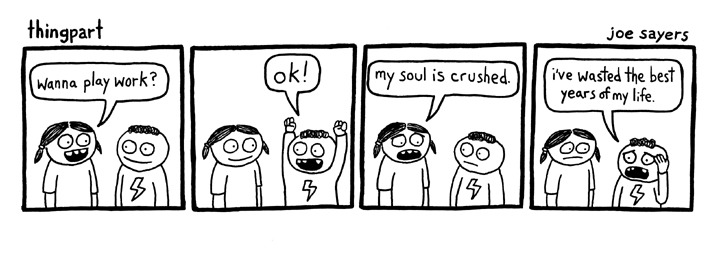
    comic - wanna play work

    Dream More, Work Less:

    I enjoy working. More specifically, I enjoy working inside my interests, anything that drives me toward a vision outside sitting behind a desk, fingers on keys for eight hours a day.In my mind I assemble new ways to do things; creating, crafting, improving, and collaborating. Until recently I was hung up on where to put that effort, managerial day-job or elsewhere?

    I want to be free to make my own decisions. I like the security of a corporate job, the health and financial benefits, but it IS a business. They’re in the market to make money. If that means cutting jobs and salary, that’s part of the equation.

    I want to do something that I’m responsible for; something I’ve poured my heart and soul into. As it happens, I don’t think my current day-job is that “something” which will help build those dreams…

    I like this post. For me personal finance is a subset of life. Like health and education, personal finance, can hamper or provide options to your life. You need to keep track of your finances and manage them but that is in order to provide yourself options to live the life you want. Don’t forget to decide what you want out of life. Then see how you can help make that happen based on finances or what steps you need to take to live your dreams in the future.

    comic: Wanna play work? – also see: Joy in Work

    Related: Medieval Peasants had More Vacation TimeSigns You Have a Great Job … or NotHow to Protect Your Financial HealthCredit Card TipsProvide a Helping Hand1,000 True Fans

  • 401(k)s are a Great Way to Save for Retirement

    401(k)s are a great way to save. Yes, today those that have been saving money have the disappointment of bad recent results. But that is a minor factor compared to the major problem: Americans not saving what they need to for retirement in 401(k)s, IRAs, even just emergency funds… Do not use the scary financial market performance recently as an excuse to avoid retirement savings (if you have actually been doing well).

    The importance of saving enough for retirement is actually increased by the recent results. You might have to re-evaluate your expectations and see whether you have been saving enough. I am actually considering increasing my contributions, mainly to take advantage of lower prices. But another benefit of doing so would be to add more to retirement savings, given me more safety in case long term results are not what I was hoping for.

    Now there can be some 401(k) plans that are less ideal. Limited investing options can make them less valuable. Those limited options could include the lack of good diverse choices, index funds, international, money market, real estate, short term bond funds… My real estate fund is down about 2% in the last year (unlike what some might think based on the media coverage of declining housing prices). And poor investing options could include diverse but not good options (options with high expenses… [ the article, see blow, mentions some with a 2% expense rate – that is horrible]).

    But those poor implementations of 401(K)s are not equivalent to making 401(k)s un-viable for saving. It might reduce the value of 401(k)s to some people (those will less good 401(k) plans). Or it might even make it so for people with bad 401(k) options that they should not save using it (or that they limit the amount in their 401k). I don’t know of such poor options, but it is theoretically possible.

    The tax deferral is a huge benefit. That benefit will only increase as tax rates rise (given the huge debt we have built up it is logical to believe taxes will go up to pay off spending today with the tax increases passed to the future to pay for our current spending).

    And if you get matching of 410(k) contributions that can often more than make up for other less than ideal aspects of a particular 401(k) option.

    Also once you leave a job you can roll the 401(k) assets into an IRA and invest in a huge variety of assets. So even if the 401k options are not great, it is normally wise to add to them and then just roll them into an IRA when you leave. If the plan is bad, also you can use an IRA for your first $5,000 in annual retirement savings and then add additional amounts in the 401k (if they are matching funds normally adding enough to get the matching is best).

    401(k)s, 403(b), IRAs… are still great tools for saving. The performance of financial markets recently have been poor. Accepting periods of poor performance is hard psychologically. But retirement accounts are still a excellent tool for saving for retirement. Using them correctly is important: allocating resources correctly, moving into safer asset allocations as one approaches and reaches retirement…
    (more…)
  • Poll: 60% say Depression Likely

    I would say the chance of a depression in the next 5 years is very unlikely. The last 2 years have been full of bad economic news but a depression is still not likely, in my opinion. However, much of the public, seems to think it is likely – Poll: 60% say depression ‘likely’

    The CNN/Opinion Research Corp. poll, which surveyed more than 1,000 Americans over the weekend, cited common measures of the economic pain of the 1930s:

    * 25% unemployment rate
    * Widespread bank failures
    * Millions of Americans homeless and unable to feed their families

    In response, 21% of those polled say that a depression is very likely and another 38% say it is somewhat likely. The poll also found that 29% feel a depression is not very likely, while 13% believe it is not likely at all.

    The economists surveyed by CNNMoney.com said they saw a drop of 2% to 4% in a worst case scenario.

    I must say I don’t think those polled don’t really hold their belief very firmly. If you actually see a depression as likely you have to take drastic steps with your finances. I really doubt many of them are and instead think they are casually saying they think it is likely without really thinking about what that would mean.

    I don’t see it as likely and don’t see any need to change significantly what made good personal financial sense 2 years ago. The biggest change I see (over the last couple of months) is the importance of taking smart person finance actions has increased dramatically. The smart moves are pretty much the same but the risks to failing to create an emergency fund, abusing your credit card, losing a job… have increased dramatically.

    Related: Uncertain Economic TimesPersonal Finance Basics: Health InsuranceFinancial Illiteracy Credit Trap

  • FDIC Limit Raised to $250,000

    The FDIC limit has been raised to $250,000 which is a good thing. The increased limit is only a temporary measure (through Dec 31, 2009) but hopefully it will be extended before it expires. I don’t see anything magical about $250,000 but something like $200,000 (or more) seems reasonable to me. The coverage level was increased to $100,000 in 1980.

    What does federal deposit insurance cover?
    FDIC insurance covers funds in deposit accounts, including checking and savings accounts, money market deposit accounts and certificates of deposit (CDs). FDIC insurance does not, however, cover other financial products and services that insured banks may offer, such as stocks, bonds, mutual fund shares, life insurance policies, annuities or municipal securities.

    Joint accounts are covered for $250,000 per co-owner. The limit is per person, per institution, so all your accounts at one institution are added together. If you have $200,000 in CDs and $100,000 in savings you would have $50,000 that is not covered.

    FDIC is an excellent example of good government in action. The Federal Deposit Insurance Corporation (FDIC) was created in 1933 and serves to stabilize banking by eliminating the need to get ahead of any panic about whether the bank you have funds in is in trouble (which then leads to people creating a run on the bank…)

    From an FDIC September 25 2008 news release: the current FDIC balance is $45 billion (that is after a decrease of $7.6 billion in the second quarter). The FDIC is 100% paid for by fees on banks. The FDIC can raise the fees charged banks if the insurance fund needs to get increased funds.
    (more…)

  • 10 Things Your Bank Won’t Tell You

    10 things your bank won’t tell you

    Take out cash from an ATM in London, and you’ll get hit with a foreign-transaction fee, plus a fee for using a competitor’s ATM. All told, it can cost up to $7 just to withdraw $200. Credit card purchases aren’t much better. Visa and MasterCard charge 1% of the purchase price for converting currency. And the issuing banks may take another cut, which can bring the total to 3% of your purchase price

    For people who travel a lot, Arnold recommends a Capital One credit card, which charges no overseas-transaction fees (and even declines to pass on Visa and MasterCard’s 1% fee to customers).

    Last year, the Government Accountability Office sent investigators to see how well banks explained their fees and other conditions to potential customers. Though banks are required by law to make this information available, the GAO said one-third of the branches it surveyed didn’t provide the required information. Worse, more than half didn’t have any fee information on their Web sites.

    Though big banks offer many conveniences, they can come at a price: high fees. In 2006, the 10 largest banks generated 54% of revenue from fees and service charges. By contrast, the 10 smallest banks generated just 28% from those sources.

    Related: Sneaky FeesDon’t Let the Credit Card Companies Play You for a FoolMajoring in Credit Card DebtAvoid Getting Squeezed by Credit Card CompaniesLegislation to Address the Worst Credit Card Fee Abuse, MaybeBad Practice: .05% Interest From a Stock BrokerHidden Credit Card Fees

  • Bankruptcies Among Seniors Soaring

    Bankruptcies among seniors soaring

    The average age for filing bankruptcy has increased and the rate of bankruptcy among those ages 65 and older has more than doubled since 1991, say researchers Teresa Sullivan of the University of Michigan, Deborah Thorne of Ohio University and Elizabeth Warren of Harvard Law School.

    Expensive health care costs from a serious illness before a patient received Medicare and the inability to work during and after a serious illness are the prime contributors to financial crises among those 55 and older. But even among those 75 to 84 and receiving retirement, Social Security and Medicare benefits, the rates soared—from just 1.8 percent of all filers in 1991 to 5 percent in 2007.

    Most Americans have two major assets: their homes and their retirement plans. And borrowing against those assets can present new risks when home values and stock markets decline, Sullivan and colleagues say. In some cases, older Americans trying to help children and grandchildren, borrow too much, putting themselves at risk.

    Related: Boomers Face RetirementRetirement Tips from TIAA CREFSaving for Retirement

  • Spending Guidelines in Retirement

    Retirement planning is a huge financial need and one of the areas where financial literacy can pay off very well. Understanding the incredible power of compound interest can be used to start your retirement savings early and provide you with a huge benefit. Understanding the risks of inflation can guide your investment decisions. The recent Business Week Retirement Guide is very good. In Spending Safely, they explore how to spend while preserving your capital in retirement.

    For more than a decade, financial advisers have warned retirees that draining over 4% of their nest eggs in their inaugural retirement year could ultimately lead to financial ruin.

    Bengen now suggests that the 4% figure – actually 4.1% for a 60/40 portfolio of large caps and bonds and 4.5% if you toss in small caps – merely seems impressive when plugged into Excel (MSFT) spreadsheets. In practice, the strategy, which Bengen stopped using with his own clients about three years ago, is inflexible and unrealistic he says – and the formula is too stingy.

    Flexibility is factored into Bengen’s revised approach, which permits withdrawals to fluctuate within guidelines. His “floor-and-ceiling strategy” suggests that an initial withdrawal rate of 5.16% would be appropriate if a retiree pares back subsequent withdrawals by as much as 10% of the initial withdrawal during hard times (the floor). On the other hand, a retiree could withdraw extra cash equaling up to 25% of the first-year withdrawal (the ceiling) when the market is strong.

    This adjusted thinking is correct I believe. People want simpler answers but some things just require a more complex understanding.

    Related: How Much Retirement Income?Add to Your Roth IRARetirement Tips from TIAA CREFOur Only Hope: Retiring Later

  • Are You Financially Literate?

    Are You Financially Literate? Do this Simple Test to Find Out by Annamaria Lusardi.

    1) Suppose you had $100 in a savings account and the interest rate was 2% per year. After 5 years, how much do you think you would have in the account if you left the money to grow?
    a) More than $102
    b) Exactly $102
    c) Less than $102
    d) Do not know

    2) Imagine that the interest rate on your savings account was 1% per year and inflation was 2% per year. After 1 year, would you be able to buy more than, exactly the same as, or less than today with the money in this account?
    a) More than today
    b) Exactly the same as today
    c) Less than today
    d) Do not know

    3) Do you think that the following statement is true or false? “Buying a single company stock usually provides a safer return than a stock mutual fund.”
    a) True
    b) False
    c) Do not know

    To be “financially literate” you need to answer correctly to all three questions.

    And I would add, just answering those 3 simple questions does not mean you are. But if you don’t answer all 3 correctly you are not financially literate. We provide several resources to help people improve their literacy, including: our blog posts on financial literacy, Curious Cat Investing Dictionary and Curious Cat Investing Books.

    Related: Questions You Should Ask About Your InvestmentsAnnual Percentage Rate (APR)Ignorance of Many Mortgage Holders
    (more…)

  • Save Some of Each Raise

    Failing to save is a huge problem in the USA. Spending money you don’t have (taking on personal debt) and not even having emergency savings and retirement savings lead to failed financial futures. Even though those in the USA today are among the richest people ever to live many still seem to have trouble saving. Here is a simple tip to improve that result for yourself.

    Anytime you get a raise split the raise between savings, paying off debt (if you have any non-mortgage debt), and increasing the amount you have to spend. I think too many people think financial success is much more complicated than it is. Doing simple things like this (and some of the other things, mentioned in this blog) will help most people do much better than they have been doing.

    There are lots of ways to spend money. And many people find ways to spend all or more than all (credit card debt, personal loans…) they have which are sure ways to a failed financial future. So anytime you get a raise (a promotion, new job…) take a portion of that extra money and put it toward your financial future. The proportion can very but I would aim for at least 50% if you have any non-mortgage debt, don’t have a 6 month emergency fund, or are behind in saving for retirement, a house…

    Exactly how you calculate if you are behind, I will address in a future post (or you can look around for more information). By taking this fairly simple action you will be setting yourself up for a successful financial future instead of finding yourself falling behind, as so many do. And then when things go badly, as they most likely will sometime during your life, you will have built up a financial position to draw on. Instead of, as so many do now, find that you were living beyond your means when things were going well – which it doesn’t take a genius to see will lead to serious problems when things take a turn for the worse.

    So lets say you take a new job and get a raise of $4,000 a year. Instead of spending $4,000 more just put $2,000 away (pay off debt, add to your retirement savings, add to savings for a house, add to your emergency fund…). Then you get a promotion of another $3,000, increase your spending by $1,500 and save the rest. It is such a simple idea and just doing this you can find yourself in the top few percent of those making smart financial decisions. And if you get to the point that you are ahead in all your financial areas then you can take more of each raise you get (but most of the time you will have learned how valuable the extra saving are and figured out the extra toys really are not worth it). But if you want to, once you have created a successful financial life, you can choose to buy more toys.

    Related: Retirement Savings Survey ResultsEarn more, spend more, want more

  • How to Protect Your Financial Health

    There are external risks to your financial health. Many people ruin their financial health even before any external risk can, but lets say you are being responsible then what risks should you seek to protect yourself from?

    Risk Strategy Also
    medical costs health insurance emergency fund, healthy lifestyle to reduce the likelihood of needing medical care
    property losses (house damaged, car stolen, property damage…) homeowners insurance, rental insurance
    job loss emergency fund, unemployment insurance (provided by the government and paid for by the company in most cases – in the USA) updating skills, maintain a career network, education, learning new skills
    disability (which both damages your earning potential and often has medical care costs) disability insurance, health insurance social security disability insurance – in the USA
    investment losses sound investment portfolio and strategy (diversification, appropriate investments, adjusting investment strategy over time) extra savings
    having to pay damages caused to others homeowners insurance often includes personal liability coverage (and car insurance often includes some coverage for damage you cause while driving). check and likely choose to pay for extra liability insurance – costs to add coverage is normally cheap.
    unexpected expenses emergency fund extra savings
    loss of income of someone you rely on (spouse) life insurance extra savings

    Another protection is to be financially literate. You can risk your financial health by being fooled in spending money you should save, borrowing too much for your house, failing to buy the right insurance, using too much leverage, investing too much in high risk investments…

    Related: credit card tipspersonal finance tipspersonal loan information