Tag: quote

  • Personal Finance Basics: Avoid Debt

    image of Droid Incredible cell phone

    Many aspects of personal finance can get a bit confusing or require some study to understand. But really much of it isn’t very complicated. Debt is often toxic to personal financial success. The simple step you can take to avoid the problems many face is to just not buy things until you save up for them. If you want some new shoes or new Droid Incredible or to go see a football game (American or World Cup style) that is fine. Just save up the money and then spend it.

    If you limit your borrowing you will get ahead financially. I think borrowing for a home is fine (I suggest saving up a 20% down-payment – or at least 10%, and many banks are again requiring this sensible step). And don’t overextend yourself – borrow what you can comfortably afford – even if you run into financial difficulty. It might be likely you earn more 5 years from now, but it is certainly possible you will earn less. Remember that.

    Borrowing for school is fine but be careful. Huge education debts are a large burden. Don’t ignore this factor when selecting a school. And don’t fall prey to the for-profit education scams that have become very prevalent. I would be very very skeptical of any for profit educational institution and would much prefer long term public or private institutions with long term success (colleges, universities and community colleges). Technical training can be very good but you have to be very careful to not be taken advantage of.

    Borrowing for a car is ok, but I would avoid it if possible. And other than that I would avoid debt, if at all possible. If you want a big expensive wedding, fine, save up the money. If you want a vacation to East Africa, great, save up the money. If you want the latest, new tech gadget, great save up the money first.

    And saving up for your emergency fund (if it isn’t fully funded already) and for retirement should be right after food, shelter, health and disability insurance and any debt you already have to be paying back. After you have committed money to your emergency fund and retirement then choose what to do with your remaining discretionary income. It is critical to have built up an emergency fund so if you have any emergency you can tap that without going into debt and digging yourself a personal financial hole you have to dig out of.

    Personal financial success is not some get rich quick scheme or magic. Success is Achieved by doing some really simple things well. It is not complicated but that isn’t the same thing as easy. Showing restraint is not what we are urged to do by the marketers. So while not buying what you can’t afford is not exactly an amazing insight, hundreds of millions of people (in the USA and Europe I know, and probably everywhere that consumer debt is easy to get) fail financially just because they refuse to follow this advice.

    Related: Avoid credit card debtHow to Protect Your Financial HealthCurious Cat personal finance basicsCan I Afford That?

  • Company Spotlight on Campaign Monitor by 37Signals

    Profitable and proud: Campaign Monitor

    we’ve managed to more than double our revenues and profits every year for the last six years. All without taking any outside investment.

    The idea for selling our own software really came out of frustration more than anything else. We were designing email newsletters for a lot of our clients but couldn’t find the right tool for the job. After trying everything on the market, we built a simple app that let our clients manage their own newsletters. All our clients loved it and it created a nice new revenue stream for us.

    Over the last six years we’ve gone from open plan, to all closed offices and then to a combination of both. I’ve paid close attention to the pros and cons of each layout, and I’m convinced that closed offices are the best layout for a software company.

    The reason for this is fairly simple. It’s all about removing distractions. Jobs like software development, design and copywriting often require juggling lots of different things in your head at once.

    Very interesting article on successful entrepreneurship. I also appreciate the management ideas discussed which resonate with those I discuss in my management blog.

    Related: Small Business Profit and Cash FlowY-Combinator’s Fresh Approach to Entrepreneurship

  • Famous Stock Traders: Nicolas Darvas

    Book cover to How I made $2 million in the Stock Market

    For the most part my investment philosophy is based on fundamental long term investing strategies. But I do also occasionally speculate with a portion of my portfolio. It is risky (and honestly most people will lose money trying so it is unwise for most, if not all, to try) but can bring great returns for the successful speculator/trader. My methods are significantly influenced by Nicolas Darvas who wrote the classic investment book – How I Made $2,000,000 in the Stock Market (which I am re-reading now). In it he provides an honest and open look at his experience from his naive start to his eventual success. He lays out, in great detail, exactly what he did and how foolish some of his actions were. Then he explains how he came to find success by focusing on the price and volume action of stocks and a pseudo fundamental component (more of a story that could presage future fundamental success than actual fundamental strength). While honing his investment strategy, in the 1950’s, he traveled the world working as a world class ballroom dancer and placed order via cable.

    Darvas’ method was a forerunner of the many technical analysis schemes used today. He is extensively referenced by William O’Neil (of Investor’s Business Daily fame) and other leading technicians. An extremely simplified overview of Darvas’ method: determine “boxes” (trading ranges) for a stock and buy on the breakout, to the upside, of the topmost box. He used a rest period of several days to set the top of the box and then determine the bottom of the box after that top was set. He used very close trailing stop loss orders to minimize losses. He sought to make large gains (let his winners run) and cut losses quickly.

    Nicholas Darvas’ ideas and books included a disdain for wall street insiders, analysts and rumors. The CAN SLIM (William O’Neil and Investor’s Business Daily) investing style owes a great deal to Darvas’ ideas on investing.

    I have created a new twitter account [removed] for to comment and follow others trading ideas. I would suggest only experience and successful investors even consider trading with a small portion of their portfolio. For most it is a losing proposition.

    More on Darvas’ investing ideas and other leading investors. Books by Nicolas Darvas: Wall Street: The Other Las VegasYou Can Still Make It in the Market (republished after a long period when it was not available) – Darvas System for Over the Counter Profits

  • Taxes – Slightly or Steeply Progressive?

    The Wall Street Journal wrote “Their Fair Share” in July of 2008 claiming that the rich are paying their fair share of taxes.

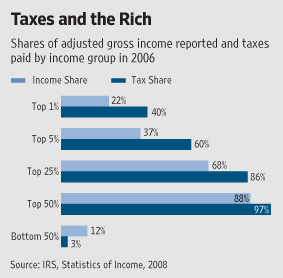
    The nearby chart shows that the top 1% of taxpayers, those who earn above $388,806, paid 40% of all income taxes in 2006, the highest share in at least 40 years. The top 10% in income, those earning more than $108,904, paid 71%. Barack Obama says he’s going to cut taxes for those at the bottom, but that’s also going to be a challenge because Americans with an income below the median paid a record low 2.9% of all income taxes, while the top 50% paid 97.1%. Perhaps he thinks half the country should pay all the taxes to support the other half.

    Wow. The Wall Street Journal against a tax cut? Well I guess if it is a tax on the poor they don’t support cutting those taxes. I think it may well make sense to reduce the social security and medicare taxes on the working poor (including the company share). Of all the taxes we have this is the one I would reduce, if I reduced any (given the huge amount of government debt any reduction may well be unwise). But reducing income taxes for those under the median income doesn’t seem like something worth doing to me.

    The top 1% earned 22% of all reported income. But they also paid a share of taxes not far from double their share of income. In other words, the tax code is already steeply progressive.

    chart of taxes by income distribution

    They seem to ignore that income inequality has drastically increased. When you have a system that puts a huge percentage of the cash in a few people’s pockets of course those people end up paying a lot of cash per person. One affect of massive wealth concentration is that the limited people all the money is flowing to naturally will pay an increasing portion of taxes.

    It is fine to argue that the rich pay too much tax, if you want. I don’t agree. I think Warren Buffett explains the issue much more clearly and truthfully when he says he, and all his fellow, billionaires (and those attempting to join the club) pay a lower percent of taxes on income than their secretaries do. He offers $1 million to any of them that prove that isn’t true.

    And I guess you can say that the top 22% of the income paying the top 40% of the taxes is “steeply progressive.” I wouldn’t call that steep, but… It is nice the graphic is at least decently honest. Saying just “top 1% of taxpayers, those who earn above $388,806, paid 40% of all income ” is fairly misleading. It is much more honest (I believe) to say that “the top 1% (that made 22% of the income) paid…” Those with the top 22% of income paid 40% of the taxes, the next 15% payed 20%, the next 31% paid 26% the next 20% 11% and the final 12% paid 3%. That is progressive. From my perspective it could be more progressive but I can see others saying it it progressive enough.

    If 22% to 40% is “steeply” progressive what is 1% to 22%? The income distribution seems to be what? very hugely massively almost asymptotently progressive? The to 1% of people, by income, take 22% of the income, the next 4% take the next 15% of the total income, the next 20% take 31%, the next 25% take 30% and the bottom 50% take 12%. This level of income inequality is much more a source of concern than any concern someone should have about a slightly progressive tax result.

    Related: House Votes to Restore Partial Estate Tax on the Very Richest: Over $7 MillionIRS Tax dataRich Americans Sue to Keep Evidence of Their Tax Evasion From the Justice Department
    (more…)

  • Consumer Debt Needs to Decline Much More

    Economic data don’t point to boom times just yet

    American households are trying to reduce debt to stabilize finances. But they are doing so slowly, with total household debt at 94 percent of gross domestic product in the fourth quarter down just slightly from 96 percent when the recession began in late 2007.

    By contrast, that ratio of household debt to economic output was 70 percent in 2000. To get back to that level, Americans would need to pay down $3.4 trillion in debt

    And it isn’t like the 2000 level was one of great consumer discipline. The economy needs to improve in several ways to be approaching a state that could be called a healthy economy. The 2 biggest, in my mind are 1) decreasing debt (consumer and government) and 2) increasing jobs. My next most important would probably be increasing the number of “good” jobs. Many other data points are important, such as: decreasing income inequality; increasing the age at retirement (because of all the systemic problems caused by extremely long retirements financed not by savings but taxes on existing workers); low inflation (luckily that is continuing to look good); value added economic activity (real GDP); decrease in the cost of the health care system as a % of GDP; decrease in financial leverage; economic strength worldwide (economic weakness of Japan, Europe… can severely hamper economic success in the USA). I do not see a bubble hyped economy as a healthy economy – even if lots of measures look good.

    Related: Americans are Drowning in DebtDollar Decline Due to Government Debt or Total Debt?Financial Illiteracy Credit TrapConsumer Debt Down Over $100 Billion So Far in 2009 (Nov 2009)

  • Real Estate and Consumer Loan Delinquency Rates 1998-2009

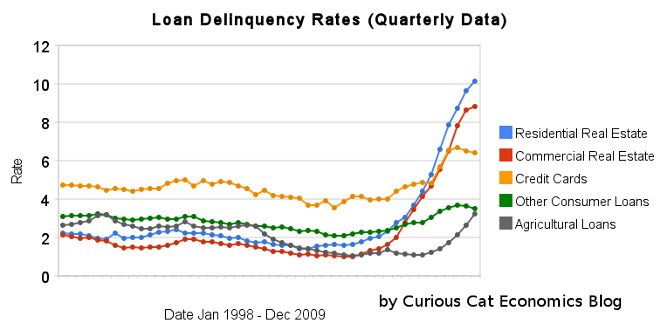
    The chart shows the total percent of delinquent loans by commercial banks in the USA.

    charts showing loan delinquency rates in the USA, 1998-2009

    That last half of 2009 saw real estate delinquencies continue to increase. Residential real estate delinquencies increased 143 basis points to 10.14% and commercial real estate delinquencies in 98 basis points to 8.81%. Agricultural loan delinquencies also increased (112 basis points) though to just 3.24%. Consumer loan delinquencies decreased with credit card delinquencies down 18 basis points to 6.4% and other consumer loan delinquencies down 19 basis points to 3.49%.

    Related: Loan Delinquency Rates Increased Dramatically in the 2nd QuarterBond Rates Remain Low, Little Change in Late 2009Government Debt as Percentage of GDP 1990-2008 – USA, Japan, Germany… posts with charts showing economic data
    (more…)

  • USA Added 162,000 Jobs in March

    Nonfarm payroll employment increased by 162,000 in March, and the unemployment rate held at 9.7%, based on U.S. Bureau of Labor Statistics surveys. Hiring for the census added 48,000 jobs in March, a large temporary increase, but less than expected amount, for the month. The change in total nonfarm payroll employment for January was revised from -26,000 to +14,000, and the change for February was revised from -36,000 to -14,000 together this results in an addition of 90,000 jobs.

    The 162,000 added jobs is the largest increase since March of 2007. It is a good start but the economy will have to continue to increase the number of job added each month to reduce unemployment. Population growth requires an addition of approximately 125,000 jobs a month. The current labor pool has been temporarily reduced by those who have dropped out of the labor market. As jobs return they will come back into the market.

    The economy has lost 8.2 million jobs since the recession started in December 2007. Now that was the bubble induced peak still, by the time the economy adds 8 million jobs many more jobs will be needed (since 125,000 additional jobs are needed each month). Still if we added 200,000 a month it would take 40 months to get back to the previous peak total. And by that time the economy would have accumulated another 9 million jobs needed (it would be about Dec 2013 = 6 * 12 months *125,000/month). While the bubble induced peak may well be a unrealistic target, the job market needs to add over 200,000 jobs a month to regain ground lost over the last several years.

    In March, the number of unemployed persons was little changed at 15.0 million, and the unemployment rate remained at 9.7%. The number of long-term unemployed (those jobless for 27 weeks and over) increased by 414,000 over the month to 6.5 million. In March, 44.1% of unemployed persons were jobless for 27 weeks or more. Both are all time highs.

    The civilian labor force participation rate (64.9%) and the employment-population ratio (58.6%) continued to edge up in March. The average length of unemployment rose to 31 weeks – the highest average ever (since 1948).
    Related: USA Unemployment Rate Remains at 9.7%663,000 Jobs Lost in March, 2009 in the USAAnother 450,000 Jobs Lost in June, 2009Manufacturing Employment Data – 1979 to 2007
    (more…)

  • Buffett Calls on Bank CEOs and Boards to be Held Responsible

    In his most recent letter to shareholders Warren Buffett suggests that bank CEOs and board members be held accountable when the risks they take (and reward themselves obscenely for when they payoff) backfire:

    In my view a board of directors of a huge financial institution is derelict if it does not insist that its CEO bear full responsibility for risk control. If he’s incapable of handling that job, he should look for other employment. And if he fails at it – with the government thereupon required to step in with funds or guarantees –
    the financial consequences for him and his board should be severe.

    It has not been shareholders who have botched the operations of some of our country’s largest financial institutions. Yet they have borne the burden, with 90% or more of the value of their holdings wiped out in most cases of failure. Collectively, they have lost more than $500 billion in just the four largest financial fiascos of the
    last two years. To say these owners have been “bailed-out” is to make a mockery of the term.

    The CEOs and directors of the failed companies, however, have largely gone unscathed. Their fortunes may have been diminished by the disasters they oversaw, but they still live in grand style. It is the behavior of these CEOs and directors that needs to be changed: If their institutions and the country are harmed by their
    recklessness, they should pay a heavy price – one not reimbursable by the companies they’ve damaged nor by insurance. CEOs and, in many cases, directors have long benefitted from oversized financial carrots; some meaningful sticks now need to be part of their employment picture as well.

    The lack of accountability or ethics from those risking the economy so they can take huge payments (and paying off politicians to allow those risks) has hugely damaged the USA and the economic future of the country. The longer we allow such unethical leadership to continue to the more we will suffer. The current low interest paid to savers and the wealth thus transferred to the banks (who then pay themselves even more bonuses) are but one legacy of this economically devastating path.

    By the way, there is no way the bankers will actually be held accountable. The behavior of politicians we continually elect shows they will not do something that those giving them the huge amounts of cash don’t like. If we don’t like that we have to elect different people – maybe people that care about the country and have moral principles instead of those lacking such qualities, that we do elect.

    The politicians believe in holding those that don’t give them huge payments accountable for their actions. They just draw the line at holding people that they play golf with accountable.

    Related: CEOs Plundering Corporate CoffersCredit Crisis the Result of Planned Looting of the World EconomyThe Best Way to Rob a Bank is as An Executive at OneFed Continues Wall Street WelfarePolitical Favors for Rich DonorsWhy Pay Taxes or be Honest

  • Mortgage Delinquencies and Foreclosures Data Indicates 2010 Could Show Improvement

    The delinquency rate for mortgage loans on one-to-four-unit residential properties fell to a seasonally adjusted rate of 9.5% of all loans outstanding as of the end of the fourth quarter of 2009, down 17 basis points from the third quarter of 2009, and up 159 basis points from one year ago, according to the Mortgage Bankers Association’s (MBA) National Delinquency Survey. The non-seasonally adjusted delinquency rate increased 50 basis points from 9.9% in the third quarter of 2009 to 10.4% this quarter.

    The delinquency rate includes loans that are at least one payment past due but does not include loans in the process of foreclosure. The percentage of loans in the foreclosure process at the end of the fourth quarter was 4.6%, an increase of 11 basis points from the third quarter of 2009 and 128 basis points from one year ago. The combined percentage of loans in foreclosure or at least one payment past due was 15% on a non-seasonally adjusted basis, the highest ever recorded in the MBA delinquency survey.

    The percentage of loans on which foreclosure actions were started during the fourth quarter was 1.2 percent, down 22 basis points from last quarter and up 12 basis points from one year ago.

    The percentages of loans 90 days or more past due and loans in foreclosure set new record highs. The percentage of loans 30 days past due is still below the record set in the second quarter of 1985.

    The data is far from good but it could well signal the situation is improving. The next few quarters seem poised to start showing better results. Granted given how bad these results are we have a long way to go before the data is actually good. “We are likely seeing the beginning of the end of the unprecedented wave of mortgage delinquencies and foreclosures that started with the subprime defaults in early 2007, continued with the meltdown of the California and Florida housing markets due to overbuilding and the weak loan underwriting that supported that overbuilding, and culminated with a recession that saw 8.5 million people lose their jobs,” said Jay Brinkmann, MBA’s chief economist.

    “The continued and sizable drop in the 30-day delinquency rate is a concrete sign that the end may be in sight. We normally see a large spike in short-term mortgage delinquencies at the end of the year due to heating bills, Christmas expenditures and other seasonal factors. Not only did we not see that spike but the 30-day delinquencies actually fell by 16 basis points from 3.79% to 3.63%. Only three times before in the history of the MBA survey has the non-seasonally adjusted 30-day delinquency rate dropped between the third and fourth quarter and never by this magnitude.

    “This drop is important because 30-day delinquencies have historically been a leading indicator of serious delinquencies and foreclosures. With fewer new loans going bad, the pool of seriously delinquent loans and foreclosures will eventually begin to shrink once the rate at which these problems are resolved exceeds the rate at which new problems come in. It also gives us growing confidence that the size of the problem now is about as bad as it will get.

    “Despite the drop in short-term delinquencies, foreclosure rates could continue to climb, however, based on the ability of borrowers 90 days or more delinquent to solve their problems. A sizable number of the loans in the 90+ day delinquent bucket are in loan modification programs. They are carried as delinquent until borrowers demonstrate they will make the payments agreed to in the plans.

    Related posts: Mortgage Delinquencies Continue to Climb (Nov 2009)USA Housing Foreclosures Slowly Declining (Dec 2009)Nearly 10% of Mortgages Delinquent or in ForeclosureHow Not to Convert Equity (Jan 2006)
    (more…)

  • USA, China and Japan Lead Manufacturing Output in 2008

    Once again the USA was the leading country in manufacturing in 2008. And once again China grew their manufacturing output amazingly. In a change with recent trends Japan grew output significantly. Of course, the 2009 data is going to show the impact of a very severe worldwide recession.

    Chart showing percent of output by top manufacturing countries from 1990 to 2008Chart showing the percentage output of top manufacturing countries from 1990-2008 by Curious Cat Management Blog, Creative Commons Attribution.
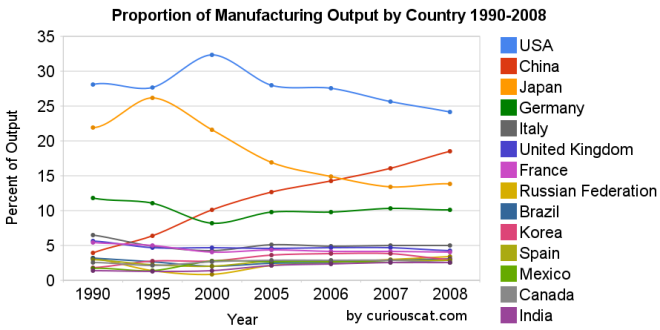
    The first chart shows the USA’s share of the manufacturing output, of the countries that manufactured over $185 billion in 2008, at 28.1% in 1990, 27.7% in 1995, 32% in 2000, 28% in 2005, 28% in 2006, 26% in 2007 and 24% in 2008. China’s share has grown from 4% in 1990, 6% in 1995, 10% in 2000, 13% in 2005, 14% in 2006, 16% in 2007 to 18% in 2008. Japan’s share has fallen from 22% in 1990 to 14% in 2008. The USA has about 4.5% of the world population, China about 20%. See Curious Cat Investment blog post” Data on the Largest Manufacturing Countries in 2008.

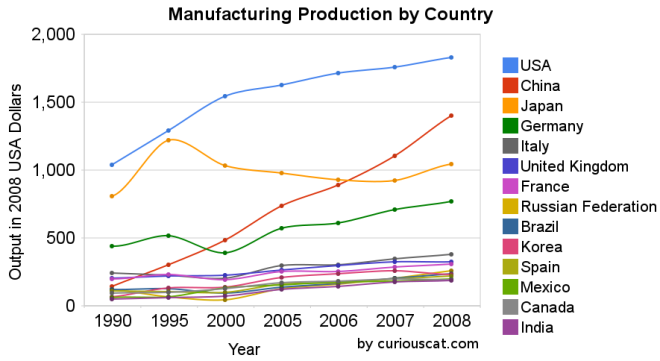
    Even with just this data, it is obvious the belief in a decades long steep decline in USA manufacturing is not in evidence. And, in fact the USA’s output has grown substantially over this period. It has just grown more slowly than that of China (as has every other country), and so while output in the USA has grown the percentage with China has shrunk. The percentage of manufacturing output by the USA (excluding output from China) was 29.3% in 1990 and 29.6% in 2008. The second chart shows manufacturing output over time.

    charts showing the top manufacturing countries output from 1990-2008Chart showing the output of the top manufacturing countries from 1990-2008 by Curious Cat Management Blog, Creative Commons Attribution.

    The 2008 China data is not provided for manufacturing alone (the latest UN Data, for global manufacturing, in billions of current USA dollars). The percentage of manufacturing (to manufacturing, mining and utilities) was 78% for 2005-2007 (I used 78% of the manufacturing, mining and utilities figure provided in the 2008 data). There is a good chance this overstates China manufacturing output in 2008 (due to very high commodity prices in 2008).

    Hopefully these charts provide some evidence of what is really going on with global manufacturing and counteracts the hype, to some extent. Global economic data is not perfect. These figures are an attempt to capture the economic reality in the world but they are not a perfect proxy. This data is shown in 2008 USA dollars which is good in the sense that it shows all countries in the same light and we can compare the 1995 USA figure to 2005 without worrying about inflation. However foreign exchange fluctuations over time can show a country, for example, having a decline in manufacturing output in some year when in fact the output increased (just the decline against the USA dollar that year results in the data showing a decrease – which is accurate when measured in terms of USA dollars).

    If the dollar declines substantially between when the 2008 data was calculated and the 2009 data is calculated that will give result in the data showing a substantial increase in those countries that had a currency strengthen against the USA dollar. At this time the Chinese Renminbi has not strengthened while most other currencies have – the Chinese government is retaining a peg to a specific exchange rate.

    Korea (1.8% in 1990, 3% in 2008), Mexico (1.7% to 2.6%) and India (1.4% to 2.5%) were the only countries to increase their percentage of manufacturing output (other than China, of course, which grew from 3.9% to 18.5%).

    Related: posts on manufacturingGlobal Manufacturing Data by Country (2007)Global Manufacturing Employment Data – 1979 to 2007Top 10 Manufacturing Countries 2006Top 10 Manufacturing Countries 2005