Tag: Retirement

  • Career Flexibility

    I think we could use some innovation in our model of a career. I have thought retirement being largely binary was lame since I figured out that is mainly how it worked. You work 40 hours a week (1,800 – 2,000 hours a year) and then dropped to 0 hours, all year long, from them on.

    It seems to me more gradual retirement makes a huge amount of sense (for society, individuals and our economy). That model is available to people, for example those that can work as consultants (and some others) but we would benefit from more options.

    Why do we have to start work at 22 (or 18 or 26 or whenever) and then work 40 or so straight years and then retire? Why not gap years (or sabbaticals)? Also why can’t we just go part time if we want.

    The broken health care system in the USA really causes problems with options (being so tightly tied to full time work). But I have convinced employers to let me go part-time (while working in orgs that essentially have 0 part time workers). And I am now basically on gap year(s)/sabbatical now. It can be done, but it certainly isn’t encouraged. You have to go against the flow and if you worry about being a conventional hire you may be nervous.

    Related: Working Less: Better Lives and Less UnemploymentWhy don’t we take five years out of retirement and spread them throughout your working life?Retiring Overseas is an Appealing Option for Some RetireesLiving in Malaysia as an Expat67 Is The New 55

  • Top Nations for Retirement Security of Their Citizens

    Across the globe, saving for retirement is a challenge. Longer lives and expensive health care create challenge to our natures (saving for far away needs is not easy for most of us to do – we are like the grasshopper not the ants, we play in the summer instead of saving). This varies across the globe, in Japan and China they save far more than in the USA for example.

    The United States of America ranks 19th worldwide in the retirement security of its citizens, according to a new Natixis Global Retirement Index. The findings suggest that Americans will need to pick up a bigger share of their retirement costs – especially as the number of retirees grows and the government’s ability to
    support them fades. The gauges how well retired citizens live in 150 nations, based on measures of health, material well-being, finances and other factors.

    Top Countries for Retirees

    • 1 – Norway
    • 2 – Switzerland
    • 3 – Luxembourg
    • 6 – Finland
    • 9 – Germany
    • 10 – France
    • 11 – Australia
    • 13 – Canada
    • 15 – Japan
    • 19 – USA
    • 20 – United Kingdom

    Western European nations – backed by robust health care and retiree social programs – dominate the top of the rankings, taking the first 10 spots, including Sweden, Austria, Netherlands and Denmark. The USA finished ahead of the United Kingdom, but trailed the Czech Republic and Slovakia.

    Globally, the number of people aged 65 or older is on track to triple by 2050. By that time, the ratio of the working-age population to those over 65 in the USA is expected to drop from 5-to-1 to 2.8-to-1. The USA actually does much better demographically (not aging as quickly) as other rich countries mainly due to immigration. Slowing immigration going forward would make this problem worse (and does now for countries like Japan that have very restrictive immigration policies).

    The economic downturn has taken a major toll on retirement savings. According to a recent report by the U.S. Senate Committee on Health, Education, Labor and Pensions, the country is facing a retirement savings deficit of $6.6 trillion, or nearly $57,000 per household. As a result, 53% of American workers 30 and older are on a path that will leave them unprepared for retirement, up significantly from 38% in 2011.

    On another blog I recently wrote about another study looking at the Best Countries to Retirement Too: Ecuador, Panama, Malaysia. The study in the case was looking not at the overall state of retirees that worked in the country (as the study discussed in this post did) but instead where expat retirees find good options (which stretch limited retirement savings along with other benefits to retirees).

    See the full press release.

    Related: Top Stock Market Capitalization by Country from 1990 to 2010Easiest Countries in Which to Operate a Businesses: Singapore, Hong Kong, New Zealand, USALargest Nuclear Power Generation Countries from 1985-2010Leading countries for Economic Freedom: Hong Kong, Singapore, New Zealand, SwitzerlandCountries with the Top Manufacturing Production

  • How Much of Current Income to Save for Retirement

    Determining exactly what needs to be saved for retirement is tricky. Basically it is something that needs to be adjusted based on how things go (savings accumulated, saving rate, planned retirement date, investing returns, predicted investing returns, government policy, tax rates, etc.). The simple idea is start by saving 15% of salary by the time you are 30. Then adjust over time. If you start earlier maybe you can get by with 12%…

    How Much to Save for Retirement is a very good report by the Boston College center for retirement research. They look at the percent of income replacement social security (for those in the USA) provides. This amount varies greatly depending on your income and retirement (date you start drawing social security payments).

    Low earners ($20,000) that retire at 65 have 49% of income replaced by social security. Waiting only 2 years, to 67, the replacement amount increases to 55%. For medium earners ($50,000) 36% and 41% of income is replaced. And for high earners ($90,000) 30% an 34%.

    Starting savings early make a huge difference. Starting retirement savings at age 25 requires about 1/3 the percentage of income be saved as starting at 45. So you can save for example 7% from age 25 to 70 or 18% from age 45 to 70. Retiring at 62 versus 70 also carries a cost of about 3 times as great savings required each year. So retiring at 62 would require an impossible 65% if you didn’t start saving until 45. But these numbers are affected by many things (the higher your income the less social security helps so the higher percentages you need to save and many other factors play a role).

    Starting to save early is a huge key. Delaying retirement makes a big difference but it is not nearly as much in your control. You can plan on doing that but need to understand that you cannot assume you will get to set the date (either because finding a job you can do and pays what you wish is not easy or you are not healthy enough to work full time).

    If you don’t have social security (those outside the USA – some countries have their versions but some don’t offer anything) you need to save more. A good strategy is to start saving for retirement in your twenties. As you get raises increase your percentage. So if you started at 6% (maybe 4% from you and a 2% match, but in any event 6% total) each time you get a raise increase your percentage 100 basis points (1 percentage point).

    If you started at 27 at 6% and got a raise each year for 9 years you would then be at 15% by age 36. Then you could start looking at how you were going and make some guesstimates about the future. Maybe you could stabilize at 15% or maybe you could keep increasing the amount. If you can save more early (start at 8% or increase by 150 or 200% basis points a year) that is even better. Building up savings early provides a cushion for coping with negative shocks (being unemployed for a year, losing your job and having to take a new job earning 25% less, very bad decade of investing returns, etc.).

    Investing wisely makes a big difference also. The key for retirement savings is safety first, especially as you move closer to retirement. But you need to think of investment safety as an overall portfolio. The safest portfolio is well balanced not a portfolio consisting of just an investment people think of as safe by itself.

    Related: Retirement Planning, Investing Asset ConsiderationsSaving for Retirement Must Be a Personal Finance PriorityInvestment Risk Matters Most as Part of a Portfolio, Rather than in Isolation
  • Save What You Can, Increase Savings as You Can Do So

    Building your saving is largely about not very sexy actions. The point where most people fail is just not saving. It isn’t really about learning some tricky secret.

    You can find yourself with pile of money without saving; if you win the lottery or inherit a few million from your rich relative via some tax dodge scheme like generation skipping trusts or charitable remainder trusts.

    But the rest of us just have to do a pretty simple thing: save money. Then, keep saving money and invest that money sensibly. The key is saving money. The next key is not taking foolish risks. Getting fantastic returns is exciting but is not likely and the focus should be on lowering risk until you have enough savings to take risks with a portion of the portfolio.

    My favorite tips along these lines are:

    Spending less than you make and building up your long term savings puts you in the strongest personal finance position. These things matter much more than making a huge salary or getting fantastic investing returns some year. Avoiding risky investments is wise, and sure making great returns helps a great deal, but really just saving and investing in a boring manner puts you in great shape in the long run. Many of those making huge salaries are in atrocious personal financial shape.

    Another way you can boost savings is to do so when you pay off a monthly bill. So when I paid off my car loan I just kept saving the old payment. Then I was able to buy my new car with the cash I saved in advance when I was ready for a new car.

    (more…)

  • Retirement Planning – Looking at Assets

    The basics of retirement planning are not tricky. Save 10-15% of your income for about 40 years working career (likely over 15%, if you don’t have some pension or social security – with some pension around 10+% may be enough depending on lots of factors). That should get you in the ballpark of what you need to retire.

    Of course the details are much much more complicated. But without understanding any of the details you can do what is the minimum you need to do – save 10% for retirement of all your income. See my retirement investing related posts for more details. Only if you actually understand all the details and have a good explanation for exactly why your financial situation allows less than 10% of income to be saved for retirement every year after age 25 should feel comfortable doing so.

    There is value in the simple rules, when you know they are vast oversimplifications. I am amazed how many professionals don’t understand how oversimplified the rules of thumb are.

    Here is one thing I see ignored nearly universally. I am sure some professions don’t but most do. If you have retirement assest such as a pension or social security (something that functions as an annuity, or an actually annuity) that is often a hugely important part of your retirement portfolio. Yet many don’t consider this when setting asset allocations in retirement. That is a mistake, in my opinion.

    A reliable annuity is most like a bond (for asset allocation purposes). Lets look at an example for if you have $1,500 a month from a pension or social security and $500,000 in other financial assets. $1,500 * 12 gives $18,000 in annual income.

    To get $18,000 in income from an bond/CD… yielding 3% you need $600,000. That means, at 3%, $600,000 yields $18,000 a year.

    Ignoring this financial asset worth the equivalent of $600,000 when considering how to invest you $500,000 is a big mistake. Granted, I believe the advice is often too biased toward bonds in the first place (so reducing that allocation sounds good to me). To me it doesn’t make sense to invest that $500,000 the same way as someone else that didn’t have that $18,000 annuity is a mistake.

    I also don’t think it makes sense to just say well I have $1,100,000 and I want to be %50 in bonds and 50% in stocks so I have “$600,000 in bonds now” (not really after all…) so the $500,000 should all be in stocks. Ignoring the annuity value is a mistake but I don’t think it is as simple as just treating it as though it were the equivalent amount actually invested.

    Related: Immediate AnnuitiesManaging Retirement Investment RisksHow to Protect Your Financial HealthMany Retirees Face Prospect of Outliving Savings

    (more…)

  • Don’t Expect to Spend Over 4% of Your Retirement Investment Assets Annually

    Pitfalls in Retirement (pdf) is quite a good white paper from Meril Lynch, I strongly recommend it.

    A survey asked investors at least 41 years of age how much of their retirement savings they can safely spend each year without running the risk of exhausting their assets. Forty percent had no idea; an additional 29% said they
    could safely spend 10% or more of their savings each year.

    But, as explained below, the respondents most on target were the one in 10 who estimated sustainable spending rates to be 5% or less. This is significantly impacted by life expectancy; if you have a much lower life expectancy due to retiring later or significant health issues perhaps you can spend more. But counting on this is very risky.

    This is likely one of the top 5 most important things to know about saving for retirement (and just 10% of the population got the answer right). You need to know that you can safely spend 5%, or likely less, of your investment assets safely in retirement (without dramatically eating into your principle.

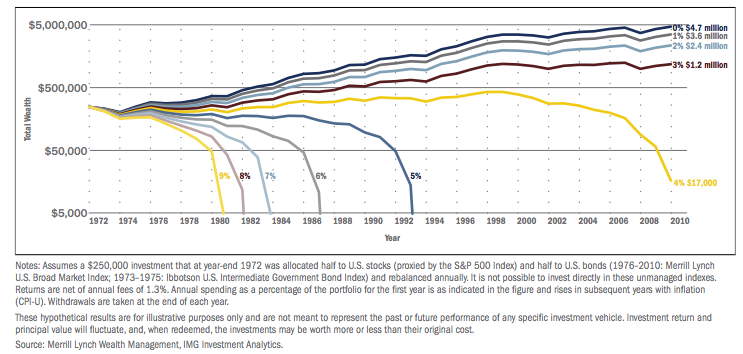
    chart showing retirement assets over time based on various spending levels
    Chart showing retirement assets over time based on various spending levels, from the Merill Lynch paper.

    The chart is actually quite good, the paper also includes another good example (which is helpful in showing how much things can be affected by somewhat small changes*). One piece of good news is they assume much larger expense rates than you need to experience if you choose well. They assume 1.3% in fees. You can reduce that by 100 basis points using Vanguard. They also have the portfolio split 50% in stocks (S&P 500) and 50% in bonds.

    Several interesting points can be drawn from this data. One the real investment returns matter a great deal. A 4% withdrawal rate worked until the global credit crisis killed investment returns at which time the sustainability of that rate disappeared. A 5% withdrawal rate lasted nearly 30 years (but you can’t count on that at all, it depends on what happens with you investment returns).

    Related: What Investing Return Projections to Use In Planning for RetirementHow Much Will I Need to Save for Retirement?Saving for Retirement

    (more…)

  • 60% of Workers in the USA Have Less Than $25,000 in Retirement Savings

    2012 Retirement Confidence Survey

    (60 percent) report they and/or their spouses have less than $25,000 in total savings and investments (excluding their home and defined benefit plans), including 30 percent who have less than $1,000

    The data would be better if some value were placed on defined benefit plans; currently it is a bit confusing how much they may help. But the $25,000 threshold is so low that no matter what being under that value is extremely bad news for anyone over 40. And failing to have saved over just $25,000 toward retirement is bad news for anyone over 30 without a defined benefit plan.

    The large majority of workers who have not saved for retirement have little in savings. Almost two-thirds (63 percent) report they have less than $1,000 in savings and investments, and another quarter (25 percent) have $1,000–$9,999.

    Thirty-four percent of workers report they had to dip into savings to pay for basic expenses in the past 12 months.

    Thirty-five percent of all workers think they need to accumulate at least $500,000 by the time they retire to live comfortably in retirement. Eighteen percent feel they need between $250,000 and $499,999, while 34 percent think they need to save less than $250,000 for a comfortable retirement.

    Workers who have performed a retirement needs calculation are more than twice as likely as those who have not (23 percent vs. 10 percent) to expect they will need to accumulate at least $1 million before retiring.

    66% of workers say their family has retirement savings and 58% say they are currently saving for retirement. These results are fairly consistent over the last few decades (the current values are in the lower ranges of results).

    Nearly everyone wishes they had more money. One way to act as though you have more than you do is to borrow and spend (which is normally unwise – it can make sense for a house and in limited amounts when you are first going out on your own). Another is to ignore long term needs and just live it up today. That is a very bad personal finance strategy but one many people follow. Saving for retirement is a personal finance requirement. If you can’t save for retirement given your current income and lifestyle you need to reduce your current spending to save or increase your income and then save for retirement.

    A year or two of failing to do so is acceptable. Longer stretches add more and more risk to your personal financial situation. It may not be fun to accept the responsibilities of adulthood and plan for the long term. But failing to do so is a big mistake. Determining the perfect amount to save for retirement is complicated. A reasonable retirement saving plan is not.

    Saving 10% of your gross income from the time you are 25 until 65 gives you a decent ballpark estimate. Then you can adjust even 5 or 10 years as you can look at your situation. It will likely take over 10% to put you in a lifestyle similar to the one you enjoy while working. But many factors are at play. To be safer saving at 12% could be wise. If you know you want to work less than 40 years saving more could be wise. If you have a defined benefit plan (rare now, but, for example police or fire personnel often still do you can save less but you must work until you gain those benefits or you will be in extremely bad shape.

    IRAs, 401(k) and 403(b) plans are a great way to save for retirement (giving you tax deferral and Roth versions of those plans are even better – assuming tax rates rise).

    Related: In the USA 43% Have Less Than $10,000 in Retirement SavingsSaving for Retirement

  • Investing Return Guesses While Planning for Retirement

    In my opinion is has never been more difficult to plan for retirement. It is extremely difficult to guess what rates of return should be expected in the next 10-30 years. It might have actually been as difficult 10 years ago, but it seemed that it wasn’t. Estimating a 7-8% return for your portfolio seemed a pretty reasonable thing to do, and evening considering 10% wasn’t unthinkable, if you wanted to be optimistic and took more risk.

    Today it is very hard to guess, going forward, what is reasonable. It is also hard to find any very safe decent yields. Is 4% a good estimate for your portfolio? 6%? 8%? What about inflation? I know inflation isn’t a huge concern of people right now, but I still think it is a very real risk. I think trying to project is helpful (even with all the uncertainty). But it is more important than ever to look at various scenarios and consider the risks if things don’t go as well as you hope. The best way to deal with that is to save more.

    In the USA save at least 10% of your income for retirement in your own savings (in addition to social security) and it would be better to save 12% and you might even need to be saving 15%. And if you waited beyond 30 to start doing this you have to save substantially more, to have a comfortable retirement plan (obviously if you are willing to live at a much lower standard of living in retirement than before, you can save less).

    Other factors matter too. If you don’t own your house with no more mortgage payments you will need to save more. Ideally you will have not debts at retirement, if you do, again you need to save more.

    That Retirement Calculator May Be Lying to You

    According to Ibbotson data, the long-term annualized gain for the Standard & Poor’s 500-stock index dating back to 1926 is 9.9 percent. For bonds, it’s 5.4 percent. (From 1970 to 2010, the Barclays Capital Aggregate Bond index average was 8.3 percent.) Plug those numbers into a portfolio of 60 percent stocks and 40 percent bonds and the return is about 8 percent, which is precisely the number most financial planners — and retirement calculators — were using up until recently.

    Vanguard founder Jack Bogle has a slightly more upbeat assessment. He expects stock returns of 7 percent to 7.5 percent over the next decade. He assumes no expansion in the market’s price-earnings ratio, dividend yields of 2.2 percent, and earnings growth of at least 5 percent. Bogle expects bond returns to be about 3 percent. For a balanced portfolio, that produces a net nominal return of slightly more than 6 percent. A higher forecast is T. Rowe Price’s estimate of 7 percent; until this year it had used 8 percent.

    I also suggest using high quality high yield dividend stocks for more of the bond portfolio. I wouldn’t hold bonds with maturities over 5 years at these yields (or if I did, they would be an extremely small portion of the portfolio). I would also have a fair amount of the bond portfolio in inflation protected bonds.

    I also invest in emerging economies like China, Brazil, India, Malaysia, Indonesia, Thailand, the continent of Africa… To some extent you get that with large companies like Google, Intel, Tesco, Toyota, Apple… that are making lots of money in emerging economies and continuing to invest more in emerging markets. VWO (.22% expense ratio) is a good exchange traded fund (ETF) for emerging markets. I also believe investing in real estate is wise as part of a retirement portfolio.

    Related: 401(k) Options, Select Low ExpensesHow Much Will I Need to Save for Retirement?Investment Risk Matters Most as Part of a Portfolio, Rather than in Isolation

  • Looking for Dividend Stocks in the Current Extremely Low Interest Rate Environment

    My preference is for a lower use of bonds than the normal portfolio balancing strategies use. I just find the risks greater than the benefits. This preference increases as yields decline. Given the historically low interest rates we have been experiencing the last few years (and low yields even for close to a decade) I really believe bonds are not a good investment. Now for someone approaching or in retirement I do think some bonds are probably wise to balance the portfolio (or CDs). But I would limit maturities/duration to 2 or 3 years. And really I would pursue high yielding stocks much more than normal.

    In general I like high yielding stocks for retirement portfolios. Many are very good long term investments overall and I prefer to put a portion of the portfolio others would place in bonds in high yielding stocks. Unfortunately 401(k) [and 403(b)] retirement accounts often don’t offer an option to do this. Luckily IRAs give you the options to invest as you chose and by placing your IRA in a brokerage account you can use this strategy. In a limited investing option retirement account [such as a 401(k)] look for short term bond funds, inflation protected bonds and real estate funds – but you have to evaluate if those funds are good – high expenses will destroy the reasons to invest in bond funds.

    There are actually quite a few attractive high yield stocks now. I would strive for a very large amount of diversity in high yield stocks that are meant to take a portion of the bonds place in a balanced portfolio. In the portion of the portfolio aimed at capital appreciation I think too much emphasis is placed on “risk” (more concentration is fine in my opinion – if you believe you have a good risk reward potential). But truthfully most people are better off being more diversified but those that really spend the time (it takes a lot of time and experience to invest well) can take on more risk.

    A huge advantage of dividends stocks is they often increase the dividend over time. And this is one of the keys to evaluate when selected these stock investments. So you can buy a stock that pays a 4% yield today and 5 years down the road you might be getting 5.5% yield (based on increased dividend payouts and your original purchase price). Look for a track record of increasing dividends historically. And the likelihood of continuing to do so (this is obviously the tricky part). One good value to look at is the dividend payout rate (dividend/earnings). A relatively low payout (for the industry – using an industry benchmark is helpful given the different requirement for investing in the business by industry) gives you protection against downturns (as does the past history of increasing payouts). It also provides the potential for outsized increases in the future.

    There are a number of stocks that look good in this category to me now. ONEOK Partners LP pays a dividend of 5.5% an extremely high rate. They historically have increased the dividend. They are a limited partnership which are a strange beast not quite a corporation and you really need to read up and understand the risks with such investments. ONEOK is involved in the transportation and storage of natural gas. I would limit the exposure of the portfolio to limited partnerships (master limited partnerships). They announced today that the are forecasting a 20% increase in 2012 earnings so the stock will likely go up (and the yield go down – it is up 3.4% in after hours trading).

    Another stock I like in this are is Abbott, a very diversified company in the health care field. This stock yields 3.8% and has good potential to grow. That along with a 3.8% yield (much higher than bond yields, is very attractive).

    My 12 stocks for 10 year portfolio holds a couple investments in this category: Intel, Pfizer and PetroChina. Intel yields 3.9% and has good growth prospects though it also has the risk of deteriorating margins. There margins have remains extremely high for a long time. Maybe it can continue but maybe not. Pfizer yeilds 4.6% today which is a very nice yield. At this time, I think I prefer Abbott but given the desire for more diversification in this portion of the portfolio both would be good holdings. Petro China yields 4% today.

    When invested in a retirement portfolio prior to retirement I would probably just set up automatic reinvesting of the dividends. Once in retirement as income is needed then you can start talking the dividends as cash, to provide income to pay living expenses. I would certainly suggest more than 10 stocks for this portion of a portfolio and an investor needs to to educate themselves evaluate the risks and value of their investments or hire someone who they trust to do so.

    Related: Retirement Savings Allocation for 2010S&P 500 Dividend Yield Tops Bond Yield: First Time Since 195810 Stocks for Income Investors

  • Retirement: Roth IRA Earnings and Contribution Limits

    For 2010 and 2011, the most that an individual can contribute to a traditional IRA or Roth IRA generally is the smaller of: $5,000 ($6,000 if the individual is age 50 or older), or the individual’s taxable compensation for the year. You have until your taxes are due (April 15th, 2011) to add to your IRA for 2010.

    This is the most that can be contributed regardless of whether the contributions are to one or more traditional or Roth IRAs or whether all or part of the contributions are nondeductible. However, other factors may limit or eliminate the ability to contribute to an IRA as follows:

    • An individual who is age 70½ or older cannot make regular contributions to a traditional IRA (just to make things complicated you can add to a Roth IRA) for the year.
    • Contributions to a Roth IRA are limited based on income. The limits are based on modified adjusted gross income (which is before deductions are taken). The Roth IRA earnings limits for 2010 are:

    • Single filers: Up to $105,000; from $105,000 – $120,000 (a partial contribution is allowed)
    • Joint filers: Up to $167,000; from $167,000 – $177,000 (a partial contribution)

    For 2011 the earning limits increase to

    • Single filers: Up to $105,000; from $107,000 – $122,000 (a partial contribution is allowed)
    • Joint filers: Up to $167,000; from $169,000 – $179,000 (a partial contribution)

    More details from the IRS website and earning limits details.

    The income limits do not cap what you can add using a 401(k). So if you were planning on adding to a Roth IRA but cannot due to the income limits you may want to look into increasing your 401(k) contributions.

    Related: Add to Your Roth IRAAdd to Your 401(k) and IRA401(k)s are a Great Way to Save for Retirement