Tag: risk

  • Huge Growth in USA Corporate Debt from 2005 to 2020

    There are many problems with the extremely low interest rates available in decade since the too-big-to-fail financial crisis. The interest rates seem to me to be artificially sustained by massive central bank actions for 12 years now.

    Extraordinarily low rates encourage businesses to borrow money, after all how hard is it to invest in something that will return the business more than a few percent a year (that they can borrow at). Along with the continued efforts by the central banks to flood the economy with money any time there is even a slowdown in growth teaches companies to not worry about building a business that can survive bad times. Just borrow and if necessary borrow more if you are having trouble then just borrow more.
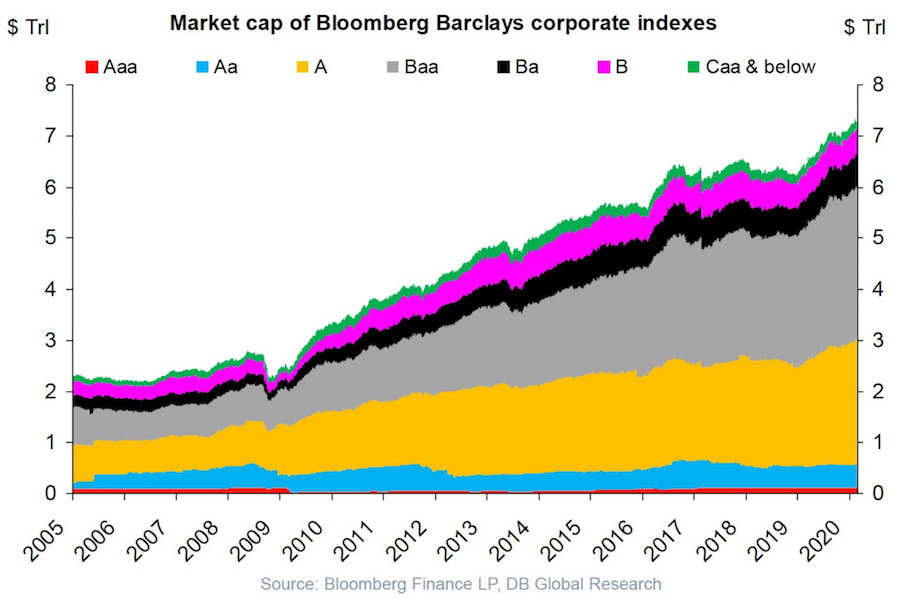
    chart showing the growth of usa corporate debt from 2005 to 2020

    USA corporate debt has increased from a bit over $2 trillion in 2005 to over $7 trillion in 2020.

    This isn’t a healthy way to build an economy. Businesses should be robust and able to sustain themselves if the economy experiences a recession and interest rates rise and the ability to borrow decreases.

    Extremely low interest rates hide a huge potential cost if interest rates rise. Sure the huge debt is covered by cash flow in good times with the interest rate on your debt is 4%. What happens if interest rates rise to 6% and the economy declines? At some point investors (and banks) are going to realize that huge debt burdens on companies that are overly leveraged are not safe and deserve a premium interest rate.

    I don’t think there is any risk to companies with very strong balance sheets and a business model that won’t have any trouble maintaining positive cash flow in a significant recession (Apple, Abbvie, Google, Costco, etc.). But many businesses are over-leveraged and at a significant risk of default in a bad economy.

    The stock market is down quite a bit today partially due to the worry that the leveraged oil shale companies in the USA will go under if OPEC does not manage to restrict the supply of oil in order to keep oil prices high (or at least keep oil prices from collapsing).

    Plenty of leveraged buyouts (where private equity firms take out cash and leave behind barely functional businesses) are barely able to survive even with extremely low interest rates. Those companies are in danger of failing when they experience even a small problems.

    (more…)

  • Retirement Portfolio Allocation for 2020

    The markets continue to provide difficult options to investors. In the typical market conditions of the last 50 years I think a sensible portfolio allocation was not that challenging to pick. I would choose a bit more in stocks than bonds than the commonly accepted strategy. And I would choose to put a bit more overseas and in real estate.

    But if that wasn’t done and even something like 60% stocks and 40% bonds were chosen it would seem reasonable (or 60% stocks 25% bonds and 15% money market – I really prefer a substantial cushion in cash in retirement). Retirement planning is fairly complex and many adjustments are wise for an individual’s particular situation (so keep in mind this post is meant to discuss general conditions today and not suggest what is right for any specific person).

    I wrote about Retirement Savings Allocation for 2010: 5% real estate, 35% global stocks, 5% money market, 55% USA stocks. This was when I was young and accumulating my retirement portfolio.

    Today, investment conditions make investing in retirement more difficult than normal. With interest rates so low bonds provide little yield and have increased risk (due to how much long term bond prices would fall if interest rates rise, given how low interest rates are today). And with stocks so highly valued the likelihood of poor long term returns at these levels seems higher than normal.

    So the 2 options for the simplest version of portfolio allocation are less attractive than usual, provide lower income than usual and have great risk of decline than usual. That isn’t a good situation.

    photo with view of Glacier National Park,
    View of Glacier National Park (a nice place to go in retirement, or before retirement) by John Hunter

    I do think looking for dividend stocks to provide some current yield in this situation makes sense. And in so doing substitute them for a portion of the bond portfolio. This strategy isn’t without risk, but given the current markets I think it makes sense.

    I have always thought including real estate as part of a portfolio was wise. It makes even more sense today. In the past Real Estate Investment Trusts (REITs) were very underrepresented in the S&P 500 index, in 2016 and 2017 quite a few REITs were added. This is useful to provide some investing in REITs for those who rely on the S&P 500 index funds for their stock investments. Still I would include REIT investments above and beyond their portion of the S&P 500 index. REITs also provide higher yields than most stocks and bonds today so they help provide current income.

    While I am worried about the high valuations of stocks today I don’t see much option but to stay heavily invested in stocks. I generally am very overweight stocks in my portfolio allocation. I do think it makes sense to reduce how overweight in stocks my portfolio is (and how overweight I think is sensible in general).

    (more…)

  • Default Rates on Loans by Credit Score

    Credit scores are far from a great measure of whether a person is a great credit risk for a specific loan, in my opinion. However, they are very widely used and therefor, very important. They also are somewhat useful. And lenders don’t base judgement solely on credit scores, they consider many other factors, if they have any sense at all.

    Credit scores range from 300 to 850. They are calculated by various credit reporting organizations, including FICO. They factor in payment history, percent of outstanding credit available that is used, credit report checks, length of outstanding credit accounts, etc..

    Metlife report on consumers and credit scores provides some interesting data.

    Credit score range Default rate*
    740-850 .4%
    680-739 2.8%
    620-679 7.5%
    550-619 17%
    300-459 33.8%

    * Default rate in this case means, 90 days past due. MetLife got this data from the Consumer Financial Health Study dataset**.

    Peer to peer lending platform, Lending Club, limits loans to those with a minimum credit score of 660 (remember there are multiple organizations that provide credit scores, this minimum is based on Lending Club’s score). In general I see scores above 700 in A and B loans, scores from 650-700 in C and D loans. Remember the credit score is not the only factor setting the rate (you will see scores above 700 in the C loans sometimes, etc.). Credit scores provide some insight but are just 1 factor in approving loans or setting rates (an important one but not a completely dominant one).

    About 38% of people have credit scores from 750-850. Another 37% from 600-749 and about 25% from 350-599.

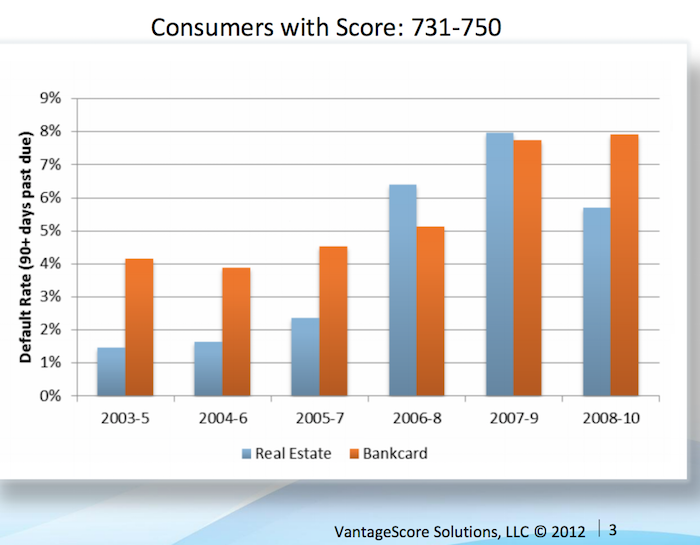
    chart of Default rate by credit score (731-750) from 2003 to 2010
    via online Vantage Score presentation

    Vantage Score decided to make their score range go up to 1000, not the standard 850. Maybe a 750 score for them is comparable to 680? They say super-prime is 900+ (750-850 on more common scale), prime is 701-900 (680-739), near-prime 641-700 (620-679), subprime 501-640 (550-619). Anyway that chart shows the changing default rates from 2003 to 2010 by type of loan.

    This Federal Reserve report on meeting between Federal Reserve Board staff and Fair Isaac Corporation (FICO) 20 June 2013 has some interesting material.

    For guidance, the following table generally matches a borrower’s odds-of-default with the corresponding FICO 8 score (calculated on performance from Oct 2008 – Oct 2010). Of course, the range of scores and odds-of-default [the data is related to mortgages] will vary with each model as creditors develop and validate their own credit scoring models.

    Odds-of Default
       
    FICO 8 Score
       
    percent of population**
    5:1 610 9%
    10:1 645 9%
    20:1 685 6%
    30:1 705 6%
    40:1 720 6%
    50:1 735 9%
    100:1 770 30%

    As you can see at a 610 level, 20 loans out of 100 defaulted. At 685 just 5 in 100 defaulted and at 770 just 1 in 100 did.

    ** I had to adjust this, because the report didn’t report it in this form, so it a very approximate measure (I made estimates for something like scores from 735 to 769 etc.). Again this is data from the Oct 2008 – Oct 2010 period. The rest of the population (about 25%) would have scores below 610.

    Related: The Impact of Credit Scores and Jumbo Size on Mortgage Rates (2009)Your FICO credit score explained$2,540,000,000,000 in USA Consumer Debt

    This page references a Fed report (that I can’t find) that found the following default rates on new loans for the two years after origination, 2000-2002:

    Credit score range Default rate*
    under 520 41%
    520-559 28%
    560-599 23%
    600-639 16%
    640-679 9%
    680-719 4.4%
    over 720 <1%

    ***

    The Consumer Financial Health Study respondents were asked to self-assess their credit quality and for permission to pull their actual credit scores.8 Forty-five percent of survey participants granted permission, yielding an “opt-in” sample size of 3,215. We appended two objective measures of creditworthiness to the dataset: Experian provided VantageScore 3.0 credit scores, and LexisNexis Risk Solutions provided RiskView scores. VantageScore is a generic credit scoring model that was created by the three major credit bureaus (Equifax, Experian and TransUnion) and, in addition to tradeline data, includes rent, utility and cell phone payment data when it is available in consumer credit files.

  • Beijing Real Estate Is Worth As Much as Tokyo Real Estate Was in 1990

    This is a startling piece of data, from The nagging fear that QE itself may be causing deflation:

    China’s top developer – says total land value in Beijing has been bid up to such extremes that is on paper worth 61.6pc of America’s GDP. The figure was 63.3pc for Tokyo at the peak of the bubble in 1990. “A dangerous level”

    The situations have many differences, for example, China is a poor country growing rapidly, Japan was a rich country growing little (though in 1990 it showed more growth promise than today). Still this one of the more interesting pieces of data on how much a bubble China real estate has today. Japan suffered more than 2 decades of stagnation and one factor was the problems created by the real estate price bubble.

    The global economic consequences of the extremely risky actions taken to bail out the failed too-big-too-fail banks including the massive quantitative easing are beyond anyones ability to really understand. We hope they won’t end badly that is all it amounts to. Noone can know how risky the actions to bail out the bankers is. The fact we not only bailed them out, but showered many billions of profit onto them (even after taking billions in fines for the numerous and continuing violations of law by those bailed out bankers), leaves me very worried.

    It seems to me we have put enormous risk on and the main beneficiaries of the policies are the bankers that caused the mess and continue to violate laws without any consequences (other than taking a bit of the profit them make on illegal moves back sometimes).

    The theme refuses to go away. India’s central bank chief, Raghuram Rajan, says QE is a beggar-thy-neighbour devaluation policy in thin disguise. The West’s QE caused a flood of hot capital into emerging markets hunting for yield, stoking destructive booms that these countries could not easily control. The result was an interest rate regime that was too lax for the world as a whole, leaving even more economies in a mess than before as they too have to cope with post-bubble hangovers.

    The West ignored pleas for restraint at the time, then left these countries to fend for themselves. The lesson they have drawn is to tighten policy, hoard demand, hold down their currencies and keep building up foreign reserves as a safety buffer. The net effect is to perpetuate the “global savings glut” that has starved the world of demand, and that some say is the underlying of the cause of the long slump.

    I hope things work out. But I fear the extremely risky behavior by the central banks and politicians could end more badly than we can even imagine.

    Related: Continuing to Nurture the Too-Big-To-Fail Eco-systemThe Risks of Too Big to Fail Financial Institutions Have Only Gotten WorseUSA Congress Further Aids The Bankers Giving Those Politicians Piles of Cash and Risks Economic Calamity AgainInvestment Options Are Much Less Comforting Than Normal These Days

  • Delaying the Start of Social Security Payments Can Pay Off

    Delaying when you start collecting Social Security benefits in the USA can enhance your personal financial situation. You may start collecting benefits at 62, but each year you delay collecting increases your payment by 5% to 8% (see below). If you retire before your “normal social security retirement age” (see below) your payments are reduced from the calculated monthly payment (which is based on your earnings and the number of years you paid into the social security fund). If you delay past that age you get a 8% bonus added to your monthly payment for each year you delay.

    The correct decision depends on your personal financial situation and your life expectancy. The social security payment increases are based on life expectancy for the entire population but if your life expectancy is significantly different that can change what option makes sense for you. If you live a short time you won’t make up for missing payments (the time while you delayed taking payments) with the increased monthly payment amount.

    The “normal social security retirement age” is set in law and depends on when you were born. If you were born prior to 1938 it is 65 and if you are born after 1959 it is 67 (in between those dates it slowly increases. Those born in 1959 will reach the normal social security retirement age of 67 in 2026.

    The social security retirement age has fallen far behind demographic trends – which is why social security deductions are so large today (it used to be social security payments for the vast majority of people did not last long at all – they died fairly quickly, that is no longer the case). The way to cope with this is either delay the retirement ago or increase the deductions. The USA has primarily increased the deductions, with a tiny adjustment of the retirement age (increasing it only 2 years over several decades). We would be better off if they moved back the normal retirement age at least another 3 to 5 years (for the payment portion – given the broken health care system in the USA retaining medicare ages as they are is wise).

    In the case of early retirement, a benefit is reduced 5/9 of one percent for each month (6.7% annually) before normal retirement age, up to 36 months. If the number of months exceeds 36, then the benefit is further reduced 5/12 of one percent per month (5% annually).

    For delaying your payments after you have reached normal social security retirement age increases payments by 8% annually (there were lower amounts earlier but for people deciding today that is the figure to use).

    Lets take a quick look at a simple example:
    (more…)

  • A Risk You Probably Don’t Consider: Solar Storms

    The extremely large investment risks due to global climate change are in the minds of sensible investors. One risk people often fail to consider is the damage that can be done to our electronics and our electrical system (large scale distribution) by solar storms.

    When space weather attacks!

    Today, electric utilities and the insurance industry are grappling with a scary possibility. A solar storm on the scale of that in 1859 would wreak havoc on power grids, pipelines and satellites. In the worst case, it could leave 20 million to 40 million people in the Northeast [USA] without power — possibly for years — as utilities struggled to replace thousands of fried transformers stretching from Washington to Boston. Chaos and riots might ensue.

    That’s not a lurid sci-fi fantasy. It’s a sober new assessment by Lloyd’s of London, the world’s oldest insurance market. The report notes that even a much smaller solar-induced geomagnetic storm in 1989 left 6 million people in Quebec without power for nine hours.

    “We’re much more dependent on electricity now than we were in 1859,” explains Neil Smith, an emerging-risks researcher at Lloyd’s and co-author of the report. “The same event today could have a huge financial impact” — which the insurer pegs at up to $2.6 trillion for an especially severe storm. (To put that in context, Hurricane Sandy caused about $68 billion in damage.)

    A truly severe geomagnetic storm could create currents powerful enough to overload electric grids and damage a significant number of high-voltage transformers, which can take a long time to repair or replace. That could leave millions without power for months or years.

    there are technologies that could harden the grid, such as capacitors that can help block the flow of ground currents induced by a geomagnetic event. In Quebec, the Canadian government has spent about $1.2 billion on these technologies since the 1989 blackout.

    Likely in the event of extremely large solar storms that knock out a significant number of large transformers would provide business to companies that manufacture replacements and companies that offer protection (once insurers raise insurance rates for unprotected equipment the economics will quickly justify the expenses).

    I am still looking for investment ideas that stand to benefit from global climate change. We seem pretty determined not to take actions to reduce the risks so reducing the impacts seems unlikely. Mostly this will cause great damage to our standards of living (and even endangering many lives). But even so I image there will be some investments that should benefit.

    Even if say global climate changes reduce global economic well being by 10% I don’t think it will be 10% evenly distributed. Some places/businesses.. will go down 20%, some 12% some 3% and I would think there is also the chance some will actually increase. But I have not been successful in thinking of investments that will benefit due to global climate change (and our refusal to take sensible steps to reduce the damage). If you have ideas add a comment.

    I wish we would take significant action to reduce the damage global climate change will cause. But since we are not, and the damage will be huge, reducing what I can expect from average investment returns, seeking investments to help balance those losses is a wise step to take.

    Related: Investment Risk Matters Most as Part of a Portfolio, Rather than in IsolationDisability Insurance is Very ImportantUnless We Take Decisive Action, Climate Change Will Ravage Our PlanetSolar Cycle PredictionDon’t Expect to Spend Over 4% of Your Retirement Investment Assets Annually

  • Long Term Care Insurance – Financially Wise but Current Options are Less Than Ideal

    The expenses for long term care is exactly the type of financial risk insurance is best for. The problem is the whole area is so uncertain that what you buy may not provide the coverage you planned on (the health care system is so broken that it is not certain insurance will cover the costs, companies can go bankrupt, change coverage rules drastically…).

    The questions about long term care insurance are not about the sensibility of the coverage abstractly, it is very wise. But the complexities, today, in the real world make the question of buying more a guess about what coverage you will actually receive if you need it.

    Many of my posts here are focused on the USA but applicable elsewhere, or just applicable wherever you are. This post is mainly focused on the USA, long term care insurance options in other locations will be very different and have different considerations (in many countries it may not even apply, mainly due to a less broken health care system than the USA has).

    Long-Term-Care Insurance: Who Needs It? by Marilyn Geewax

    “the reality is that each year, an estimated 11 million U.S. adults need some type of long-term care.

    Such care can be crushingly expensive: Just one hour of home-health-aide care costs roughly $20, while the average private nursing home room costs $87,000 a year. Neither routine employer-based medical insurance nor Medicare will pay for extended periods of custodial care.”

    Also, some people pay their premiums for years, and then get hit with rate hikes they can’t afford.

    Insurance has a transaction cost. Paying that transaction cost for expenses you can afford is just waste. You should pay the cost directly. This is why higher deductibles are most often wise. It doesn’t make sense to cover pay insurance costs every year to pay for a $500 risk you can afford to absorb yourself.

    But huge expenses are exactly what you want coverage for. Long term care expenses are huge. However, long term care insurance is still in flux, which isn’t good for something you want to provide long term protection. A huge risk is paying premiums for years, and then getting hit with rate hikes that may well be designed primarily just to get people to drop coverage (or be so expensive that those that stay pay enough that the insurance company makes money).

    Ideally such insurance would be set so maybe the cost rose at some preset limit when you signed up. The problem is the USA health care system is so broken this won’t work. No one can predict how much more excessively expensive long term coverage will be in 30 years so the insurance companies can’t predict. It leaves consumers in a risky place.

    Insurance is regulated by the states. There are huge differences in which states do a good job regulating long term care insurance and those that don’t. The majority don’t.

    This is one of the more important areas of personal finance. Unfortunately there is no easy answer. If the system were stable, reliable and predictable, long term care insurance would be a definite requirement for a sound financial plan. Today it is wise to insure yourself from those risks, the problem is determining whether any of the options available are worth it. The risk of needing this insurance is high: it is both likely and costly. So getting coverage is definitely wise if you can find some you think is reliable over the long term. Because of the uncertain nature of the options, this will require much more effort on your part than many personal finance actions (I included several links below to help your research).

    Also look at how long the coverage is for. This is another limitation insurance companies have put in place that makes it much less worthwhile.

    Related: Personal Finance Basics: Long-term Care InsuranceNational Clearinghouse for Long-Term Care InformationAARP adviceDisability Insurance is Very ImportantHow to Protect Your Financial Health

  • Disability Insurance is Very Important

    I believe long term disability insurance is a must for a safe personal financial plan. The risk of not being covered isn’t worth it. An office worker should have a very low risk of something happening that qualifies you for receiving benefits (even with fairly serious injuries for a hunter-gatherer or farmer they can earn a living).

    That is actually the perfect situation for insurance. Insurance should be cheap when the risk is small. You want insurance for unlikely but very costly events. You don’t want insurance for likely and inexpensive events (paying the middle man just adds to the cost).

    I believe, other than health insurance it is the most important insurance. For someone with dependents life insurance can be important too. And auto and homeowners insurance are also important. Insurance if an important part of a smart personal finance. It is wise to chose high deductibles (to reduce cost).

    In many things I believe you can chose what you want to do and just deal with the results. Forgoing health or disability insurance I think don’t fall into that category. Just always have those coverages. I think doing without is just a bad idea.

    When I would have had gaps in coverage from work, I have purchased disability insurance myself.

    I am all in favor of saving money. About the only 2 things I don’t believe in saving money being very important are health and disability insurance. Get high deductible insurance in general (you should insure against small loses). And with disability insurance you can reduce the cost by having the insurance only start after 6 or 12 months (I chose 12). As you get close to retirement (say 5 years) the risk is much less, you only have so many earning years left. If you wanted to save some money at that point it might be ok if you have saved well for retirement and have a cushion (in case you have to retire 3 year early). Long term care insurance may well be wise to get (if you didn’t when it was cheaper and you were younger. Long term care insurance is really tricky and very tied to whatever our politicians decide not to do (or do) about the broken health care system we have in the USA. The cost also becomes higher as it is moving toward a likely event, instead of a unlikely event (as you age you are more frail).

    Related: How to Protect Your Financial HealthPersonal Finance Basics: Avoid Debt

  • Charlie Munger’s Thoughts on the Credit Crisis and Risk

    Charlie Munger’s Thoughts on Just About Everything by Morgan Housel

    The academic elites failed us with their utterly asinine ideas of risk control. It was grounded on the idea that all risk took Gaussian distributions, which is just totally wrong. Very high IQ people can be completely useless. And many of them are.

    Benjamin Graham used to say, “It’s not the bad investment ideas that fail; it’s the good ideas that get pushed into excess.” And that’s a lot of what happened here.

    Some economic distortions come from the masses believing that other people are right. Others come from the need to make a living through behavior that may be less than socially desirable. I’ve always been skeptical of conventional wisdom. You have to be able to keep your head on when everyone else is losing theirs.

    Take soccer as an example. It’s a tremendously competitive sport, and often times one team tries to work mayhem on the other team’s best player. The referee’s job is to limit this mayhem and rein in extreme forms of competition.

    Regulation is similar. Most ambitious young men will be more aggressive than they should. That’s what happened with investment banking. I mean, look at Lehman Brothers. Everyone did what they damn well wanted until the whole place was pathological about its extremeness.

    A lot of this [financial collapse] can be blamed on accountants. Accountants as a whole have been trained with too much math and not enough horse sense. If some of these insane accounting practices were never allowed, huge messes could have been avoided. Bankers have become quite good at manipulating accountants

    Learning has never been work for me. It’s play. I was born innately curious. If that doesn’t work for you, figure out your own damn system.

    More good thoughts from Warren Buffett’s partner at Berkshire Hathaway.

    Related: Buffett and Munger’s 2009 Q&A With ShareholdersBerkshire Hathaway Annual Meeting 2008Misuse of Statistics, Mania in Financial MarketsLeverage, Complex Deals and Mania

  • The Formula That Killed Wall Street

    The Formula That Killed Wall Street

    For five years, Li’s formula, known as a Gaussian copula function, looked like an unambiguously positive breakthrough, a piece of financial technology that allowed hugely complex risks to be modeled with more ease and accuracy than ever before. With his brilliant spark of mathematical legerdemain, Li made it possible for traders to sell vast quantities of new securities, expanding financial markets to unimaginable levels.

    His method was adopted by everybody from bond investors and Wall Street banks to ratings agencies and regulators. And it became so deeply entrenched—and was making people so much money—that warnings about its limitations were largely ignored.

    Then the model fell apart. Cracks started appearing early on, when financial markets began behaving in ways that users of Li’s formula hadn’t expected. The cracks became full-fledged canyons in 2008—when ruptures in the financial system’s foundation swallowed up trillions of dollars and put the survival of the global banking system in serious peril.

    Very nice article on the dangers of financial markets to those that believe that math can provide all the answers. Math can help find opportunities. However markets have physical, psychological and regulatory limitations. And markets frequently experience huge panics or manias. People continue to fail to model that properly.

    Related: All Models Are Wrong But Some Are UsefulLeverage, Complex Deals and ManiaFinancial Markets with Robert ShillerFinancial Market MeltdownFailure to Regulate Financial Markets Leads to Predictable Consequences