Tag: UK

  • Stock Market Capitalization by Country from 2000 to 2016

    The total stock market capitalization by country gives some insight but it is also data that is a bit muddy. The data doesn’t tell you how the economies of the countries are doing as there is quite a bit of room for misinterpreting the data.

    Apple, Alphabet, Intel, 3M, Abbvie… all are included in the USA market capitalization but much of their sales, earnings and employment are overseas. And USA companies have done very well in global markets so the USA totals are not just an indication how the USA has performed but includes great gains made by profiting from global growth. Also you may be surprised to learn that 26% of USA equities are owned by investors outside the USA.
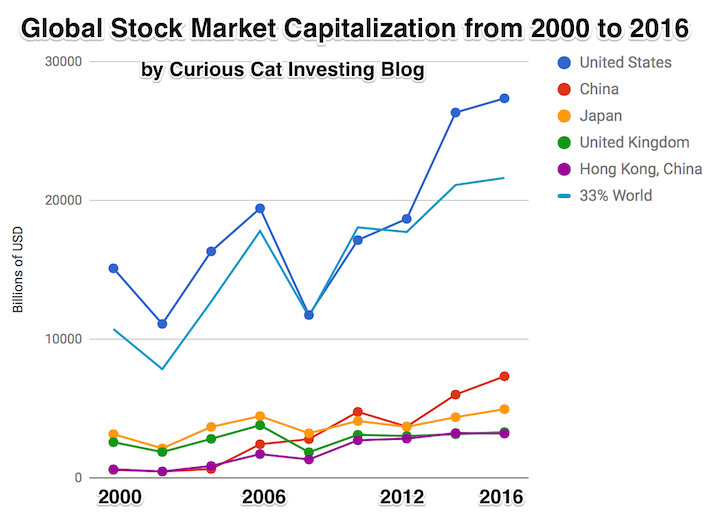
    chart of top 5 counties by stock market capitalization (2000 to 2016)
    The chart shows the top countries based on stock market capitalization, with data from 2000 to 2016. The chart was created by Curious Cat Investing and Economics Blog may be used with attribution. Data from the World Bank.

    It is important to keep in mind the data is shown in current USA dollars, so large swings in exchange rates can have a large impact.

    China’s performance has been remarkable. China also shows some of the challenges in collecting this data. I am fairly certain Alibaba (BABA), one of the 10 most valuable companies in the world and a Chinese company has the stock issued in the USA (even this is confusing as it is a complex arrangement but the only publicly traded stock is traded in the USA). And many other Chinese companies are traded this way and therefore are not included in the Chinese total value. In addition Hong Kong is part of China but also separate. The data is reported separately by the world bank and I include them that way in the charts.

    As with so much recent economic data China’s performance here is remarkable. China grew from 1.8% of world capitalization in 2000 to 6.9% in 2012 and 11.2% in 2016. Adding Hong Kong to China’s totals shows 3.7% in 2000 with growth to to 12.2% in 2012 and 16.2% in 2016. If you look at my post global stock market capitalization from 2000 to 2012 you will see significantly different historical data for Hong Kong. Collecting this data is much more complex than people realize and data determinations can change over the years resulting in changes in historical data.

    The chart shows the 1/3 of the total global market capitalization in order to have the chart display look better (and it also makes it easier to compare the USA performance to the total global performance). The USA market capitalization was at 46.9% of the global market cap in 2000 and fell to 31.6% in 2000 before rising to 42% in 2016. This shows that the USA has largely held its own globally as measured by market cap. This may not seem impressive but when you consider that China has grown from 3.7% to 16.2% you can see that for the market cap outside of China the USA has actually gained quite a bit of ground. This is the result of what I mentioned before – how well USA companies have done at capture global markets (especially in high technology areas with very high profits and therefore very high market caps).

    (more…)

  • Global Stock Market Capitalization from 2000 to 2012

    Looking at stock market capitalization by country gives some insight into how countries, and stocks, are doing. Looking at the total market capitalization by country doesn’t equate to the stock holdings by individuals in a country or the value of companies doing work in a specific country. Some countries (UK and Hong Kong, for example) have more capitalization based there than would be indicated by the size of their economy.

    It is important to keep in mind the data is in current USA dollars, so big swings in exchange rates can have a big impact (and can cause swings to be exacerbated when they move in tandem with stock market movements – if for example the market declines by 15% and the currency declines by 10% against the US dollar those factors combine to move the result down).

    Chart of stock market capitalization from 2000 to 2012 for USA, China, Japan, UK and world
    The chart shows the top four countries based on stock market capitalization, with data from 200 to 2012. The chart created by Curious Cat Investing and Economics Blog may be used with attribution. Data from the World Bank.

    As with so much recent economic data China’s performance here is remarkable. China grew from 1.8% of world capitalization in 2000 to 6.9% in 2012. And Hong Kong’s data is reported separately, as it normally is with global data sets. Adding Hong Kong to China’s totals would give 3.7% in 2000 with growth to to 8.9% in 2012 (Hong Kong stayed very stable – 1.9% in 2000, 2% in 2012). China alone (without HK) is very slightly ahead of Japan.

    The first chart shows the largest 4 market capitalizations (2012: USA $18.6 trillion, China and Japan at $3.7 trillion and UK at $3 trillion). Obviously the dominance of the USA in this metric is quite impressive the next 7 countries added together don’t quite reach the USA’s stock market capitalization. I also including the data showing the global stock market capitalization divided by 3 (I just divide it by three to have the chart be more usable – it lets us see the overall global fluctuations but doesn’t cram all the other data in the lower third of the chart).

    Canada is the 5th country by market capitalization (shown on the next chart) with $2 trillion. From 2000 to 2012 China’s market capitalization increased by $3.1 trillion. The USA increased by $3.6 trillion from a much larger starting point. China increased by 536% while the USA was up 23.5%. The world stock market capitalization increased 65% from 2000 to 2012.

    Related: Stock Market Capitalization by Country from 1990 to 2010Government Debt as Percent of GDP 1998-2010Manufacturing Output by Country 1999-2011: China, USA, Japan, Germany

    (more…)

  • Top Nations for Retirement Security of Their Citizens

    Across the globe, saving for retirement is a challenge. Longer lives and expensive health care create challenge to our natures (saving for far away needs is not easy for most of us to do – we are like the grasshopper not the ants, we play in the summer instead of saving). This varies across the globe, in Japan and China they save far more than in the USA for example.

    The United States of America ranks 19th worldwide in the retirement security of its citizens, according to a new Natixis Global Retirement Index. The findings suggest that Americans will need to pick up a bigger share of their retirement costs – especially as the number of retirees grows and the government’s ability to
    support them fades. The gauges how well retired citizens live in 150 nations, based on measures of health, material well-being, finances and other factors.

    Top Countries for Retirees

    • 1 – Norway
    • 2 – Switzerland
    • 3 – Luxembourg
    • 6 – Finland
    • 9 – Germany
    • 10 – France
    • 11 – Australia
    • 13 – Canada
    • 15 – Japan
    • 19 – USA
    • 20 – United Kingdom

    Western European nations – backed by robust health care and retiree social programs – dominate the top of the rankings, taking the first 10 spots, including Sweden, Austria, Netherlands and Denmark. The USA finished ahead of the United Kingdom, but trailed the Czech Republic and Slovakia.

    Globally, the number of people aged 65 or older is on track to triple by 2050. By that time, the ratio of the working-age population to those over 65 in the USA is expected to drop from 5-to-1 to 2.8-to-1. The USA actually does much better demographically (not aging as quickly) as other rich countries mainly due to immigration. Slowing immigration going forward would make this problem worse (and does now for countries like Japan that have very restrictive immigration policies).

    The economic downturn has taken a major toll on retirement savings. According to a recent report by the U.S. Senate Committee on Health, Education, Labor and Pensions, the country is facing a retirement savings deficit of $6.6 trillion, or nearly $57,000 per household. As a result, 53% of American workers 30 and older are on a path that will leave them unprepared for retirement, up significantly from 38% in 2011.

    On another blog I recently wrote about another study looking at the Best Countries to Retirement Too: Ecuador, Panama, Malaysia. The study in the case was looking not at the overall state of retirees that worked in the country (as the study discussed in this post did) but instead where expat retirees find good options (which stretch limited retirement savings along with other benefits to retirees).

    See the full press release.

    Related: Top Stock Market Capitalization by Country from 1990 to 2010Easiest Countries in Which to Operate a Businesses: Singapore, Hong Kong, New Zealand, USALargest Nuclear Power Generation Countries from 1985-2010Leading countries for Economic Freedom: Hong Kong, Singapore, New Zealand, SwitzerlandCountries with the Top Manufacturing Production

  • Easiest Countries in Which to Operate a Businesses (2011)

    Singapore is again ranked first for Ease of Doing Business by the World Bank.

    Country 2011 2008 2005
    Singapore 1 1 2
    Hong Kong 2 4 6
    New Zealand 3 2 1
    United States 4 3 3
    Denmark 5 5 7
    other countries of interest
    United Kingdom 7 6 5
    Korea 8 23 23
    Canada 13 8 4
    Malaysia 18
    Germany 19 25 21
    Japan 20 12 12
    France 29 31 47
    Mexico 53 56 62
    Ghana 63
    China 91 83 108
    India 132 122 138
    Brazil 126 122 122

    The rankings include ranking of various aspects of running a business. Some rankings for 2011: starting a business (New Zealand 1st, Singapore 4th, USA 13th, Japan 107th), Dealing with Construction Permits (Hong Kong 1st, New Zealand 2nd, Singapore 3rd, USA 17th, China 179th), protecting investors (New Zealand 1st, Singapore 2nd, Hong Kong 3rd, Malaysia 4th, USA 5th), enforcing contracts (Luxemburg 1, Korea 2, Iceland 3, Hong Kong 5, USA 7, Singapore 12, China 16, India 182), paying taxes (Maldives 1, Hong Kong 3, Singapore 4, USA 72, Japan 120, China 122, India 147).

    These rankings are not the final word on exactly where each country truly ranks but they do provide a valuable source of information. With this type of data there is plenty of room for judgment and issues with the data.

    Related: Easiest Countries from Which to Operate Businesses 2008Stock Market Capitalization by Country from 1990 to 2010Looking at GDP Growth Per Capita for Selected Countries from 1970 to 2010Top Manufacturing Countries (2000 to 2010)Country Rank for Scientific PublicationsInternational Health Care System PerformanceBest Research University Rankings (2008)

  • Manufacturing Employment Data: USA, Japan, Germany, UK… 1990-2009

    I try to find global economic data on manufacturing and manufacturing jobs, but it isn’t easy. This is one of the areas I will be working on with the time I have freed up by moving to Malaysia (and taking a “sabbatical” [it isn’t really a sabbatical, I guess, just me studying and working on what I want to instead of what someone pays me to]).

    I found some interesting data from the USA census bureau on manufacturing employment in several countries (it would be interesting to see the data for more countries but for now I am limited to this data). Sadly they just use indexed data (I would rather see raw data). This data for example lets you see the changes in countries but I don’t see any way to compare the absolute values between countries – all you can compare is the changes between countries.

    The data is all indexed at 2002 = 100. Interestingly the USA has increased output per hour much more than any other country since 2002. The USA index stands at 146, the next highest is Sweden at 127 then the UK at 120. Italy is the only country tracked that fell since 2002, to 94. Japan (the 3rd largest manufacturer and 2nd largest of the countries include, China isn’t included) only increased to 113. Germany (4th and 3rd) increased to 111.

    The data also lets you look back from 1990 to 2002 and again the USA has increased productivity very well (2nd most) – the value in 1990 was 58. Sweden actually had the largest gain from 1990-2002, rising from 49. In 1990 Japan stood at 71 and Germany 70.

    (more…)

  • Manufacturing Output as a Percent of GDP by Country

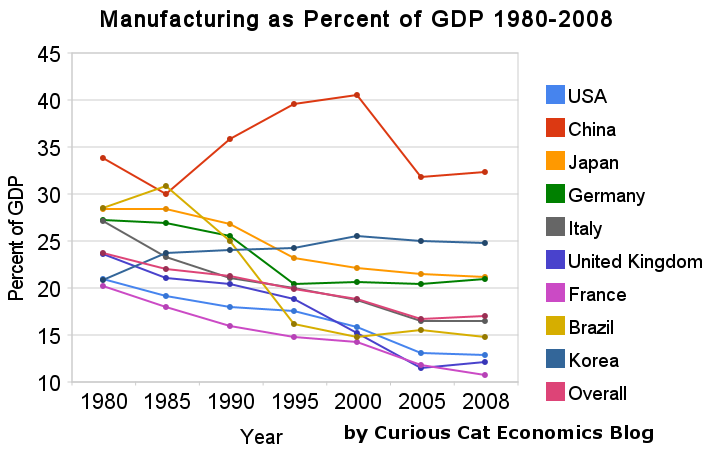
    In previous posts I have shown data for global manufacturing output by country. One of the things those posts have showed is that manufacturing output in China is growing tremendously, but it is also growing in the United States. The chart below shows manufacturing production by country as a percent of GDP. China dominates again, with over 30% of the GDP from manufacturing.

    chart of manufacturing output as percent of gdp by country 1980-2008

    Chart showing manufacturing output, as percent of GDP, by country was created by the Curious Cat Economics Blog based on UN data* (based on current USA dollars). You may use the chart with attribution.

    For the 14 biggest manufacturing countries in 2008, the overall manufacturing GDP percentage was 23.7% of GDP in 1980 and dropped to 17% in 2008. I left India (15% in 1980, 15% in 2008), Mexico (20%, 18%), Canada (17%, 13%), Spain (25%, 14%) and Russia (21% in 1990 [it was part of USSR in 1980], 15%) off the chart.

    Over the last few decades Korea, and to some extent China, are the only countries that have increased the percent of GDP from manufacturing. China has not only grown manufacturing activity tremendously but also other areas of the economy (construction, mining, information technology). The countries with the largest manufacturing portions of their economies in 2008 were: China 32%, South Korea 25%, Japan and Germany at 21%. The next highest is Mexico at 18% which declined slightly over the last 15 years (with NAFTA in place). Globally, while manufacturing has grown, other areas of economic activity have been growing faster than manufacturing.

    The manufacturing share of the USA economy dropped from 21% in 1980 to 18% in 1990, 16% in 2000 and 13% in 2008. Still as previous posts show the USA manufacturing output has grown substantially: over 300% since 1980, and 175% since 1990. The proportion of manufacturing output by the USA (for the top 14 manufacturers) has declined from 31% in 1980, 28% in 1990, 32% in 2000 to 24% in 2008. The proportion of USA manufacturing has declined from 33% in 1980, 29% in 1990, 36% in 2000 to 30% in 2008. While manufacturing output has grown in the USA it has done so more slowly than the economy overall.

    Related: The Relative Economic Position of the USA is Likely to DeclineManufacturing Data, Accuracy QuestionsTop 12 Manufacturing Countries in 2007Manufacturing Employment Data: 1979 to 2007USA Manufacturing Output Continues to Increase (over the long term)

    * I made edits to the 1980 Brazil manufacturing data and 1980, 1985 and 2008 China manufacturing data because the UN data only showed manufacturing data combined with mining and utility data. And I am using older UN data that had manufacturing separated from mining and utility figures for China in the other years.

  • Private Foreign Banking Deposits by Country

    According to a new report on Privately Held, Non-Resident Deposits in Secrecy Jurisdictions the United States is the country with the largest amount of private, non-resident, deposits. Cayman Islands takes second, upholding its commonly held reputation as a tax haven often used to avoid paying taxes own by wealthy people. Switzerland comes in 9th.

    The countries with the most private, foreign deposits in billion of $US.

    Country June 2008 June 2009
    1 United States $2,899 $2,183
    2 Cayman Islands $1,515 $1,550
    3 United Kingdom $1,796 $1,534
    4 Luxembourg 588 435
    5 Germany 494 426
    6 Jersey 544 393
    7 Netherlands 413 316
    8 Ireland 273 276
    9 Switzerland 289 274
    10 Hong Kong 325 268

    Since 2001 deposits in the Cayman Islands have more than tripled, while those in the UK have close to tripled and in the USA they have a bit more than doubled.

    • Total Current total deposits by non-residents in offshore centers and secrecy jurisdictions are just under US$10 trillion;
    • The United States, the United Kingdom, and the Cayman Islands top the list of jurisdictions, with the United States out in front with more than US$2 trillion in non-resident, privately held deposits in the most recent quarter for which data are available (June 2009);
    • Contrary to expectations of perceived favorability for deposits, Asia accounts for only 6 percent of worldwide offshore deposits, although Hong Kong is the tenth most popular secrecy jurisdiction by deposits in this report;
    • The rate of growth of offshore deposits in secrecy jurisdictions has expanded at an average of 9 percent per annum since the early 1990s, significantly outpacing the rise of world wealth in the last decade. The gap between these two growth rates may be attributed to increases in illicit financial flows from developing countries and tax evasion by residents of developed countries.

    The report is an interesting read and provides some background on the banking practices often used in concert with wealthy people avoiding paying taxes. As you may we recall we noted that rich USA tax evaders tried to sue to hide their illegal activities from the Department of Justice. As far as I know those rich thieves have not been put in jail. I guess stealing tens and hundreds of thousands of dollars from the United States of America, by rich people, is not seen as important (either that or brides work to make sure the way rich people steal isn’t punished) say compared to some teenager stealing from a store.

    Related: Government Debt Globally as Percentage of GDP 1990-2008USA, China and Japan Lead Manufacturing Output in 2008Oil Consumption by Country in 2007

    (more…)