Tag: yield

  • Taking a Look at Some Dividend Aristocrats

    See the full list of Dividend Aristocrats below. The stocks in this index are companies within the S&P 500 that have increased dividends every year for at least 25 consecutive years. After 10 were added and 1 removed, this month, there are now 51 companies included (so just over 10% of all S&P 500 stocks) – and remember many S&P 500 stocks haven’t existed for 25 years, or pay no dividend today, or didn’t 10 or 20 years ago (Google, Apple, Intel, …). It is surprising so many companies have successfully done this.

    I’ll take a look at a few of them here (I looked at the new additions in my previous post: Investing in stocks that have raised dividends consistently).

    Stock Yield
       
    div/share 2011 div/share 2000 % increase
    3M (MMM) 2.8% $2.20 $1.16 90%
    Aflac (AFL) 3.2% $1.23 $0.165 645%
    Abbott Laboratories (ABT) 3.5% $1.92 $0.74 159%
    Cincinnati Financial (CINF) 5.3% $1.60 $0.69 132%
    Coca-Cola Co (KO) 2.8% $1.88 $0.68 176%
    Exxon Mobil Corp (XOM) 2.4% $1.85 $0.88 110%
    Johnson & Johnson (JNJ) 3.6% $2.25 $0.62 263%
    Kimberly-Clark (KMB) 3.9% $2.80 $1.08 159%
    Medtronic (MDT) 2.8% $0.94 $0.18 417%
    Procter & Gamble (PG) 3.2% $2.06 $.67 207%

    Just looking at this data Aflac sure looks appealing. Having both a high yield and strong growth is an appealing combination. And Warren Buffet agree (he owns quite a bit) which is also reassuring (he also owns a large stake in Coke). Of course strong growth over the last 11 years won’t necessarily repeat (in fact it gets much harder). On the other had some slow growth companies would likely continue slow growth (at best): Exxon Mobil, 3M…

    Really almost all of these stocks are pretty attractive. Medtronic, Johnson & Johnson and Abbot Laboratories look particularly appealing to me (along with Aflac and Kimberly-Clark). I would have to do more research on any of these (other than Abbot Laboratories, which I already own) before deciding to buy, but they sure look good as safe long term investments. Health care is a growing need (in the USA and globally). It is true the costs in the USA have to be reduced, and this could make things more difficult for companies in the health care industry.

    Related: Sleep well investing portfolioLooking for Dividend Stocks in the Current Extremely Low Interest Rate EnvironmentIs the Stock Market Efficient?

    Full list of Dividend Aristocrats, an index measures the performance of large cap, blue chip companies within the S&P 500 that have followed a policy of increasing dividends every year for at least 25 consecutive years.
    (more…)

  • Investing in Stocks That Have Raised Dividends Consistently

    The Dividend Aristocrats index measures the performance of S&P 500 companies “that have followed a policy of increasing dividends every year for at least 25 consecutive years.” S&P makes additions and deletions from the index annually. This year 10 companies were added and 1 was deleted.

    Stock Yield
       
    div/share 2011 div/share 2000 % increase
    AT&T (T) 6% $1.72 $1.006 72%
    HCP Inc (HCP) 4.9% $1.92 $1.47 31%
    Sysco (SYY) 3.7% $1.04 $0.24 333%
    Nucor (NUE) 3.7% $1.45 $0.15 867%
    Illinois Tool Works (ITW) 3.1% $1.40 $0.38 268%
    Genuine Parts (GPC) 3.1% $1.80 $1.10 64%
    Medtronic (MDT) 2.8% $0.936 $0.181 417%
    Colgate-Palmolive (CL) 2.6% $2.27 $0.632 259%
    T-Rowe Price (TROW) 2.9% $1.24 $0.27 359%
    Franklin Resources (BEN) 1.2% $1.00 $.0245 308%

    You can’t expect members of the Dividend Aristocrats to match the dividend increases shown here. As companies stay in this screen of companies the rate of growth often decreases as they mature. Also some have already increased the payout rate (so have had an increasing payout rate boost dividend increases) significantly.

    The chart also shows that a smaller current yield need not dissuade investing in a company even when your target is dividend yield, giving the large dividend increase in just 10 years. Nucor yielded just 1.5% in 2000 (at a price of $10). Ignoring reinvested dividends your current yield on that investment would be 14.5%. To make the math easy 10 shares in 2000 cost $100, and they paid $1.50 in dividends (%1.5). Dividends have now increase so those 10 shares are paying $14.50 in dividends (14.5%). Of course Nucor worked out very well; that type of return is not common. But the idea to consider is that the long term dividend yield is not only a matter of looking at the current yield.

    The period from 2000 to 2011 was hardly a strong one economically. Yet look at how many of these companies dramatically increased their dividend payouts. Even in tough economic times many companies do well.

    Related: Looking for Dividend Stocks in the Current Extremely Low Interest Rate EnvironmentWhere to Invest for Yield Today10 Stocks for Income Investors

  • Looking for Dividend Stocks in the Current Extremely Low Interest Rate Environment

    My preference is for a lower use of bonds than the normal portfolio balancing strategies use. I just find the risks greater than the benefits. This preference increases as yields decline. Given the historically low interest rates we have been experiencing the last few years (and low yields even for close to a decade) I really believe bonds are not a good investment. Now for someone approaching or in retirement I do think some bonds are probably wise to balance the portfolio (or CDs). But I would limit maturities/duration to 2 or 3 years. And really I would pursue high yielding stocks much more than normal.

    In general I like high yielding stocks for retirement portfolios. Many are very good long term investments overall and I prefer to put a portion of the portfolio others would place in bonds in high yielding stocks. Unfortunately 401(k) [and 403(b)] retirement accounts often don’t offer an option to do this. Luckily IRAs give you the options to invest as you chose and by placing your IRA in a brokerage account you can use this strategy. In a limited investing option retirement account [such as a 401(k)] look for short term bond funds, inflation protected bonds and real estate funds – but you have to evaluate if those funds are good – high expenses will destroy the reasons to invest in bond funds.

    There are actually quite a few attractive high yield stocks now. I would strive for a very large amount of diversity in high yield stocks that are meant to take a portion of the bonds place in a balanced portfolio. In the portion of the portfolio aimed at capital appreciation I think too much emphasis is placed on “risk” (more concentration is fine in my opinion – if you believe you have a good risk reward potential). But truthfully most people are better off being more diversified but those that really spend the time (it takes a lot of time and experience to invest well) can take on more risk.

    A huge advantage of dividends stocks is they often increase the dividend over time. And this is one of the keys to evaluate when selected these stock investments. So you can buy a stock that pays a 4% yield today and 5 years down the road you might be getting 5.5% yield (based on increased dividend payouts and your original purchase price). Look for a track record of increasing dividends historically. And the likelihood of continuing to do so (this is obviously the tricky part). One good value to look at is the dividend payout rate (dividend/earnings). A relatively low payout (for the industry – using an industry benchmark is helpful given the different requirement for investing in the business by industry) gives you protection against downturns (as does the past history of increasing payouts). It also provides the potential for outsized increases in the future.

    There are a number of stocks that look good in this category to me now. ONEOK Partners LP pays a dividend of 5.5% an extremely high rate. They historically have increased the dividend. They are a limited partnership which are a strange beast not quite a corporation and you really need to read up and understand the risks with such investments. ONEOK is involved in the transportation and storage of natural gas. I would limit the exposure of the portfolio to limited partnerships (master limited partnerships). They announced today that the are forecasting a 20% increase in 2012 earnings so the stock will likely go up (and the yield go down – it is up 3.4% in after hours trading).

    Another stock I like in this are is Abbott, a very diversified company in the health care field. This stock yields 3.8% and has good potential to grow. That along with a 3.8% yield (much higher than bond yields, is very attractive).

    My 12 stocks for 10 year portfolio holds a couple investments in this category: Intel, Pfizer and PetroChina. Intel yields 3.9% and has good growth prospects though it also has the risk of deteriorating margins. There margins have remains extremely high for a long time. Maybe it can continue but maybe not. Pfizer yeilds 4.6% today which is a very nice yield. At this time, I think I prefer Abbott but given the desire for more diversification in this portion of the portfolio both would be good holdings. Petro China yields 4% today.

    When invested in a retirement portfolio prior to retirement I would probably just set up automatic reinvesting of the dividends. Once in retirement as income is needed then you can start talking the dividends as cash, to provide income to pay living expenses. I would certainly suggest more than 10 stocks for this portion of a portfolio and an investor needs to to educate themselves evaluate the risks and value of their investments or hire someone who they trust to do so.

    Related: Retirement Savings Allocation for 2010S&P 500 Dividend Yield Tops Bond Yield: First Time Since 195810 Stocks for Income Investors

  • Bond Yields Stay Very Low, Treasury Yields Drop Even More

    chart showing corporate and government bond yields 2005-2010Chart showing corporate and government bond yields from 2005-2010 by Curious Cat Investing Economics Blog, Creative Commons Attribution, data from the Federal Reserve.
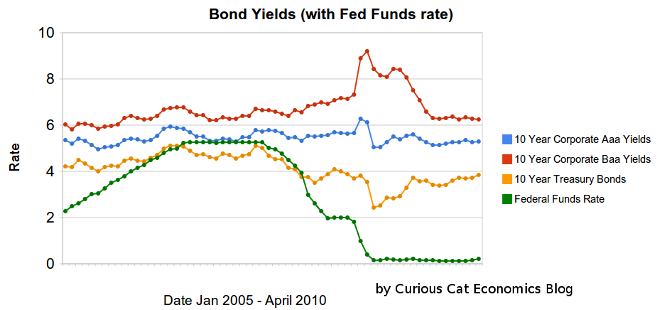
    Bond yields have dropped even lower over the last 6 months, dramatically so for treasury bonds. 10 year Aaa corporate bonds yields have decreased 61 basis points to 4.68%. 10 year Baa yields have decreased 53 basis points to 5.72%. 10 year USA treasury bonds have decreased an amazing 169 basis points to a incredibly low yield of %2.54. The federal funds rate remains under .25%.

    The Fed continues to try and discourage saving and encourage spending by punishing savers with policies to drive interest rates far below what the market alone would set. Partially this is a continuation of their subsidy to the large banks that caused the credit crisis. And partially it is an attempt to find a way to encourage spending to try and build job creation in the economy. The Fed announced they are taking huge steps to purchase $600 billion more bonds in an attempt to lower rates even further (much of the impact has been priced into the market as they have been saying they will take this action – but the size is larger than the consensus expectation). I do not think this is a sensible move.

    Savers do not have many good options for safely investing retirement assets for a reasonable income. The best options are probably to hold short term bonds and money markets and hope that the Fed finally stops making things so difficult for them. But that will take awhile. I think investing in medium or long term bonds (over 4 years) is crazy at these rates (especially government bonds – unless you are a large bank that can get essentially free money from the Fed to then loan the government and make a profit). Dividends stocks may be a good alternative for some more yield (but this needs to be done carefully to not take unwise risks). And I think you to look at investing overseas because these fiscal policies are just too damaging to savers to continue to just wait for a decent rate of return in bonds in the USA. But there are not many good options. TIPS, inflation protected bonds, are another option to consider (mainly as a less bad, of bad choices).

    It is a great time to take on debt however (as often is the case, there are benefits and costs to economic conditions). If you have a mortgage, and can qualify, or are looking to buy a home, mortgage rates are amazingly low.

    Related: Bond Rates Remain Low, Little Change in Last 6 Months (April 2010)Bond Yields Change Little Over Previous Months (December 2009)Chart Shows Wild Swings in Bond Yields in Late 2008Government Debt as Percentage of GDP 1990-2009 in USA, Japan, Germany, China…

  • Earnings and Dividends Grow, Bond Yields Sink

    Dividends Beating Bond Yields by Most in 15 Years

    More U.S. stocks are paying dividends that exceed bond yields than any time in at least 15 years as profits rise at the fastest pace in two decades.

    Kraft Foods Inc. and DuPont Co. are among 68 companies in the Standard & Poor’s 500 Index with payouts that top the 3.78 percent average rate in credit markets, based on data since 1995 compiled by Bloomberg and Bank of America Corp. While Johnson & Johnson sold 10-year debt at a record low interest rate of 2.95 percent last month, shares of the world’s largest health products maker pay 3.66 percent.

    The combination of record-low interest rates, potential profit growth of 36 percent this year and a slowing economy has forced investors into the relative value reversal. For John Carey of Pioneer Investment Management and Federated Investors Inc.’s Linda Duessel, whose firms oversee $566 billion, it means stocks are cheap after companies raised payouts by 6.8 percent in the second quarter

    S&P 500 companies’ cash probably has grown to a record for a seventh straight quarter, according to S&P. For companies that reported so far, balances increased to $824.8 billion in the period ended June 30 from the first three months of the year, based on data from the New York-based firm.

    Cash represents 10.2 percent of total assets at S&P 500 companies, excluding banks and financial firms, according to data compiled by Bloomberg. That’s higher than the 9.5 percent at the end of the second quarter last year, 8.4 percent in 2008 and 7.95 percent in 2007.

    “The economy is slowing down, but productivity has been so great in this country and companies have been able to make good profits,”

    10-year Treasury note yields were as low as 2.42% last month. The combination of continued extraordinarily low interest rates and good earnings increase this odd situation where dividends increase and interest yields fall. Extremely low yields aimed at by the Fed continue to aid banks and those that caused the credit crisis a huge deal and harm investors.

    Money markets and bonds are not attractive places to invest now. Putting money in those places is still necessary for diversification (and as a safety net – especially in cases like 401-k plans where options are often very limited). Seeking out solid companies with strong long term prospects that pay reasonable dividends is a very sensible strategy today.

    Related: Where to Invest for Yield TodayS&P 500 Dividend Yield Tops Bond Yield: First Time Since 195810 Stocks for Income InvestorsBond Yields Show Dramatic Increase in Investor Confidence (Aug 2009)

  • Bond Rates Remain Low, Little Change in Last 6 Months

    chart showing corporate and government bond yieldsChart showing corporate and government bond yields from 2005-2010 by Curious Cat Investing Economics Blog, Creative Commons Attribution, data from the Federal Reserve.

    Bond yields have remained low, with little change over the last 6 months. 10 year Aaa corporate bonds yields have increase 10 basis points to 5.29%. 10 year Baa yields have decreased 7 basis points to 6.25%. 10 year USA treasury bonds have increased 45 basis points (largely the effective of money scared into the safety of US treasuries leaving as the credit crisis eased. The federal funds rate remains under .25%.

    The United States economy appears to be gaining strength and if job growth can continue the Fed will likely reduce the amount giveaways to the banks by increasing the fed funds rate (though when this will happen is still very hard to judge). The Fed will also likely sell mortgages back to the market which will increase long term rates. The Fed will likely start by changing the wording that the economic conditions “are likely to warrant exceptionally low levels of the federal funds rate for an extended period.” When this language changes rates may well go up 25 to 50 basis points quickly.

    Related: Bond Yields Change Little Over Previous Months (December 2009)Chart Shows Wild Swings in Bond Yields in Late 2008Real Estate and Consumer Loan Delinquency Rates 1998-2009Government Debt as Percentage of GDP 1990-2008 in OECD: USA, Japan, Germany…

  • Where to Invest for Yield Today

    Yields are staying amazingly low today. Due to the credit crisis the federal reserve is shifting hundreds of billions of dollars from savers to bankers to allow banks to make up for losses they experienced (both in losses on bad loans and huge cash payments made to hundreds of executives over more than a decade). For that reason (and others) yields are extremely low now which is a great burden on those that saved and counted on reasonable investment yield.

    Don’t be fooled by apologist for those causing the credit crisis that try and excuse their behavior and act as those paying back the bailout payments means they paid back the favors they were given. They have received much more from the policies of the federal reserve that has taken hundreds of billions of dollars from savers and given it to bankers. It has the same effect as a direct tax on savers being paid to bankers.

    What is an investor/saver to do? James Jubak provides some excellent advice.

    How to maximize what your cash pays even when nothing is paying much of anything now

    A three month Treasury bill pays just 0.12%. A two-year note pays just 0.79%. Inflation may not be very high at an annual rate of 2.6% for headline inflation (and 1.6% minus volatile energy and food prices) but it’s enough to eat up all the interest from those investments and more. (TIPS, Treasury Inflation-Protected Securities will protect you from inflation but the yields are really low (1.43% for a 10-year TIPS at recent auction) and they only protect you from inflation and not rising interest rates. I-Bonds, a savings bond that pays an interest rate that combines a fixed component, currently 0.3%, with an inflation-adjusted variable rate, current 3.06%, offer a higher yield but since the variable rate is pegged to inflation and not interest rates, the yield on these bonds won’t necessarily go up if interest rates do. You also have to hold for at least 12 months. (After that and until you’ve held for 5 years you lose the last 3-months of interest when you sell.)

    You could lock your money up for decades and get 4.56% in a 30-year Treasury bond but 30 years is forever. And besides interest rates have to go up from today’s lows and that means bond prices will be coming down, probably fast enough to eat up all the interest that bond pays and more.

    Not if you remember that interest rates are going up in most of the world (except maybe Europe and Japan) quite dramatically over the next 12 months. A year from now, perhaps sooner, you’ll be able to get yields swell north of anything you can find now.

    That pretty much means that you’re guaranteed to lose money two ways by locking it up for the long term now.

    For the short term you need to put your cash into something that’s as safe as possible but that offers you as much income as possible—and that doesn’t lock up your money for very long.

    My choice dividend paying stocks—if they pay a high dividend, are extremely liquid, and are battle tested.

    Whether you agree with his suggestions in the article is up to you. But even if you don’t he provides a very good overview of the options and risks that you have to navigate now as an investor seeking investments that provide a decent yield. I agree with him that interest rates seem likely to rise, making bonds an investment I largely avoid now myself.

    Related: posts on financial literacyJubak Picks 10 Stocks for Income InvestorsS&P 500 Dividend Yield Tops Bond Yield: First Time Since 1958Bond Yields Show Dramatic Increase in Investor Confidence