Category: economy

  • Manufacturing Output as Percent of GDP from 1980 to 2010 by Country

    The largest manufacturing countries are China, USA, Japan and then Germany. These 4 are far in the lead, and very firmly in their positions. Only the USA and China are close, and the momentum of China is likely moving it quickly ahead – even with their current struggles.

    The chart below shows manufacturing production by country as a percent of GDP of the 10 countries that manufacture the most. China has over 30% of the GDP from manufacturing, though the GDP share fell dramatically from 2005 and is solidly in the lead.

    Nearly every country is decreasing the percentage of their economic output from manufacturing. Korea is the only exception, in this group. I would expect Korea to start following the general trend. Also China has reduced less than others, I expect China will also move toward the trend shown by the others (from 2005 to 2010 they certainly did).

    For the 10 largest manufacturing countries in 2010, the overall manufacturing GDP percentage was 24.9% of GDP in 1980 and dropped to 17.7% in 2010. The point often missed by those looking at their country is most of these countries are growing manufacturing, they are just growing the rest of their economy more rapidly. It isn’t accurate to see this as a decline of manufacturing. It is manufacturing growing more slowly than (information technology, health care, etc.).
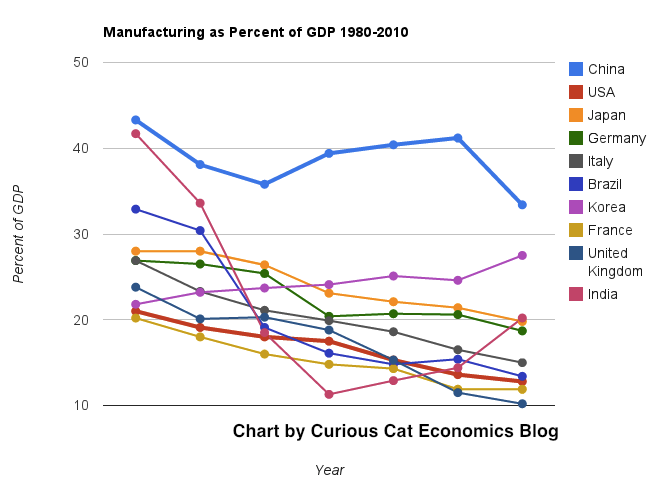
    chart of manufacturing output as percent of GDP by country from 1980 to 2010
    This chart shows manufacturing output, as percent of GDP, by country and was created by the Curious Cat Economics Blog based on UN data. You may use the chart with attribution.

    The manufacturing share of the USA economy dropped from 21% in 1980 to 18% in 1990, 15% in 2000 and 13% in 2010. Still, as previous posts show, the USA manufacturing output has grown substantially: over 300% since 1980, and 175% since 1990. The proportion of manufacturing output by the USA (for the top 10 manufacturers) has declined from 33% in 1980, 32% in 1990, 35% in 2000 to 26% in 2010. If you exclude China, the USA was 36% of the manufacturing output of these 10 countries in 1980 and 36% in 2010. China’s share grew from 7.5% to 27% during that period.

    The United Kingdom has seen manufacturing fall all the way to 10% of GDP, manufacturing little more than they did 15 years ago. Japan is the only other country growing manufacturing so slowly (but Japan has one of the highest proportion of GDP from manufacturing – at 20%). Japan manufactures very well actually, the costs are very high and so they have challenges but they have continued to manufacture quite a bit, even if they are not growing output much.
    (more…)

  • Leading Economic Freedom: Hong Kong, Singapore, New Zealand, Switzerland

    Hong Kong again topped the rankings, followed by Singapore, New Zealand, and Switzerland. Australia and Canada tied for fifth, of the 144 countries and territories in the Fraiser Institute’s 2012 Economic Freedom of the World Report.

    “The United States, like many nations, embraced heavy-handed regulation and extensive over-spending in response to the global recession and debt crises. Consequently, its level of economic freedom has dropped,” said Fred McMahon, Fraser Institute vice-president of international policy research.

    The annual Economic Freedom of the World report uses 42 distinct variables to create an index ranking countries around the world based on policies that encourage economic freedom. The cornerstones of economic freedom are personal choice, voluntary exchange, freedom to compete, and security of private property. Economic freedom is measured in five different areas: (1) size of government, (2) legal structure and security of property rights, (3) access to sound money, (4) freedom to trade internationally, and (5) regulation of credit, labor, and business.

    Hong Kong offers the highest level of economic freedom worldwide, with a score of 8.90 out of 10, followed by Singapore (8.69), New Zealand (8.36), Switzerland (8.24), Australia and Canada (each 7.97), Bahrain (7.94), Mauritius (7.90), Finland (7.88), Chile (7.84).

    The rankings and scores of other large economies include: United States (18th), Japan (20th), Germany (31st), South Korea (37th), France (47th), Italy (83rd), Mexico (91st), Russia (95th), Brazil (105th), China (107th), and India (111th).

    When looking at the changes over the past decade, some African and formerly Communist nations have shown the largest increases in economic freedom worldwide: Rwanda (44th this year, compared to 106th in 2000), Ghana (53rd, up from 101st), Romania (42nd, up from 110th), Bulgaria (47th, up from 108th), and Albania (32nd, up from 77th). During that same period the USA has dropped from 2nd to 19th.

    The rankings are similar to the World Bank Rankings of easiest countries in which to do business. But they are not identical, the USA is still hanging in the top 5 in that ranking. The BRICs (Brazil, Russia, India and China) do just as poorly in both. The ranking due show the real situation of economies that are far from working well in those countries. China and Brazil, especially, have made some great strides when you look at increasing GDP and growing the economy. But there are substantial structural changes needed. India is suffering greatly from serious failures to improve basic economic fundamentals (infrastructure, universal education, eliminating petty corruption [China has serious problems with this also]…).

    (more…)

  • Easiest Countries in Which to Operate a Businesses (2011)

    Singapore is again ranked first for Ease of Doing Business by the World Bank.

    Country 2011 2008 2005
    Singapore 1 1 2
    Hong Kong 2 4 6
    New Zealand 3 2 1
    United States 4 3 3
    Denmark 5 5 7
    other countries of interest
    United Kingdom 7 6 5
    Korea 8 23 23
    Canada 13 8 4
    Malaysia 18
    Germany 19 25 21
    Japan 20 12 12
    France 29 31 47
    Mexico 53 56 62
    Ghana 63
    China 91 83 108
    India 132 122 138
    Brazil 126 122 122

    The rankings include ranking of various aspects of running a business. Some rankings for 2011: starting a business (New Zealand 1st, Singapore 4th, USA 13th, Japan 107th), Dealing with Construction Permits (Hong Kong 1st, New Zealand 2nd, Singapore 3rd, USA 17th, China 179th), protecting investors (New Zealand 1st, Singapore 2nd, Hong Kong 3rd, Malaysia 4th, USA 5th), enforcing contracts (Luxemburg 1, Korea 2, Iceland 3, Hong Kong 5, USA 7, Singapore 12, China 16, India 182), paying taxes (Maldives 1, Hong Kong 3, Singapore 4, USA 72, Japan 120, China 122, India 147).

    These rankings are not the final word on exactly where each country truly ranks but they do provide a valuable source of information. With this type of data there is plenty of room for judgment and issues with the data.

    Related: Easiest Countries from Which to Operate Businesses 2008Stock Market Capitalization by Country from 1990 to 2010Looking at GDP Growth Per Capita for Selected Countries from 1970 to 2010Top Manufacturing Countries (2000 to 2010)Country Rank for Scientific PublicationsInternational Health Care System PerformanceBest Research University Rankings (2008)

  • USA Adds 163,000 Jobs in July, Unemployment Rate at 8.3%

    After several poor months for job creation (adding well under 100,000 each month) we have some good news. Total nonfarm payroll employment rose by 163,000 in July, with the unemployment rate at 8.3%. Since the beginning of this year, employment growth has averaged 151,000 per month, about the same as the average monthly gain of 153,000 in 2011.

    The change in total nonfarm payroll employment for May was revised from +77,000 to +87,000, and the change for June was revised from +80,000 to +64,000. Which means the total job gains for this report is 157,000 (163,000 +10,000 [for May] and -16,000 [for June]).

    One of the continuing severe problems (since the credit crisis bubble burst) has been long term unemployment. In July, the number of long-term unemployed (those jobless for 27 weeks and over) was 5.2 million. These individuals accounted for 40.7% of the unemployed (a high figure historically).

    Given all the problems created by the financial system failure (created over the last 15 years – in the USA and Europe) it is actually fairly amazing that we have been adding jobs nearly as much as we have. But climbing out of the huge whole we created for ourselves (by continually re-electing those that allowed the too-big-too-fail financial mess – and those we elect continue to reward their friends that created the mess instead of fixing it) is a huge task. It requires much better job creation than we have had this year.

    Adding 150,000 jobs a month would be decent if we hadn’t created such a huge problem that digging out of it requires much better results. Moving back above that average is much better than being below it, but we really need to bring the new jobs created above 200,000 for a couple years to make a serious dent in the problems created earlier.

    Related: USA add 117,000 Jobs in July 2011 and Adjusts Previous Growth in May and June Up 56,000 MoreUSA Unemployment Rate at 9.6% (Sept 2010)Unemployment Rate Drops Slightly to 9.4% (Aug 2009)
    Over 500,000 Jobs Disappeared in November 2008
    (more…)

  • Working Less: Better Lives and Less Unemployment

    The average worker in Germany and the Netherlands puts in 20% fewer hours in a year than the average worker in the United States. This means that if the US adopted Germany’s work patterns tomorrow, it would immediately eliminate unemployment.

    I do think there is merit to reducing yearly hours worked in the USA. The problem is this is all within a larger system. The USA’s broken health care system makes it extremely expensive to hire workers. One way to deal with the health care system failure is maximizing hours worked to spread out the massively expensive USA health care costs.

    Also the USA standard of living is partially based on long hours (it is but one factor). We also have to work quite a few hours (about 5% of the total hours) to just bring us equal with other rich countries, in order to pay for our broken health care system.

    Still reducing our purchases by cutting out some fancy coffee, a few pairs or shoes, a few cable channels (or all of them), text messages from overcharging phone companies… in order to have a couple more weeks of vacation would be a great tradeoff in my opinion. And one I have made with my career.

    I have changed to part time in 2 of my full time jobs (to make my own sensible yearly hour model even if the bigger system can’t. Another time I bargained for more vacation time over more $. It isn’t easy to do though, most organizations are not willing to think and accommodate employees (hard to believe they respect people in this case, right?). The system is not setup to allow people to adjust total hours to maximize their well being.

    Another option in the USA is to live within your means and then make your own sabbaticals during your career. Take a year off and travel the world, or hike the Appalachian Trail, or read trashy novels, or whatever you want.

    Related: Medieval Peasants had More Vacation Time Than We DoDream More, Work LessVacation: Systems Thinking

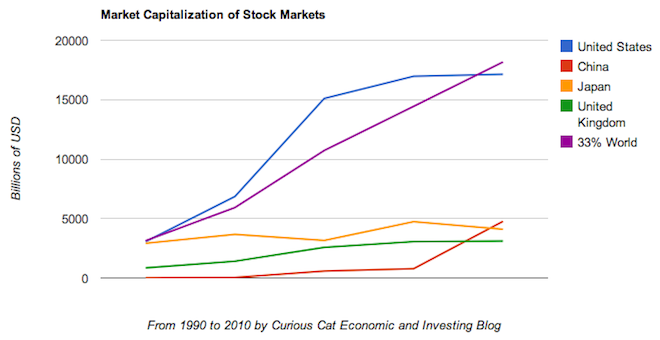
  • Stock Market Capitalization by Country from 1990 to 2010

    The stock market capitalization by country gives some insight into how countries, and stocks, are doing. Looking at the total market capitalization by country doesn’t equate to the stock holdings by individuals in a country or the value of companies doing work in a specific country.

    Chart of largest stock market capitalizations by country from 1990 to 2010
    Chart of largest stock market capitalizations by country from 1990 to 2010

    In the chart, I divided the world total by 3: just to make the chart look better. The USA was 32.5% of the total in 1990. The USA grew to 46.9% as the tech, finance and housing bubbles were all underway (also Japan was stagnating and the Chinese stock market hadn’t started booming to a significant extent). In 2010 the USA was back down to 31.4%. This will likely continue to decrease (at a much slower pace – I wouldn’t be surprised to see the USA at 25% in 2020) as the rest of the world’s markets continue to grow more quickly.

    As with so much recent economic data China’s performance here is remarkable and Japan’s is distressing. China grew from nothing in 1990 to the 2nd largest country in 2010. Hong Kong add another $1 trillion to China’s $4.5 trillion. Canada is the only country above $2 trillion not included on this chart. China grew by $4 trillion from 2005 to 2010.

    Related: Don’t Expect to Spend Over 4% of Your Retirement Investment Assets AnnuallyTop 10 Countries for Manufacturing Production from 1980 to 2010
    Investment Risk Matters Most as Part of a Portfolio, Rather than in IsolationGovernment Debt as Percent of GDP 1998-2010

    (more…)

  • Is Adding More Banker and Politician Bailouts the Answer?

    When critics say that Europe is running out of time to deal with the financial crisis I wonder if they are not years too late. Both in Europe responding and those saying it is too late.

    It feels to me similar to a situation where I have maxed out 8 credit cards and have a little bit left on my 9th. You can say that failing to approve my 10th credit card will lead to immediate pain. Not just to me, but all those I owe money to. That is true.

    But wasn’t the time to intervene likely when I maxed out my 2nd credit card and get me to change my behavior of living beyond my means then? If you only look at how to avoid the crisis this month or year, yeah another credit card to buy more time is a decent “solution.”

    But I am not at all sure that bailing out more bankers and politicians for bad financial decisions is a great long term strategy. It has been the primary strategy in the USA and Europe since the large financial institution caused great recession started. And, actually, for long before that the let-the-grandkids-pay-for-our-high-living-today has been the predominate economic “strategy” of the last 30 years in the USA and Europe.

    That has not been the strategy in Japan, Korea, China, Singapore, Brazil, Malaysia… The Japanese government has adopted that strategy (with more borrowing than even the USA and European government) but for the economy overall in Japan has not been so focused on living beyond what the economy produces (there has been huge personal savings in Japan). Today the risks of excessive government borrowing in Japan and borrowing in China are potentially very serious problems.

    I can understand the very serious economic problems people are worried about if bankers and governments are not bailed out. I am very unclear on how those wanting more bailout now see the long term problem being fixed. Unless you have some system in place to change the long term situation I don’t see the huge benefit in delaying the huge problems by getting a few more credit cards to maintain the fiction that this is sustainable.

    We have seen what bankers and politicians have done with the trillions of dollars they have been given (by governments and central banks). It hardly makes me think giving them more is a wonderful strategy. I would certainly consider it, if tied to some sensible long term strategy. But if not, just slapping on a few more credit cards to let the bankers and politicians continue their actions hardly seems a great idea.

    Related: Is the Euro Going to Survive in the Long Run? (2010)Which Currency is the Least Bad?Let the Good Times Roll (using Credit)The USA Economy Needs to Reduce Personal and Government Debt (2009 – in the last year this has actually been improved, quite surprisingly, given how huge the federal deficit is) – What Should You Do With Your Government “Stimulus” Check?Americans are Drowning in DebtFailure to Regulate Financial Markets Leads to Predictable Consequences

  • USA Adds Just 120,000 Job in March, Unemployment Rate Falls to 8.2%

    Nonfarm payroll employment rose by 120,000 in March, and the unemployment rate dropped to 8.2%, the United States Bureau of Labor Statistics reported today. Employment rose in manufacturing, food services, and health care, but was down in retail trade. The change in total nonfarm payroll employment for January was revised from +284,000 to +275,000, and the change for February was revised from +227,000 to +240,000 (together this adds just 4,000 more jobs brining the total added jobs with this report to 124,000.

    Adding 120,000 jobs in a month is mediocre in general for the USA economy. The biggest reason for disappointment is during recoveries jobs are normally added at a higher rate, and given how many jobs were lost in the during the credit crisis outsized job gains are needed. The other reason adding 120,000 jobs was disappointing is the consensus estimate was for over 200,000 jobs to be added.

    The number of long-term unemployed (those jobless for 27 weeks and over) was essentially unchanged at 5.3 million in March and remains one of the biggest employment problems for the economy. These individuals accounted for 42.5% of the unemployed. Since April 2010, the number of long-term unemployed has fallen by 1.4 million.

    In the prior 3 months, payroll employment had risen by an average of 246,000 per month. Private-sector employment grew by 121,000 in March, including gains in manufacturing, food services, and health care.

    Manufacturing employment rose by 37,000 in March, with gains in motor vehicles and parts (+12,000), machinery (+7,000), fabricated metals (+5,000), and paper manufacturing (+3,000). Factory employment has risen by 470,000 since a recent low point in January 2010. Manufacturing continues providing some of the best employment news.

    Related: Latest USA Jobs Report Adds 286,000 Jobs; Another Very Strong Month (Mar 2012)USA Adds 216,00 Jobs in March 2011; the Unemployment Rate Stands at 8.8%USA Added 162,000 Jobs in March 2010Another 663,000 Jobs Lost in March 2009 in the USA

    (more…)

  • Latest USA Jobs Report Adds 286,000 Jobs; Another Very Strong Month

    Nonfarm payroll employment rose by 227,000 in February, and the unemployment rate was unchanged at 8.3%, the U.S. Bureau of Labor Statistics reported today. The change in total nonfarm payroll employment for December was revised from +203,000 to +223,000, and the change for January was revised from +243,000 to +284,000. Which brings the total new jobs for this report to 286,000 (227+20+39). This is very good news. There are other serious economic concerns (failure, after years, to take any meaningful action to prevent systemic too big to fail risk, policies harming savers to benefit too big to fail institutions, extremely large and dangerous budget deficits…) and the employment situation still has a long way to go to recover from the credit crisis crash but the recent job news is strongly positive.

    The number of unemployed persons, at 12.8 million, was essentially unchanged in February. The unemployment rate held at 8.3%, 80 basis points below the August 2011 rate of 9.1%.

    The number of long-term unemployed (those jobless for 27 weeks and over) remains at very damaging levels; it was little changed at 5.4 million in February. These individuals accounted for 42.6% of the unemployed.

    Both the labor force and employment rose in February. The civilian labor force participation rate, at 63.9 percent, and the employment-population ratio, at 58.6 percent, edged up over the month.

    Private-sector employment grew by 233,000, with job gains in professional and business services, health care and
    social assistance, leisure and hospitality, manufacturing, and mining. Government jobs declined by 6,000. In 2011,
    government lost an average of 22,000 jobs per month.

    Professional and business services added 82,000 jobs in February. Just over half of the increase occurred in temporary help services (+45,000). Job gains also occurred in computer systems design (+10,000) and in management and technical consulting services (+7,000). Employment in professional and business services has grown by 1.4 million since a recent low point in September 2009.

    Health care and social assistance employment rose by 61,000 over the month. Within health care, ambulatory care services added 28,000 jobs, and hospital employment increased by 15,000. Over the past 12 months, health care employment has risen by 360,000.

    In February, employment in leisure and hospitality increased by 44,000, with nearly all of the increase in food services and drinking places (+41,000). Since a recent low in February 2010, food services has added 531,000 jobs.

    Manufacturing employment rose by 31,000 in February. All of the increase occurred in durable goods manufacturing, with job gains in fabricated metal products (+11,000), transportation equipment (+8,000), machinery (+5,000), and furniture and related products (+3,000). Durable goods manufacturing has added 444,000 jobs since a recent trough in January 2010. Of all the good news the continued manufacturing gains may well be the best news.

    Related: Nov 2010 USA Unemployment Rate Rises to 9.8%USA Unemployment Rate Remains at 9.7% (Feb 2010)Another 663,000 Jobs Lost in March 2009, in the USA

    (more…)

  • Consumer and Real Estate Loan Delinquency Rates from 2001 to 2011 in the USA

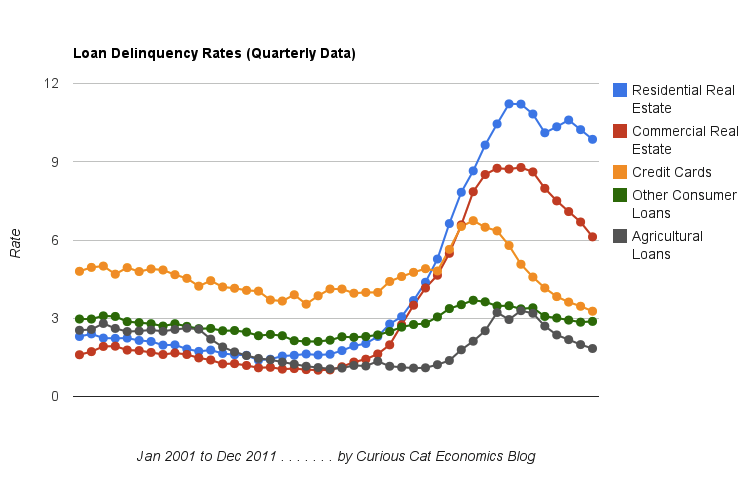
    chart showing loan delinquency rates from 2001 to 2011 in the USA
    Chart showing loan delinquency rates from 2001-2011. It shows seasonally adjusted data for all banks for consumer and real estate loans. The chart is available for use with attribution. Data from the Federal Reserve.

    2011 saw delinquency rates for loans fall across the board in the USA. Residential real estate delinquency rates fell just 25 basis points (to a still extremely large 9.86%). Commercial real estate delinquency rates fell an impressive 186 basis points (to a still high 6.12%). Credit card delinquency rates fell 86 basis points to a 17 year low, 3.27%.

    The job market continues to struggle, though it is doing fairly well the last few months. The serious long term problems created by governments spending beyond their means (for decades) and allowing too big to fail institutions to destroy economic wealth and create great risk to the economy are not easy to solve: and we made no progress in doing so in 2011. The reduction in delinquency rates is a good sign for the economy. The residential real estate delinquency rates are still far too high as is government debt. And the failure to address the too big to fail (big donors to the politicians) is continuing to cause great damage to the economy.

    We need to reduce consumer and government debt. Many corporations are actually flush with cash, so at least we don’t have a huge corporate debt problem. Reducing debt load will decrease risks to the economy and provide wealth for consumers to tap as they move into retirement. The too-big-to-fail big political donors like to keep policies in place that encourage too much debt and favor complex financial instruments that they take huge fees from and then let the government deal with the aftermath. The politicians continued favors to too-big-to-fail institutions is very damaging to out economic well being.

    Across the board, the wealthy economies are facing a rapidly aging population (the USA is actually acing this at a much slower rate than most other rich countries – which is helpful).

    Related: Consumer and Real Estate Loan Delinquency Rates 2000-2011Real Estate and Consumer Loan Delinquency Rates 1998-2009Government Debt as Percent of GDP 1998-2010 for OECD

    (more…)