Category: economy

  • USA Unemployment Rate Drops to 8.6%

    The unemployment rate fell from 9.0% to 8.6% in November, however that is not an accurate representation of employment in the USA. The news is good, but very mildly good, while a decrease in the unemployment rate by 40 basis points would lead you to believe the improvement was dramatic. Nonfarm payroll employment rose by 120,000 which is about the number needed to keep up with population growth each month. Employment continued to trend up in retail trade, leisure and hospitality, professional and business services, and health care. Government employment continued to trend down.

    The change in total nonfarm payroll employment for September was revised from +158,000 to +210,000, and the change for October was revised from +80,000 to +100,000. This means this report shows an increase of 192,000 jobs which is pretty good news (especially for those that think the economy has been in a recession – it has not).

    One year ago the unemployment rate stood at 9.6%.

    The number of unemployed persons, at 13.3 million, was down by 594,000 in November. The labor force, which is the sum of the unemployed and employed, was down by a little more than half that amount. What this means is the reduction in the unemployment rate was largely due to the decrease in those actively looking for jobs.

    Among the major worker groups, the unemployment rate for adult men fell to 8.3% in November. The jobless rate rates for adult women (7.8%), teenagers (23.7%), African-Americans (15.5%), and Hispanics (11.4%) showed little or no change. The jobless rate for Asians was 6.5%.

    The number of long-term unemployed (those jobless for 27 weeks and over) was little changed at 5.7 million and accounted for 43.0% of the unemployed. This is one of the numbers that has to come down drastically for the job situation to really show good improvement.

    Related: Jobs News in the USA is not Good, Unemployment Remains at 9.1% (Aug 2011)USA Economy Adds 151,000 Jobs in October, Unemployment Rate Steady at 9.6% (Oct 2010)Unemployment Rate Reached 10.2% (Oct 2009)Over 500,000 Jobs Disappeared in November (2008)

    (more…)

  • Manufacturing Employment Data: USA, Japan, Germany, UK… 1990-2009

    I try to find global economic data on manufacturing and manufacturing jobs, but it isn’t easy. This is one of the areas I will be working on with the time I have freed up by moving to Malaysia (and taking a “sabbatical” [it isn’t really a sabbatical, I guess, just me studying and working on what I want to instead of what someone pays me to]).

    I found some interesting data from the USA census bureau on manufacturing employment in several countries (it would be interesting to see the data for more countries but for now I am limited to this data). Sadly they just use indexed data (I would rather see raw data). This data for example lets you see the changes in countries but I don’t see any way to compare the absolute values between countries – all you can compare is the changes between countries.

    The data is all indexed at 2002 = 100. Interestingly the USA has increased output per hour much more than any other country since 2002. The USA index stands at 146, the next highest is Sweden at 127 then the UK at 120. Italy is the only country tracked that fell since 2002, to 94. Japan (the 3rd largest manufacturer and 2nd largest of the countries include, China isn’t included) only increased to 113. Germany (4th and 3rd) increased to 111.

    The data also lets you look back from 1990 to 2002 and again the USA has increased productivity very well (2nd most) – the value in 1990 was 58. Sweden actually had the largest gain from 1990-2002, rising from 49. In 1990 Japan stood at 71 and Germany 70.

    (more…)

  • Looking at the Value of Different College Degrees

    Georgetown University Center on Education and the Workforce has produced a new report looking at the value of different college degrees in the USA. I have seen a great increase in discussions of the “bubble” in education. Those articles often say a college degree doesn’t assure the success it used to. The data I review seems to show extremely large benefits for those with a college degree (higher salaries but, much more importantly, in my opinion, they also have much lower unemployment rates).

    Those benefits are greatest for several majors including science, math and engineering. The problem I see is not so much that significant benefits are lacking for college degrees but the huge increases in costs of getting a degree are so large that for some majors the cost is just so large that even with the benefits it is arguable whether it is worth the cost (while a few decades ago the benefits were universal and so large the economic benefit was not debatable).

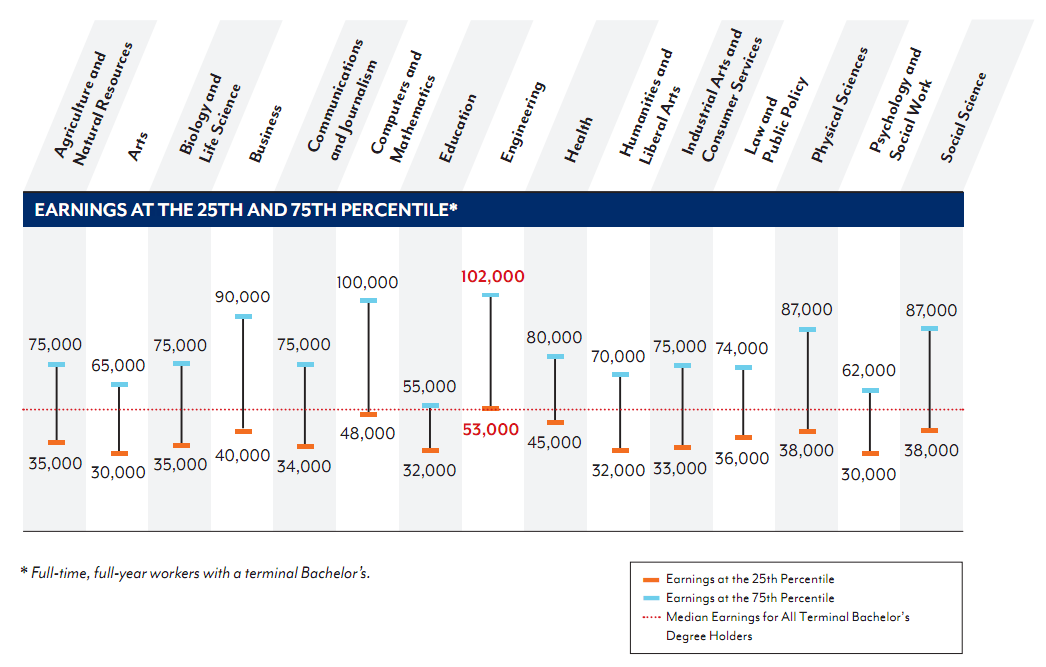
    The authors of the report found that all undergraduate majors are worthwhile, even taking into account the cost of college and lost earnings. However, the lifetime advantage ranges from $1,090,000 for Engineering majors to $241,000 for Education majors. As I have written frequently on the Curious Cat Science and Engineering blog, engineering degrees are very financially rewarding.

    The top 10 majors with the highest median earnings for new graduates are:

    • Petroleum Engineer ($120,000)
    • Pharmacy/pharmaceutical Sciences and Administration ($105,000)
    • Mathematics and Computer Sciences ($98,000)
    • Aerospace Engineering ($87,000)
    • Chemical Engineering ($86,000)
    • Electrical Engineering ($85,000)
    • Naval Architecture and Marine Engineering ($82,000)
    • Mechanical Engineering, Metallurgical Engineering and Mining and Mineral Engineering (each with median earnings of $80,000)
    chart showing the salaries by major in the USA (2009)
    Chart of salaries (25th and 75th percentile) by major in the USA based on data from 2009

    Related: 10 Jobs That Provide a Great Return on InvestmentMathematicians Top List of Best OccupationsNew Graduates Should Live Frugally

    (more…)

  • Consumer and Real Estate Loan Delinquency Rates from 2000 to 2011

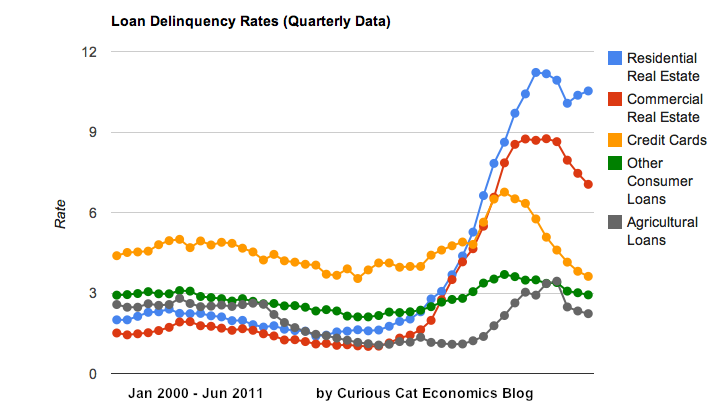
    chart showing loan delinquency rates from 2000-2011 in the USA
    Chart showing loan delinquency rates from 2000-2011, shows seasonally adjusted data for all banks for consumer and real estate loans. The chart is available for use with attribution. Data from the Federal Reserve.

    Residential real estate delinquency rates increased in the first half of 2011 in the USA. Other debt delinquency rates decreased. Credit card delinquency rates have actually reached a 17 year low.

    While the job market remains poor and the serious long term problems created by governments spending beyond their means (for decades) and allowing too big to fail institutions to destroy economic wealth and create great risk for world economic stability the USA economy does exhibit positive signs. The economy continues to grow – slowly but still growing. And the reduction in delinquency rates is a good sign. Though the residential and business real estate rates are far far too high.

    Related: Consumer and Real Estate Loan Delinquency Rates 2000-2010Real Estate and Consumer Loan Delinquency Rates 1998-2009Government Debt as Percent of GDP 1998-2010 for OECD

    (more…)

  • The USA Doesn’t Understand that the 1950s and 1960s are Not a Reasonable Basis for Setting Expectations

    After World War II essentially the only significantly large industrial base was in the USA. The USA was emerging as a national power in the early 1900’s. The wake of World War I and World War II left a very odd situation. You had many formerly very rich countries that were devastated and one rich country that wasn’t. Devastation is not easy to overcome in even 20 years. So for a good 2 decades the USA got wealthier and wealthier even while other formerly rich countries were re-developing their countries rapidly.

    This made the USA even richer as selling to all those around the world was pretty easy, just creating enough stuff was the hardest part. Almost none of the current emerging markets were doing much of anything economically. This resulted in the USA being able to live incredibly well and generate enormous wealth.

    The main legacy of this is a huge benefit to the USA – enormous wealth and experience. However, it seems to have left people thinking the USA is just suppose to be enormously wealthy always no matter if we throw away hundreds of billions a year on a broken health care system, provide huge benefits to political donors (farmers or bankers or phone oligopolists or robbers of the public domain [preventing innovation through repressive, outdated “intellectual property” regimes]), spending many hundreds of billions yearly on military expenditures far beyond those of any other country… It doesn’t work that way.

    You can waste huge amounts of economic benefit when you are the dominant economic power globally. And when you were as rich as the USA was in the 1950s and 1960s more and more people felt they deserved to be favored with economic gifts. So for a a few decades the USA used the excess wealth to pay off all sorts of special interests and still do very well economically. The only thing surprising is how long we have been able to keep this up.

    It isn’t rational to base expectations on periods when we were granted economic wealth largely by virtue of the world industrial production, other than ours, being destroyed. This isn’t the only reason we were wealthy, we do many things very well (compared to other countries) entrepreneurship, less corruption (still way too much but less than average), from 1950 to about 1990 an equitable distribution of economic gains, until recently a good advanced education system, a brilliant system to turn science and engineering breakthroughs into economic profit (that in the last few decades other countries are starting to do, but they are still way behind)…

    From 1970s until say the 2000s we could use our accumulated wealth to live off and allow huge inefficiencies to continue (lousy job of regulating banks, lousy job of subsidizing farming, lousy job of subsidizing lousy food [making it cheap to eat unhealthy food and expensive to eat healthy food], lousy job of controlling the costs of higher education, lousy job of getting people to realize they cannot expect to live far beyond most everyone else in the world just because they were born in the USA…
    (more…)

  • Jobs News in the USA is not Good, Unemployment Remains at 9.1%

    This was a bad month for jobs in the USA. Not only did the U.S. Bureau of Labor Statistics report that the number of jobs remained at the same level as last month (125,000 additional jobs are needed for population growth, on average and we have huge losses from the credit crisis recession that have to be gained back) the last 2 months were revised down. The change in total nonfarm payroll employment for June was revised from
    a gain of 46,000 to a gain of 20,000, and the July was revised down from gaining 117,000 job to gaining
    85,000. That results in a total loss for this report of 58,000.

    Still much better than the huge losses of several years ago but, along with the last few months, not a good sign for short term job growth. And the failure to address decades of favors given by politicians to too big to fail banks may actually create serious problems much sooner than most people feared. Pretty much everyone knew that the failure to address the main cause of the credit crisis was setting us up for again having the economy suffer huge blows due to the behavior of too big to fail institutions but I, and I think most people, thought it would be at least 5 years away and maybe even 10 before we had to seriously pay for the failures of our politicians to address this problem they (and their predecessors created).

    It really seems like politicians don’t understand that their predecessors (decades ago) could afford to payoff large political donors and avoid dealing with problems and the enormous amount of wealth the economy was generating would let us prosper (even with lousy leadership), but that is no longer the case. The USA has used up huge economic advantages and that easy time is not coming back. Sadly the main hope for the USA is that other countries leaders create enough waste that the USA can remain competitive with all the waste our create (extremely lousy health care system, for example). It seems the American public doesn’t understand either, if anything we are electing even less intelligent and capable leaders today (over the last 10 years).

    The USA has 14 million unemployed. Among the major worker groups, the unemployment rates for adult men was 8.9%, adult women 8.0% and teenagers 25.4%, whites. Of those 14 million the number of long-term unemployed (those jobless for 27 weeks and over) was about unchanged at 6 million in August.

    The number of persons employed part time for economic reasons (sometimes referred to as involuntary part-time workers) rose from 8.4 million to 8.8 million in August. These individuals were working part time because their hours had been cut back or because they were unable to find a full-time job.

    The average workweek for all employees on private nonfarm payrolls edged down by 0.1 hour over the month to 34.2 hours. The manufacturing workweek was 40.3 hours for the third consecutive month; factory overtime increased by 0.1 hour over the month to 3.2 hours. The average workweek for production and nonsupervisory employees on private nonfarm payrolls edged down to 33.5 hours in August, after holding at 33.6 hours for the prior 6 months.

    As bad as this news is, it could be much worse. The economy is actually growing (very slowly), probably. Many companies are actually still very profitable (I am not counting companies that have fake profits with congress approved ability to report fake values for their assets – Congress granted their too big too fail donors, this, and many other favors while most others are left out in the cold). The wealth in the USA, even after we have been consuming our capital to live beyond what we earn each year (for decades) is still extremely high. This allows us to live well and invest even with many bad practices in place. We continue to have many excellent companies doing great work and providing great jobs. Even with all the problems in the USA there are few countries that are in as enviable an economic position. The biggest problem I see is we have been squandering those advantages far too easily and quickly for far too long. That leaves us much more economically venerable than we need to be.

    Related: Paying Back Direct Cash Bailouts from Taxpayers Does not Excuse Bank MisdeedsUSA Unemployment Rate at 9.6% (after losing 54,000 job in Aug 2010)
  • The Return of the Multi-Generational Family Household

    There are many good economic reasons to have multi-generational (at least 3 generations) households. There are some good social reasons too. There can be interpersonal benefits but also annoyances (which I think is why they decreased – plus we could afford it, the USA was living extremely richly).

    The Return of the Multi-Generational Family Household

    As of 2008, a record 49 million Americans, or 16.1% of the total U.S. population, lived in a family household that contained at least two adult generations

    This represents a significant trend reversal. Starting right after World War II, the extended family household fell out of favor with the American public. In 1940, about a quarter of the population lived in one; by 1980, just 12% did. A range of demographic factors likely contributed to this decline, among them the rapid growth of the nuclear-family-centered suburbs; the decline in the share of immigrants in the population; and the sharp rise in the health and economic well-being of adults ages 65 and older.

    Another factor has been the big wave of immigration, dominated by Latin Americans and Asians, that began around 1970. Like their European counterparts from earlier centuries, these modern immigrants are far more inclined than native-born Americans to live in multi-generational family households.

    However, the trend reversal has also played out among native-born Americans. And for all groups, the move into multi-generational family households has accelerated during the Great Recession that began at the end of 2007.

    The percentage of the population in such households now is 16%, still significantly below the high of 24.7% in 1940.

    Related: Mortgage Rates Falling on Fed Housing FocusPersonal Finance Basics: Long-term Care InsuranceBankruptcies Among Seniors Soaring (2008)

  • Curious Cat Investing and Economic Carnival #15

    The global economy continue to be fragile and chaotic. At the same time companies continue to make large, and often increasing, profit. Here are some good blog posts on investing, personal finance and the economy.

    • The Economy is Weak and Prospects May be Grim, But Many Companies Have Rosy Prospects by John Hunter – “the prospects in emerging markets look incredibly good to me. Yes they will slow their growth a bit if the large economies stall, but I think it is foolish to avoid investments in China, Singapore, Brazil, Korea, India, Ghana, Malaysia, Indonesia. In fact that is where companies like Google, Tesco, Apple, Toyota and Amazon are going to be making lots of money. Emerging markets are volatile and the companies in them are too. This will continue.”
    • Extreme Early Retirement in Practice: How Two People Did It by Robert Brokamp – “We recently spent three months in Guatemala nestled between three volcanoes, on the shores of beautiful Lake Atitlan, and our average spending was $40 per day for the two of us, which equates to $14,600 per year. Our hotel price included daily cleaning, wi-fi, room service, cable TV, and a view.”
    • Are stocks cheap yet? Not if the economy is slowing, these numbers say by James Jubak – “A 20% drop in forecast earnings—the rough equivalent of an economic slowdown instead of a recession—would put the price-to-earnings ratio of the S&P 500 at 13. That’s below the average of 15 but not really very cheap given the degree of economic risk that an investor is taking on right now.”
    • Private Pensions: Another Gradual Catastrophe by Evan Tarte – “Despite the arguably noble intent of defined benefit plans and the PBGC, these plans demand crippling contributions from employers and inevitably the taxpayer, and make little sense in today’s market environment. PBGC’s current deficit stands at $22 billion”
    • Emergency Savings: is 6 Months Still Enough? by GE Miller – “with the average unemployment duration at 40.4 weeks, 6 months (or 26 weeks) is no longer enough, particularly when you take into account the possibility of medical emergency, pet operations, or other unforeseen circumstances. What is a good length these days? 1 year, at a minimum.”
    • (more…)

  • Good News: Credit Card Delinquencies at 17 Year Low

    The national credit card delinquency rate (the rate of borrowers 90 or more days past due) decreased for the sixth consecutive quarter, dropping to 0.6% at the end of the second quarter in 2011. This is the lowest mark observed in 17 years. Credit card debt per borrower increased $20 in the quarter to $4,699, though it remains near record-low levels (and yet still at a level that is far too high).

    Although credit card delinquencies were expected to drop, the data released today shows credit card delinquency rates improving by more than at any other time since the recovery began in 2009, both on a quarter-over-quarter basis (-18.9%) and on a year-over-year basis (-34.8%).

    “National credit card delinquency rates have fallen to levels not seen since 1994 as consumers continue to tighten their spending,” said Ezra Becker, vice president of research and consulting in TransUnion’s financial services business unit. “TransUnion believes that the recovering economy is only indirectly impacting delinquency rates. More important and impactful to the decline in bank card delinquency are that consumers are using credit cards more responsibly; a large number of delinquent accounts have moved to charge-off status; and lenders remain conservative in their underwriting.”

    The record low-level of credit card debt that has continued post recession is supported by a separate TransUnion credit card deleveraging analysis released in July. The analysis found that consumers made an estimated $72 billion more in payments on their credit cards than purchases between the first quarters of 2009 and 2010.

    This is good news. We still need to reduce pay off much more of the excessive debt we took on living beyond our means the last few decades, but at least this is a small positive step. Overall consumer debt increased in the 2nd quarter, according to the Federal Reserve, and stands at over $2.45 Trillion. Revolving debt (credit cards) decreased slightly but non-revolving debt increased more. Consumer debt peaked near $2.55 Trillion in 2009 and recently bottomed just below around $2.4 in 2010. Consumer debt totals still need a great deal of improvement.

    Related: Consumer and Real Estate Loan Delinquency Rates 2000-2010Consumer Debt Down, but Still Over $2.4 Tillion in the USA

  • Economic Consequences Flow from Failing to Follow Real Capitalist Model and Living Beyond Our Means

    The current frustration with economic conditions in the USA and Europe has at its core two main elements. First the anti-capitalist concentration of power in a few monopolistic and oligopolistic corporations (along with the support and encouragement of governments and the governments failure to regulate markets to encourage capitalist practices). And second the consequences of living beyond our means finally becoming much more challenging.

    What we have had has been very questionably capitalist. The largest reason for this “questionable” nature is not related to labor but instead to the inordinate power given to a limited number of large corporations. The corporations are suppose to not have “market power” in real capitalism. They have huge and growing market power. To me the main problem is that power disruption to the functioning of capitalist free markets.

    There is also the problem that we have been living far beyond our means. This has nothing to do with capitalism or not capitalism. It is as simple as you produce 100 units of goods and use 110 that can’t continue forever. The USA started building a surplus in the 1940’s, I imagine Europe did in the 1950’s. Since about the 1980’s both areas have been living far beyond their means. While they were consuming what they saved over the previous decades it wasn’t so bad. While they mortgaged their future to live lavishly today that was worse. We continue to live beyond our means and are beginning to see some consequences but we haven’t come close to accepting the lavish lifestyles we enjoyed (while Europe and the USA lived off past gains and off very advantageous trade with the rest of the world) is not possible any longer. We can’t just have everyone in Europe and the USA live exceeding well and the rest of the world support us. Eventually we have to realize this (or in any event we will experience it, even if we don’t realize it).

    Those 2 factors need to be addressed for our economic future to be as bright as it should be.

    Related: Too big too fail, too big to existUsing Capitalism in Mali to Create Better LivesCreating a World Without Poverty