Category: Financial Literacy

  • USA Fiscal Cliff – Better Than Past Behavior

    I am glad we have a “fiscal cliff” to finally get some reduction in the future taxes both parties have been piling on with abandon the last few decades. When you have enormous spending beyond your income, as the USA has had the last few decades, cutting current taxes is just raising taxes on your grandchildren to pay for your spending. Shifting taxes to your grand children is not cutting taxes it is shifting them to future generations.

    If you want to really cut taxes you must cut taxes and not pass on paying for your cuts to your kids. It seems pretty obvious those that advocating cutting current taxes the last few decades were only interested in living beyond their means today and foisting the responsibility to pay to their grandchildren. That is despicable behavior.

    The fiscal cliff is an opportunity to return to a budget that has the generation doing the spending paying the taxes (last seen in the Clinton administration). The fiscal cliff outcome is going to be far from perfect. But the result will be a much more honorable outcome than foisting ever increasing taxes on future generations to pay for our current spending.

    Obviously, if you reducing how much you are adding to your credit card balance each month and start paying your bills that means you don’t get to live off your future earnings today. So you will suffer today compared to continuing to tax the future to pay for your spending.

    I hope the compromise results in spending cuts and an elimination of the Bush generation shifting taxes (cutting taxes on the the current wealthy without spending cuts – so just taxing the future to pay for tax cuts today). It is unlikely the fiscal cliff results in us actually paying for our spending (the best possible result is not an elimination of adding to the taxes future generations must pay but just a reduction in the level of tax increases we are imposing on the future every year).

    Lots of little things should be done to save a few billion (maybe it could add up to $50 billion a year if we are very lucky). But the serious spending cuts have to come from reductions in military spending, reducing waste in the health care system and making social security more actuarially sensible (social security is not part of the fiscal cliff discussions though). Reducing tax breaks also has to happen, unless absolutely huge spending cuts can be found which is not at all likely.
    (more…)

  • Save What You Can, Increase Savings as You Can Do So

    Building your saving is largely about not very sexy actions. The point where most people fail is just not saving. It isn’t really about learning some tricky secret.

    You can find yourself with pile of money without saving; if you win the lottery or inherit a few million from your rich relative via some tax dodge scheme like generation skipping trusts or charitable remainder trusts.

    But the rest of us just have to do a pretty simple thing: save money. Then, keep saving money and invest that money sensibly. The key is saving money. The next key is not taking foolish risks. Getting fantastic returns is exciting but is not likely and the focus should be on lowering risk until you have enough savings to take risks with a portion of the portfolio.

    My favorite tips along these lines are:

    Spending less than you make and building up your long term savings puts you in the strongest personal finance position. These things matter much more than making a huge salary or getting fantastic investing returns some year. Avoiding risky investments is wise, and sure making great returns helps a great deal, but really just saving and investing in a boring manner puts you in great shape in the long run. Many of those making huge salaries are in atrocious personal financial shape.

    Another way you can boost savings is to do so when you pay off a monthly bill. So when I paid off my car loan I just kept saving the old payment. Then I was able to buy my new car with the cash I saved in advance when I was ready for a new car.

    (more…)

  • Withdrawing Huge Amounts of Cash From Companies You Saddle with Debt is Despicable Behavior

    Bain Capital is a product of the Great Deformation by David Stockman

    Bain’s billions of profits were not rewards for capitalist creation; they were mainly windfalls collected from gambling in markets that were rigged to rise.

    Except Mitt Romney was not a businessman; he was a master financial speculator who bought, sold, flipped, and stripped businesses. He did not build enterprises the old-fashioned way—out of inspiration, perspiration, and a long slog in the free market fostering a new product, service, or process of production. Instead, he spent his 15 years raising debt in prodigious amounts on Wall Street so that Bain could purchase the pots and pans and castoffs of corporate America, leverage them to the hilt, gussy them up as reborn “roll-ups,” and then deliver them back to Wall Street for resale—the faster the better.

    That is the modus operandi of the leveraged-buyout business, and in an honest free-market economy, there wouldn’t be much scope for it because it creates little of economic value. But we have a rigged system—a regime of crony capitalism—where the tax code heavily favors debt and capital gains, and the central bank purposefully enables rampant speculation by propping up the price of financial assets and battering down the cost of leveraged finance.

    So the vast outpouring of LBOs in recent decades has been the consequence of bad policy, not the product of capitalist enterprise.

    I abhor the subsidies provided to those that saddle corporations (that build up value through decades of hard work by employees) with huge debt. The actions of leveraged by out firms are atrocious. They seek to pretend that business is once again the land of the amoral behavior, as the robber barron’s sought to convince society of long ago. Those that saddle corporations (that have an obligation to those that built them up) with huge debt are despicable.

    Those same despicable people then take huge amounts of cash (for themselves) from the debt they saddled the corporation with.

    Quite a few smart people have figured out how to pay congress to allow those smart people to take huge profits out of businesses. By being smart enough to have congress create laws to allow their behavior they can say it was just doing what the law allowed. When you conspire with the authorities to create a system to drain cash from legitimate businesses into your pocket you can claim you are acting legally (if you do so by having them change the law, instead of having them just ignore the existing laws). But what is being done (for decades by both parties) by those we continue to elect to allow this behavior shows just how corrupt the system is.

    It is sad we allow those politicians who payoff those that give them large amount of cash, at the expense of our society, to remain in office. But we don’t even discuss the issues in any significant sense. Those using this cronyism and corruption know they are continuing to be given the open door to continue their very destructive ways. These are smart people. They know how to use public apathy and rhetoric to keep from discussing the important issues. It is going to take us to stop the corrupting cronyism that has taken over our political parties.

    Related: Too Much Leverage Killed MervynsFailed Executives Use Leverage to Increase Their Pay, Let Others Bailouts LaterExecutives Treating Corporate Treasuries as Their Money, A Sad State of AffairsCEOs Plundering Corporate CoffersLeverage, Complex Deals and ManiaLooting: Bankruptcy for Profit

  • Manufacturing Output as Percent of GDP from 1980 to 2010 by Country

    The largest manufacturing countries are China, USA, Japan and then Germany. These 4 are far in the lead, and very firmly in their positions. Only the USA and China are close, and the momentum of China is likely moving it quickly ahead – even with their current struggles.

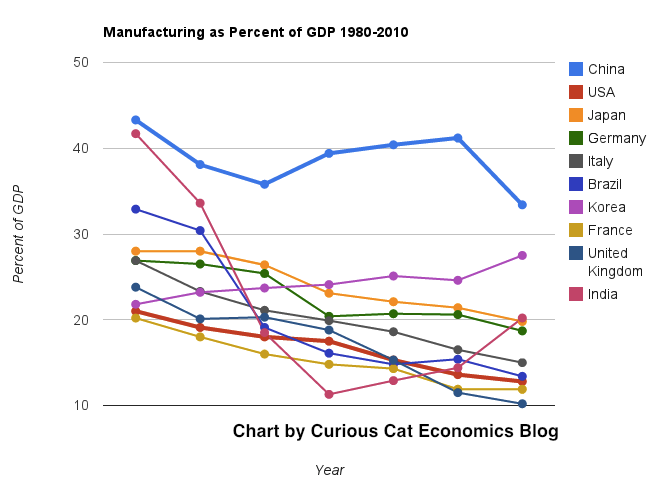
    The chart below shows manufacturing production by country as a percent of GDP of the 10 countries that manufacture the most. China has over 30% of the GDP from manufacturing, though the GDP share fell dramatically from 2005 and is solidly in the lead.

    Nearly every country is decreasing the percentage of their economic output from manufacturing. Korea is the only exception, in this group. I would expect Korea to start following the general trend. Also China has reduced less than others, I expect China will also move toward the trend shown by the others (from 2005 to 2010 they certainly did).

    For the 10 largest manufacturing countries in 2010, the overall manufacturing GDP percentage was 24.9% of GDP in 1980 and dropped to 17.7% in 2010. The point often missed by those looking at their country is most of these countries are growing manufacturing, they are just growing the rest of their economy more rapidly. It isn’t accurate to see this as a decline of manufacturing. It is manufacturing growing more slowly than (information technology, health care, etc.).

    chart of manufacturing output as percent of GDP by country from 1980 to 2010
    This chart shows manufacturing output, as percent of GDP, by country and was created by the Curious Cat Economics Blog based on UN data. You may use the chart with attribution.

    The manufacturing share of the USA economy dropped from 21% in 1980 to 18% in 1990, 15% in 2000 and 13% in 2010. Still, as previous posts show, the USA manufacturing output has grown substantially: over 300% since 1980, and 175% since 1990. The proportion of manufacturing output by the USA (for the top 10 manufacturers) has declined from 33% in 1980, 32% in 1990, 35% in 2000 to 26% in 2010. If you exclude China, the USA was 36% of the manufacturing output of these 10 countries in 1980 and 36% in 2010. China’s share grew from 7.5% to 27% during that period.

    The United Kingdom has seen manufacturing fall all the way to 10% of GDP, manufacturing little more than they did 15 years ago. Japan is the only other country growing manufacturing so slowly (but Japan has one of the highest proportion of GDP from manufacturing – at 20%). Japan manufactures very well actually, the costs are very high and so they have challenges but they have continued to manufacture quite a bit, even if they are not growing output much.

    (more…)

  • Household Income Data in the USA Since the Credit Crisis Recession Began

    Big Income Losses for Those Near Retirement takes a look at some interesting data, including data on median income drops due to the too-big-too-fail credit crisis recession.

    Households led by people between the ages of 55 and 64 have taken the biggest hit; their household incomes have fallen to $55,748 from $61,716 over the last three years, a decline of 9.7 percent.

    The post also includes data showing the only groups with income increases as those 65-74 years old and, 75 and over which is surprising. 25-34 took the 2nd largest drop decreasing 8.9%.

    Another interesting tidbit is the percent of people over 65 with jobs. In 1960 20% of those over 65 had jobs. Which pretty much decreased steadily to 10% in 1986 and then has increased steadily to 17% in 2011.

    Related: USA Individual Earnings Levels: Top 1% $343,000, 5% $154,000, 10% $112,000, 25% $66,000
    Looking at Data on the Value of Different College Degrees60% of Workers in the USA Have Less Than $25,000 in Retirement SavingsCredit Card Regulation Has Reduced Abuse By Banks

  • Working Less: Better Lives and Less Unemployment

    The average worker in Germany and the Netherlands puts in 20% fewer hours in a year than the average worker in the United States. This means that if the US adopted Germany’s work patterns tomorrow, it would immediately eliminate unemployment.

    I do think there is merit to reducing yearly hours worked in the USA. The problem is this is all within a larger system. The USA’s broken health care system makes it extremely expensive to hire workers. One way to deal with the health care system failure is maximizing hours worked to spread out the massively expensive USA health care costs.

    Also the USA standard of living is partially based on long hours (it is but one factor). We also have to work quite a few hours (about 5% of the total hours) to just bring us equal with other rich countries, in order to pay for our broken health care system.

    Still reducing our purchases by cutting out some fancy coffee, a few pairs or shoes, a few cable channels (or all of them), text messages from overcharging phone companies… in order to have a couple more weeks of vacation would be a great tradeoff in my opinion. And one I have made with my career.

    I have changed to part time in 2 of my full time jobs (to make my own sensible yearly hour model even if the bigger system can’t. Another time I bargained for more vacation time over more $. It isn’t easy to do though, most organizations are not willing to think and accommodate employees (hard to believe they respect people in this case, right?). The system is not setup to allow people to adjust total hours to maximize their well being.

    Another option in the USA is to live within your means and then make your own sabbaticals during your career. Take a year off and travel the world, or hike the Appalachian Trail, or read trashy novels, or whatever you want.

    Related: Medieval Peasants had More Vacation Time Than We DoDream More, Work LessVacation: Systems Thinking

  • USA Social Security Disability Insurance

    Studies show that a 20 year old has a 30% chance of becoming disabled before reaching retirement age. In the USA, the Social Security Administration provides disability benefits for total disabilities. You still want to get your own long term disability insurance (this can cover for partial disabilities), but here is some information on the SSA disability coverage.

    To qualify for Social Security disability benefits, you must first have worked in jobs covered by Social Security. Then you must have a medical condition that meets Social Security’s definition of disability. In general, they pay monthly cash benefits to people who are unable to work for a year or more because of a disability.

    Benefits usually continue until you are able to work again on a regular basis. There are also a number of special rules, called “work incentives,” that provide continued benefits and health care coverage to help you make the transition back to work.

    If you are receiving Social Security disability benefits when you reach full retirement age, your disability benefits automatically convert to retirement benefits, but the amount remains the same.

    Generally, you need 40 credits, 20 of which were earned in the last 10 years ending with the year you become disabled. You earn essentially 4 credit each year you work. There are reduced requirements if you are young and haven’t had a chance to earn 10 years worth of credit. So essentially you have to have worked 10 years (and 5 years in the last 10 years) paying social security tax.

    The definition of disability under Social Security is different than other programs. Social Security pays only for total disability. No benefits are payable for partial disability or for short-term disability.

    “Disability” under Social Security is based on your inability to work. The Social Security Administration consider you disabled under Social Security rules if:

    • You cannot do work that you did before;
    • We decide that you cannot adjust to other work because of your medical condition(s); and
    • Your disability has lasted or is expected to last for at least one year or to result in death.

    This is a strict definition of disability. Social Security program rules assume that working families have access to other resources to provide support during periods of short-term disabilities, including workers’ compensation, insurance, savings and investments.

    The benefit amount is calculated based on your average annual earnings and is subject to a maximum of $2,346/month (in 2011). The average benefit payment, last month, was $1,111. Minor, dependent, children are also eligible for a small monthly payment.

    In June 2012, 8.7 million people received disability benefits. Theoretically the number of recipients shouldn’t increase just because there is a recession, but they generally do increase in recessions.

    There is no means testing on receiving the disability payment from the SSA. It is based on your income and disability. There are other Social Security programs (SSI, Medicare) where you must show you have very few assets before you are eligible for benefits.

    Related: SSA Disability websitePersonal Finance Basics: Long Term Disability InsuranceDisability Insurance is Wise (in addition to SSA disability benefits)

  • Is Adding More Banker and Politician Bailouts the Answer?

    When critics say that Europe is running out of time to deal with the financial crisis I wonder if they are not years too late. Both in Europe responding and those saying it is too late.

    It feels to me similar to a situation where I have maxed out 8 credit cards and have a little bit left on my 9th. You can say that failing to approve my 10th credit card will lead to immediate pain. Not just to me, but all those I owe money to. That is true.

    But wasn’t the time to intervene likely when I maxed out my 2nd credit card and get me to change my behavior of living beyond my means then? If you only look at how to avoid the crisis this month or year, yeah another credit card to buy more time is a decent “solution.”

    But I am not at all sure that bailing out more bankers and politicians for bad financial decisions is a great long term strategy. It has been the primary strategy in the USA and Europe since the large financial institution caused great recession started. And, actually, for long before that the let-the-grandkids-pay-for-our-high-living-today has been the predominate economic “strategy” of the last 30 years in the USA and Europe.

    That has not been the strategy in Japan, Korea, China, Singapore, Brazil, Malaysia… The Japanese government has adopted that strategy (with more borrowing than even the USA and European government) but for the economy overall in Japan has not been so focused on living beyond what the economy produces (there has been huge personal savings in Japan). Today the risks of excessive government borrowing in Japan and borrowing in China are potentially very serious problems.

    I can understand the very serious economic problems people are worried about if bankers and governments are not bailed out. I am very unclear on how those wanting more bailout now see the long term problem being fixed. Unless you have some system in place to change the long term situation I don’t see the huge benefit in delaying the huge problems by getting a few more credit cards to maintain the fiction that this is sustainable.

    We have seen what bankers and politicians have done with the trillions of dollars they have been given (by governments and central banks). It hardly makes me think giving them more is a wonderful strategy. I would certainly consider it, if tied to some sensible long term strategy. But if not, just slapping on a few more credit cards to let the bankers and politicians continue their actions hardly seems a great idea.

    Related: Is the Euro Going to Survive in the Long Run? (2010)Which Currency is the Least Bad?Let the Good Times Roll (using Credit)The USA Economy Needs to Reduce Personal and Government Debt (2009 – in the last year this has actually been improved, quite surprisingly, given how huge the federal deficit is) – What Should You Do With Your Government “Stimulus” Check?Americans are Drowning in DebtFailure to Regulate Financial Markets Leads to Predictable Consequences

  • Long Term Care Insurance – Financially Wise but Current Options are Less Than Ideal

    The expenses for long term care is exactly the type of financial risk insurance is best for. The problem is the whole area is so uncertain that what you buy may not provide the coverage you planned on (the health care system is so broken that it is not certain insurance will cover the costs, companies can go bankrupt, change coverage rules drastically…).

    The questions about long term care insurance are not about the sensibility of the coverage abstractly, it is very wise. But the complexities, today, in the real world make the question of buying more a guess about what coverage you will actually receive if you need it.

    Many of my posts here are focused on the USA but applicable elsewhere, or just applicable wherever you are. This post is mainly focused on the USA, long term care insurance options in other locations will be very different and have different considerations (in many countries it may not even apply, mainly due to a less broken health care system than the USA has).

    Long-Term-Care Insurance: Who Needs It? by Marilyn Geewax

    “the reality is that each year, an estimated 11 million U.S. adults need some type of long-term care.

    Such care can be crushingly expensive: Just one hour of home-health-aide care costs roughly $20, while the average private nursing home room costs $87,000 a year. Neither routine employer-based medical insurance nor Medicare will pay for extended periods of custodial care.”

    Also, some people pay their premiums for years, and then get hit with rate hikes they can’t afford.

    Insurance has a transaction cost. Paying that transaction cost for expenses you can afford is just waste. You should pay the cost directly. This is why higher deductibles are most often wise. It doesn’t make sense to cover pay insurance costs every year to pay for a $500 risk you can afford to absorb yourself.

    But huge expenses are exactly what you want coverage for. Long term care expenses are huge. However, long term care insurance is still in flux, which isn’t good for something you want to provide long term protection. A huge risk is paying premiums for years, and then getting hit with rate hikes that may well be designed primarily just to get people to drop coverage (or be so expensive that those that stay pay enough that the insurance company makes money).

    Ideally such insurance would be set so maybe the cost rose at some preset limit when you signed up. The problem is the USA health care system is so broken this won’t work. No one can predict how much more excessively expensive long term coverage will be in 30 years so the insurance companies can’t predict. It leaves consumers in a risky place.

    Insurance is regulated by the states. There are huge differences in which states do a good job regulating long term care insurance and those that don’t. The majority don’t.

    This is one of the more important areas of personal finance. Unfortunately there is no easy answer. If the system were stable, reliable and predictable, long term care insurance would be a definite requirement for a sound financial plan. Today it is wise to insure yourself from those risks, the problem is determining whether any of the options available are worth it. The risk of needing this insurance is high: it is both likely and costly. So getting coverage is definitely wise if you can find some you think is reliable over the long term. Because of the uncertain nature of the options, this will require much more effort on your part than many personal finance actions (I included several links below to help your research).

    Also look at how long the coverage is for. This is another limitation insurance companies have put in place that makes it much less worthwhile.

    Related: Personal Finance Basics: Long-term Care InsuranceNational Clearinghouse for Long-Term Care InformationAARP adviceDisability Insurance is Very ImportantHow to Protect Your Financial Health

  • Retirement Planning – Looking at Assets

    The basics of retirement planning are not tricky. Save 10-15% of your income for about 40 years working career (likely over 15%, if you don’t have some pension or social security – with some pension around 10+% may be enough depending on lots of factors). That should get you in the ballpark of what you need to retire.

    Of course the details are much much more complicated. But without understanding any of the details you can do what is the minimum you need to do – save 10% for retirement of all your income. See my retirement investing related posts for more details. Only if you actually understand all the details and have a good explanation for exactly why your financial situation allows less than 10% of income to be saved for retirement every year after age 25 should feel comfortable doing so.

    There is value in the simple rules, when you know they are vast oversimplifications. I am amazed how many professionals don’t understand how oversimplified the rules of thumb are.

    Here is one thing I see ignored nearly universally. I am sure some professions don’t but most do. If you have retirement assest such as a pension or social security (something that functions as an annuity, or an actually annuity) that is often a hugely important part of your retirement portfolio. Yet many don’t consider this when setting asset allocations in retirement. That is a mistake, in my opinion.

    A reliable annuity is most like a bond (for asset allocation purposes). Lets look at an example for if you have $1,500 a month from a pension or social security and $500,000 in other financial assets. $1,500 * 12 gives $18,000 in annual income.

    To get $18,000 in income from an bond/CD… yielding 3% you need $600,000. That means, at 3%, $600,000 yields $18,000 a year.

    Ignoring this financial asset worth the equivalent of $600,000 when considering how to invest you $500,000 is a big mistake. Granted, I believe the advice is often too biased toward bonds in the first place (so reducing that allocation sounds good to me). To me it doesn’t make sense to invest that $500,000 the same way as someone else that didn’t have that $18,000 annuity is a mistake.

    I also don’t think it makes sense to just say well I have $1,100,000 and I want to be %50 in bonds and 50% in stocks so I have “$600,000 in bonds now” (not really after all…) so the $500,000 should all be in stocks. Ignoring the annuity value is a mistake but I don’t think it is as simple as just treating it as though it were the equivalent amount actually invested.

    Related: Immediate AnnuitiesManaging Retirement Investment RisksHow to Protect Your Financial HealthMany Retirees Face Prospect of Outliving Savings

    (more…)