Category: Financial Literacy

  • Looking at the Value of Different College Degrees

    Georgetown University Center on Education and the Workforce has produced a new report looking at the value of different college degrees in the USA. I have seen a great increase in discussions of the “bubble” in education. Those articles often say a college degree doesn’t assure the success it used to. The data I review seems to show extremely large benefits for those with a college degree (higher salaries but, much more importantly, in my opinion, they also have much lower unemployment rates).

    Those benefits are greatest for several majors including science, math and engineering. The problem I see is not so much that significant benefits are lacking for college degrees but the huge increases in costs of getting a degree are so large that for some majors the cost is just so large that even with the benefits it is arguable whether it is worth the cost (while a few decades ago the benefits were universal and so large the economic benefit was not debatable).

    The authors of the report found that all undergraduate majors are worthwhile, even taking into account the cost of college and lost earnings. However, the lifetime advantage ranges from $1,090,000 for Engineering majors to $241,000 for Education majors. As I have written frequently on the Curious Cat Science and Engineering blog, engineering degrees are very financially rewarding.

    The top 10 majors with the highest median earnings for new graduates are:

    • Petroleum Engineer ($120,000)
    • Pharmacy/pharmaceutical Sciences and Administration ($105,000)
    • Mathematics and Computer Sciences ($98,000)
    • Aerospace Engineering ($87,000)
    • Chemical Engineering ($86,000)
    • Electrical Engineering ($85,000)
    • Naval Architecture and Marine Engineering ($82,000)
    • Mechanical Engineering, Metallurgical Engineering and Mining and Mineral Engineering (each with median earnings of $80,000)
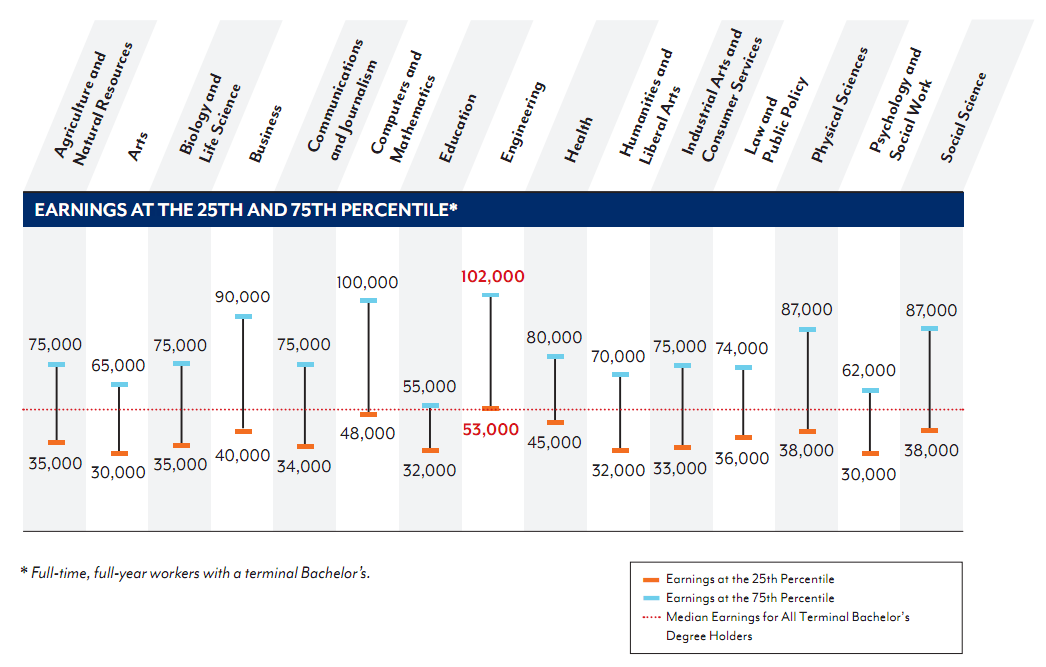
    chart showing the salaries by major in the USA (2009)
    Chart of salaries (25th and 75th percentile) by major in the USA based on data from 2009

    Related: 10 Jobs That Provide a Great Return on InvestmentMathematicians Top List of Best OccupationsNew Graduates Should Live Frugally

    (more…)

  • Anti-Market Policies from Our Talking Head and Political Class

    It is very simple. Adam Smith understood it and commented on it. If you allow businesses to have control of the market they will take benefits they don’t deserve at the expense of society. And many business will seek every opportunity to collude with other businesses to stop the free market from reducing their profits and instead instituting anti-competitive practices. Unless you stop this you don’t get the benefits of free market capitalism. Free markets (where perfect competition exists, meaning no player can control the market) distribute the gains to society by allowing those that provide services in an open market efficiently and effectively to profit.

    Those that conflate freedom in every form and free markets don’t understand that free markets are a tool to and end (economic well being for a society) not a good in and of themselves. Politically many of these people just believe in everyone having freedom to do whatever they want. Promoting that political viewpoint is fine.

    When we allow them to discredit free market capitalism by equating anti-market policies as being free market capitalism we risk losing a great benefit to society. People, see the policies that encourage allowing a few to collude and take “monopoly rents” and to disrupt markets, and to have politicians create strong special interest policies at the expense of society are bad (pretty much anyone, conservative liberal, anything other than those not interested in economics see this).

    When people get the message that collusion, anti-competitive markets, political special interest driven policies… are what free market capitalism is we risk losing even more of the benefits free markets provide (than we are losing now). That so few seem to care about the benefit capitalism can provide that they willingly (I suppose some are so foolish they don’t understand, but that can’t be the majority) sacrifice capitalism to pay off political backers by supporting anti-market policies.

    Allowing businesses to buy off politicians (and large swaths of the “news media” talking heads that spout illogical nonsense) to give them the right to tap monopoly profits based on un-free markets (where they use market power to extract monopoly rents) is extremely foolish. Yet the USA has allowed this to go on for decades (well really a lot longer – it is basically just a modification of the trust busting that Teddy Roosevelt tried). It is becoming more of an issue because we are allowing more of the gains to be driven by anti-competitive forces (than at least since the boom trust times) and we just don’t have nearly as much loot to allow so much pilfering and still have plenty left over to please most people.

    I am amazed and disgusted that we have, for at least a decade or two, allowed talking head to claim capitalist and market support for their special interest anti-market policies. It is an indictment of our educational system that such foolish commentary is popular.

    Free Texts Pose Threat to Carriers

    At 20 cents and 160 characters per message, wireless customers are paying roughly $1,500 to send a megabyte of text traffic over the cell network. By comparison, the cost to send that same amount of data using a $25-a-month, two-gigabyte data plan works out to 1.25 cents.

    This is exactly the type of behavior supported by the actions of the politicians you elect (if you live in the USA).

    It is ludicrous that we provide extremely anti-market policies to help huge companies extract monopoly profits on public resources such as the spectrum of the airwaves. It is an obvious natural monopoly. It obviously should be managed as one. Several bandwidth providers provide bandwidth and charge a regulated rate. And let those using it do as they wish. Don’t allowing ludicrous fees extracted by anti-free-market forces such as those supporting such companies behavior at Verizon, AT&T…

    Related: Financial Transactions Tax to Pay Off Wall Street Welfare DebtExtremely Poor Broadband for the USA (brought to us by the same bought and paid for political and commentary class)Ignorance of CapitalismMonopolies and Oligopolies do not a Free Market Make

    (more…)

  • Investing Return Guesses While Planning for Retirement

    In my opinion is has never been more difficult to plan for retirement. It is extremely difficult to guess what rates of return should be expected in the next 10-30 years. It might have actually been as difficult 10 years ago, but it seemed that it wasn’t. Estimating a 7-8% return for your portfolio seemed a pretty reasonable thing to do, and evening considering 10% wasn’t unthinkable, if you wanted to be optimistic and took more risk.

    Today it is very hard to guess, going forward, what is reasonable. It is also hard to find any very safe decent yields. Is 4% a good estimate for your portfolio? 6%? 8%? What about inflation? I know inflation isn’t a huge concern of people right now, but I still think it is a very real risk. I think trying to project is helpful (even with all the uncertainty). But it is more important than ever to look at various scenarios and consider the risks if things don’t go as well as you hope. The best way to deal with that is to save more.

    In the USA save at least 10% of your income for retirement in your own savings (in addition to social security) and it would be better to save 12% and you might even need to be saving 15%. And if you waited beyond 30 to start doing this you have to save substantially more, to have a comfortable retirement plan (obviously if you are willing to live at a much lower standard of living in retirement than before, you can save less).

    Other factors matter too. If you don’t own your house with no more mortgage payments you will need to save more. Ideally you will have not debts at retirement, if you do, again you need to save more.

    That Retirement Calculator May Be Lying to You

    According to Ibbotson data, the long-term annualized gain for the Standard & Poor’s 500-stock index dating back to 1926 is 9.9 percent. For bonds, it’s 5.4 percent. (From 1970 to 2010, the Barclays Capital Aggregate Bond index average was 8.3 percent.) Plug those numbers into a portfolio of 60 percent stocks and 40 percent bonds and the return is about 8 percent, which is precisely the number most financial planners — and retirement calculators — were using up until recently.

    Vanguard founder Jack Bogle has a slightly more upbeat assessment. He expects stock returns of 7 percent to 7.5 percent over the next decade. He assumes no expansion in the market’s price-earnings ratio, dividend yields of 2.2 percent, and earnings growth of at least 5 percent. Bogle expects bond returns to be about 3 percent. For a balanced portfolio, that produces a net nominal return of slightly more than 6 percent. A higher forecast is T. Rowe Price’s estimate of 7 percent; until this year it had used 8 percent.

    I also suggest using high quality high yield dividend stocks for more of the bond portfolio. I wouldn’t hold bonds with maturities over 5 years at these yields (or if I did, they would be an extremely small portion of the portfolio). I would also have a fair amount of the bond portfolio in inflation protected bonds.

    I also invest in emerging economies like China, Brazil, India, Malaysia, Indonesia, Thailand, the continent of Africa… To some extent you get that with large companies like Google, Intel, Tesco, Toyota, Apple… that are making lots of money in emerging economies and continuing to invest more in emerging markets. VWO (.22% expense ratio) is a good exchange traded fund (ETF) for emerging markets. I also believe investing in real estate is wise as part of a retirement portfolio.

    Related: 401(k) Options, Select Low ExpensesHow Much Will I Need to Save for Retirement?Investment Risk Matters Most as Part of a Portfolio, Rather than in Isolation

  • Looking for Dividend Stocks in the Current Extremely Low Interest Rate Environment

    My preference is for a lower use of bonds than the normal portfolio balancing strategies use. I just find the risks greater than the benefits. This preference increases as yields decline. Given the historically low interest rates we have been experiencing the last few years (and low yields even for close to a decade) I really believe bonds are not a good investment. Now for someone approaching or in retirement I do think some bonds are probably wise to balance the portfolio (or CDs). But I would limit maturities/duration to 2 or 3 years. And really I would pursue high yielding stocks much more than normal.

    In general I like high yielding stocks for retirement portfolios. Many are very good long term investments overall and I prefer to put a portion of the portfolio others would place in bonds in high yielding stocks. Unfortunately 401(k) [and 403(b)] retirement accounts often don’t offer an option to do this. Luckily IRAs give you the options to invest as you chose and by placing your IRA in a brokerage account you can use this strategy. In a limited investing option retirement account [such as a 401(k)] look for short term bond funds, inflation protected bonds and real estate funds – but you have to evaluate if those funds are good – high expenses will destroy the reasons to invest in bond funds.

    There are actually quite a few attractive high yield stocks now. I would strive for a very large amount of diversity in high yield stocks that are meant to take a portion of the bonds place in a balanced portfolio. In the portion of the portfolio aimed at capital appreciation I think too much emphasis is placed on “risk” (more concentration is fine in my opinion – if you believe you have a good risk reward potential). But truthfully most people are better off being more diversified but those that really spend the time (it takes a lot of time and experience to invest well) can take on more risk.

    A huge advantage of dividends stocks is they often increase the dividend over time. And this is one of the keys to evaluate when selected these stock investments. So you can buy a stock that pays a 4% yield today and 5 years down the road you might be getting 5.5% yield (based on increased dividend payouts and your original purchase price). Look for a track record of increasing dividends historically. And the likelihood of continuing to do so (this is obviously the tricky part). One good value to look at is the dividend payout rate (dividend/earnings). A relatively low payout (for the industry – using an industry benchmark is helpful given the different requirement for investing in the business by industry) gives you protection against downturns (as does the past history of increasing payouts). It also provides the potential for outsized increases in the future.

    There are a number of stocks that look good in this category to me now. ONEOK Partners LP pays a dividend of 5.5% an extremely high rate. They historically have increased the dividend. They are a limited partnership which are a strange beast not quite a corporation and you really need to read up and understand the risks with such investments. ONEOK is involved in the transportation and storage of natural gas. I would limit the exposure of the portfolio to limited partnerships (master limited partnerships). They announced today that the are forecasting a 20% increase in 2012 earnings so the stock will likely go up (and the yield go down – it is up 3.4% in after hours trading).

    Another stock I like in this are is Abbott, a very diversified company in the health care field. This stock yields 3.8% and has good potential to grow. That along with a 3.8% yield (much higher than bond yields, is very attractive).

    My 12 stocks for 10 year portfolio holds a couple investments in this category: Intel, Pfizer and PetroChina. Intel yields 3.9% and has good growth prospects though it also has the risk of deteriorating margins. There margins have remains extremely high for a long time. Maybe it can continue but maybe not. Pfizer yeilds 4.6% today which is a very nice yield. At this time, I think I prefer Abbott but given the desire for more diversification in this portion of the portfolio both would be good holdings. Petro China yields 4% today.

    When invested in a retirement portfolio prior to retirement I would probably just set up automatic reinvesting of the dividends. Once in retirement as income is needed then you can start talking the dividends as cash, to provide income to pay living expenses. I would certainly suggest more than 10 stocks for this portion of a portfolio and an investor needs to to educate themselves evaluate the risks and value of their investments or hire someone who they trust to do so.

    Related: Retirement Savings Allocation for 2010S&P 500 Dividend Yield Tops Bond Yield: First Time Since 195810 Stocks for Income Investors

  • Protect Yourself from Credit Card Fraud

    I have written about the importance of protecting yourself against the companies that provide you financial services. There are few (if any) industries that as systemically try to trick and deceive customers out of large amounts of money as the financial services sector does. In addition to watching them, you it also makes sense to watch your credit card charges. For some reason attorneys general let large scale financial fraud go with much less policing than petty theft by juveniles (if some kids come in and take your TV they will be in trouble, if some large bank does the same thing to all of the household goods of many people that never even were their customers criminal charges are ignored for everyone involved – one of many such examples of bad decisions by attorneys general).

    Because financial fraudsters are allowed to continue without much fear of prosecution: thousands, or tens or thousands, or hundreds of thousands and then maybe something will be done, of course that is a lot of people to suffer before action is taken. For that reason we are subject to long standing schemes to take money fraudulently go on for a long time. I wouldn’t even be surprised if most companies found to have taken money that isn’t theirs are left off when they refund money to those people that caught them and that is seen as ok.

    Given this state of affairs, many have discovered just sending bills to people and companies and billing your credit card for things you didn’t order is a good way to steal money. Since law enforcement is extremely lax about stopping this. It is in your interest to protect yourself.

    Bill Guard is one new service to watch your credit card charges and alert you to potentially fraudulent charges. It seems like a pretty good idea. Like Google flagging spam email for you. I really would think credit card companies should do this (they do but I guess not nearly well enough – no surprise there). I don’t so much love the idea of sharing credit card info with these people. And I don’t charge much so I can review my bill easily, myself. I can imagine lots of others though have difficulty remember every charge. If so, this may well be wise.
    (more…)

  • Is the Stock Market Efficient?

    I believe in weak stock market efficiency. And recently the market is making me think it is weaker than I believed :-/ I believe that the market does a decent job of factoring in news and conditions but that the “wisdom of crowds” is far from perfect. There are plenty of valuing weaknesses that can lead to inefficient pricing and opportunities for gain. The simplest of those are spotted and then adopted by enough money that they become efficient and don’t allow significant gains.

    And a big problem for investors is that while I think there are plenty of inefficiencies to take advantage of finding them and investing successfully is quite hard. And so most that try do not succeed (do not get a return that justifies their time and risk – overall trying to take advantage of inefficiencies is likely to be more risky). Some Inefficiencies however seem to persist and allow low risk gains – such as investing in boring undervalued stocks. Read Ben Graham’s books for great investing ideas.

    There is also what seems like an increase in manipulation in the market. While it is bad that large organizations can manipulate the market they provide opportunities to those that step in after prices reflect manipulation (rather than efficient markets). It is seriously annoying when regulators allow manipulators to retroactively get out of bad trades (like when there was that huge flash crash and those engaging in high frequency “trading” front-running an manipulation in reality but not called that because it is illegal). Those that were smart enough to buy stocks those high frequency traders sold should have been able to profit from their smart decision. I definitely support a very small transaction tax for investment trades – it would raise revenue and serve reduce non-value added high frequency trading (which just seems to allow a few speculators to siphon of market gains through front running). I am fine with speculation within bounds – I don’t like markets where more than half of the trades are speculators instead of investors.

    Related: Market Inefficiencies and Efficient Market TheoryLazy Portfolios Seven-year Winning Streak – investing in stocksNaked Short Selling

  • Economic Consequences Flow from Failing to Follow Real Capitalist Model and Living Beyond Our Means

    The current frustration with economic conditions in the USA and Europe has at its core two main elements. First the anti-capitalist concentration of power in a few monopolistic and oligopolistic corporations (along with the support and encouragement of governments and the governments failure to regulate markets to encourage capitalist practices). And second the consequences of living beyond our means finally becoming much more challenging.

    What we have had has been very questionably capitalist. The largest reason for this “questionable” nature is not related to labor but instead to the inordinate power given to a limited number of large corporations. The corporations are suppose to not have “market power” in real capitalism. They have huge and growing market power. To me the main problem is that power disruption to the functioning of capitalist free markets.

    There is also the problem that we have been living far beyond our means. This has nothing to do with capitalism or not capitalism. It is as simple as you produce 100 units of goods and use 110 that can’t continue forever. The USA started building a surplus in the 1940’s, I imagine Europe did in the 1950’s. Since about the 1980’s both areas have been living far beyond their means. While they were consuming what they saved over the previous decades it wasn’t so bad. While they mortgaged their future to live lavishly today that was worse. We continue to live beyond our means and are beginning to see some consequences but we haven’t come close to accepting the lavish lifestyles we enjoyed (while Europe and the USA lived off past gains and off very advantageous trade with the rest of the world) is not possible any longer. We can’t just have everyone in Europe and the USA live exceeding well and the rest of the world support us. Eventually we have to realize this (or in any event we will experience it, even if we don’t realize it).

    Those 2 factors need to be addressed for our economic future to be as bright as it should be.

    Related: Too big too fail, too big to existUsing Capitalism in Mali to Create Better LivesCreating a World Without Poverty

  • Truly Free Credit Report

    You should review your credit reports annually (at least) to correct any errors. Also doing so can be a tool to help you spot identity theft.

    The real free credit report site (for those in the USA), annualcreditreport.com, is provided by government regulation (so those that don’t believe in regulation would maybe rather use one of the sites advertising “free” credit reports). But I suggest using the government provided reports and I would suggest spreading the requests out during the year (you get 3 a year, 1 from each of the nationwide consumer credit reporting companies).

    The site also has a large frequently asked question section including:

    How do I request a “fraud alert” be placed on my file?
    You have the right to ask that nationwide consumer credit reporting companies place “fraud alerts” in your file to let potential creditors and others know that you may be a victim of identity theft. A fraud alert can make it more difficult for someone to get credit in your name because it tells creditors to follow certain procedures to protect you. It also may delay your ability to obtain credit. You may place a fraud alert in your file by calling just one of the three nationwide consumer credit reporting companies. As soon as that agency processes your fraud alert, it will notify the other two, which then also must place fraud alerts in your file.

    Where can I find out more about credit reports, my rights as a consumer, the Fair Credit Reporting Act and the FACT Act?
    Please visit www.ftc.gov/credit

    Related: Credit Card TipsPersonal Finance Basics: Avoid DebtSave Some of Each RaisePersonal Finance Basics: Long Term Disability Insurance

  • I Strongly Support Elizabeth Warren and the Consumer Financial Protection Bureau

    I strongly support Elizabeth Warren and strongly support her for to head the Consumer Financial Protection Bureau. She would do a great deal to improve the economy of the USA. And she would do a great deal to improve the life of tens or hundreds of millions of people. We have allowed a few people to bribe our elected officials to distort markets to damage hundreds of millions and provide huge gains for a few. We need to support capitalism not crooked elites breaking capitalism to favor their allies at the expense of the economy and those who want to benefit from free markets. It is very difficult to impede the greed fueled distortions that politicians put in place to break free markets and provide huge benefits to those who pay them. Elizabeth Warren is one of the few that is knowledgeable and skillful enough to reduce the damage those people cause the economy and everyone else.

    Why I Support Elizabeth Warren and the CFPB

    To simplify, government’s retreat from principled and thoughtful regulation licensed investment banks, credit agencies, insurance companies, and Wall Street gurus to put greed above reason. We permitted them to persuade ordinary citizens (and pension funds and homeowners) that securitized instruments, of similar efficacy to carney-sold patent medicines, were worth buying. We also allowed them to sell the idea that wishing could repeal the law that what goes up must come down.

    Nobody is entirely innocent; money’s promise is for most of us a siren’s call. And, as a nation, we’ve willfully scanted education in civic and financial literacy in schools at all levels. So guilt is not worth focusing on. We need instead a future practice of clear rules and tough oversight. And we need to remind ourselves that Adam Smith’s concept of an invisible hand did not contemplate that hand’s picking the pockets of the people whose individual decisions and actions, if the market works perfectly, let supply match demand.

    There are few political appointments I care much about. They normally are so co-opted even if they have good ideas they can’t get anything done. Don Berwick is a great person to have lead health care reform. The system is so messed up I am skeptical he can actually get much done, but I also strongly support him.

    Elizabeth Warren is excellent and wise enough to actually accomplish things even with those who will attempt to thwart and improvements in the financial system that move forward capitalism at the expense of a few nobles that are protected by political allies. I have no doubt those in power will still thwart most efforts to stop politically sanctioned distortion of markets to enrich a few people that then pay a portion of their gains to the politicians that let them ruin free markets for their own huge personal gains.

    Very few political appointees make much difference. If Elizabeth Warren gets this position she will have a good chance and making a huge difference o the quality of life for hundreds of millions of people and the economy overall. That is true even though she will have to continually fight those politicians seeking to protect the anti-competitive benefits they have lavished upon those that pay them to enact policies that benefit them at the expense of everyone else.

    Related: If you Can’t Explain it, You Can’t Sell ItMiddle Class Families from 1970-2005 (webcast of Elizabeth Warren)What the Financial Sector Did to UsPoliticians Again Raising Taxes On Your Children

  • Personal Finance Basics: Long Term Disability Insurance

    Most people know living without health insurance is very risky (and shouldn’t be done). But people are much less aware of the importance of long term disability insurance. The census bureau estimates that you have a 20% chance you will be disabled in your lifetime. A disability can decrease your earning power and also can increase your expenses (to cope with your disability). In my opinion your emergency fund is best used for short term disability insurance.

    One of the most important things you can do is be sure you have disability coverage. In the USA about 50% of the jobs provide coverage. If your job does not you should get insurance yourself. Many companies may not pay for disability insurance but may allow you to pay for it (this often can be the best option as the company can gain a better price than individuals but you have to check out the details). Also social security includes some disability insurance coverage but it is very limited. Relying on social security alone is not wise. For one thing it does not protect you from being unable to do your current job but will only pay benefits if you are unfit to do any job.

    There are numerous factors to consider for disability insurance. Normally a long term disability insurance policy will pay 50-60% of your salary (be sure to check and see, and check if there is any cap). The terms of the policy will also determine how long you will be paid, being paid until at least 65 is what I would suggest – but some only pay for a limited number of years.

    Often policies will offer pro-rated benefits if you earning power is reduced by a disability but you are still able to earn something. So you may have a policy that pay 60% of your original salary but if you make 50% of your previous salary then the payout is reduce to say 20%. So if you originally made $80,000 and now, due to a disability (not just losing your job), you could no longer do your job but could do one that paid less – say $40,000. You would then get your new salary of $40,000 + $16,000 in disability payments or $56,000.

    Another detail you should check is whether the payments you will receive are indexed to inflation. In addition, make sure the policy is guaranteed renewable. You also want to buy from a reputable insurance company (check AM Best, Moody’s, Weiss rating agencies). It doesn’t help to have a guaranteed renewable policy if the insurance company goes out of business.

    Another thing to consider is buying additional disability coverage. For example, if your company provides a 60% coverage policy it is often possible to purchase addition coverage (to provide additional benefits of 10% or 20% or more of your current salary).

    A rough guide is disability insurance will cost 1-2% of the income replaced. For example, a policy replacing $50,000 per year of annual salary would cost about $1,000 per year. Of course, the older or sicker you are the higher the cost. Premiums are based on risk factors, so if you have health risks that will cost more. And, as age is a significant disability factor, the older you are the higher the cost will be.

    Remember if you have disability insurance through work, and lose you job you need to get your own disability insurance. This is yet another reason to have an adequate emergency fund.

    Related: Personal Finance Basics: Long-term Care InsurancePersonal Finance Basics: Health InsuranceHow to Protect Your Financial HealthLife Happens: disability insurance