Category: Investing

  • Investing in the Poorest of the Poor

    I have donated more to Tricke Up than any other charity for about 20 years now. There is a great deal of hardship in the world. It can seem like what you do doesn’t make a big dent in the hardship. But effective help makes a huge difference to those involved.

    My personality is to think systemically. To help put a band aid on the current visible issue just doesn’t excite me. Lots of people are most excited to help whoever happens to be in their view right now. I care much more about creating systems that will produce benefits over and over into the future. This view is very helpful for an investor.

    Trickle Up invests in helping people create better lives for themselves. It provides some assistance and “teaches people to fish” rather than just giving them some fish to help them today.

    The stories in this video show examples of the largest potential for entrepreneurship. While creating a few huge visible successes (like Google, Apple…) is exciting the benefits of hundreds of millions of people having small financial success (compared to others) but hugely personally transforming success is more important. Capitalism is visible in these successes. What people often think of as capitalism (Wall Street) has much more resonance with royalty based economic systems than free market (free of market dominating anti-competitive and anti-market behavior) capitalism.

    Related: Kiva Loans Give Entrepreneurs a Chance to SucceedMicro-credit ResearchUsing Capitalism in Mali to Create Better Lives

  • Don’t Expect to Spend Over 4% of Your Retirement Investment Assets Annually

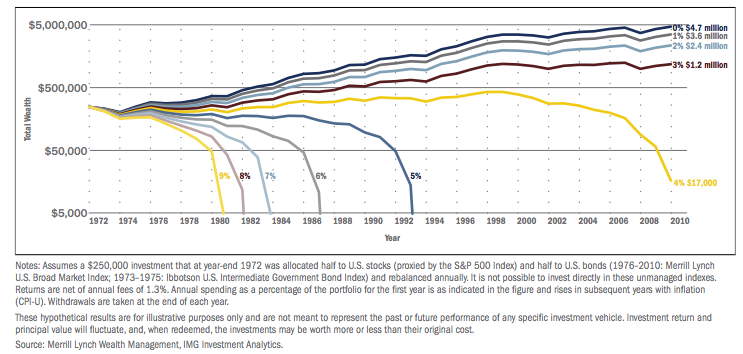
    Pitfalls in Retirement (pdf) is quite a good white paper from Meril Lynch, I strongly recommend it.

    A survey asked investors at least 41 years of age how much of their retirement savings they can safely spend each year without running the risk of exhausting their assets. Forty percent had no idea; an additional 29% said they
    could safely spend 10% or more of their savings each year.

    But, as explained below, the respondents most on target were the one in 10 who estimated sustainable spending rates to be 5% or less. This is significantly impacted by life expectancy; if you have a much lower life expectancy due to retiring later or significant health issues perhaps you can spend more. But counting on this is very risky.

    This is likely one of the top 5 most important things to know about saving for retirement (and just 10% of the population got the answer right). You need to know that you can safely spend 5%, or likely less, of your investment assets safely in retirement (without dramatically eating into your principle.

    chart showing retirement assets over time based on various spending levels
    Chart showing retirement assets over time based on various spending levels, from the Merill Lynch paper.

    The chart is actually quite good, the paper also includes another good example (which is helpful in showing how much things can be affected by somewhat small changes*). One piece of good news is they assume much larger expense rates than you need to experience if you choose well. They assume 1.3% in fees. You can reduce that by 100 basis points using Vanguard. They also have the portfolio split 50% in stocks (S&P 500) and 50% in bonds.

    Several interesting points can be drawn from this data. One the real investment returns matter a great deal. A 4% withdrawal rate worked until the global credit crisis killed investment returns at which time the sustainability of that rate disappeared. A 5% withdrawal rate lasted nearly 30 years (but you can’t count on that at all, it depends on what happens with you investment returns).

    Related: What Investing Return Projections to Use In Planning for RetirementHow Much Will I Need to Save for Retirement?Saving for Retirement

    (more…)

  • Warren Buffett’s 2011 Letter to Shareholders

    Warren Buffett continues to write his excellent annual shareholder letter. It is a pleasure to read them every year. I have selected a few passages to include:

    The logic is simple: If you are going to be a net buyer of stocks in the future, either directly with your own money or indirectly (through your ownership of a company that is repurchasing shares), you are hurt when stocks rise. You benefit when stocks swoon. Emotions, however, too often complicate the matter: Most people, including those who will be net buyers in the future, take comfort in seeing stock prices advance. These shareholders resemble a commuter who rejoices after the price of gas increases, simply because his tank contains a day’s supply.

    Charlie and I don’t expect to win many of you over to our way of thinking – we’ve observed enough human behavior to know the futility of that – but we do want you to be aware of our personal calculus. And here a confession is in order: In my early days I, too, rejoiced when the market rose. Then I read Chapter Eight of Ben Graham’s The Intelligent Investor, the chapter dealing with how investors should view fluctuations in stock prices. Immediately the scales fell from my eyes, and low prices became my friend. Picking up that book was one of the luckiest moments in my life.

    Investors face challenges within their own psychology. This is one, but not the only one.

    At bottom, a sound insurance operation needs to adhere to four disciplines. It must (1) understand all exposures that might cause a policy to incur losses; (2) conservatively evaluate the likelihood of any exposure actually causing a loss and the probable cost if it does; (3) set a premium that will deliver a profit, on average, after both prospective loss costs and operating expenses are covered; and (4) be willing to walk away if the appropriate premium can’t be obtained.

    Many insurers pass the first three tests and flunk the fourth. They simply can’t turn their back on business that their competitors are eagerly writing. That old line, “The other guy is doing it so we must as well,” spells trouble in any business, but in none more so than insurance. Indeed, a good underwriter needs an independent mindset akin to that of the senior citizen who received a call from his wife while driving home. “Albert, be careful,” she warned, “I just heard on the radio that there’s a car going the wrong way down the Interstate.” “Mabel, they don’t know the half of it,” replied Albert, “It’s not just one car, there are hundreds of them.”

    Tad has observed all four of the insurance commandments, and it shows in his results. General Re’s huge float has been better than cost-free under his leadership, and we expect that, on average, it will continue to be. In the first few years after we acquired it, General Re was a major headache. Now it’s a treasure.

    The insurance business is explained well in this, and his other shareholder letter.

    Related: Warren Buffett’s 2010 Letter to ShareholdersWarren Buffett’s Q&A With Shareholders 2009Warren Buffett’s 2007 Letter to Shareholders

    (more…)

  • Avoiding Hedge Fund Investments is One of the Benefits of Being in the 99%

    Hedge funds sell themselves as investments for elites and justify their extraordinary expenses mainly by appealing to elites egos. Well, hedge funds by and large do poorly. This is largely due to huge expenses. Add to that the incentives managers have to take huge risks: the managers often get 20% of extraordinary gains and if they lose, well you lose your money. These incentives to take huge risks do mean a few hedge funds do spectacularly well each year (of course more usually do spectacularly poorly over time).

    Warren Buffett knew this and wagered a long term investment in a low cost Vanguard S&P 500 Index fund would beat a hedge fund over the long term.

    Buffett Seizes Lead in Bet on Stocks Beating Hedge Funds

    The wager that began on Jan. 1, 2008, pits the Omaha, Nebraska, billionaire against Protégé Partners LLC, a New York fund of hedge funds co-founded by Ted Seides and Jeffrey Tarrant. Protégé built an index of five funds that invest in hedge funds to compete against a Vanguard mutual fund that tracks the Standard & Poor’s 500 Index. The winner’s charity of choice gets $1 million when the bet ends on Dec. 31, 2017.

    Buffett’s argument, like the large pension funds, is that funds of hedge funds cost too much, according to a statement he posted on longbets.org, a website backed by the nonprofit Long Now Foundation that fosters “long-term thinking.” In addition to the 2 percent management fee and 20 percent performance fee that hedge funds typically charge, the funds of funds add another layer of fees, on average 1.25 percent of assets and 7.5 percent of any gains, according to data compiled by Bloomberg.

    There may be many nice things about being in the 1% of the USA (being in 1% of the World is something more people in the USA should realize they are – more than 50% of the USA is in the 1% of everyone) but investing in hedge funds is mainly fools helping make a few more of the 1% by paying huge fees for lousy investments. Yes a few hedge funds will manage to do well. As would a few monkey’s throwing darts at a page of investments each quarter. The odds of picking a hedge fund for a long period of time that does so well the huge fees are justified are not great. Missing out on this investment option is not one you should feel sad about.

    Related: Is the Stock Market Efficient?Investment Risk Matters Most as Part of a Portfolio, Rather than in Isolation12 Stocks for 10 Years: January 2012 Update

  • 60% of Workers in the USA Have Less Than $25,000 in Retirement Savings

    2012 Retirement Confidence Survey

    (60 percent) report they and/or their spouses have less than $25,000 in total savings and investments (excluding their home and defined benefit plans), including 30 percent who have less than $1,000

    The data would be better if some value were placed on defined benefit plans; currently it is a bit confusing how much they may help. But the $25,000 threshold is so low that no matter what being under that value is extremely bad news for anyone over 40. And failing to have saved over just $25,000 toward retirement is bad news for anyone over 30 without a defined benefit plan.

    The large majority of workers who have not saved for retirement have little in savings. Almost two-thirds (63 percent) report they have less than $1,000 in savings and investments, and another quarter (25 percent) have $1,000–$9,999.

    Thirty-four percent of workers report they had to dip into savings to pay for basic expenses in the past 12 months.

    Thirty-five percent of all workers think they need to accumulate at least $500,000 by the time they retire to live comfortably in retirement. Eighteen percent feel they need between $250,000 and $499,999, while 34 percent think they need to save less than $250,000 for a comfortable retirement.

    Workers who have performed a retirement needs calculation are more than twice as likely as those who have not (23 percent vs. 10 percent) to expect they will need to accumulate at least $1 million before retiring.

    66% of workers say their family has retirement savings and 58% say they are currently saving for retirement. These results are fairly consistent over the last few decades (the current values are in the lower ranges of results).

    Nearly everyone wishes they had more money. One way to act as though you have more than you do is to borrow and spend (which is normally unwise – it can make sense for a house and in limited amounts when you are first going out on your own). Another is to ignore long term needs and just live it up today. That is a very bad personal finance strategy but one many people follow. Saving for retirement is a personal finance requirement. If you can’t save for retirement given your current income and lifestyle you need to reduce your current spending to save or increase your income and then save for retirement.

    A year or two of failing to do so is acceptable. Longer stretches add more and more risk to your personal financial situation. It may not be fun to accept the responsibilities of adulthood and plan for the long term. But failing to do so is a big mistake. Determining the perfect amount to save for retirement is complicated. A reasonable retirement saving plan is not.

    Saving 10% of your gross income from the time you are 25 until 65 gives you a decent ballpark estimate. Then you can adjust even 5 or 10 years as you can look at your situation. It will likely take over 10% to put you in a lifestyle similar to the one you enjoy while working. But many factors are at play. To be safer saving at 12% could be wise. If you know you want to work less than 40 years saving more could be wise. If you have a defined benefit plan (rare now, but, for example police or fire personnel often still do you can save less but you must work until you gain those benefits or you will be in extremely bad shape.

    IRAs, 401(k) and 403(b) plans are a great way to save for retirement (giving you tax deferral and Roth versions of those plans are even better – assuming tax rates rise).

    Related: In the USA 43% Have Less Than $10,000 in Retirement SavingsSaving for Retirement

  • Curious Cat Investing, Economics and Personal Finance Carnival #26

    Welcome to the Curious Cat Investing, Economics and Personal Finance Carnival: find useful recent personal finance, investing and economics blog posts and articles. The carnival is published twice each month. This carnival is different than others in two significant ways. First, I select posts from the blogs I read (instead of just posting those that submit to the carnival). I think this provides readers a better selection of valuable material (many of the best blogs don’t take time to submit to carnivals). And second, I include articles when I think they are interesting. I figure the primary purpose is to provide links to good recent content, so just because something isn’t a blog post doesn’t exclude it from inclusion.

    • What would happen if Greece defaulted and left the euro? by Jim Jubak – “I think it’s much too late to head off an eventual Greek default sometime, in my opinion, in 2012. But it still does make a huge difference how that default happens. Right now it looks like Greece is headed toward the kind of disorderly default—if not in March then in June or so–that results in the country leaving the euro and produces all the long-term damage I’ve described above…
    • My Top 6 Financial Commandments by Ryan Yates – “Don’t overlook saving for retirement. Remember, there’s no amount too little to save. Everything helps. Setting up an IRA or making the maximum contributions to your 401k are essential to keeping your future financial status secure.”
    • Euro is not to blame for crisis, interview with Jim Rodgers – “You can debase currency, and history is replete with governments that have debased their own currency and ruined their own currency for hundreds of – well for thousands of years it has been going on. You can do that and everything is okay for a while, but eventually you have inflation, you have high interest rates, you have currency turmoil, you have people no longer trusting each other to invest with each other, and then you have the end of the system, and we have chaos, and it starts over again.”
    • Apple’s Stock May Not Be as Cheap as It Looks by Jonathan Weil – “Using the fiscal 2009 earnings that Apple initially reported, its price-earnings ratio that day was about 33. Using its restated numbers, the ratio would have been about 23. My guess is a similar effect is occurring today: Had it not been for the rule change, Apple’s P/E ratio would be higher, because the ‘E’ would be lower.”
    • Why Dropbox Is A Major Disruption by Bill Gurley – “Once you begin using Dropbox, you become more and more indifferent to the hardware you are using, as well as the operating system on that device. Dropbox commoditizes your devices and their OS, by being your “state” system in the sky. Storing credentials and configurations of devices, and even applications are natural next steps for this company.” [I’ll admit I still don’t understand why Dropbox is worth so much, it seems useful but doesn’t seem to have much a “moat” (in Warren Buffett’s meaning) – John]
    Empire State Building, New York City
    Empire State Building, New York City by John Hunter

    (more…)

  • USA Apartment Market in 2011

    The national occupancy climbed 110 basis points during the year, and effective rents jumped 4.7% according MPF Research.

    Occupancy rates increased to 94.6% at the end of 2011, up from 93.5% a year ago and from 91.8% when the occupancy rates bottomed in late 2009.

    MPF Research predicts occupancy rates to increase another 50 basis points, and rents to rise 4.5%.

    Northern California’s apartment markets ranked as the nation’s rent growth leaders during calendar 2011, despite the fact that some weakness registered in the performances recorded in parts of the Pacific Northwest specifically during the fourth quarter. Year-over-year, effective rents for new leases jumped 14.6% in San Francisco, 12.3% in San Jose, and 9% in Oakland. With rents down 0.4%, Las Vegas was the nation’s only major apartment market that lost pricing power during calendar 2011.

    Rent Growth Leaders in Calendar 2011

    Rank Metro Area Annual Rent Growth
    1 San Francisco 14.6%
    2 San Jose 12.3%
    3 Oakland 9.0%
    4 Boston 8.3%
    5 New York 7.3%
    6 Austin 7.2%

    Related: Apartment Vacancies Fall to Lowest in 3 Years in the USA (April 2011)Top USA Markets for Buying Rental PropertyApartment Rents Rise, Slightly, for First Time in 5 QuartersIt’s Now a Renter’s Market

  • Curious Cat Investing, Economics and Personal Finance Carnival #24

    The Curious Cat Investing, Economics and Personal Finance Carnival is published twice each month. We find useful recent personal finance, investing and economics blog posts and articles to share with you.

    • 2 Billionaire Brothers’ Insider Buying At Colfax by Zack Miller – “[In] the Danaher Business System… management believes its found a demonstrable, repeatable recipe for success, and it drives both culture and process at the company and its acquisitions. DBS is a form of Japanese kaizen, comprising 4 components: 1) People 2) Plans 3) Processes 4) Performance” [I own Danaher and have it in my 12 stocks for 10 year portfolio – John, my management blog focuses on such management systems]
    • Apple’s Impossibly Good Quarter by John Hunter – “You can’t grow quarterly sales from $26.7 billion to $46.3 billion. $26 million to $46 million, fine that is possible, billions however – not possible. Except Apple did. You can’t grow a $6 billion quarterly profit to $13 billion in 1 year. Except Apple did. You can’t generate a cash flow of $17.5 billion in a quarter. Except Apple did. You can’t have a stockpile of $100 billion in cash. Except Apple does. These figures would not have been seen as unlikely just 3 years ago. They were impossible. But Apple achieved them.”
    • How to Save the Euro by George Soros – “the cuts in government expenditures that Germany wants to impose on other countries will push Europe into a deflationary debt trap. Reducing budget deficits will put both wages and profits under downward pressure, the economies will contract, and tax revenues will fall. So the debt burden, which is a ratio of the accumulated debt to the GDP, will actually rise, requiring further budget cuts, setting in motion a vicious circle.”
    • Japan’s Trade Figures: Some Perspective by Eamonn Fingleton – “In a typical maneuver, goods might be shipped to China via Hong Kong. The goods are exported from Japan at heavily discounted prices and a Hong Kong subsidiary takes a huge profit in selling to China. Such profits constitute hidden export revenues that are not caught in the visible trade numbers. The maneuver makes sense because Japan’s corporate tax rate is one of the world’s highest.” [This is one, of many things, that make economic data difficult to rely on – you have to pay close attention to the details – John]
    • (more…)

  • Apple’s Impossibly Good Quarter

    Apple has been performing amazingly well for years. They keep producing blockbuster hits over and over. Not only are these hits enormously popular they are enormously profitable.

    The only real objections to Apple’s stock I can see are: the overall market value is so huge it just has to collapse (over $400 billion – the largest in the world) or it has to be time for a huge reversal of fortunes.

    The problem with the view that it will fall is that the stock is very cheap by any rational measure. You are not paying much for all the earnings. Even if Apple does not continue the trend of the last 5 years, if it just stopped growing altogether, it is still cheap (if it does continue that trend it will break $1 trillion by 2014 – but I don’t think it will). The biggest risk is the profit margin shrinks drastically. That is possible. It is even somewhat likely to shrink a fair amount. But there isn’t much reason to think revenues will not grow. And to me, the current price makes sense only if revenues fall and profit margins fall. It takes the worst case scenario to make this stock seem overpriced.

    The data on the last quarter (and for 2011 overall) are impossible (except they actually happened).

    • record quarterly revenue of $46.33 billion ($26.74 billion in 2010)
    • record quarterly net profit of $13.06 billion ($6 billion in 2010)
    • Gross margin was 44.7 percent compared to 38.5 percent in the year-ago quarter
    • $17.5 billion in cash flow from operations during the quarter (and $38 billion in the last year)
    • $100 billion in cash now ($97.6 billion to be exact but since the data was gathered they probably passed $100 billion anyway). That is more than the market cap of all but 52 companies in the world.

    You can’t grow quarterly sales from $26.7 billion to $46.3 billion. $26 million to $46 million, fine that is possible, billions however – not possible. Except Apple did. You can’t grow a $6 billion quarterly profit to $13 billion in 1 year. Except Apple did. You can’t generate a cash flow of $17.5 billion in a quarter. Except Apple did. You can’t have a stockpile of $100 billion in cash. Except Apple does. These figures would not have been seen as unlikely just 3 years ago. They were impossible. But Apple achieved them.

    These figures are not short term blips. They are the latest in a long stream of amazingly results.

    Related: How Apple Can Grow from $200 Billion to $300 Billion In Market CapApple Tops Google (August 2008)

    Apple has numerous, incredibly strong businesses. Each could be the linchpin of an extremely valuable company.

    • iPhone initial sales and reoccurring income (over 50% of Apple’s revenue)
    • app sales (for iPhones, iPads and Macs)
    • iPads
    • iTunes
    • Macs
    • Their retail store business – selling all their products

    (more…)

  • Curious Cat Investing, Economics and Personal Finance Carnival #23

    Welcome to the Curious Cat Investing, Economics and Personal Finance Carnival: find useful recent personal finance, investing and economics blog posts and articles. The carnival is published twice each month. This carnival is different than others in two significant ways. First, I select posts from the blogs I read (instead of just posting those that submit to the carnival). I think this provides readers a better selection of valuable material (many of the best blogs don’t take time to submit to carnivals). And second, I include articles when I think they are interesting. I figure the primary purpose is to provide links to good recent content, so just because something isn’t a blog post doesn’t exclude it from inclusion.

    • Recovering Adam Smith’s ethical economics – “He justified commercial society for its tremendous contribution to the prosperity, justice, and freedom of its members, and most particularly for the poor and powerless in society.” [This post covers a topic I think is very important and have written about several times – John]
    • A Man. A Van. A Surprising Business Plan. by Zoe Chace – “Adam had tricked out the van to be a mobile solution to Chinese bureaucracy. There are a couple of Mac laptops and a printer, plus an old couch, Christmas lights and bamboo mats. It’s as cozy as a dorm room. And confused visa applicants line up outside.” [wonderful – John]
    • Chart of Manufacturing Output from 2000 to 2010 by Country by John Hunter – “Europe has 4 countries in this list (if you exclude Russia) and they do not appear likely to do particularly well in the next decade, in my opinion. I would certainly expect Brazil, India, Korea and Indonesia to out produce Italy, France, UK and Spain in 2020. In 2010 the total was $976 billion by the European 4 to $961 billion by the non-European 4. In 2000 it was $718 billion for the European 4 to $343 billion (remember all the data is in 2010 USD).”
    • Ultimate Sustainable Dividend Portfolio – “I would expect the Ultimate Sustainable to do better in difficult times and worse in great times. Why? The USDP is a more stable portfolio that will fluctuate less over time…”
    • (more…)