Category: Investing

  • 12 Stocks for 10 Years: January 2012 Update

    The 12 stock for 10 years portfolio consists of stocks I would be comfortable putting into an IRA for 10 years. The main criteria is for companies with a history of large positive cash flow, that seemed likely to continue that trend. I am considering adding Abbot to the portfolio, and maybe dropping Cisco.

    Since April of 2005 the portfolio Marketocracy* calculated annualized rate or return (which excludes Tesco) is 5.7% (the S&P 500 annualized return for the period is 3.9%). Marketocracy subtracts the equivalent of 2% of assets annually to simulate management fees – as though the portfolio were a mutual fund – so without that (it is not like this portfolio takes much management), the return beats the S&P 500 annual return by about 380 basis points annually (it would be a bit less with Tesco, but still close above 3%, I would think – calculating rates of return with purchases and sales and dividends is a complete pain, which is one reason Marketocracy is so nice).

    The current stocks, in order of return:

    Stock Current Return % of sleep well portfolio now % of the portfolio if I were buying today
    Amazon – AMZN 350% 9% 7%
    Google – GOOG 187% 17% 14%
    PetroChina – PTR 115% 8% 6%
    Templeton Dragon Fund – TDF 85% 8% 7%
    Templeton Emerging Market Fund – EMF 44% 5% 7%
    Danaher – DHR 43% 10% 10%
    Apple – AAPL 42% 9% 9%
    Intel – INTC 18% 6% 6%
    Cash (likely to be ABT soon) 4% 6%
    Cisco – CSCO -2% 5% 4%
    Toyota – TM -8% 8% 12%
    Pfizer – PFE -9% 6% 7%
    Tesco – TSCDY -13%** 0%* 5%

    The current marketocracy results can be seen on the Sleep Well marketocracy portfolio page.

    Related: 12 Stocks for 10 Years: Feb 2011 Update12 Stocks for 10 Years, July 2011 Update12 Stocks for 10 Years, July 2009 Updatehand picked articles on investing
    (more…)
  • Taking a Look at Some Dividend Aristocrats

    See the full list of Dividend Aristocrats below. The stocks in this index are companies within the S&P 500 that have increased dividends every year for at least 25 consecutive years. After 10 were added and 1 removed, this month, there are now 51 companies included (so just over 10% of all S&P 500 stocks) – and remember many S&P 500 stocks haven’t existed for 25 years, or pay no dividend today, or didn’t 10 or 20 years ago (Google, Apple, Intel, …). It is surprising so many companies have successfully done this.

    I’ll take a look at a few of them here (I looked at the new additions in my previous post: Investing in stocks that have raised dividends consistently).

    Stock Yield
       
    div/share 2011 div/share 2000 % increase
    3M (MMM) 2.8% $2.20 $1.16 90%
    Aflac (AFL) 3.2% $1.23 $0.165 645%
    Abbott Laboratories (ABT) 3.5% $1.92 $0.74 159%
    Cincinnati Financial (CINF) 5.3% $1.60 $0.69 132%
    Coca-Cola Co (KO) 2.8% $1.88 $0.68 176%
    Exxon Mobil Corp (XOM) 2.4% $1.85 $0.88 110%
    Johnson & Johnson (JNJ) 3.6% $2.25 $0.62 263%
    Kimberly-Clark (KMB) 3.9% $2.80 $1.08 159%
    Medtronic (MDT) 2.8% $0.94 $0.18 417%
    Procter & Gamble (PG) 3.2% $2.06 $.67 207%

    Just looking at this data Aflac sure looks appealing. Having both a high yield and strong growth is an appealing combination. And Warren Buffet agree (he owns quite a bit) which is also reassuring (he also owns a large stake in Coke). Of course strong growth over the last 11 years won’t necessarily repeat (in fact it gets much harder). On the other had some slow growth companies would likely continue slow growth (at best): Exxon Mobil, 3M…

    Really almost all of these stocks are pretty attractive. Medtronic, Johnson & Johnson and Abbot Laboratories look particularly appealing to me (along with Aflac and Kimberly-Clark). I would have to do more research on any of these (other than Abbot Laboratories, which I already own) before deciding to buy, but they sure look good as safe long term investments. Health care is a growing need (in the USA and globally). It is true the costs in the USA have to be reduced, and this could make things more difficult for companies in the health care industry.

    Related: Sleep well investing portfolioLooking for Dividend Stocks in the Current Extremely Low Interest Rate EnvironmentIs the Stock Market Efficient?

    Full list of Dividend Aristocrats, an index measures the performance of large cap, blue chip companies within the S&P 500 that have followed a policy of increasing dividends every year for at least 25 consecutive years.

    (more…)

  • Investing in Stocks That Have Raised Dividends Consistently

    The Dividend Aristocrats index measures the performance of S&P 500 companies “that have followed a policy of increasing dividends every year for at least 25 consecutive years.” S&P makes additions and deletions from the index annually. This year 10 companies were added and 1 was deleted.

    Stock Yield
       
    div/share 2011 div/share 2000 % increase
    AT&T (T) 6% $1.72 $1.006 72%
    HCP Inc (HCP) 4.9% $1.92 $1.47 31%
    Sysco (SYY) 3.7% $1.04 $0.24 333%
    Nucor (NUE) 3.7% $1.45 $0.15 867%
    Illinois Tool Works (ITW) 3.1% $1.40 $0.38 268%
    Genuine Parts (GPC) 3.1% $1.80 $1.10 64%
    Medtronic (MDT) 2.8% $0.936 $0.181 417%
    Colgate-Palmolive (CL) 2.6% $2.27 $0.632 259%
    T-Rowe Price (TROW) 2.9% $1.24 $0.27 359%
    Franklin Resources (BEN) 1.2% $1.00 $.0245 308%

    You can’t expect members of the Dividend Aristocrats to match the dividend increases shown here. As companies stay in this screen of companies the rate of growth often decreases as they mature. Also some have already increased the payout rate (so have had an increasing payout rate boost dividend increases) significantly.

    The chart also shows that a smaller current yield need not dissuade investing in a company even when your target is dividend yield, giving the large dividend increase in just 10 years. Nucor yielded just 1.5% in 2000 (at a price of $10). Ignoring reinvested dividends your current yield on that investment would be 14.5%. To make the math easy 10 shares in 2000 cost $100, and they paid $1.50 in dividends (%1.5). Dividends have now increase so those 10 shares are paying $14.50 in dividends (14.5%). Of course Nucor worked out very well; that type of return is not common. But the idea to consider is that the long term dividend yield is not only a matter of looking at the current yield.

    The period from 2000 to 2011 was hardly a strong one economically. Yet look at how many of these companies dramatically increased their dividend payouts. Even in tough economic times many companies do well.

    Related: Looking for Dividend Stocks in the Current Extremely Low Interest Rate EnvironmentWhere to Invest for Yield Today10 Stocks for Income Investors

  • Curious Cat Investing, Economics and Personal Finance Carnival #21

    Welcome to the Curious Cat Investing, Economics and Personal Finance Carnival: find useful recent personal finance, investing and economics blog posts and articles.

    • Why Financial Literacy Fails (and What to Do About It) by JD Roth – “‘For years, I struggled with money,’ I told my interviewer today. ‘I knew the math, but I still couldn’t seem to defeat debt. It wasn’t until I started applying psychology to the situation that I was able to make changes.’”
    • Get ready for the three big financial crises of 2012 by Jim Jubak – “So in 2012 Ireland—and Greece and Portugal—are going to face a huge choice. They can either try to grind out more austerity in the midst of a EuroZone recession or they can try to renegotiate some of that debt. If you remember, the battle over Greek bank debt almost scuttled the euro this year. Well, we’re going to see the same problem again in 2012…”
    • How Long Would It Take To Build A $5000/Year Dividend Cash Flow? – John is able to investing $1000 per month in a portfolio now yielding 2.86% and dividends increasing 9% a year (under historical level for the stocks included)… a bit over 7 years…
    • Mark Cuban, invest in yourself. Keep your cash – wait to get a bargin based on the cash your have which allows you to take advantage of market opportunities.

    • (more…)

  • Relocating to Another Country

    There is an increasing trend to move from the USA to another country to work and live. This is not surprising to me. Recently this has picked up quite a bit; I am surprised by the velocity at which this interest in moving (I figured it would be a long term mega trend but not so drastic, so quickly). Economic changes are often quite surprising in how rapidly they move forward.

    An interesting survey shows USA investors have become much more interested in relocating in the last two years (the data they show though has tremendous volatility over time, so I am not really sure this means much). I wonder how much of it can be explained by investors wanting to get a deep understanding of very promising markets. I wouldn’t image the actual number that do this is huge, but maybe the number considering it is significant. Billionaire investor, Jim Rodgers moved to Asia because he sees Asia as key to the future. One of the reasons I moved to Malaysia this year was to get a in depth understanding of what South East Asia is like (it is not a deciding reason, at all but maybe the 4th or 5th reason).

    I believe the globalization of the employment market is a long term trend that will continue – especially for “knowledge workers.” The USA rested on the post WW II economic domination for nearly 50 years. The policies also helped this continue: investing in science and engineering, favoring entrepreneurship… But other countries have realized the value of these things (and the USA is slipping – not investing nearly as much in science and engineering and favoring large corporations that give politicians large amounts of cash over innovation – see things like the incredibly outdated “intellectual property” system, SOPA, favoring huge financial institutions…

    The combination of long term policy weakness, the inevitable decline in the USA to world ratio of economic wealth, and the financial crisis caused by the policy weaknesses have seemingly greatly accelerated the trend. The next 2 or 3 years will determine if that is a permanent acceleration or if we go back to a slower pace – but on the same path. My guess is that we will stay on this path but the pace will not follow the level surveys might indicate (showing interest in such a big change is far different from actually moving).

    There don’t seem to be any decent estimates of Americans living abroad. The US State Department claims releasing their estimates would be a national security risk? And the Census bureau says it would cost too much to try. Wild guesses seem to be between 4 and 6 million.

    Related: I want out (subreddit)Why Investing is Safer OverseasUSA Heath Care System Needs ReformCopywrong

  • Curious Cat Investing, Economics and Personal Finance Carnival #20

    Welcome to the Curious Cat Investing, Economics and Personal Finance Carnival. Investing markets continue to move in seemingly haphazard ways. The risks from excessive debt, failure to regulate financial institutions, political weakness (both of politicians and of populaces electing such incapable politicians), financial fraud and more make this a very difficult time to invest. We hope to help find useful recent personal finance, investing and economics blog posts and articles.

    • The Unemployment Plan – “I just found out that I’m being “downsized” at the end of the year. While I have a small emergency fund, I do have a mortgage and a bit of credit card debt. I also have three kids at home. My wife will continue to work, but she has only a part-time job with minimal benefits. I am receiving a pretty good severance package, though.
      Rather than panicking, I’m trying to be calm and rational about figuring out what’s next…”
    • Choosing Between An Annuity And A Dividend Portfolio – “Personally, I consider the choice between an annuity or a dividend portfolio to be a no-brainer. I think a systematic, sustainable and disciplined approach to dividend investing will outperform in almost all cases and while it will require a bigger time investment, that is a small price to get more flexibility, better returns and a much stronger growth potential.”
    • From the webcast (see above) with Jim Rodgers. He sees a difficult period worldwide the next 2 years. He is short many shares everywhere (including emerging market). He also owns some shares. But overall he sees a difficult few years for stock markets.
      He says China has a price bubble in real estate and many bankruptcies will take place. But it is not as bad as the USA problems where there was a credit bubble (you have to have a job to get real estate loans, while in the USA and UK you didn’t have too). Chinese banks are is less bad shape than the USA and Europe.
    • Manufacturing Employment Data: USA, Japan, Germany, UK… 1990-2009 by John Hunter – “Compensation in the countries currency is remarkably consistent across all countries from 1990-2009. Japan shows the only significant divergence in the period of 2002 – 2009 actually decreasing pay in real terms (a small amount – from 100 to 98) while the average increases to about 110.”
    • (more…)

  • Where are Profit Margins Headed?

    Where is the economy headed? With the troubles of huge debt (by governments and consumers) and the possible collapse of the Euro it is very hard to be certain. And where is the stock market headed? That is also difficult to predict. Of course, where the stock market is headed in the short term is never easy to predict. If you can predict, you should be rich (though it likely takes a bit more, knowing how much to risk…).

    At least by knowing what has happened you can be ahead of where many people are. The USA economy has not been in a recession, we have actually been growing. Just doing so very slowly. And doing so without many added jobs. Companies however, have been doing very well.

    U.S. companies’ ability to squeeze more profit from each dollar of sales is pushing earnings higher, even as the economy has grown at a below-average clip since the recession ended in June 2009.

    For investors knowing if this is a positive trend that can be expected to continue or an aberration is key. But I have no way of knowing. My guess is it is at least partially something that will continue (but maybe a portion of the gains are an aberration) – but this is just a guess. This bloomberg article looks more at the issue.

    Grantham, who called corporate profits “freakishly high” in an August commentary, sees wide margins as an aberration. Some of his competitors say changes in the economy and the way firms operate could keep them near peak levels for another year or two. “We don’t think they have to fall,” Doll, whose New York- based firm is the world’s largest asset manager, said in a phone interview. BlackRock oversees $3.35 trillion.

    The margins of non-financial companies in the U.S., a widely used measure of profitability, reached 15 percent in the third quarter, according to data from Moody’s Analytics Inc. in West Chester, Pennsylvania. That was the highest level since 1969. When the recession ended in the second quarter of 2009, the comparable number was 8.7 percent.

    The most compelling data supporting my belief is the long term trend.

    Profit margins have been trending higher since the mid-1980s, said Chris Christopher, an economist at IHS (IHS) Global Insight, who has written on the subject. Quarterly margins peaked at 11.9 percent in the 1980s, 13.6 percent in the 1990s and 14.5 percent in the most recent decade, Moody’s data show.

    But where this trend ends and starts reversing won’t be obvious until years after it happens. But investors that can predict (or guess) margin changes will likely be rewarded financially.

    Related: The Economy is Weak and Prospects May be Grim, But Many Companies Have Rosy ProspectsIs the Stock Market Efficient?Investment Risk Matters Most as Part of a Portfolio, Rather than in Isolation

  • Curious Cat Investing, Economics and Personal Finance Carnival #19

    Welcome to the Curious Cat Investing and Economics Carnival: find useful recent personal finance, investing and economics blog posts and articles.

  • Looking at the Value of Different College Degrees

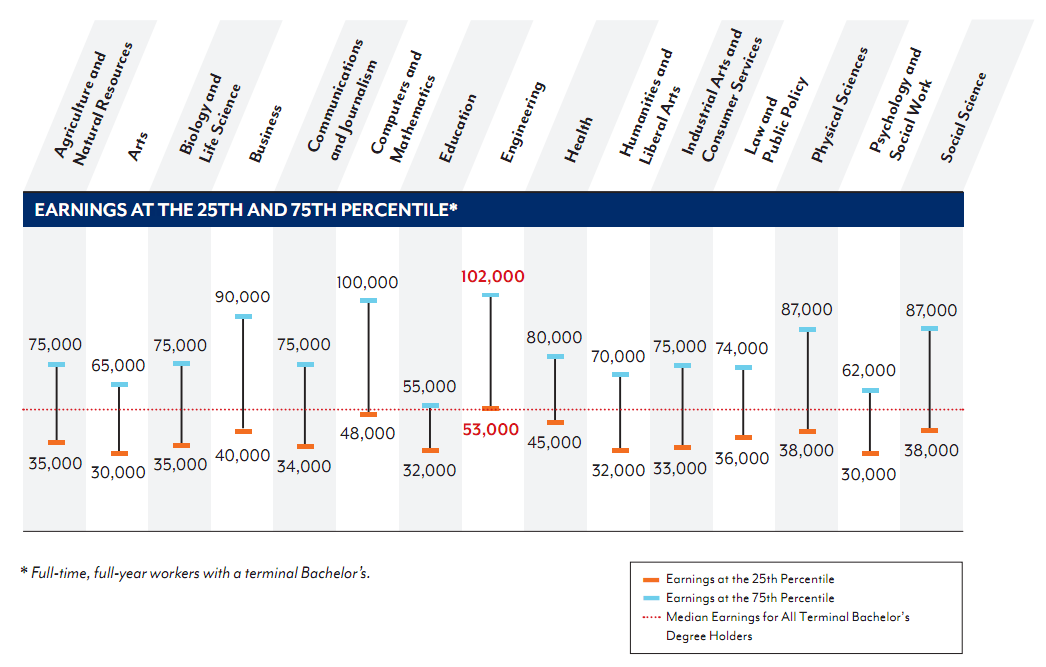
    Georgetown University Center on Education and the Workforce has produced a new report looking at the value of different college degrees in the USA. I have seen a great increase in discussions of the “bubble” in education. Those articles often say a college degree doesn’t assure the success it used to. The data I review seems to show extremely large benefits for those with a college degree (higher salaries but, much more importantly, in my opinion, they also have much lower unemployment rates).

    Those benefits are greatest for several majors including science, math and engineering. The problem I see is not so much that significant benefits are lacking for college degrees but the huge increases in costs of getting a degree are so large that for some majors the cost is just so large that even with the benefits it is arguable whether it is worth the cost (while a few decades ago the benefits were universal and so large the economic benefit was not debatable).

    The authors of the report found that all undergraduate majors are worthwhile, even taking into account the cost of college and lost earnings. However, the lifetime advantage ranges from $1,090,000 for Engineering majors to $241,000 for Education majors. As I have written frequently on the Curious Cat Science and Engineering blog, engineering degrees are very financially rewarding.

    The top 10 majors with the highest median earnings for new graduates are:

    • Petroleum Engineer ($120,000)
    • Pharmacy/pharmaceutical Sciences and Administration ($105,000)
    • Mathematics and Computer Sciences ($98,000)
    • Aerospace Engineering ($87,000)
    • Chemical Engineering ($86,000)
    • Electrical Engineering ($85,000)
    • Naval Architecture and Marine Engineering ($82,000)
    • Mechanical Engineering, Metallurgical Engineering and Mining and Mineral Engineering (each with median earnings of $80,000)
    chart showing the salaries by major in the USA (2009)
    Chart of salaries (25th and 75th percentile) by major in the USA based on data from 2009

    Related: 10 Jobs That Provide a Great Return on InvestmentMathematicians Top List of Best OccupationsNew Graduates Should Live Frugally

    (more…)

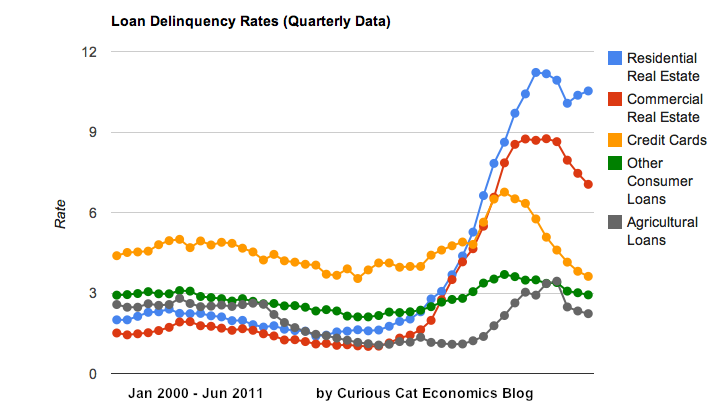
  • Consumer and Real Estate Loan Delinquency Rates from 2000 to 2011

    chart showing loan delinquency rates from 2000-2011 in the USA
    Chart showing loan delinquency rates from 2000-2011, shows seasonally adjusted data for all banks for consumer and real estate loans. The chart is available for use with attribution. Data from the Federal Reserve.

    Residential real estate delinquency rates increased in the first half of 2011 in the USA. Other debt delinquency rates decreased. Credit card delinquency rates have actually reached a 17 year low.

    While the job market remains poor and the serious long term problems created by governments spending beyond their means (for decades) and allowing too big to fail institutions to destroy economic wealth and create great risk for world economic stability the USA economy does exhibit positive signs. The economy continues to grow – slowly but still growing. And the reduction in delinquency rates is a good sign. Though the residential and business real estate rates are far far too high.

    Related: Consumer and Real Estate Loan Delinquency Rates 2000-2010Real Estate and Consumer Loan Delinquency Rates 1998-2009Government Debt as Percent of GDP 1998-2010 for OECD

    (more…)