Category: Investing

  • The Formula That Killed Wall Street

    The Formula That Killed Wall Street

    For five years, Li’s formula, known as a Gaussian copula function, looked like an unambiguously positive breakthrough, a piece of financial technology that allowed hugely complex risks to be modeled with more ease and accuracy than ever before. With his brilliant spark of mathematical legerdemain, Li made it possible for traders to sell vast quantities of new securities, expanding financial markets to unimaginable levels.

    His method was adopted by everybody from bond investors and Wall Street banks to ratings agencies and regulators. And it became so deeply entrenched—and was making people so much money—that warnings about its limitations were largely ignored.

    Then the model fell apart. Cracks started appearing early on, when financial markets began behaving in ways that users of Li’s formula hadn’t expected. The cracks became full-fledged canyons in 2008—when ruptures in the financial system’s foundation swallowed up trillions of dollars and put the survival of the global banking system in serious peril.

    Very nice article on the dangers of financial markets to those that believe that math can provide all the answers. Math can help find opportunities. However markets have physical, psychological and regulatory limitations. And markets frequently experience huge panics or manias. People continue to fail to model that properly.

    Related: All Models Are Wrong But Some Are UsefulLeverage, Complex Deals and ManiaFinancial Markets with Robert ShillerFinancial Market MeltdownFailure to Regulate Financial Markets Leads to Predictable Consequences

  • Managing Retirement Investment Risks

    The Society for Actuaries has published a good resource: Managing post-retirement risks.

    Experts disagree about when annuitization is a good strategy. Disadvantages include losing control of assets, costs, and inability to leave money to one’s heirs. Annuities without inflation protection are only partial protection against living “too long.”

    Many investors try to own some assets whose value may grow in times of inflation. However, this sometimes will trade inflation risk for investment risk.
    Common stocks have outperformed inflation in the long run, but are
    poor short-term hedges. The historically higher returns from stocks
    are not guaranteed and may vary greatly during retirement years.

    Retirement planning should not rely heavily on income from a bridge job. Many retirees welcome the chance to change careers and move into an area with less pay but more job satisfaction, or with fewer demands on their time and energy.

    Terminating employment before age 65 may make it difficult to find a source of affordable health insurance before Medicare is available.

    Insurance for long-term care covers disabilities so severe that assistance is needed with daily activities such as bathing, dressing and eating. Some policies require a nursing home stay; others do not. The cost of long-term care insurance is much less if purchased at younger ages, well before anticipated need.

    The full document is well worth reading.

    Related: Many Retirees Face Prospect of Outliving SavingsHow to Protect Your Financial HealthFinancial Planning Made Easypersonal finance tips

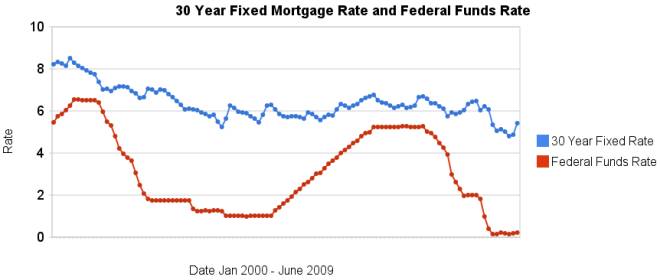
  • 30 Year Mortgage Rate and Federal Funds Rate Chart

    Once again the data shows that the 30 year fixed mortgage rates are not directly related to federal funds rates. In June the fed funds rate increased 3 basis points, 30 year mortgage rates increased 56 basis points. Since January the fed funds rate is up 6 basis points is up while 30 year mortgage rates are up 36 basis points. Home prices have continued to fall even with the very low mortgage rates.

    30 year fixed mortgage rates and the federal funds rate 2000-2009

    Related: Mortgage Rates: 6 Month and 5 Year Chartshistorical comparison of 30 year fixed mortgage rates and the federal funds rateposts on financial literacyGM and Citigroup Replaced by Cisco and Travelers in the DowJumbo v. Regular Fixed Mortgage Rates: by Credit Score

    For more data, see graphs of the federal funds rate versus mortgage rates for 1980-1999. Source data: federal funds rates30 year mortgage rates

  • Another Wave of Foreclosures Loom

    Another wave of foreclosures is poised to strike

    loan defaults are up sharply. And with many government and banks’ self-imposed foreclosure moratoriums expiring, the biggest lenders indicate that they are likely to move more aggressively to clear up a backlog of troubled mortgages.

    Mark Zandi of Moody’s Economy.com estimates that 15.4 million homeowners — or about 1 in 5 of those with first mortgages — owe more on their homes than they are worth.

    Government and company reports show that the number of completed foreclosures nationwide slowed sharply late last year and into early this year, largely because of various moratoriums in effect during much of the first quarter.

    But anecdotal reports indicate that foreclosure sales have started to climb again in the second quarter. And the pipeline is clearly getting fuller. In the first quarter, some 1.8 million homeowners nationwide fell behind on their loans by 60 to 90 days, a 15% increase from the prior quarter, according to Moody’s Economy.com. The research firm said that loan defaults rose sharply as well, to 844,000 in the first three months of this year.

    Even as defaults among subprime borrowers have trended lower this year, newly initiated foreclosures involving prime mortgage loans saw a significant increase in the first quarter, jumping 21.5% from the fourth quarter, according to a government report of loan data from national banks and federally regulated thrifts.

    This is more bad news for the economy. As I have been saying the economy is still in serious trouble. Cleaning up the damage caused by living beyond our means for decades does not get cleaned up quickly. This are actually going as well as could be hoped for, I think. We need to hope the remainder of this year sees the economy stabilize and then hope 2010 brings some good news.

    Related: Nearly 10% of Mortgages Delinquent or in ForeclosureOver Half of 2008 Foreclosures From Just 35 CountiesHow Much Worse Can the Mortgage Crisis Get? (March 2008)Mortgage Rates Falling on Fed Housing Focus

  • Increasing USA Saving Rate is a Good Sign

    Surging U.S. Savings Rate Reduces Dependence on China

    Government data today showed that the household savings rate rose to 6.9 percent in May, the highest since December 1993, as personal spending increased less than incomes. The rate in April 2008 was zero. Most of the rise in income in May was due to one-time government stimulus payments to seniors

    Nouriel Roubini, an economics professor at New York University and chairman of RGE Monitor, forecasts that the savings rate will ultimately reach 10 percent to 11 percent. What’s critical, he said in a Bloomberg Television interview on June 24, is how quickly it increases.

    A rapid rise in the next year because of a collapse in consumption would push the economy, already in its deepest contraction in 50 years, further into recession, he said. If it occurs over a few years, the economy may grow.

    From 1960 until 1990, households socked away an average of about 9 percent of their after-tax income, government figures show. Americans got out of the habit in the 1990s as they saw their wealth build up in other ways, first through surging stock prices and then soaring home values, Gramley said.

    That process has now gone into reverse. U.S. household wealth fell by $1.3 trillion in the first quarter of this year, with net worth for households and nonprofit groups reaching the lowest level since 2004, according to a Fed report. Wealth plunged by a record $4.9 trillion in the last quarter of 2008.

    Edmund Phelps, winner of the Nobel Prize in economics in 2006 and a professor at Columbia University in New York, said it may take as long as 15 years for households to rebuild what they lost in the recession.

    As I have been saying the living beyond our means must stop. Those that think health of an economy is only the GDP forget that if the GDP is high due to spending tomorrows earnings today that is not healthy. Roubini correctly indicates the speed at which savings increases could easily determine the time we crawl out of the recession. I hope the savings rate does increase to over 10 percent.

    If we do that over 3 years that would be wonderful. But it is more important we save more. If that means a longer recession to pay off the excessive spending over the last few decades so be it. And it is going to take a lot longer than a few years to pay off those debts. It is just how quickly we really start to make a dent in paying them off that is in question now (or whether we continue to live beyond our means, which I think it still very possible – and unhealthy).

    Related: Will Americans Actually Save and Worsen the Recession?Can I Afford That?$2,540,000,000,000 in USA Consumer Debt (April 2008)Paying for Over-spending

  • Canada’s Sound Regulation Resulted in a Sound Banking System Even During the Credit Crisis

    The IMF 2009 country report on Canada discusses there current economic condition. As part of that they explore the success Canada had in regulating their banking sector (which stands in stark contract to the catastrophic regulatory failures in the USA and Europe). And also provide ample evidence of that wise regulation did indeed prevent the financial crisis.

    Canada’s banking system has so far displayed remarkable stability amid the global turbulence, thanks in good part to strong supervision and regulation. The financial system has avoided systemic pressures: no financial institution has failed or required public capital injections (banks have raised capital in markets, albeit at elevated cost owing to higher global risk aversion). Key factors behind this relatively strong performance were:

    • Sound supervision and regulation: The 2008 FSSA Update found that the regulatory and supervisory framework meets best practice in many dimensions, including with regard to
      the revised Basel Core Principles for banking supervision.
    • Stringent capital requirements: Solvency standards apply to banks’ consolidated commercial and securities operations. Tier 1 capital generally significantly exceeds the required 7 percent target (which in turn exceeds the Basel Accord minimum of 4 percent). The leverage ratio is limited to 5 percent of total capital.
    • Low risk tolerance and conservative balance sheet structures: Banks have a profitable and stable domestic retail market, and (like their customers) exhibit low risk tolerance. Banks had smaller exposures to “toxic” structured assets and relied less on volatile wholesale funding than many international peers.
    • Conservative residential mortgage markets: Only 5 percent of mortgages are non- prime and only 25 percent are securitized (compared with 25 percent and 60 percent, respectively, in the United States). Almost half of residential loans are guaranteed, while the remaining have a loan-to-value ratio (LTV) below 80 percent—mortgages with LTV above this threshold must be insured for the full loan amount (rather than the portion above 80 percent LTV, as in the United States). Also mortgage interest is nondeductible, encouraging borrowers to repay quickly.
    • Regulation reviews: To keep pace with financial innovation, federal authorities review financial sector legislation every five years (Ontario has a similar process for securities market legislation).
    • Effective coordination between supervisory agencies: Officials meet regularly in the context of the Financial Institutions Supervisory Committee (FISC) and other fora to discuss issues and exchange information on financial stability matters.
    • Proactive response to financial strains: The authorities have expanded liquidity facilities, provided liability guarantees, and purchased mortgage-backed securities. In addition, several provinces now provide unlimited deposit insurance for provincially-regulated credit unions. The 2009 Budget further expands support to credit markets, while providing authority for public capital injections and other transactions to support financial stability.

    Related: Failure to Regulate Financial Markets Leads to Predictable ConsequencesSound Canadian Banking System2nd Largest Bank Failure in USA HistoryEasiest Countries for Doing Business 2008

  • Y-Combinator’s Fresh Approach to Entrepreneurship

    Four Lessons from Y-Combinator’s Fresh Approach to Innovation

    Y Combinator’s basic approach is to give promising ideas a small amount of seed capital (the average investment is less than $25,000), then house those startups for a short period of time. The startups get the capital, strategic input from the Y Combinator team (Graham and his wife), access to a robust network of potential investors, and the opportunity to learn from other Y Combinator–funded startups. In return Y Combinator gets a slice of the business.

    Tight windows enable “good enough” design. Most Y Combinator–funded companies are expected to release a version of their idea in less than 3 months. That tight time frame forces entrepreneurs to introduce “good enough” software packages that can then iterate in market. This approach contrasts to efforts by many companies to endlessly perfect ideas in a laboratory, only to fail the real test of being exposed to real market conditions.
    Business plans are nice, not necessary. Y Combinator doesn’t obsess over whether entrepreneurs have detailed business plans. Again, the focus is getting something out in the market to drive iteration and learning. After all, if you are trying to create a market, most of the material in a business plan is assumption-based anyway.

    Y-combinator is very interesting. I have posted about them several times: Find Joy and Success in Business, Build Your Business Slowly and Without Huge Cash Requirements. Investors can learn a great deal about how to grow businesses from their model. Brains, effort, customer focus, the ability to learn and business savvy can do huge things with little cash in information technology. The opportunities are available today. Y-combinator’s support of the businesses with knowledgeable resources and education (startup school) are far more important than the money they provide.

    Related: Small Business Profit and Cash FlowInnovation StrategySome Good IT Business IdeasGoogle and Paul Graham’s Latest EssayMIT Launches Initiatives in Innovation and India

  • Saving Spurts as Spending Slashed

    One factor you must understand when evaluating economic data is that the data is far from straight forward. Even theoretically it is often confusing what something like “savings rate” should represent. And even if that were completely clear the ability to get data that accurately measures what is desired is often difficult if not impossible. Therefore most often there is plenty of question about economic conditions even when examining the best available data. Learning about these realities is important if you wish to be financially literate.

    Bigger U.S. Savings Than Official Stats Suggest

    The official data from the Bureau of Economic Analysis say that in February personal spending was down 0.4%, or $40 billion, from the year before. Certainly any drop is bad news, since consumer spending rarely decreases – but $40 billion out of total spending of $10 trillion doesn’t seem like enough to wreak economic havoc.

    A closer look, however, shows that Americans have tightened their belts more sharply than the numbers report. The reason? Official figures for personal spending include a lot of categories, such as Medicare outlays, that are not under the control of households. They also include items, such as education spending, that should be treated as investment in the future rather than current consumption.

    After removing these spending categories from the data, let’s call what’s left “pocketbook” spending – the money that consumers actually lay out at retailers and other businesses. By this measure, Americans have cut consumption by $200 billion, or 3.1%, over the past year. This explains why the downturn has hit Main Street hard.

    Finally, for technical reasons the BEA throws in some “spending” categories where no money actually changes hands. The biggest is “rent on owner-occupied housing,” the money that people supposedly pay themselves for living in their own homes. Despite the housing bust, this number rose by 2.6% over the past year, to $1.1 trillion.

    A closer look at BEA numbers shows that Americans reduced spending by 3.1% in the past year, indicating that the savings rate has risen to 6.4%

    He raises good issues to consider though I am not sure I agree 100% with his reasoning.

    Related: The USA Should Reduce Personal and Government DebtFinancial Markets with Robert ShillerSave Some of Each RaiseOver 500,000 Jobs Disappeared in November (2008)

  • GM and Citigroup Replaced by Cisco and Travelers in the Dow

    Starting next Monday GM and Citigroup will no longer be in the list of 30 companies making up the Dow Jones Industrial Average. I posted in 2005 that GM should be dropped from the DJIA. GE has lasted in the Dow for more than 100 years. 12 of the 30 stocks have been added since 1997. Cisco and Travelers are the companies that are joining the Dow on June 8th.

    The 30 stocks of the Dow Jones Industrial Average, as of June 8th, 2009:

    (more…)

    Stock Market Capitalization Year Added
    Exxon (XOM)             $347 Billion     1928
    Walmart (WMT) 195     1997
    Microsoft 189     1999
    Proctor & Gamble (PG) 155     1932
    Johnson & Johnson (JNJ) 153     1997
    GE 147     1896
    AT&T (T) 145     1999
    IBM 143     1979
    JPMorgan Chase (JPM) 141     1991
    Chevron (CVX) 138     2008
    Coca-Cola (KO) 113     1987
    Cisco (CSCO) 112     2009
    Pfizer (PFE) 100     2004
    Intel (INTC)   91     1999
  • Home Prices Fall by Record 19%

    Home prices fall by record 19.1 percent in 1Q

    The National Index, which is released quarterly and covers a broader area than the monthly 20- and 10-city indexes, posted a 19% drop in the first quarter from a year earlier and a 7.5% decline from the fourth quarter.

    New York still is up 73.4% from January 2000, though down 19.7% from its June 2006 peak. The Detroit index is 29% lower than in January 2000. Detroit home prices are back to their mid-1995 levels.

    Phoenix, Las Vegas and San Francisco continued to lead year-over-year decliners, with drops over 30%. Minneapolis led month-to-month decliners, as the rate of decline accelerated there. The rates of decline also accelerated in Boston, Detroit, Las Vegas, Miami, New York, Portland, San Diego and Seattle.

    Dallas, Denver, Cleveland, Boston and Charlotte managed to avoid double-digit year-over-year declines. Measuring from each market’s peak, Dallas has suffered the least, down 11.1% from its peak in June 2007; while Phoenix is down 53% from its peak in June of 2006. All of the 20 metro areas are in double digit declines from their peaks, with two — Phoenix and Las Vegas — in excess of 50%.

    Related: Home Price Declines Exceeding 10% Seen for 20% of Housing Markets (Sep 2007)Nearly 10% of Mortgages Delinquent or in ForeclosureRecord Home Price Declines (Sep 2008)