Category: Investing

  • It’s Now a Renter’s Market

    It’s Now a Renter’s Market by Prashant Gopal

    Effective rents fell in 64 of 79 markets that Reis tracks. Effective rents in San Francisco dropped 2.8% in the first quarter of this year, compared with the previous quarter—the nation’s largest quarterly decline. Rents fell 2.6% in New York City (all five boroughs), 1.3% in Charlotte, 2.5% in San Jose, 0.9% in San Antonio, 0.9% in Cleveland, 1.2% in Chicago, and 2.3% on Long Island.

    Oklahoma City, where people spent just 12% of their income on rent, was the most affordable. Other cheap markets included Indianapolis, Denver, Fort Worth, and Cleveland. The least affordable market was New York, where people spent 57% of their income on rent.

    Rental markets are driven largely by 2 factors, vacancy rates and jobs. If jobs in a metropolitan area are increasing rents usually increase. If more new apartments are added to the market than jobs (which then increases vacancy rates) this will push down rates. Other factors influence vacancy rates (such as people moving back in with parent, people sharing apartments…). Those factors often are largely influenced by losing jobs in an area.

    D.C. apartment market remains strong

    The D.C. area continues to boast one of the best apartment markets in the U.S., with a vacancy rate well below the national number

    Rent increases over the past 12 months for all investment grade apartments kept under the long-term average of 4.2 percent per annum, at 0.5 percent since March 2008.

    Related: Housing Rents Falling in the USAHome Values and Rental RatesReal estate investing articlesUrban PlanningLonger Commutes Translate to Larger Housing Price Declines
    (more…)
  • Continued Large Spreads Between Corporate and Government Bond Yields

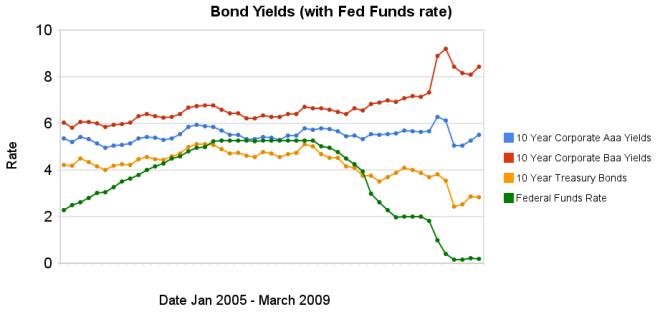
    graph of 10 year Aaa, Baa and corporate bond rates from 2005-2009Chart showing corporate and government bond yields by Curious Cat Investing Economics Blog, Creative Commons Attribution, data from the Federal Reserve.

    The federal funds rate remains under .25%. The large spread between government bonds and corporate bonds remains very large. In the last 3 months the yields on Aaa corporate bonds have increased 45 basis points, Baa corporate bond yields have decreased 1 basis points, while treasury bond yields have increased 40 basis points.

    The spread between 10 year Aaa corporate bond yields and 10 year government bond yields is now 268 basis points. In January, 2008 the spread was 159 points. The larger the spread the more people demand in interest, to compensate for the increased risk. The spread between government bonds and Baa corporate bonds decreased to a still very large 566 basis points, the spread was 280 basis point in January 2008, and 362 basis points in September 2008.

    Data from the federal reserve: corporate Aaacorporate Baaten year treasuryfed funds

    Related: Chart Shows Wild Swings in Bond YieldsFed to Start Buying Treasury Bonds TodayCorporate and Government Bond Rates Graph (Oct 2008)investing and economic charts

  • The Best Way to Rob a Bank is as An Executive at One

    William Black wrote The Best Way to Rob a Bank Is to Own One: How Corporate Executives and Politicians Looted the S&L. I think he a bit off on the “owning one,” being the best way to loot. The looters are not owners, they are executives that loot from owners, taxpayers, customers… And those looters pay politicians a great deal of money to help them. He appeared on Bill Moneys Journal discussing the huge mess we know are in and how little is being done to hold those responsible for the enormous crisis created by them.

    Fraud is deceit. And the essence of fraud is, “I create trust in you, and then I betray that trust, and get you to give me something of value.” And as a result, there’s no more effective acid against trust than fraud, especially fraud by top elites, and that’s what we have.

    The FBI publicly warned, in September 2004 that there was an epidemic of mortgage fraud, that if it was allowed to continue it would produce a crisis at least as large as the Savings and Loan debacle. And that they were going to make sure that they didn’t let that happen. So what goes wrong? After 9/11, the attacks, the Justice Department transfers 500 white-collar specialists in the FBI to national terrorism. Well, we can all understand that. But then, the Bush administration refused to replace the missing 500 agents. So even today, again, as you say, this crisis is 1000 times worse, perhaps, certainly 100 times worse, than the Savings and Loan crisis. There are one-fifth as many FBI agents as worked the Savings and Loan crisis.

    Well, certainly in the financial sphere, I am. I think, first, the policies are substantively bad. Second, I think they completely lack integrity. Third, they violate the rule of law. This is being done just like Secretary Paulson did it. In violation of the law. We adopted a law after the Savings and Loan crisis, called the Prompt Corrective Action Law. And it requires them to close these institutions. And they’re refusing to obey the law.

    In the Savings and Loan debacle, we developed excellent ways for dealing with the frauds, and for dealing with the failed institutions. And for 15 years after the Savings and Loan crisis, didn’t matter which party was in power, the U.S. Treasury Secretary would fly over to Tokyo and tell the Japanese, “You ought to do things the way we did in the Savings and Loan crisis, because it worked really well. Instead you’re covering up the bank losses, because you know, you say you need confidence. And so, we have to lie to the people to create confidence. And it doesn’t work. You will cause your recession to continue and continue.”

    And their ideologies, which swept away regulation. So, in the example, regulation means that cheaters don’t prosper. So, instead of being bad for capitalism, it’s what saves capitalism. “Honest purveyors prosper” is what we want. And you need regulation and law enforcement to be able to do this. The tragedy of this crisis is it didn’t need to happen at all.

    Related: Fed Continues Wall Street WelfareCredit Crisis the Result of Planned Looting of the World EconomyLobbyists Keep Tax Off Billion Dollar Private Equities DealsPoll: 60% say Depression LikelyCanadian Banks Avoid Failures Common ElsewhereToo Big to FailWhy Pay Taxes or be Honest

  • Tax Considerations with Mutual Fund Investments

    One problem with investing in mutual funds is potential tax bills. If the fund has invested well and say bought Google at $150 and then Google was at $700 (a few years ago) there is the potential tax liability of the $550 gain per share. So if funds have been successful (which is one reason you may want to invest in them) they often have had a large potential tax liability.

    With an open end mutual fund the price is calculated each day based on the net asset value, which is fair but really the true value if there is a large potential tax liability is less than if there was none. So in reality you had to believe the management would outperform enough to make up for the extra taxes that would be owed.

    Well, the drastic stock market decline over the last few years has turned this upside down and many mutual funds actual have tax losses that they have realized (which can be used to offset future capital gains). Say the fund had realized capital losses of $30,000,000 last year. Then if they have capital gains of $20,000,000 next year they can use the losses from last year and will not report any taxable capital gains. And the next year the first $10,000,000 in capital gains would be not table either. Business Week, had an article on this recently – Big Losers Can Be Big Tax Shelters

    Take Dodge & Cox International. It has a -80% capital-gains exposure, meaning it has a capital loss that covers 80% of assets. So it could have several years of tax-free gains.

    Yet it is Miller’s newer charge, Legg Mason Opportunity, which holds stocks of all sizes and can take short positions, that will prove to be the real tax haven. Morningstar pegs its losses at 285% of its $1.2 billion in assets.

    There are other funds with returns so ugly and losses so large that it may not matter what their trading style is for many years: Fidelity Select Electronics (FSELX), -539%; MFS Core Equity A, -369%; Janus Worldwide (JAWWX), -304%; Vanguard U.S. Growth (VWUSX), -227%.

    How does a fund have over 100% tax losses? The way I can think of is if they have a great deal of redemptions. If the fund shrinks in size from a $3 billion fund to a $300 million fund they could have a 50% realized capital loss (down to $750 million) but then another $450 million in redemptions). Now the $300 million has a $750 million capital loss or 250%.

    Related: Shorting Using Inverse FundsLazy Portfolio ResultsDoes a Declining Stock Market Worry You?Asset Allocations Make A Big Difference

  • Curious Cat Investing and Economics Carnival #1

    I have been running the Curious Cat Management Management Improvement Carnival for several years and decided to start one on the investing and economics theme. I hope you enjoy the inaugural edition. If you like these posts you may also be interested in the Invest Reddit where a community of those interested in investing submit and rate articles and blog posts.

    • Case-Shiller: Is it Really THAT Bad? by Stan Humphries – “Unfortunately, in combining both foreclosures and non-foreclosures into a single metric, you’re not really getting a good insight into either market. In the current climate, you’re underestimating the decline in value of foreclosed homes and overestimating the decline in value of non-foreclosure homes.”
    • This is unquestionably the worst global economic crisis since the 1930s by Brad Setser – “Both the IMF and World Bank are now forecasting an outright fall in global output in 2009… Anything below 2% [growth] is generally considered a global recession.”
    • Value Added Tax (VAT): The Pros and Cons by Eric Stinson – “The VAT is also a consumption tax, so there is incentive for you to limit your spending. Like the Fair Tax, if you spend less than you make, you’ll pay less in taxes (all else equal).”
    • Face To Face With The Deficit by Scott Bittle – “The public simply will not permit Washington to raise their taxes, change their health insurance, or cut programs without their consent. Nor should they. But the public should understand the rules, too. It’s not enough to complain about red ink and then reject any possible solution.”
    • Confusing price discrimination – “Any way I think about it, the discount should either be to all consumers or to students for the entire day. Why would it be only to students in the afternoon?”
    • Leave Your Money in Your Retirement Accounts by Patrick – “At this point, the best thing you can do is stick to your retirement savings and investment plans. Continue contributing to your retirement accounts, make sure your asset allocation is set at your desired level, and don’t withdraw your retirement savings.”
    • Invisible Hands Explain Nothing: a response to a critic by Gavin Kennedy – “Indeed, Smith gives over 60 instances in Books I and II of Wealth Of Nations where the actions of individuals for their own ‘gain’ have less than beneficial consequences on those around them”

    A couple of my posts have appeared in other carnivals recently: California Unemployment Rate Climbs to 10.5 Percent in the Money Hacks Carnival and Add to Your 401(k) and IRA in the Carnival of Personal Finance.

    Related: Money Hacks Carnival #50Curious Cat Investing and Economics Search

  • A Banker Who Avoided Toxic Debt Bubble

    The Banker Who Said No

    n late 2006 he sold $74 million of preferred stock although he had no immediate use for the proceeds. He says he couldn’t resist the “stupidly mispriced” terms–as low as Libor plus 1.7 percentage points for 30 years. He wanted as much money available when the boom turned to bust. With the extra money the bank could pay off nearly all its depositors with capital on hand–nearly unheard of in the history of banking.

    Then came a shocker: Amid one of the most reckless lending sprees in history, regulators focused on the one bank that refused to play along. Beal’s moves confused and worried them, and so they began to probe him with questions. “What are you doing?” he recalls them asking. “You’re shrinking yet you’re raising capital?”

    Says Beal about the scrutiny, “I just didn’t fit into any box.” One regulator, the former head of the Texas Savings & Loan Department, Charles Danny Payne, says, “I was skeptical at first, but I’ve gained a lot of confidence over the years,” adding that Beal has an “uncanny ability to sniff out deals.”

    Next, the credit rating agencies started pestering him about his dwindling loan portfolio. They never downgraded him but scolded him for seeming not to have a “sustainable” business model. This while their colleagues were signing off on $32 billion of bum collateralized debt obligations issued by Merrill Lynch.

    He thinks the government is going to be “disappointed” by its various programs to revive lending. He says Treasury Secretary Timothy Geithner’s new plan to guarantee loans to buyers of toxic assets won’t lead to many sales because the problem isn’t liquidity but price. They are not low enough. Half the country’s banks–4,000 in all–would be bust, he says, if they marked their loans to what the loans would fetch in an auction. He says banks are fooling themselves by refusing to mark busted assets down.

    “Banks are on a prayer mission that somehow prices will come back and they won’t have to face reality,” Beal says. And that reality, according to Beal, is going to get a lot worse. “Unemployment is going over 10%, commercial real estate hasn’t even begun collapsing and corporate credit defaults are just getting started,” he says. His prediction: depression, without bread lines this time, thanks to the government safety net, but with equal cost to society.

    There are some (very few) who succeeded in not acting like lemmings. I wish someone would explain to me why people are worthy of millions in bonuses when they just do what every single other person in their position did that was also getting millions in bonuses. Obviously they were just practicing bankruptcy for profit (which worked out incredibly well for them) and still we seem to think the only solution is to support these moral bankrupt (and now commercially bankrupt) organizations and individuals.

    Related: What the Bailout and Stimulus Are and Are NotSound Canadian Banking SystemMore on Failed ExecutivesJim Rogers on the Financial Market Mess

  • Small Business Profit and Cash Flow

    A couple posts by Jeff Vogel, founder of Spiderweb Software, discussing the financial success of his small computer gaming company are quite interesting. They provide a nice view of one successful small businesses’ finances and the customer focus and market awareness needed to succeed.

    How Many Games I Sell

    Releasing games for two platforms has always been the key to our profitability. Porting games is free money, and it’s awesome. I suppose this is the sort of thing we should keep secret, as it’ll only get us more competition on the Macintosh. But, on the other hand, more games makes the Macintosh more viable as a gaming platform and thus attracts more potential customers for me. So I don’t worry about it.

    Geneforge 4 cost about $120K and has made about $117K. Given current sales rates, it should be in the black in at most 2-3 months. After that, everything it earns is pure, tasty profit. And we will sell it in bundles (we sell a Geneforge 4-5 bundle already, and a Geneforge 1-5 CD is coming), making more money. So I don’t regret the time spent writing it at all.

    And it gets better. What was my reward for the year spent writing Geneforge 4? It wasn’t just the cash. I also own the game! That means, in ten years or so, I can return to it, give it better graphics and interface, add a bonus 2-3 dungeons, and release it to a new generation of gamers. I’ve done it before, with my games Exile 1-3, Blades of Exile, and Nethergate, and the resulting products, since I didn’t need to write them from scratch, were immensely profitable.

    Don’t underestimate the value of owning your own intellectual property.

    A lot of people have commented that I should lower the game’s price to $10. The idea that this would increase my profits is, I feel, purest nonsense. Bearing in mind that the percentage cost of credit card processing increases as the price goes down, and, to make the same profits from Geneforge 4, I would have had to triple my sales. Triple! As in, go from a conversation rate of about 1.5% to almost 5%. This is just not realistic.

    Or, to put it another way, Geneforge 4 was the game where we raised our prices to $28. Our sales did not go down from Geneforge 3 (which was $25). They went up. A lot. And Avernum 5 ($28) sold a lot more than Avernum 4 ($25).

    So Here’s How Many Games I Sell.

    It’s worthwhile at this point to go to the web site and look at the screenshots. Some of you might ask, “Why would anyone pay money for a game that looks like that?” The answer is, “I don’t know, but they do.”

    But I think the most important thing to note is that Geneforge 4, after a few years, is almost in the black, and it continues to sell. In the long run, the time spent on it will be quite profitable. Despite the crude graphics. Despite the high price.

    A neat example, I think. he doesn’t specifically talk about cash flow but you can see that the business needs to pay salaries and sales come much later. So you need to have cash to sustain the business (which could be a loan, that then is paid back as sales are made). And then, as you have games that were developed earlier you get sales with very little cost to you in the present time (you paid for the bulk of the effort earlier).

    Related: posts on entrepreneursEntrepreneur in EthiopiaEntrepreneur ResultsCurious Cat Management Blog

  • Data Shows Subprime Mortgages Were Failing Years Before the Crisis Hit

    Here is a very interesting paper showing real analysis of the data to illustrate that the deteriorating condition of loans should have been caught by those financing such loans years before the mortgage crisis erupted. Understanding the Subprime Mortgage Crisis by Yuliya Demyanyk, Federal Reserve Bank of Cleveland and Otto Van Hemert, New York University.

    Using loan-level data, we analyze the quality of subprime mortgage loans by adjusting their performance for differences in borrower characteristics, loan characteristics, and macroeconomic conditions. We find that the quality of loans deteriorated for six consecutive years before the crisis and that securitizers were, to some extent, aware of it. We provide evidence that the rise and fall of the subprime mortgage market follows a classic lending boom-bust scenario, in which unsustainable growth leads to the collapse of the market. Problems could have been detected long before the crisis, but they were masked by high house price appreciation between 2003 and 2005.

    In many respects, the subprime market experienced a classic lending boom-bust scenario with rapid market growth, loosening underwriting standards, deteriorating loan performance, and decreasing risk premiums.30 Argentina in 1980, Chile in 1982, Sweden, Norway, and Finland in 1992, Mexico in 1994, Thailand, Indonesia, and Korea in 1997 all experienced the culmination of a boom-bust scenario, albeit in different economic settings.
    Were problems in the subprime mortgage market apparent before the actual crisis erupted in 2007? Our answer is yes, at least by the end of 2005. Using the data available only at the end of 2005, we show that the monotonic degradation of the subprime market was already apparent. Loan quality had been worsening for five years in a row at that point. Rapid appreciation in housing prices masked the deterioration in the subprime mortgage market and thus the true riskiness of subprime mortgage loans. When housing prices stopped climbing, the risk in the market became apparent.

    Related: Nearly 10% of Mortgages Delinquent or in ForeclosureHow Much Worse Can the Mortgage Crisis Get?Homes Entering Foreclosure at RecordArticles on Real Estate

  • Fed to Start Buying Treasury Bonds Today

    Fed to start buying T-bonds today, hoping to move rates

    The Federal Reserve will try to get long-term interest rates moving down again when the central bank today launches its first purchases of Treasury bonds. The Fed triggered a stunning drop in Treasury bond yields on March 18 when policymakers surprised Wall Street by announcing a plan to buy up to $300 billion of Treasuries over the next six months.

    The yield on the 10-year T-note plunged to 2.53% on March 18 from 3% the previous day, the biggest one-day drop in decades. But since then, Treasury bond yields have been creeping higher. The 10-year T-note ended Tuesday at 2.65%. Conventional mortgage rates have flattened or inched up, although they remain historically low, in the range of 4.75% to 5%.

    On Tuesday the Treasury sold $40 billion of new two-year T-notes at a yield of 0.95%, which was lower than expected, indicating healthy investor demand. The government will auction $34 billion in five-year notes today and $24 billion in seven-year notes on Thursday. Against numbers like those in just one week, the Fed’s commitment to buy $300 billion of Treasuries over six months doesn’t look like much.

    there’s nothing to stop the Fed from suddenly announcing that its $300-billion commitment will get substantially bigger: The central bank can, in effect, print as much money as it wants to buy bonds — at least, until the day that global investors stop wanting dollars.

    The original announcement caused a dramatic move but since then yields have been drifting up, every day, including today. Rates are already very low. And the huge amount of increased federal borrowing is a potential serious problem for lowering rates. And potentially an even more serious problem is foreign investors deciding the yield does not provide a good investment given the risks of inflation (I know that is how I feel). It will be interesting to see what happens with rates.

    Related: Who Will Buy All the USA’s Debt?Lowest 30 Year Fixed Mortgage Rates in 37 Yearsmortgage terms

  • Credit Crisis the Result of Planned Looting of the World Economy

    Fluke? Credit crisis was a heist by James Jubak

    What we’re now living through, though, is the result of a conscious, planned looting of the world economy. Its roots stretch back decades. And it wouldn’t have been possible without the contrivances of the bought-and-paid-for folks who sit in Congress.

    Of course, just because the plan blew up on the looters, taking off a financial finger here and a portfolio hand there, you shouldn’t have any illusion that they’ve retired. In fact, in the “solutions” now being proposed — by Congress — to fix the global and U.S. financial systems, you can see the looters at work as hard as ever.

    He is exactly right.

    Question: Why weren’t state insurance regulators more aggressive in regulating AIG?

    Answer: Because the federal government had forced them to back off. An aggressive interpretation of the definition of insurance could have let state insurance agencies regulate the derivatives contracts that AIG’s financial-products group was writing out of London. These were, in fact, insurance policies that guaranteed the companies taking them out (banks, other insurance companies, investment banks and the like) against losses on securities in their portfolios.

    But Congress had made it very clear in the Commodity Futures Modernization Act — supported by then-Federal Reserve Chairman Alan Greenspan, steered through Congress by then-Sen. Phil Gramm, R-Texas, and signed into law by President Bill Clinton in December 2000 — that most over-the-counter derivatives contracts were outside the regulatory purview of all federal agencies, even the Commodity Futures Trading Commission.

    With the new law on the books, the market for credit default swaps exploded from $632 billion outstanding in the first half of 2001, according to the International Swaps and Derivatives Association, to $62 trillion in the second half of 2007.

    Question: Wasn’t anybody worried about the risk to the financial system posed by a market that dwarfed the assets of the sellers of this insurance?

    Answer: Worry about leverage? You’ve got to be kidding.

    In 2004, the Securities and Exchange Commission, after hard lobbying by Wall Street, reversed its 1975 rule limiting investment banks to leverage of 15-to-1. The new limit could be as high as 40-to-1 if the investment banks’ own computer models said it was safe.

    Understanding the people paid lots of money to politicians and then (after they got lots of money) those politicians enacted laws that endangered the economy to favor those giving them lots of money. Now maybe these politicians just like letting exceptionally wealthy people endanger the economy for personal gain. Maybe they think that is a good idea. I tend to think instead they do what those they give them lots of money want. But maybe I am wrong on that.
    (more…)