Category: Investing

  • Low Mortgage Rates But High Eligibility Requirements

    Low Mortgage Rates a Mirage as Fees Climb, Eligibility Tightens

    The average rate on a 30-year fixed mortgage dropped to 5.07 percent for the week ending Feb. 26 from 6.63 percent for the one ending July 24

    “A score of 700 was once near perfect,” said Gwen Muse Evans, vice president of credit policy at Fannie Mae, the government-controlled company that helps set lending standards. “Today, a 700 performs more like a 660 did. We have updated our policy to take into account the drift in credit scores.”

    Consumer credit scores, called FICOs after creator Fair Isaac Corp., range from 300 to 850. The average FICO score on mortgages bought by Freddie Mac and Fannie Mae rose to 747.5 in the fourth quarter of last year from 722.3 in 2005, according to Inside Mortgage Finance.

    Accunet’s Wickert said that a 660 FICO score would have qualified most borrowers for loans with no upfront fees in the past. Now, someone trying to borrow $200,000 with a 660 score would have to pay a 2.8 percent fee, or $5,600, he said. Even someone with a 719 score would have to pay $1,750 in cash.

    The low mortgage rates are attractive but a decision to re-finance (or buy) must consider the long term implications. Also if you are re-financing to take advantage of the low rates consider a 20 year or 15 year loan if you are already well into your 30 year loan. A fixed rate loan is the most sensible option at this time.

    Related: Low Mortgage Rates Not Available to Everyone30 Year Fixed Mortgage Rates and the Fed Funds Rate ChartIgnorance of Many Mortgage HoldersFed Plans To Curb Mortgage ExcessesHow Not to Convert Home Equity

  • Warren Buffet Webcast to MBAs

    Warren Buffett is really someone worth listening to. This is a short talk he gave to MBA students and then he answers questions for over an hour. I think he is speaking at the University of Florida in 1998.

    Here is a great quote to remember as you invest (from part 2): “To make money they didn’t have and didn’t need, they risked what they did have and did need. And that’s foolish.” That goes for anyone I think. He was talking about the geniuses behind Long Term Capital Management (and the collapse about a decade ago – for those of you that think finance people risking serious harm to the economy for their personal gain is something new, it isn’t). You can read a good book about Long Term Capital Management’s fail: When Genius Failed.

    Related: Warren Buffett’s Annual ReportGreat Advice from Warren BuffettMisuse of Statistics, Mania in Financial MarketsInvesting Books
    (more…)

  • More Companies Cutting Dividends Than Any Year Since Before 1954

    Dividends Falling Means S&P 500 Is Still Expensive

    U.S. equities returned 6 percent a year on average since 1900, inflation-adjusted data compiled by the London Business School and Credit Suisse Group AG show. Take away dividends and the annual gain drops to 1.7 percent, compared with 2.1 percent for long-term Treasury bonds, according to the data.

    A total of 288 companies cut or suspended payouts last quarter, the most since Standard & Poor’s records began 54 years ago, when Dwight D. Eisenhower was president. While the S&P 500 is trading at the lowest price relative to earnings since 1985 and all 10 Wall Street strategists tracked by Bloomberg forecast a rally this year, predictions based on dividends show shares are overvalued by as much as 46 percent.

    Just last November the S&P 500 dividend yield topped the bond yield for the first time since 1958. Yields often rise as stock prices fall on future prospects and companies announce dividend cuts after stocks have already fallen (due to the deteriorating conditions the company faces). So you always must be careful not to count dividends before they are paid. As an investor you need to look into the future and see how secure the dividends are likely to be.

    Related: 10 Stocks for Income Investors10 Stocks for 10 YearsCurious Cat Investing Books

  • Jumbo Loan Defaults Rise at Fast Pace

    Jumbo Loan Defaults Rise at Fast Pace as Rich Suffer

    About 2.57 percent of prime borrowers who took out jumbo loans last year were at least 60 days delinquent

    2.57% of homeowners with jumbo mortgage are 60 days late, of those that just got loan last year! That is crazy. These kinds of figures are astounding to me. I am still (posted Feb 2007) amazed that 4.4% is the historic low for mortgages over a month late.

    About 1.92 percent of homeowners with 2008 mortgages backed by Fannie Mae and Freddie Mac fell at least 60 days behind, LPS Applied Analytics said. Jumbo loans are bigger than what the two government-controlled agencies buy or guarantee, and Obama’s plan focuses on shoring up mortgages eligible to be bought by Fannie and Freddie.

    The top five U.S. jumbo lenders — Chase Home Finance LLC, Bank of America Corp., Washington Mutual Inc., Wells Fargo & Co. and Citigroup Inc. — originated a combined $55.3 billion in jumbos in 2008. They lent just $4.3 billion of that during the last three months of the year, according to Inside Mortgage Finance.

    The national average for a 30-year fixed-rate jumbo mortgage was 6.57 percent this week compared with 5.34 percent for a conforming loan, according to White Plains, New York-based financial data provider BanxQuote.

    Related: The Impact of Credit Scores and Jumbo Size on Mortgage RatesLow Mortgage Rates Not Available to Everyone30 Year Fixed Mortgage Rates and the Fed Funds Rateposts about mortgages

  • Who Will Buy All the USA’s Debt?

    Who Will Buy All the USA’s Debt? That is a question worth thinking about. The USA is a huge net borrower. The government can’t borrow from consumers because they are hugely in debt themselves. Over the last few decades huge investments from Japan, China and the Middle East in USA government debt have allowed the huge amount of federal debt to continue to grow rapidly. But who is going to buy the increasing amounts of debt; in the next few years, and the next few decades?

    China is right to have doubts about who will buy all America’s debt

    Chinese doubts about the value of US Treasury bonds highlight a crucial question: who will buy the estimated $2.7 trillion (£1.9 trillion) to $4.2 trillion of debt expected to be issued over the next two years?

    The other area of concern for China is the value of its Treasuries. Given the US borrowing requirement and its lax monetary policy, Treasury bond yields could well rise sharply, causing a corresponding price decline. If China’s holdings match Treasuries’ average 48-month duration, then a 5pc rise in yields, from 1.72pc on the 5-year note to 6.72pc, would lose China 17.5pc of its holdings’ value, or $119bn.

    Foreign buyers have absorbed a little over $200bn of Treasuries annually, a useful contribution to financing the $459bn 2008 deficit, but only a modest help towards the $1.35 trillion minimum average deficit forecast for 2009 and 2010.

    Unless that changes substantially, there will be $1 trillion annually to be raised by the Treasury from domestic sources, more than double the previous record from domestic and foreign sources together, plus whatever is needed to bail out the banks.

    Even if the US savings rate were to rise from zero to its long-term average of 8% of disposable personal income, that would create only an additional $830bn of savings — not enough to fund the domestic share of the deficit. Interest rates would probably have to rise substantially to pull in more foreign investors.

    Very true. Anyone buying government debt at these rates has reason to question the wisdom of doing so. Exporters to the USA have macro-economic reasons for buying debt (to keep the value of the dollar from collapsing) but the investing reasons for buying USA debt I find very questionable (I wouldn’t be buying it as an investment, if I were them).

    Related: Personal Saving and Personal Debt in the USAAmericans are Drowning in DebtUSA Federal Debt Now $516,348 Per HouseholdIs the USA Broke?

  • Money Hacks Carnival #50

    I am glad to be hosting the 50th edition of the Money Hacks Carnival. There really are a ton of great post on money hacks for your personal finances. I have highlighted some of my favorites from the last week. New visitors to the Curious Cat Economics and Investing Blog may be interested in some of past personal finance posts.

    I have included snippets from a some highlighted posts which illustrate the great number of thoughtful individuals writing blogs about how to manage your money more effectively and the economic conditions that impact each of our personal financial lives.

    Income

      Using money and budgeting

      (more…)

    • Housing Rents Falling in the USA

      Apartment Rents Fall, Vacancies at 4-Year High

      U.S. apartment rents fell in the fourth quarter from the third as the national vacancy rate climbed to a four-year high of 6.6 percent

      Asking rents fell 0.1 percent from the previous quarter, to $1,052 on average, their first quarter-to-quarter decline in almost six years. They rose 2.4 percent from a year earlier. Effective rents, what tenants actually paid, fell to an average $996 last quarter, down 0.4 percent from the prior quarter and up 2.2 percent from a year earlier.

      U.S. rental market set to slow down amid housing glut

      “Unsold properties being turned into rental units are creating a shadow market that’s driving up the vacancy rate and slowing the growth of rents,” Chandan said. “Areas that saw the most speculative investing, particularly in condos, will see the biggest pressure on rents.”

      Anthony De Silva said he was not happy that he had become a landlord. He bought a two-bedroom condominium 18 months ago on the ocean in Hollywood, Florida, expecting to sell at a $100,000 profit. Instead, he is now looking for tenants at $1,700 a month.

      “Increasing vacancies does not bode well for rental incomes,” said Nabil El-Hage, a professor at Harvard Business School. “We’ve seen a softening in apartment REITs as a result.”

      So for renters nationwide this is one possible silver lining to the current economic crisis. Granted not a large one but in these times any good news is worth appreciating. For real estate investors the news is not as good. The Washington DC market is forecast to go against the trend for reduced rents in 2009.

      According to Marus and Millichap, Metrowide vacancy is expected to rise 60 basis points this year to 6.5 percent. Asking rents are projected to advance 3.1 percent to $1,410 per month in 2009, while effective rents increase 2.8 percent to $1,351 per month. Rent growth will lag slightly in Suburban Maryland. Of the 43 rental market they track they project San Francisco to see the largest increases in rent in 2009, followed by San Diego and Washington DC.

      Related: Home Values and Rental RatesRent Controls are Unwiseposts on housingHow Walkable is Your Prospective Neighborhood

    • Great Time for a Vacation

      Times are tough. Economic news is grim. But if you are looking to relax somewhere warm, you are in luck. Deals in Paradise

      In the Caribbean, travelers seeking bargains this winter are finding big ones: beachfront rooms in famous resorts for less than $100 a night; cheap inter-island cruises; all-inclusive stays (including breakfast, dinner and water sports) for less than the normal room rate; and island-wide promotions. On St. Kitts, for example, the Feel the Warmth promotion offers free room nights; food and beverage credits of $75; and even 10 percent off airfares.

      The bargains in Las Vegas are so gigantic that I couldn’t figure them out myself. I called Howard Lefkowitz, the chief executive of Vegas.com, for a little help. After a little patter promising that “everything is 25 to 30 percent” less than last year, Lefkowitz agreed to a real-time test.

      “What would a room at the Bellagio cost me tonight?” I asked. After a few keystrokes — I heard his keyboard clacking over his website — he found a $129 rate for a standard room at the five-star property. “That probably would have cost $225 last year,” he said. “What would $129 have gotten me last year?” I wondered. Lefkowitz didn’t hesitate: “A night at Paris, a nice four-star resort.” What was Paris charging tonight?” I asked. A few more keystrokes and Lefkowitz had an answer: $90.

      “Call me,” the general manager at a new hotel in Miami advised. “I’ll offer you a price you won’t find on the Web.”

      Related: Medieval Peasants had More Vacation TimeDream More, Work Less9 Days in EgyptCosta Rica Photo EssaySouth Carolina Photos

    • Too Much Leverage Killed Mervyns

      I do not like the actions of many in “private equity.” I am a big fan of capitalism. I also object to those that unjustly take from the other stakeholders involved in an enterprise. It is not the specific facts of this case, that I see as important, but the thinking behind these types of actions. Which specific actions are to blame for this bankruptcy is not my point. I detest that financial gimmicks by “private capital” that ruin companies.

      Those gimmicks that leave stakeholders that built such companies in ruin should be criticized. It is a core principle that I share with Dr. Deming, Toyota… that companies exist not to be plundered by those in positions of power but to benefit all the stakeholders (employees, owners, customers, suppliers, communities…). I don’t believe you can practice real lean manufacturing and subscribe to this take out cash and leave a venerable company behind kind of thinking.

      How Private Equity Strangled Mervyns

      Much of the blame for its demise lies with three private equity titans: Cerberus Capital Management, Sun Capital Partners, and Lubert-Adler.

      When those firms bought Mervyns from Target for $1.2 billion in 2004, they promised to revive the limping West Coast retailer. Then they stripped it of real estate assets, nearly doubled its rent, and saddled it with $800 million in debt while sucking out more than $400 million in cash for themselves, according to the company. The moves left Mervyns so weak it couldn’t survive.

      Mervyns’ collapse reveals dangerous flaws in the private equity playbook. It shows how investors with risky business plans, unrealistic financial assumptions, and competing agendas can deliver a death blow to companies that otherwise could have survived. And it offers a glimpse into the human suffering wrought by owners looking to turn a quick profit above all else.

      Too much debt is not just a personal finance problem it is a problem for companies too. Continue reading on my original post on the Curious Cat Management Blog.

      Related: Leverage, Complex Deals and ManiaFailed Executives Used Too Much Leverageposts on debt

    • The Impact of Credit Scores and Jumbo Size on Mortgage Rates

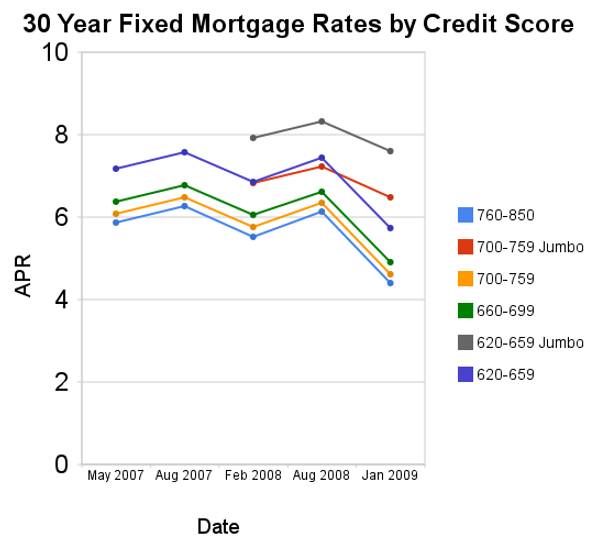
      Since August of 2008 conforming mortgage rates are have declined a huge amount. Jumbo rates have fallen a large amount also, but much less (for example for a credit score of 700-759 the jumbo rates declined 73 basis points while the conventional rate declined 172 basis points.

      chart of 30 year fixed mortgage rates by credit score from May 2007 to Jan 2009

      For scores above 620, the APRs above assume a mortgage with 1 point and 80% Loan-to-Value Ratio. For scores below 620, these APRs assume a mortgage with 0 points and 60 to 80% Loan-to-Value Ratio. You can see, with these conditions the rate difference between a credit score of 660 and 800 is not large (remember this is with 20% down-payment) and has not changed much (the difference between the rates if fairly consistent).

      Related: Low Mortgage Rates Not Available to Everyone30 Year Fixed Rate Mortgage Rate DataReal Free Credit Report (in USA)Jumbo Mortgage Shoppers Get Little Relief From Ratesposts on mortgages
      (more…)