Category: Real Estate

  • Apartment-vacancy Rate is 7.8%, a 23-year High

    Landlords Offer Incentives to Stay Put

    In the third quarter, the national apartment-vacancy rate hit 7.8%, a 23-year high, according to Reis Inc., which tracks vacancies and rents in the top 79 markets.

    One problem for landlords is that existing tenants can easily check the Web to see what deals new tenants are being offered. And new tenants are getting incentives like a waived pet deposit or two months’ free rent.

    Apartment landlords say that one benefit of the bad market is that it has practically halted new construction. New completions are expected to be 98,000 next year and 109,000 in 2011, compared with 188,000 last year and 204,000 this year, according to Green Street Advisors Inc.

    But when loss rates are taken into account—the removal of units because of obsolescence—the actual addition will be immaterial. That means that when the economy rebounds, the supply will be tight, increasing landlord profits.

    Related: Apartment Vacancy at 22-Year High in USA (July 2009)Articles on Real Estate InvestingIt’s Now a Renter’s MarketHousing Rents Falling in the USA

  • House Prices Seem to be Stabilizing

    Home prices in the United States rose 0.3% on a seasonally-adjusted basis from June to July, according to the Federal Housing Finance Agency’s monthly House Price Index. The previously reported 0.5% increase in June was revised downward to a 0.1% increase. For the 12 months ending in July, U.S. prices fell 4.2%. The U.S. index is 10.5% below its April 2007 peak.

    The FHFA monthly index is calculated using purchase prices of houses backing mortgages that have been sold to or guaranteed by Fannie Mae or Freddie Mac. Read the full press release. The Case-Shiller Home Price Indices also have increased (10 and 20 city indices) for June and July.

    I am still not convinced we have seen the bottom of the housing price declines nationwide. The economy is still in very fragile territory. But the data does show the declining prices have been stopped in many locations, at least for a while. If job losses continue housing prices may well resume the decline. The commercial real estate market seems to be even weaker than housing.

    Related: The Value of Home OwnershipHousing Prices Post Record Declines (April 2008)posts on economic datareal estate articles

  • Buffett: Economy Stable, But Residential Real Estate Has Improved

    Warren Buffet on the economy:

    Warren Buffett tells CNBC that while the economy “hasn’t gotten worse” but also hasn’t “gotten much better” over the past three months, he doesn’t expect a ‘double-dip’ recession and sees significant improvement in residential real estate.

    BECKY: All right. Let me go at this another way. Let’s pretend you’re on a desert island for a month. There’s only one set of numbers you can get. What would it be?

    BUFFETT: Well, I would probably look at– perhaps freight car loadings and– perhaps– and– and truck tonnage moved and– but I’d want to look at a lot of figures.

    BUFFETT: Well, I think that– unfortunately, I think that the — what– what– we’re really talking about reforming health insurance more than health care. So I– the incentives that produce the 16 or so percent of GDP that’s going to health care, I think unfortunately they’re getting– they’re going to get changed. But– so I think that we really– and I’m talking as much about reforming health care as we’re talking about reforming the insurance. And I think that will be an opportunity missed if we don’t do more about looking at what– what the incentives are in the present system and what they would be in an ideal system.

    Related: Buffett’s Fix for the Economy (Oct 2008)Warren Buffett Webcast on the Credit CrisisWarren Buffett on TaxesMany Experts Say Health-Care System Inefficient, Wasteful

  • Loan Delinquency Rates Increased Dramatically in the 2nd Quarter

    chart of loan default rates 1998 to 2009Chart showing loan delinquency rates for real estate, consumer and agricultural loans for 1998 to 2009 by the Curious Cat Investing Economics Blog, Creative Commons Attribution, data from the Federal Reserve.
    Delinquency rates on commercial (up another 151 basis points) and residential (93 basis points) real estate continued to increase dramatically in the second quarter. Credit card delinquency rates increased but only by 20 basis points.

    Real estate delinquency rates exploded in 2008. In the 4th quarter of 2007 residential delinquency rates were 3.02% by the 4th quarter of 2008 they were 6.34% and in the 2nd quarter of this year they were 8.84% (582 basis points above the 4th quarter of 2007). Commercial real estate delinquency rates were at 2.74% in the 4th quarter of 2007, 5.43% in the fourth quarter of 2008 and 7.91% in the 2nd quarter of 2009 (a 517 basis point increase).

    Credit card delinquency rates were much higher than real estate default rates for the last 10 years (the 4-5% range while real estate hovered above or below 2%). Now they are over 200 and 300 basis points bellow residential and commercial delinquency rates respectively. From 4.8% in the 3rd quarter 2008 to 5.66% in the 4th and 6.5% in the 1st quarter of 2009.

    The delinquency rate on other consumer loans and agricultural loan delinquency rates are up but nowhere near the amounts of real estate or credit cards.

    As I wrote recently bond yields in the last few months show a dramatic increase in investor confidence for corporate bonds.

    Data from the Federal Reserve

    Related: Loan Delinquency Rates: 1998-2009The Impact of Credit Scores and Jumbo Size on Mortgage Rates30 Year Mortgage Rate and Federal Funds Rate Chart

  • Commercial Real Estate Market Still Slumping

    Fed Focusing on Real-Estate Recession as Bernanke Convenes FOMC

    The collapse in commercial real estate is preventing Federal Reserve Chairman Ben S. Bernanke from declaring the economy and financial markets are healed. Property values have fallen 35 percent since October 2007, according to Moody’s Investors Service.

    Commercial property is “certainly going to be a significant drag” on growth, said Dean Maki, a former Fed researcher who is now chief U.S. economist in New York at Barclays Capital Inc., the investment-banking division of London-based Barclays Plc. “The bigger risk from it would be if it causes unexpected losses to financial firms that lead to another financial crisis.”

    Any sales of mortgage-backed bonds would be the first new issues in the $700 billion U.S. market for commercial-mortgage- backed securities since it was shut down by the credit freeze in 2008. About $3 billion are in the pipeline, and the success of these sales may foster as much as $25 billion in total deals in the next six months

    Forty-seven percent of loans at the 7,000-plus smaller U.S. lenders are in commercial real estate, compared with 17 percent for the biggest banks…

    Related: Data Shows Subprime Mortgages Were Failing Years Before the Crisis HitHome Values and Rental RatesRecord Home Price Declines (Sep 2008)

  • Apartment Vacancy at 22-Year High in USA

    Apartment Vacancy at 22-Year High in U.S.

    Vacancies climbed to 7.5 percent from 6.1 percent a year earlier, New York-based real estate research firm Reis Inc. said today. The last time landlords had so much empty space was in 1987, when vacancies reached 7.6 percent

    Asking rents for apartments fell 0.6 percent in the second quarter from the first, Reis said. That matched the rate of change in the first quarter, the biggest drop since Reis began reporting such data in 1999.

    New York had the lowest vacancy rate in the second quarter, at 2.9 percent, followed by New Haven, home to Yale University; Central New Jersey; New York’s Long Island; and Syracuse, New York, according to Reis.

    Related: Housing Rents Falling in the USARent Controls are UnwiseIt’s Now a Renter’s Marketarticles on investing and real estate

  • Loan Default Rates: 1998-2009

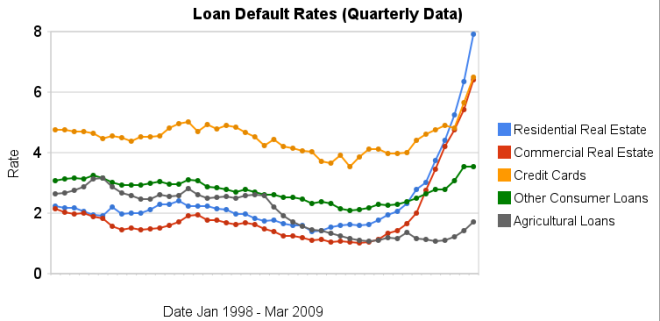
    chart of loan default rates 1998 to 2009Chart showing loan default rates for real estate, consumer and agricultural loans for 1998 to 2009 by the Curious Cat Investing Economics Blog, Creative Commons Attribution, data from the Federal Reserve.

    As you can see real estate default rates exploded in 2008. In the 4th quarter of 2007 residential default rates were 3.02% by the 4th quarter of 2008 they were 6.34% and in the 1st quarter of this year they were 7.91% (471 basis points above the 4th quarter of 2007). Commercial real estate default rates were at 2.74 in the 4th quarter of 2007, 5.43% in the fourth quarter of 2008 and 6.5% in the 1st quarter of 2009 (a 366 basis point increase).

    Credit card default rates were much higher for the last 10 years (the 4-5% range while real estate hovered above or below 2%). In the last 2 quarters it has increased sharply. From 4.8% in the 3rd quarter 2008 to 5.66% in the 4th and 6.5% in the 1st quarter of 2009. The default rate on other consumer loans are up but nowhere near the amounts of real estate or credit cards.

    Agricultural loan default rates are actually about as low now as they have every been 1.71%. That is up a bit from the 1.06% low the default rate hit in the 1st quarter of 2009 but actually lower than it was for half of the last decade (the last 5 years it has been lower but prior to that it was higher – in fact with higher default rates than either real estate loan category).

    Data from the Federal Reserve

    Related: Mortgage Rates: 6 Month and 5 Year ChartsJumbo Loan Defaults Rise at Fast PaceContinued Large Spreads Between Corporate and Government Bond YieldsNearly 10% of Mortgages Delinquent or in Foreclosure

  • Another Wave of Foreclosures Loom

    Another wave of foreclosures is poised to strike

    loan defaults are up sharply. And with many government and banks’ self-imposed foreclosure moratoriums expiring, the biggest lenders indicate that they are likely to move more aggressively to clear up a backlog of troubled mortgages.

    Mark Zandi of Moody’s Economy.com estimates that 15.4 million homeowners — or about 1 in 5 of those with first mortgages — owe more on their homes than they are worth.

    Government and company reports show that the number of completed foreclosures nationwide slowed sharply late last year and into early this year, largely because of various moratoriums in effect during much of the first quarter.

    But anecdotal reports indicate that foreclosure sales have started to climb again in the second quarter. And the pipeline is clearly getting fuller. In the first quarter, some 1.8 million homeowners nationwide fell behind on their loans by 60 to 90 days, a 15% increase from the prior quarter, according to Moody’s Economy.com. The research firm said that loan defaults rose sharply as well, to 844,000 in the first three months of this year.

    Even as defaults among subprime borrowers have trended lower this year, newly initiated foreclosures involving prime mortgage loans saw a significant increase in the first quarter, jumping 21.5% from the fourth quarter, according to a government report of loan data from national banks and federally regulated thrifts.

    This is more bad news for the economy. As I have been saying the economy is still in serious trouble. Cleaning up the damage caused by living beyond our means for decades does not get cleaned up quickly. This are actually going as well as could be hoped for, I think. We need to hope the remainder of this year sees the economy stabilize and then hope 2010 brings some good news.

    Related: Nearly 10% of Mortgages Delinquent or in ForeclosureOver Half of 2008 Foreclosures From Just 35 CountiesHow Much Worse Can the Mortgage Crisis Get? (March 2008)Mortgage Rates Falling on Fed Housing Focus

  • Home Prices Fall by Record 19%

    Home prices fall by record 19.1 percent in 1Q

    The National Index, which is released quarterly and covers a broader area than the monthly 20- and 10-city indexes, posted a 19% drop in the first quarter from a year earlier and a 7.5% decline from the fourth quarter.

    New York still is up 73.4% from January 2000, though down 19.7% from its June 2006 peak. The Detroit index is 29% lower than in January 2000. Detroit home prices are back to their mid-1995 levels.

    Phoenix, Las Vegas and San Francisco continued to lead year-over-year decliners, with drops over 30%. Minneapolis led month-to-month decliners, as the rate of decline accelerated there. The rates of decline also accelerated in Boston, Detroit, Las Vegas, Miami, New York, Portland, San Diego and Seattle.

    Dallas, Denver, Cleveland, Boston and Charlotte managed to avoid double-digit year-over-year declines. Measuring from each market’s peak, Dallas has suffered the least, down 11.1% from its peak in June 2007; while Phoenix is down 53% from its peak in June of 2006. All of the 20 metro areas are in double digit declines from their peaks, with two — Phoenix and Las Vegas — in excess of 50%.

    Related: Home Price Declines Exceeding 10% Seen for 20% of Housing Markets (Sep 2007)Nearly 10% of Mortgages Delinquent or in ForeclosureRecord Home Price Declines (Sep 2008)

  • Mortgage Rates: 6 Month and 5 Year Charts

    mortgage rate chart - late 2008 to May 2009Showing mortgage rates over the last 6 months. Red: 30 year fixed rate. Blue: 15 year fixed rate. Tan: 1 year adjustable rate.

    mortgage rate chart - May 2004 to May 2009Showing mortgage rates over the last 5 years. Red: 30 year fixed rate. Blue: 15 year fixed rate. Tan: 1 year adjustable rate. From Yahoo Finance, for conventional loans in Virginia.

    The 6 month chart shows that mortgage rates have been declining ever so slightly. Rates on a 1 year adjustable mortgage fell from 5.5 to 4% and have stayed near 4% for all of 2009. 30 and 15 year rates (15 year rates staying about 25 basis points cheaper) have declined from 6.5%, 6 months ago to about 5% at the start of the year and have moved around slightly since. This is while the yield 10 year government treasuries have been rising (normally 30 year fixed rate mortgages track moves in the 10 year government bond). The federal reserve has been buying bonds in order to push down the yield (and stimulate mortgage financing and other borrowing).

    Mortgage rates certainly could fall further but the current rates are extremely attractive and I just locked in a mortgage refinance for myself. I am getting a 20 year fixed rate mortgage; I didn’t want to extend the mortgage period by getting another 30 year fixed rate mortgage. For me, the risk of increasing rates outweigh the benefits of picking up a bit lower rate given the current economic conditions. But I can certainly understand the decision to hold out a bit longer in the hopes of getting a better rate. If I had to guess I would say rates will be lower during the next 3 months, but I am not confident enough to hold off, and so I decided to move now.

    Related: Mortgage Rates Falling on Fed Housing Focusposts on mortgages30 Year Fixed Mortgage Rates and the Fed Funds RateContinued Large Spreads Between Corporate and Government Bond YieldsLowest 30 Year Fixed Mortgage Rates in 37 Years