Category: Personal finance

  • Five Consumer Laws You Really Ought to Know (for the UK)

    Five consumer laws you really ought to know if you live in the United Kingdom.

    To mark National Consumer Week, here are five laws the canny shopper should be using in their battle to get stuff that actually works. There is a war being fought between customers and many of the firms they have to deal with. It is an asymmetric conflict – the little man versus the faceless, bad customer service monoliths.

    Your iconic white MP3 player, the totemic centre of your life, breaks down precisely 366 days after you bought it. The large electronics firm that sold you the MP3 player says that because the one-year guarantee had elapsed, there’s nothing they can do to help you. You’ll just have to buy another one.

    if the player has been lovingly treated and has still conked out that suggests something may have been wrong with it at the very beginning.

    It works like this. For the first four-five weeks you have a “right of rejection” – if the item you’ve bought breaks down, you can demand a refund.

    For the next six months, you are entitled to replacement or repair of the goods. It is up to the retailer to prove there was nothing wrong with it if they wish to get out of having to do the work. And then after six months, there is still a duty to replace or repair faulty goods, but the onus is on you, the consumer, to prove that there was something wrong.

    And the key time span is six years. That’s how long goods may be covered by the Sale of Goods Act. It all depends on what “sufficiently durable” means. If a light bulb goes after 13 months, the consumer is not going to be overly gutted.

    Extended warranties are general a very bad personal finance move. I never purchase them. Many companies push them on customers because of the large profit margin and because they don’t want to provide value to customers.

    Related: 10 Things Your Bank Won’t Tell YouOhio Acts to Protect Citizens from Payday Loan PracticesSave Money on PrintingDon’t Let the Credit Card Companies Play You for a FoolStudent Credit Cards

  • It is Never to Late to Invest

    I like to buy stocks cheap and then hold them as they rise in price. This is not a unique desire, I know. One thing this lead me to do was find a stock I liked but hold off buying it until I could buy it for less. When that works it is great. However, one thing that happened several times is that I found stocks I really liked and they just went up and went up more and kept going up. And I never owned them.

    I learned, after awhile, that is was ok to buy a stock at a higher price once I realized I made a mistake. Instead of just missing out because I made a mistake and didn’t buy it at a lower price than I needed to pay today (which made it feel really lame to buy it now at a higher price) I learned to accept that buying at the higher price available today was the best option.

    I have seen two types of situations where this takes place: one I realize I was just way off, it was a great deal at the price I could have bought at – I just made a mistake. And if it was still a good buy, I should buy it. Another is that the stock price goes up but new news more than makes up for the increased stock price (the news makes the value of stock increase more than the price has increased).

    I missed out on the Google IPO, even though I really wanted to buy. Then the price went way up and even though I had learned this (don’t avoid buying a stock today just because you made the mistake of not buying it at a lower price earlier) tip I wanted to buy it for less than the current price and so kept not buying it (emotion is a real factor in investing and that is another thing I have realized – you need to accept it and deal with it to be a good investor). Then Google announced spectacular earnings and it was finally enough to get me to buy the stock a few days later at $219 (which was well over twice the price 6 months earlier). But it was a great buy at $219 and losing that just because I should have bought it at $119 is not wise – but something I did many times in the past.

    In March of 2009 I bought some ATPG at $3.20. In August I bought more at $11. The news was bit better but really it was just a huge huge bargain at $3.20 and I should have bought a lot more. In the last 5 trading days ATPG was up $5.12 (16.78 – 11.66). A nice gain. Right now, it is up another 68 cents today at $17.43. Now this is a volatile stock and until I sell it may not turn out to be profitable investment, but the odds are good that it will.

    It is also hard to know when to sell – in fact for many selling at the wrong time (either selling too late – after it collapses [for good or sell it after a collapse only to see it recover], or too early missing out on huge gains) is the biggest problem they have in becoming a successful investor). One trait of many successful investors is holding the right investments for huge gains. A few stellar performances can lift the entire portfolio to long term investing success. And if you sell those stocks early you miss huge opportunities.

    Holding on for the huge gains is a mistake I do not want to make – and so when the opportunity is there for such gains I am willing to risk losing some gains for the potential of a much larger gain. Right now the balance is keeping me from selling any ATPG, though I am likely to sell some if it increases (while continuing to hold some of the position).

    Related: Great Google Earnings April 2007Nicolas Darvas (investor and speculator)Not Every Day is ProfitableDoes a Declining Stock Market Worry You?401(k)s are a Great Way to Save for RetirementBeating the Market, Suckers Game?Sleep Well Fund

  • Mark Mobius on Emerging Markets

    Mark Mobius is an investment manager with Franklin-Templeton that I have invested with for over a decade (through the Templeton Emerging Markets Trust and Templeton Dragon Fund – they are closed end funds). I believe in Templeton’s emerging market investment team and Mark Mobius and believe his thoughts are worth paying attention to. He recently wrote an overview on Emerging Markets:

    Year-to-date, however, emerging markets were still up 51%. While Eastern European and Latin American markets continued to record positive returns, Asian markets, as represented by the MSCI AC Asia ex Japan index lost 3%.

    In Mexico, GDP contracted 10% y-o-y in the second quarter of 2009 as a result of the global economic crisis and swine flu outbreak. In comparison, GDP fell 8% in the first quarter of the year. Declines in the manufacturing, construction and retail sectors had negatively impacted GDP during the period.

    Since 1995, portfolio inflows into emerging markets have totaled more than US$123 billion. A significant amount, considering it includes the US$49 billion in net outflows in 2008 as a result of the global financial crisis. The recovery in emerging markets and hunt for attractive investment opportunities, however, saw these funds return just as quickly with inflows totaling more than US$44 billion in the first seven months of 2009, nearly 90% of the outflows registered all of last year.

    Emerging markets account for more than 80% of the world’s population. With economic growth accelerating and population growth decelerating, per capita income is one the rise. In our view, markets such as China, India and Brazil stand at the front of the class.

    As of end-August 2009, the benchmark MSCI Emerging Markets index had a P/E of 16 times, cheaper than the MSCI World index which was trading at a P/E of 21 times.

    (more…)

  • Consumer Debt Declined a Record $21.5 Billion in July

    Last November USA consumer debt fell, by a then record of $8 billion. In July, 2009, consumer debt was reduced another $21 billion, which is a good sign.

    April of 2008 USA consumer debt stood at $2.54 trillion. Based on a population of 300 million people that would mean $8,467 for every person in just personal debt. Living beyond your means is not a good thing. After the July decrease of $21.55 billion, the total consumer debt stood at $2.47 trillion, a decline of $70 billion over the last 15 months.

    Decreasing this debt level was (and is) necessary. If that means we have some suffering today to pay for living beyond our means for years the ‘fix’ is not to continue to live beyond our means. The ‘fix’ is to accept the consequences of past behavior and build a more sustainable economy now for the future.

    Consumer credit down record amount in July

    This is the sixth straight monthly drop in consumer credit — the longest consecutive string of declines in credit since the second half of 1991.

    Consumers have retrenched since the financial crisis hit in full force last September. Credit has fallen in every month except January. In percentage terms, the drop in credit is the biggest since June 1975.

    And on a year-on-year basis, credit is down 4.3%, the biggest drop since June 1944. The retrenchment was much more than expected. Economists surveyed by MarketWatch expected consumer credit to decline by $4.3 billion. There were also sharp downward revisions to June data.

    Economists said shrinking credit might strangle the recovery. “There is no real way to put a positive spin on these data. Credit is still shrinking and that is going to have an impact on consumption,” wrote Charmaine Buskas, senior economics strategist at TD Securities, in a note to clients.

    credit-card debt fell $6.11 billion, or 8.5%, in July to $905.58 billion. This is the record 11th straight monthly drop in credit card debt. Non-revolving credit, such as auto loans, personal loans and student loans fell a record $15.44 billion or 11.7% to $1.57 trillion.

    Here is a positive spin on it. We owe $21.5 billion less than we did last month. How lost are we that there is no positive way to spin owing less money than you used to owe?

    Related: Personal Saving and Personal Debt in the USAAmericans are Drowning in Debt

  • Move to Finland for Cell Phone Service Savings

    Ok, maybe moving to lower your cell phone bill would be a bit extreme. But the cost of cell phone service is almost 5 times as high in the USA as in Finland:
    Mobile phone calls lowest in Finland, Netherlands and Sweden

    Finland, the Netherlands and Sweden have the lowest prices for mobile phone calls among OECD countries, according to the latest OECD Communications Outlook. The highest were found in Canada, Spain and the United States.

    Comparing prices on a medium-use basis for a package of 780 voice calls, 600 short texts (SMS), and eight multimedia (MMS) messages, the survey found monthly prices ranged from 11 to 53 US dollars across countries as of August 2008.

    The OECD Communications Outlook says between 2006 and 2008 mobile phone call prices fell on average by 21% for low usage consumers, 28% for medium usage and by 32% for subscribers with the highest consumption patterns.

    Related: Kiss Your Phone Bill Good-byemoney saving ideasInvesting dictionary

  • Financial Services for the Poor from the Gates Foundation

    The behavior of banks is despicable enough when they are merely trying to trick educated, financially secure people out of their money. Banks charged $38.5 billion in fees last year according to the Financial Times. But that behavior, toward the poor, by banks (paying millions to hundreds of executives for, I guess, getting congress to send the companies billions) is immoral.

    The Gates Foundation has decided to go into improving financial services for the poor. The are supporting micro-credit but also micro finance. Saving is key for poor people to get and stay out of poverty. Most already save money informally but want better, safer options. Setting aside money in a safe place will allow poor people to weather setbacks, build assets and financial security, and invest in opportunities for the next generation. Formal savings accounts also help them keep more of what they earn and easily access their money when they need it.

    The poor need better banking options in poor countries. But the poor need better banking options in at least one rich country (the only one I know is the USA and banks in the USA provide lousy options for the poor). Credit Unions are much more likely to actually try and provide value to customers. Unfortunately banks in the USA seem to operate on the principle that customer are suckers that exist to pay for Porches for the children of bank executives.

    Related: FDIC Study of Bank Overdraft FeesMicrofinancing EntrepreneursIncredibly Bad Customer Service from Discover Card10 Things Your Bank Won’t Tell You

  • Bond Yields Show Dramatic Increase in Investor Confidence

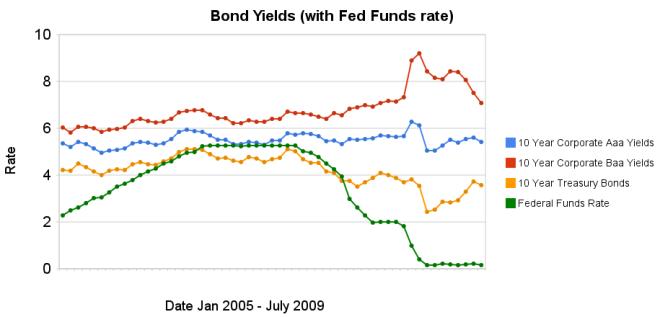
    graph of 10 year Aaa, Baa and corporate bond rates from 2005-2009Chart showing corporate and government bond yields by Curious Cat Investing Economics Blog, Creative Commons Attribution, data from the Federal Reserve.

    The changes in bond yields over the last 3 months months indicate a huge increase in investor confidence. The yield spread between corporate Baa 10 year bonds and 10 year treasury bonds increased 304 basis points from July 2008 to December 2008, indicating a huge swing in investor sentiment away from risk and to security (US government securities). From April 2009 to July 2009 the yield spread decreased by 213 basis points showing investors have moved away from government bonds and into Baa corporate bonds.

    From April to July 10 year corporate Aaa yields have stayed essentially unchanged (5.39% to 5.41% in July). Baa yields plunged from 8.39% to 7.09%. And 10 year government bond yields increased from 2.93% to 3.56%. federal funds rate remains under .25%.

    Investors are now willing to take risk on corporate defaults for a much lower premium (over government bond yields) than just a few months ago. This is a sign the credit crisis has eased quite dramatically, even though it is not yet over.

    Data from the federal reserve: corporate Aaacorporate Baaten year treasuryfed funds

    Related: Continued Large Spreads Between Corporate and Government Bond Yields (April 2009)Chart Shows Wild Swings in Bond Yields (Jan 2009)investing and economic charts

  • Lazy Portfolios Seven-year Winning Streak

    Here is an excellent article on how to invest in the stock market. I personally tweak this advice a bit but it is much better than most advice you get. Basically keep costs down (don’t pay large fees) and diversify. Lazy Portfolios seven-year winning streak by Paul Farrell

    Greed drives this [mutual fund] industry. The “world’s largest skimming operation” has now lost over 50% of America’s savings in the decade since the peak of 2000. The track record of actively managed funds during the recent subprime-credit meltdown continues to prove that the industry is failing America. The only way to invest is with index funds, which make up just 14% of the total.

    In short, even though we know that the average compensation of portfolio managers is often $400,000 to more than a $1 million, the hot-shot managers of these actively managed funds provided no value-added to their funds’ performance. Conclusion: Their investors would be better off investing in index funds.

    Yes, the market was in negative territory the past few years, but still all eight Lazy Portfolios outperformed each of the six actively-managed funds.

    Customize your own Lazy Portfolio following these six rules and you’ll win. More important, you’ll have lots of time left to enjoy what really counts, your family, friends, career, sports, hobbies, living.

    2) Frugality, savings versus financial obesity. Tools like starting early, autopilot saving plans, dollar-cost averaging, frugal living and other tricks are familiar to long-term investors. Trust your frugality instincts — living below your means — it’s a trait common among America’s “millionaires next door.”

    Related: Lazy Portfolio Results (April 2008)Allocations Make A Big Difference12 stocks for 10 years401(k)s are a Great Way to Save for Retirement

  • Retirement Planning – How Secure Are You?

    Wells Fargo is offering to donate $1 to Kiva for every person that completes a 7 question survey (no contact information is required) to get what they call a retirement security index. I did and there are 2 benefits to doing so yourself. First, most of us would benefit from more attention to our retirement planning. Second help out Kiva – which I have mentioned many time.

    Now I think their questionnaire is far too simplistic but it is hard to get people to spend even 15 minutes looking at a saving plan for retirement. So I know they are trying to keep it very simple so people will complete it. That said, read our posts on retirement planning to lean more about planning for retirement. It is critical that you spend the time in your 20’s, 30’s and 40’s doing this or you are really going to have trouble making decent retirement plans.

    Related: Add to Your 401(k) and IRASpending Guidelines in RetirementRetirement Savings Survey ResultsPersonal Finance: Saving for Retirement

  • 12 Stocks for 10 Years – July 2009 Update

    I originally setup the 10 stocks for 10 years portfolio in April of 2005. In order to track performance created a marketocracy portfolio but had to make some minor adjustments (and marketocracy doesn’t allow Tesco to be purchased, though it is easily available as an ADR to anyone in the USA to buy in real life – it is based in England). The current marketocracy calculated annualized rate or return (which excludes Tesco) is 3.5% (the S&P 500 annualized return for the period is -1.7%) – marketocracy subtracts the equivalent of 2% of assets annually to simulate management fees – as though the portfolio were a mutual fund – so without that the return is about 5.5%).

    The current stocks, in order of return:

    Stock Current Return % of sleep well portfolio now % of the portfolio if I were buying today
    Amazon – AMZN 136% 9% 9%
    Google – GOOG 105% 15% 13%
    Templeton Dragon Fund – TDF 80% 11% 11%
    PetroChina – PTR 78% 11% 10%
    Templeton Emerging Market Fund – EMF 28% 5% 6%
    Cisco – CSCO 15% 6% 8%
    Toyota – TM 7% 9% 11%
    Danaher – DHR -14% 6% 9%
    Tesco – TSCDY -14%* 0%* 10%
    Intel – INTC -15% 4% 6%
    Pfizer – PFE -38% 5% 7%
    Dell -60% 4% 0%

    The portfolio is beating the S&P 500 by 5.2% annually (which is actually quite good. Also it is a bit confused due to to Tesco not being included. View the current marketocracy Sleep Well portfolio page.

    Related: 12 Stocks for 10 Years Update – June 2008posts on stocksinvesting books
    (more…)