Category: Personal finance

  • Mobius Says Derivatives, Stimulus to Spark New Crisis

    Mobius Says Derivatives, Stimulus to Spark New Crisis

    A new financial crisis will develop from the failure to effectively regulate derivatives and the extra global liquidity from stimulus spending, Templeton Asset Management Ltd.’s Mark Mobius said.

    “Political pressure from investment banks and all the people that make money in derivatives” will prevent adequate regulation, said Mobius, who oversees $25 billion as executive chairman of Templeton in Singapore. “Definitely we’re going to have another crisis coming down,”

    A “very bad” crisis may emerge within five to seven years as stimulus money adds to financial volatility, Mobius said. Governments have pledged about $2 trillion in stimulus spending.

    “Banks have lobbied hard against any changes that would make them unable to take the kind of risks they took some time ago,” said Venkatraman Anantha-Nageswaran, global chief investment officer at Bank Julius Baer & Co. in Singapore. “Regulators are not winning the battle yet and I’m not sure if they are making a strong case yet for such changes.”

    Mobius also predicted a number of short, “dramatic” corrections in stock markets in the short term, saying that “a 15 to 20 percent correction is nothing when people are nervous.” Emerging-market stocks “aren’t expensive” and will continue to climb

    I share this concern for those we bailed out using the money we paid them to pay politicians for more favors. Those paying our politicians like very much paying themselves extremely well and then being bailed out by the taxpayers when their business fails. They are going to try to retain the system they have in place. And they are likely to win – politicians are more likely to provide favors to those giving them large amounts of money than they are to learn about proper management of an economy.

    Related: Congress Eases Bank Laws for Big Donors (1999)Lobbyists Keep Tax Off Billion Dollar Private Equities Deals and On For Our GrandchildrenGeneral Air Travel Taxes Subsidizing Private Plane AirportsCEOs Plundering Corporate Coffers

  • Loan Default Rates: 1998-2009

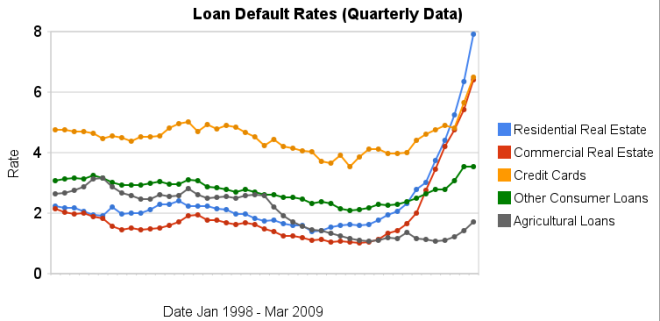
    chart of loan default rates 1998 to 2009Chart showing loan default rates for real estate, consumer and agricultural loans for 1998 to 2009 by the Curious Cat Investing Economics Blog, Creative Commons Attribution, data from the Federal Reserve.

    As you can see real estate default rates exploded in 2008. In the 4th quarter of 2007 residential default rates were 3.02% by the 4th quarter of 2008 they were 6.34% and in the 1st quarter of this year they were 7.91% (471 basis points above the 4th quarter of 2007). Commercial real estate default rates were at 2.74 in the 4th quarter of 2007, 5.43% in the fourth quarter of 2008 and 6.5% in the 1st quarter of 2009 (a 366 basis point increase).

    Credit card default rates were much higher for the last 10 years (the 4-5% range while real estate hovered above or below 2%). In the last 2 quarters it has increased sharply. From 4.8% in the 3rd quarter 2008 to 5.66% in the 4th and 6.5% in the 1st quarter of 2009. The default rate on other consumer loans are up but nowhere near the amounts of real estate or credit cards.

    Agricultural loan default rates are actually about as low now as they have every been 1.71%. That is up a bit from the 1.06% low the default rate hit in the 1st quarter of 2009 but actually lower than it was for half of the last decade (the last 5 years it has been lower but prior to that it was higher – in fact with higher default rates than either real estate loan category).

    Data from the Federal Reserve

    Related: Mortgage Rates: 6 Month and 5 Year ChartsJumbo Loan Defaults Rise at Fast PaceContinued Large Spreads Between Corporate and Government Bond YieldsNearly 10% of Mortgages Delinquent or in Foreclosure

  • Managing Retirement Investment Risks

    The Society for Actuaries has published a good resource: Managing post-retirement risks.

    Experts disagree about when annuitization is a good strategy. Disadvantages include losing control of assets, costs, and inability to leave money to one’s heirs. Annuities without inflation protection are only partial protection against living “too long.”

    Many investors try to own some assets whose value may grow in times of inflation. However, this sometimes will trade inflation risk for investment risk.
    Common stocks have outperformed inflation in the long run, but are
    poor short-term hedges. The historically higher returns from stocks
    are not guaranteed and may vary greatly during retirement years.

    Retirement planning should not rely heavily on income from a bridge job. Many retirees welcome the chance to change careers and move into an area with less pay but more job satisfaction, or with fewer demands on their time and energy.

    Terminating employment before age 65 may make it difficult to find a source of affordable health insurance before Medicare is available.

    Insurance for long-term care covers disabilities so severe that assistance is needed with daily activities such as bathing, dressing and eating. Some policies require a nursing home stay; others do not. The cost of long-term care insurance is much less if purchased at younger ages, well before anticipated need.

    The full document is well worth reading.

    Related: Many Retirees Face Prospect of Outliving SavingsHow to Protect Your Financial HealthFinancial Planning Made Easypersonal finance tips

  • Increasing USA Saving Rate is a Good Sign

    Surging U.S. Savings Rate Reduces Dependence on China

    Government data today showed that the household savings rate rose to 6.9 percent in May, the highest since December 1993, as personal spending increased less than incomes. The rate in April 2008 was zero. Most of the rise in income in May was due to one-time government stimulus payments to seniors

    Nouriel Roubini, an economics professor at New York University and chairman of RGE Monitor, forecasts that the savings rate will ultimately reach 10 percent to 11 percent. What’s critical, he said in a Bloomberg Television interview on June 24, is how quickly it increases.

    A rapid rise in the next year because of a collapse in consumption would push the economy, already in its deepest contraction in 50 years, further into recession, he said. If it occurs over a few years, the economy may grow.

    From 1960 until 1990, households socked away an average of about 9 percent of their after-tax income, government figures show. Americans got out of the habit in the 1990s as they saw their wealth build up in other ways, first through surging stock prices and then soaring home values, Gramley said.

    That process has now gone into reverse. U.S. household wealth fell by $1.3 trillion in the first quarter of this year, with net worth for households and nonprofit groups reaching the lowest level since 2004, according to a Fed report. Wealth plunged by a record $4.9 trillion in the last quarter of 2008.

    Edmund Phelps, winner of the Nobel Prize in economics in 2006 and a professor at Columbia University in New York, said it may take as long as 15 years for households to rebuild what they lost in the recession.

    As I have been saying the living beyond our means must stop. Those that think health of an economy is only the GDP forget that if the GDP is high due to spending tomorrows earnings today that is not healthy. Roubini correctly indicates the speed at which savings increases could easily determine the time we crawl out of the recession. I hope the savings rate does increase to over 10 percent.

    If we do that over 3 years that would be wonderful. But it is more important we save more. If that means a longer recession to pay off the excessive spending over the last few decades so be it. And it is going to take a lot longer than a few years to pay off those debts. It is just how quickly we really start to make a dent in paying them off that is in question now (or whether we continue to live beyond our means, which I think it still very possible – and unhealthy).

    Related: Will Americans Actually Save and Worsen the Recession?Can I Afford That?$2,540,000,000,000 in USA Consumer Debt (April 2008)Paying for Over-spending

  • Saving Spurts as Spending Slashed

    One factor you must understand when evaluating economic data is that the data is far from straight forward. Even theoretically it is often confusing what something like “savings rate” should represent. And even if that were completely clear the ability to get data that accurately measures what is desired is often difficult if not impossible. Therefore most often there is plenty of question about economic conditions even when examining the best available data. Learning about these realities is important if you wish to be financially literate.

    Bigger U.S. Savings Than Official Stats Suggest

    The official data from the Bureau of Economic Analysis say that in February personal spending was down 0.4%, or $40 billion, from the year before. Certainly any drop is bad news, since consumer spending rarely decreases – but $40 billion out of total spending of $10 trillion doesn’t seem like enough to wreak economic havoc.

    A closer look, however, shows that Americans have tightened their belts more sharply than the numbers report. The reason? Official figures for personal spending include a lot of categories, such as Medicare outlays, that are not under the control of households. They also include items, such as education spending, that should be treated as investment in the future rather than current consumption.

    After removing these spending categories from the data, let’s call what’s left “pocketbook” spending – the money that consumers actually lay out at retailers and other businesses. By this measure, Americans have cut consumption by $200 billion, or 3.1%, over the past year. This explains why the downturn has hit Main Street hard.

    Finally, for technical reasons the BEA throws in some “spending” categories where no money actually changes hands. The biggest is “rent on owner-occupied housing,” the money that people supposedly pay themselves for living in their own homes. Despite the housing bust, this number rose by 2.6% over the past year, to $1.1 trillion.

    A closer look at BEA numbers shows that Americans reduced spending by 3.1% in the past year, indicating that the savings rate has risen to 6.4%

    He raises good issues to consider though I am not sure I agree 100% with his reasoning.

    Related: The USA Should Reduce Personal and Government DebtFinancial Markets with Robert ShillerSave Some of Each RaiseOver 500,000 Jobs Disappeared in November (2008)

  • Paying for Over-spending

    Trading down

    Americans are rediscovering thrift. Retail sales fell by 11% from their peak in late 2007 to April 2009. Personal consumption has fallen 2.5% since last summer.

    A recent Pew poll found that 21% of Americans planned to grow their own vegetables, 16% had held a garage sale or sold things online and 10% had either taken in a friend or relative or moved in with one. Pundits are coining phrases such as “austerity chic” and “luxury shame”. Four-fifths of Americans told the BCG they would defer big purchases that can wait.

    The beneficiaries of the new parsimony are, unsurprisingly, firms that offer low prices. The only two stocks on the Dow Jones Industrial Average that rose in 2008 were Wal-Mart and McDonald’s.

    The hangover from this party will be long and painful. Households’ total outstanding borrowing fell in the fourth quarter of 2008, for the first time since the second world war. The personal-saving rate rose to 4.2% in the first quarter of 2009, from a nadir of minus 0.7% in 2005. “It is easy to see how consumer deleveraging could result in hundreds of billions of dollars-worth of forgone consumption in coming years,” say Martin Baily, Susan Lund and Charles Atkins of the McKinsey Global Institute.

    American consumers are burdened by far too much consumer debt. And spending on non-essentials with debt is un-wise and creates personal risks and a weak (fundamentally) economy. It is true the current economic data will look good when people spend money they don’t have. But it just creates a huge burden for the future economy to cope with.

    Related: USA Consumers Paying Down DebtToo Much Personal Debt$2,540,000,000,000 in USA Consumer Debt

  • Manage Your Borrowing and Avoid Debt Negotiators

    Debt Negotiators May Give Little Relief to Consumers

    “They never told me that the money I was paying wasn’t going to my debt, it was going to them,” said Hopkins, 59, who quit work in January 2008 after a brain tumor led to surgery. He now receives $1,539 a month in disability checks. “You are better on your own.”

    Credit-card delinquencies are at record highs, according to Fitch Ratings, and the U.S. unemployment rate of 8.9 percent is the highest since 1983. As more consumers fall behind on bills, settlement companies often end up adding to the debt burden rather than offering a cost-saving solution, said Gail Cunningham, a spokeswoman for the National Foundation for Credit Counseling in Silver Spring, Maryland.

    New York Attorney General Andrew Cuomo has begun a national investigation of settlement companies, and has sued two for fraud and false advertising. Illinois Attorney General Lisa Madigan has also filed two lawsuits against debt-settlement companies, alleging they “engage in deceptive marketing practices” and “do little or nothing to improve consumers’ financial standings.” Texas Attorney General Greg Abbott sued a debt settlement company in March, saying it engaged in “deceptive and misleading acts,” according to court documents.

    It is much better to avoid this problem by taking wise personal finance actions – don’t take on personal debt for minor purchases (for a mortgage then debt is fine, probably fine for a car – though avoid debt if you can). The “secret” is not very secret. Just don’t buy what you can’t pay for. It is very simple, many people just don’t want to follow that simple strategy. Also save money in an emergency fund, so when some emergency comes along you don’t go into debt. You just use your emergency fund.

    Once you are stuck in a bad situation with more debt than you can afford to pay back you have bad choices. Obviously many try to take advantage of you. Frankly they realize many that are stuck in bad financial position make bad financial decisions. Therefor it is a good place for those trying to rip people off to find people to take advantage of. The best way to deal with this is not to try and find the best debt negotiators it is to manage you finances well and not get in trouble.

    Related: Personal Saving and Personal Debt in the USAHow to Use a Credit Card SuccessfullyCredit Card Companies Willing to Deal Over DebtWhere to Keep Your Emergency Funds?Americans are Drowning in Debt

  • Bogle on the Retirement Crisis

    John Bogle was the founder of Vanguard Group and a well respected investment mind. He has written several good books including: The Little Book of Common Sense Investing, Common Sense on Mutual Funds and Bogle on Mutual Funds. This interview from 2006 discusses the state of the retirement system, before the credit crisis.

    John Bogle: The whole retirement system, in fact, in the country is in, I think, very poor shape, and it’s going to be the next big financial crisis in the country, I honestly believe. … The private pension plans are underfunded by an estimated $400 billion, and the state and local government plans are underfunded by an estimated $800 billion. That’s a $1.2 trillion shortfall between the assets the plans have and the liabilities they will have to the pensioners as they pay out their retirement checks over the rest of their lifetimes.

    Frontline: How do they get away with that? Don’t they have to fund them?

    John Bogle: No, they don’t, because a lot of it is based on assumptions. Our corporations are now assuming that future returns in their pension plan will be about 8.5 percent per year, and that’s not going to happen. The future returns in the bond market will be about 4.5 percent, and maybe if we’re lucky 7.5 percent on stocks. Call it a 6 percent return — before you deduct the cost of investing all that money, the turnover cost, the management fees. So maybe a 5 percent return is going to be possible, in my judgment, and they are estimating 8.5 percent.

    Why? Because when they do it that way, corporation earnings become greatly overstated, and all the executives get nice, big bonuses. They are using pension plan assumptions as a way to manage corporate earnings and meet the expectations of Wall Street.

    Frontline: So if a company overstates the value of its pension plan assets, it makes the company look better to Wall Street, so there’s an incentive to kind of exaggerate, if not cheat.

    John Bogle: That is precisely correct. And let me clear on the cheating: It’s legal cheating; it’s not illegal cheating. In other words, you can change any reasonable set of numbers — and corporations have done this, have raised the pension assumption from 7 percent to 8.5 percent — and all of a sudden that corporation will report an earnings gain for the year rather than an earnings loss that they would otherwise have. Simple, legal.

    The entire PBS series (from 2006) on 401(k)s (including interviews with Elizabeth Warren, David Wray and Alicia Munnell) is worth reading.

    In February of 2009 he spoke to the House of Representatives committee exploring retirement security.
    (more…)

  • Mortgage Rates: 6 Month and 5 Year Charts

    mortgage rate chart - late 2008 to May 2009Showing mortgage rates over the last 6 months. Red: 30 year fixed rate. Blue: 15 year fixed rate. Tan: 1 year adjustable rate.

    mortgage rate chart - May 2004 to May 2009Showing mortgage rates over the last 5 years. Red: 30 year fixed rate. Blue: 15 year fixed rate. Tan: 1 year adjustable rate. From Yahoo Finance, for conventional loans in Virginia.

    The 6 month chart shows that mortgage rates have been declining ever so slightly. Rates on a 1 year adjustable mortgage fell from 5.5 to 4% and have stayed near 4% for all of 2009. 30 and 15 year rates (15 year rates staying about 25 basis points cheaper) have declined from 6.5%, 6 months ago to about 5% at the start of the year and have moved around slightly since. This is while the yield 10 year government treasuries have been rising (normally 30 year fixed rate mortgages track moves in the 10 year government bond). The federal reserve has been buying bonds in order to push down the yield (and stimulate mortgage financing and other borrowing).

    Mortgage rates certainly could fall further but the current rates are extremely attractive and I just locked in a mortgage refinance for myself. I am getting a 20 year fixed rate mortgage; I didn’t want to extend the mortgage period by getting another 30 year fixed rate mortgage. For me, the risk of increasing rates outweigh the benefits of picking up a bit lower rate given the current economic conditions. But I can certainly understand the decision to hold out a bit longer in the hopes of getting a better rate. If I had to guess I would say rates will be lower during the next 3 months, but I am not confident enough to hold off, and so I decided to move now.

    Related: Mortgage Rates Falling on Fed Housing Focusposts on mortgages30 Year Fixed Mortgage Rates and the Fed Funds RateContinued Large Spreads Between Corporate and Government Bond YieldsLowest 30 Year Fixed Mortgage Rates in 37 Years

  • Beware of the Sucker’s Rally

    Beware of the sucker’s rally

    The Bull Market Express may really be pulling out of the station, but Wall Street’s trains have a nasty tendency to derail just as passengers jostle for seats. Most recently, the S&P 500 soared 24 per cent over seven weeks ending in early January, only to plunge to a new low. It was a fairly typical sucker’s rally and bear markets often need more than one to create sufficient disillusionment for a definitive bottom.

    The 2000–2002 bear market had three, with average gains of 21 per cent in the Dow Jones Industrials over 45 days.

    The granddaddy of all bear markets, 1929 –1932, had six false alarms with an average gain of 47 per cent. And Japan’s ongoing bear saw the Nikkei rise by at least a third four times in its first four years with 10 more false dawns since then.

    Bear markets typically end with a whimper rather than a bang, casting doubt on the latest recovery according to Hussman Econometrics, which analysed numerous US market bottoms and bear market rallies. With the exception of the 1987 crash, the month before the lowest point of a downturn saw a gradual descent.

    I don’t put much money on the line trying to time the stock market. I thought the decline was overdone and I have found some things to buy. I am not convinced the current assent of the USA market especially means the bear market is over. If I had to sell stocks, I would be much happier to do it now than 3 months ago. That said, I am not selling anything or reducing my planned buying (401k buying).

    Related: Financial Markets Continue Panicky Behavior (Oct 2008)Trying to Beat the MarketAdd to Your 401(k) and IRAsee my investing portfolio results