Category: quote

  • Add to Your 401(k) and IRA

    The recent performance of investments can be discouraging. However, the most damaging reaction to your financial future is to reduce your contributions to retirement savings. IRAs and 401(k)s are great ways to save for retirement. In fact the recent performance has convinced me to increase my contributions. This is for two reasons.

    First, I had been somewhat optimistic in my guesses about investment returns. The current decline means that investments in the S&P 500 have returned about 0% over the last 10 years. That is a horrible performance and it will take many years to even bring that up to a bad performance. So if you reduce your long term investment performance expectations you need to add more while you are working (or reduce your retirement expectations – or work longer).

    Second, I think now is a very good time (long term) to be investing. I think the declines in the markets (both the stock market and real estate market) now provide good investment opportunities. Of course I could be wrong but I am willing to make investments based on this believe. And I believe there are plenty of place real estate prices may still be too high, but I believe there are also good buys.

    A third reason worth considering is the damage done to the economy over the last 10 years and the costs of dealing with that today. Those costs are going to have long term impacts. Likely the economy will be stressed paying for the over-indulgences of the past for quite a long time. That means the risks to those in that economy will increase. And therefore having larger reserves is a wise course of action to survive the rough times ahead. Those rough times include a substantial risk of inflation. Investing to protect against that risk is important.

    I would recommend starting with at least a 200 basis point increase in retirement contributions. For example, if you were saving 10% for retirement, increase that to 12%. If you have not added to your IRA for 2008, do so now (you have until April 15th to do so). In fact, if you haven’t added to your IRA for 2009, do so now.

    Related: How Much Will I Need to Save for Retirement?Nearly half of all workers have less than $25,000 in retirement savingsInvesting – What I am Doing Now

  • There is No Invisible Hand

    There is no invisible hand by Joseph Stiglitz, 2001 Nobel Prize in Economics

    This year’s [2002] Nobel Prize celebrates a critique of simplistic market economics, just as last year’s award (of which I was one of the three winners) did. Last year’s laureates emphasised that different market participants have different (and imperfect) information, and these asymmetries in information have a profound impact on how an economy functions.

    In particular, last year’s laureates implied that markets were not, in general, efficient; that there was an important role for government to play. Adam Smith’s invisible hand – the idea that free markets lead to efficiency as if guided by unseen forces – is invisible, at least in part, because it is not there.

    That such models prevailed, especially in America’s graduate schools, despite evidence to the contrary, bears testimony to a triumph of ideology over science. Unfortunately, students of these graduate programmes now act as policymakers in many countries, and are trying to implement programmes based on the ideas that have come to be called market fundamentalism.

    Let me be clear: the rational expectations models made an important contribution to economics; the rigour which its supporters imposed on economic thinking helped expose the weaknesses underlying many hypotheses. Good science recognises its limitations, but the prophets of rational expectations have usually shown no such modesty.

    Related: Greenspan Says He Was Wrong On RegulationIgnorance of How Markets WorkLeverage, Complex Deals and ManiaEstate Tax RepealMisuse of Statistics – Mania in Financial Markets

  • The USA Economy Needs to Reduce Personal and Government Debt

    The economy has structural problems. The solution at this time is not to convince people that everything is fine and just go spend money you don’t have. Personal debt is much to high. The practices that allowed huge anti-competitive and economy endangering institutions to threaten the economy have not been addressed. Hundreds of billions of dollars have been given to those who caused the credit crisis. Making the federal debt problem even worse.

    Some suggest we need to regain consumer confidence. Unfortunately that fixes nothing. That “strategy” is just to convince people problems don’t exist and buying what you can’t afford is fine. Just convince people to go spend more money, run up their credit card debt, borrow against their house, as long as everyone believes it can continue. That can work for awhile but it then fails due to structural issues. And the solution becomes more and more difficult the longer such a strategy is used. The same way a ponzi scheme eventually implodes.

    If you could convince those in a ponzi scheme (and new investors) that they should just be optimistic it can continue. But eventually people ask for their money to buy something and none exists and the scheme fails.

    With an economy, after structural problems are addressed then you need to convince people to be less fearful and to be more optimistic. Because often by that time people have become so fearful that they are not taking even reasonable steps. They don’t buy even though they have the money in the bank and have a real need for the purchase. When this happens, convincing people that the economy is stable is important. However, cheerleading and convincing people to just continue to run up their debts to spend more is not wise when the economy is already far to in debt is not wise (though it is politically expedient).

    The USA needs to stop living beyond its means. That is the most important factor to long term economic strength. But the focus doesn’t seem to be on doing this, instead it seems to be on printing money to paper over the problems. There are many great strengths of the economy and those have allowed huge federal deficits, huge personal debt, monopolistic practices, destabilizing financial risks taking… Even with that things have been quite good. But those areas need to be addressed over the long term.

    Related: Let the Good Times Roll (using Credit)Families Shouldn’t Finance Everyday Purchases on CreditLiving on Less

  • USA Unemployment Rate Rises to 8.1%, Highest Level Since 1983

    The employment news in the USA continues to be very bad. We knew the news on job was going to be bad in 2009; still the actual news confirming those beliefs is not welcome. Of all the economic statistics for the health of the economy, employment is about the most important.

    U.S. Unemployment Rate Jumps to 8.1 Percent by Debbi Wilgoren

    The Bureau of Labor Statistics said the jobless rate rose from 7.6 percent in January to 8.1 percent in February, the highest rate in more than 25 years. An estimated 12.5 million Americans were unemployed in February, the data show, an increase of 851,000 since January. More than 4.4 million people have lost their jobs since the recession began in December 2007, U.S. Labor Secretary Hilda Solis said.

    The government revised sharply upward the number of jobs the economy lost in December and January, showing a staggering 1.99 million jobs disappearing in the past three months. More jobs were lost in each of those months than in any single month since October 1949

    The February data showed profound losses in the professional and business services sector, with 180,000 jobs gone. Some 168,000 jobs were lost in the manufacturing industry, with most of the decline in the durable goods sector. There were 104,000 construction jobs lost as projects stalled due to the collapse of the real estate industry and the ongoing credit crisis. The financial sector shed 44,000 jobs, retail lost 40,000 jobs and the leisure and hospitality industry reported 33,000 fewer jobs. Job growth continued, however, in the health-care sector.

    Analysts say the pace of job cuts is likely to remain brisk for at least a few more months

    The number of people working part time because they cannot find full-time employment rose by 767,000 in February to 8.6 million, the government said. The unemployment rate does not reflect people who say they would like to work full-time, but can only find part-time job

    Related: Over 500,000 Jobs Disappeared in NovemberWhat Do Unemployment Stats Mean?Bad News on JobsPoll: 60% say Depression Likely

  • More Companies Cutting Dividends Than Any Year Since Before 1954

    Dividends Falling Means S&P 500 Is Still Expensive

    U.S. equities returned 6 percent a year on average since 1900, inflation-adjusted data compiled by the London Business School and Credit Suisse Group AG show. Take away dividends and the annual gain drops to 1.7 percent, compared with 2.1 percent for long-term Treasury bonds, according to the data.

    A total of 288 companies cut or suspended payouts last quarter, the most since Standard & Poor’s records began 54 years ago, when Dwight D. Eisenhower was president. While the S&P 500 is trading at the lowest price relative to earnings since 1985 and all 10 Wall Street strategists tracked by Bloomberg forecast a rally this year, predictions based on dividends show shares are overvalued by as much as 46 percent.

    Just last November the S&P 500 dividend yield topped the bond yield for the first time since 1958. Yields often rise as stock prices fall on future prospects and companies announce dividend cuts after stocks have already fallen (due to the deteriorating conditions the company faces). So you always must be careful not to count dividends before they are paid. As an investor you need to look into the future and see how secure the dividends are likely to be.

    Related: 10 Stocks for Income Investors10 Stocks for 10 YearsCurious Cat Investing Books

  • What the Bailout and Stimulus Are and Are Not

    The huge banking bailouts and stimulus bill are meant to counter-balance the huge problems the economy is suffering through. The damage caused to the economy, is largely from unwise risks that were allowed by regulators and politicians that have not panned out and are now greatly damaging the economy. It is always easy for politicians to pay out money in an attempt to buy our way out of problems. That is what the stimulus and bailout bills are doing. They are yet again heaping huge debts on our children and grandchildren.

    The bailout and stimulus packages are not about preventing foolish risks to the economy by huge banks that would make the economy safer in the future. Those types of bills are very hard to pass as the politicians get great sums of money to allow people to risk the economy for their own benefit. The concept of the stimulus is not to fix the cause of the problem but do cope with the problem we are left with due to people that paid themselves huge amounts of money. Now the taxpayers get to fund the huge payouts wall street has given themselves.

    This is because they never actually provided the value they claimed. They merely created false returns to claim they provided a benefit to justify obscene pay (many of them truly didn’t understand this is what they were doing so beyond failing they were so incompetent [while accepting well over a million dollars a year] they didn’t even understand that the financial games they were playing were failing. It is hard to know what is worse, being so incompetent while claiming you deserve millions or knowing you are just paying yourself money based on false claims of value.

    Either way, the banks are left bankrupt – having worthless securities created by those paying themselves huge amounts of money. If the huge banks fail the financial system collapse creates huge problems – businesses that have operated for decades by borrowing some funds (responsibly) go bankrupt because no funds are available to lend them, etc..

    The stimulus is not about fixing the problems of the past it is about countering the huge decline from the bubble economy. That bubble economy was funded largely by claiming value where none existed thereby allowing people to spend huge amounts of money based on those faulty claims. How people are shocked that playing financial games doesn’t actually make hundreds of billions of dollars appear out of thin air is beyond me.
    (more…)

  • Our Capacity Remains Undiminished

    President Barack Obama’s Inaugural Address

    We remain the most prosperous, powerful nation on Earth. Our workers are no less productive than when this crisis began. Our minds are no less inventive, our goods and services no less needed than they were last week, or last month, or last year. Our capacity remains undiminished. But our time of standing pat, of protecting narrow interests and putting off unpleasant decisions — that time has surely passed. Starting today, we must pick ourselves up, dust ourselves off, and begin again the work of remaking America.

    That sounds nice I believe however, it is fairly irrelevant. Economic demand is what is down, not production capacity. We are “no less productive than when this crisis began.” Ok, that is probably true. So what. That implies that the crisis has something to do with productivity. If we say the color of our eyes is the same as when the crisis began it is obvious that is a non-sequitur. Well so is the quote by the new President, though that is less obvious.

    Our demand was definitely over stimulated using massive federal government budget deficits, massive trade deficits, massive amounts of consumer debt, massive amounts of unjustified mortgage debt and massive amounts of leverage. None of those things has anything to do with capacity in the implied sense – capacity to produce. They have to do with the capacity to consume. And while our capacity to consume has not declined. The funding that allows that consumption (foreign lending, high leverage, junk mortgages…) has decreased.
    (more…)

  • The Impact of Credit Scores and Jumbo Size on Mortgage Rates

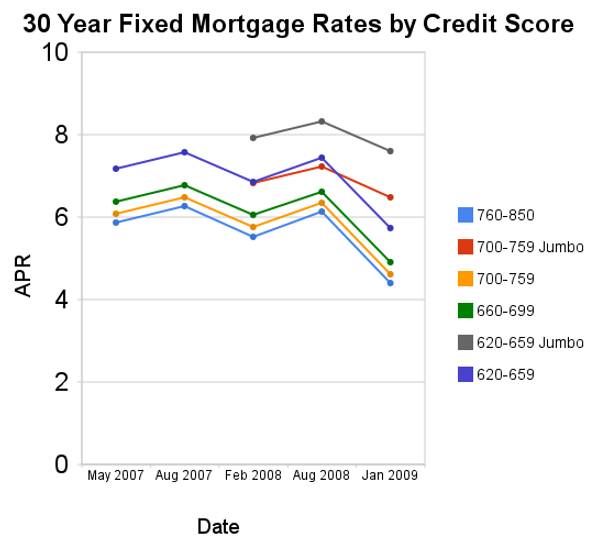
    Since August of 2008 conforming mortgage rates are have declined a huge amount. Jumbo rates have fallen a large amount also, but much less (for example for a credit score of 700-759 the jumbo rates declined 73 basis points while the conventional rate declined 172 basis points.

    chart of 30 year fixed mortgage rates by credit score from May 2007 to Jan 2009

    For scores above 620, the APRs above assume a mortgage with 1 point and 80% Loan-to-Value Ratio. For scores below 620, these APRs assume a mortgage with 0 points and 60 to 80% Loan-to-Value Ratio. You can see, with these conditions the rate difference between a credit score of 660 and 800 is not large (remember this is with 20% down-payment) and has not changed much (the difference between the rates if fairly consistent).

    Related: Low Mortgage Rates Not Available to Everyone30 Year Fixed Rate Mortgage Rate DataReal Free Credit Report (in USA)Jumbo Mortgage Shoppers Get Little Relief From Ratesposts on mortgages
    (more…)

  • Consumer Credit Falls By Record Amount in November

    Consumer Credit Falls By Record Amount in November

    The Federal Reserve reported yesterday that borrowing through credit cards and other consumer loans dropped $7.94 billion in November, the biggest decline in 65 years of record-keeping. That also was much larger than the $500 million decline economists expected, and left total consumer credit outstanding at $2.57 trillion.

    This is good news. People need to stop spending money they don’t have. I understand perfectly well this means that spending will go down (which will likely lead to reduced economic output – though technically it doesn’t have to, a reduction in imported goods could more than offset the reduced spending and GDP would not decline). Living beyond your means is not a good thing. We should hope that consumer debt continues to decrease. If that means we have some suffering today to pay for living beyond our means for years the “fix” is not to continue to live beyond our means. The “fix” is to accept the consequences of past behavior and build a more sustainable economy now for the future.

    Ideally this decrease can be someone gradual, abrupt changes in the economy often cause problems, but far too many economists and policy makers only care about today and the next 6 months. They have been living this way for decades. And it is not sustainable. Consumer debt levels in the USA are far too high. The UK has an even worse personal debt problem. They should come down. Reducing those levels is good for the individuals involved (they gain most of the benefit) and also for the health of the economy (though it does decrease the current economy a bit while making the foundation for future economy much stronger).
    (more…)

  • Low Mortgage Rates Not Available to Everyone

    The lowest 30 Year fixed mortgage rates in 37 years is great news for those looking to buy a house or to re-finance. However, that truth (the lowest rate) masks another truth, that it is available to a somewhat limited pool of borrowers. The rates for jumbo 30 year fixed mortgages and for regular 30 year fixed mortgages, for those with lower credit ratings, are not at the lowest rates they have ever reached. And getting mortgage rates that don’t require a 10-20% down payment and fully documented financial position are not as low as they have ever been. 15 year fixed rates are also low, but are not at all time lows. FHA loans still allow very low down payments, but others have moved away from this practice (which is a wise move).

    Current rates, national average, from Bankrate: 30 year fixed 5.26%, 30 year fixed jumbo 6.96% (a full 170 basis points higher rate), 15 year fixed 5.07%. Jumbo rates have been less than 40 basis points higher than conventional rates most of time (based on my memory – I am looking for a source to confirm). The site does not present the credit score but my guess is these rates are based on a credit score of 700, or higher. Last week the jumbo rates increased by 11 basis points and regular 30 year rates fell by 3 basis points.

    Related: Jumbo v. Regular Fixed Mortgage Rates: by Credit Scorehistorical mortgage rate chartNearly 10% of Mortgages Delinquent or in Foreclosuremisinterpreting data

    Changes in the Market For Jumbo Mortgages

    During the period May 4, 2007 to November 7, 2008, the spread in wholesale interest rates between a $417,000 loan eligible for purchase by Fannie Mae and Freddie Mac, and a $418,000 loan that is not eligible, increased from 0.28% to 2.97%.

    On Nov 12, 2008 I shopped for an $800,000 30-year fixed-rate mortgage on Mortgage Marvel, an on-line site that I reviewed earlier in 2008 (see A Look at Mortgage Marvel). The mortgage companies on the site quoted rates of 8.125% to 8.375%. The credit unions and banks, in contrast, quoted rates ranging from 5.875% to 7.875%. I have never before seen rate differences on the same transaction this large. They no doubt reflect wide differences in lender access to funding, which is symptomatic of a market in turmoil.

    Mortgage Q&A

    For example, I see from today’s rate sheet that a homeowner with 40 percent equity and an excellent credit score of 740 would receive a quote of 5.125 percent with no points or origination fees for a 30-year fixed-rate mortgage. A borrower with a credit score of 670 who has 20 percent equity would receive the same rate but would be charged two points. On a $300,000 loan, this makes the 5.25 percent rate $6,000 more expensive. If the homeowner with the lower credit score wanted to pay zero points, the rate would be well north of 6 percent.