Category: quote

  • Have We Lost Our Capitalist Heritage?

    I read various things stating that the USA is behaving in socialist (or similar ways). And there are often attempts to state that what the writer desires is capitalism and what they don’t like is an attack on motherhood, apple pie and capitalism.

    I’m not sure when or where those writers would say capitalism did exist. It is true we have corporations using their power (political power and market power [oligopolies, monopolies]) to serve their interests. This would not surprise Adam Smith at all, from the Wealth of Nations:

    People of the same trade seldom meet together, even for merriment and diversion, but the conversation ends in a conspiracy against the public, or in some contrivance to raise the prices/

    He knew that is what they would attempt to do and said they had to be regulated to allow capitalism to function (but many that say they want capitalism don’t want any regulation of the sort they don’t want). Some seem to agree that some regulation is needed but any regulation they don’t want is seen as “socialist” or “anti-capitalist” or… At least the Libertarians are very consistent about practically no regulation – I question that being capitalism, but at least I understand their position.

    Maybe the amount of direct cash payments and sheer amount of not very indirect subsidies (free money from the Fed, huge government contracts to political friends, tax breaks for big contributors [hedge fund managers, corporations using offshore tax havens…], quotas to aid political contributors) have been very high recently. But those changes are more a matter of degree than a qualitative change from the few years before that and few year before that and so on.

    I am not sure if people are thinking back to the days when we had large trusts as “capitalism”? Some people equate “capitalism” with essentially no government (no FDA, no SEC, no DoD, no FDIC, no EPA…) – so then maybe the wild west or Afghanistan today is capitalism. I don’t. I would say that we have been become less interested in maintaining a free market (allowing oligopolies and monopolies to exist and distort markets) and an excessive amount of letting those with gold pay politicians to get special deals lately (the last 20-30 years). But it is really just a matter of being worse in those areas not some huge qualitative change.

    We broke up trusts for awhile but lately have been supporting those with lots of clout using the clout to prevent competition.

    Of course perfect competition is not really reasonable to expect in many markets in the real world. But the aim of shooting toward open and competitive markets is just not something we seem to have paid much attention to for decades. I’m not sure when we did. And paying attention to sensible things like externalities is still very weak. Even in the trust busting era the actions (to move toward a more capitalist economy where markets could function more freely) were fought by many. And while the efforts made a huge difference, it isn’t as though they went to anything close to perfect competition.

    Countries like Hong Kong (questionably a “country”) and Singapore do lots of things that are nice capitalistic practices. But they have plenty of practices that are not very capitalistic. I’m not really sure what paragons of Capitalism those that appose regulating markets suggest as better models than the USA. Perhaps they believe the USA is the most capitalistic but it is still not capitalistic enough. A perfectly reasonable positions, I would think, but I am not sure if that is their belief or not.

    Related: Ignorance of CapitalismUSA Spent $2.2 Trillion, 16.2% of GDP, on Health Care in 2007

  • Would Your Spending Habits Change if You Had More Money

    photo of Swiftcurrent Lake waterfall

    Another blog asks: Does Income Change Who You Are as a Spender? or your Tastes?

    I would think in most cases more income should change your spending habits. Unless your tastes are so far below your income that additional income makes no difference then it should.

    I save money for retirement, emergency fund, an addition to my house… If I have get another $50,000 a year I can think of good ways to spend it (for me I would save lots of it, but I could also spend some). If now I think I can give $100 to some charity I might give $200 if I have a bunch more money. I buy Odwalla juice, which is pretty crazy expensive, but compared to my overall spending it doesn’t amount to much. But in my first few years of work life I wouldn’t have. I eat out a lot because I like that better than cooking. If I couldn’t afford it then I would eat out less.

    I would also “buy” more free time. I would take advantage of the extra cash to cut back at work so I had more time to spend however I wanted. And I would buy a Droid Incredible.

    I’d probably buy a solar energy system and battery backup if I had a ton of extra cash… I’d try some services to do things I would like to do but don’t have time for. I like photography and posting my photos online. But I am far behind and have a bunch I would like to do. If I had a bunch of extra cash I would pay someone to take my photos and post them how I want. I would buy a slide scanner and scan a bunch of my Dad’s old slides (or pay to have it done). If I had an fortune I would buy a place with indoor basketball court (or one that where I could build one) and fly first class or use Net Jets and travel a bunch more. Unfortunately I don’t foresee those things happening 🙁

    So yeah I would definitely change my spending habits. It isn’t really changing my tastes. I have the tastes now, I just figure given my financial situation it isn’t worth the money (and some I couldn’t even get people to lend me enough money to buy) for some things. But if I had a bunch more money I would buy them.

    A mistake many people make is increasing spending too much as income increases. I definitely suggest avoiding this risky behavior. It is fine to add some expenses but make sure you are adding to your retirement account, emergency fund, general savings with part of the raise. And it is risky to develop expensive tastes that you continue if you income declines (or lock into long term expenses – new car, mortgage…). So enjoy, but be careful.

    Photo by John Hunter, Swiftcurrent Lake trail in the Many Glaciers area of Glacier National Park.

    Related: Using Your Credit Card ProperlyTrying to Keep up with the JonesHow Rich Are You?

  • Manufacturing Output as a Percent of GDP by Country

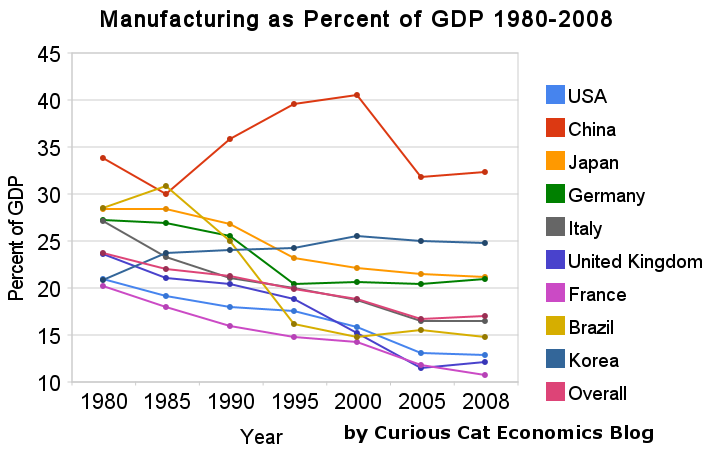
    In previous posts I have shown data for global manufacturing output by country. One of the things those posts have showed is that manufacturing output in China is growing tremendously, but it is also growing in the United States. The chart below shows manufacturing production by country as a percent of GDP. China dominates again, with over 30% of the GDP from manufacturing.

    chart of manufacturing output as percent of gdp by country 1980-2008

    Chart showing manufacturing output, as percent of GDP, by country was created by the Curious Cat Economics Blog based on UN data* (based on current USA dollars). You may use the chart with attribution.

    For the 14 biggest manufacturing countries in 2008, the overall manufacturing GDP percentage was 23.7% of GDP in 1980 and dropped to 17% in 2008. I left India (15% in 1980, 15% in 2008), Mexico (20%, 18%), Canada (17%, 13%), Spain (25%, 14%) and Russia (21% in 1990 [it was part of USSR in 1980], 15%) off the chart.

    Over the last few decades Korea, and to some extent China, are the only countries that have increased the percent of GDP from manufacturing. China has not only grown manufacturing activity tremendously but also other areas of the economy (construction, mining, information technology). The countries with the largest manufacturing portions of their economies in 2008 were: China 32%, South Korea 25%, Japan and Germany at 21%. The next highest is Mexico at 18% which declined slightly over the last 15 years (with NAFTA in place). Globally, while manufacturing has grown, other areas of economic activity have been growing faster than manufacturing.

    The manufacturing share of the USA economy dropped from 21% in 1980 to 18% in 1990, 16% in 2000 and 13% in 2008. Still as previous posts show the USA manufacturing output has grown substantially: over 300% since 1980, and 175% since 1990. The proportion of manufacturing output by the USA (for the top 14 manufacturers) has declined from 31% in 1980, 28% in 1990, 32% in 2000 to 24% in 2008. The proportion of USA manufacturing has declined from 33% in 1980, 29% in 1990, 36% in 2000 to 30% in 2008. While manufacturing output has grown in the USA it has done so more slowly than the economy overall.

    Related: The Relative Economic Position of the USA is Likely to DeclineManufacturing Data, Accuracy QuestionsTop 12 Manufacturing Countries in 2007Manufacturing Employment Data: 1979 to 2007USA Manufacturing Output Continues to Increase (over the long term)

    * I made edits to the 1980 Brazil manufacturing data and 1980, 1985 and 2008 China manufacturing data because the UN data only showed manufacturing data combined with mining and utility data. And I am using older UN data that had manufacturing separated from mining and utility figures for China in the other years.

  • Personal Finance Basics: Avoid Debt

    image of Droid Incredible cell phone

    Many aspects of personal finance can get a bit confusing or require some study to understand. But really much of it isn’t very complicated. Debt is often toxic to personal financial success. The simple step you can take to avoid the problems many face is to just not buy things until you save up for them. If you want some new shoes or new Droid Incredible or to go see a football game (American or World Cup style) that is fine. Just save up the money and then spend it.

    If you limit your borrowing you will get ahead financially. I think borrowing for a home is fine (I suggest saving up a 20% down-payment – or at least 10%, and many banks are again requiring this sensible step). And don’t overextend yourself – borrow what you can comfortably afford – even if you run into financial difficulty. It might be likely you earn more 5 years from now, but it is certainly possible you will earn less. Remember that.

    Borrowing for school is fine but be careful. Huge education debts are a large burden. Don’t ignore this factor when selecting a school. And don’t fall prey to the for-profit education scams that have become very prevalent. I would be very very skeptical of any for profit educational institution and would much prefer long term public or private institutions with long term success (colleges, universities and community colleges). Technical training can be very good but you have to be very careful to not be taken advantage of.

    Borrowing for a car is ok, but I would avoid it if possible. And other than that I would avoid debt, if at all possible. If you want a big expensive wedding, fine, save up the money. If you want a vacation to East Africa, great, save up the money. If you want the latest, new tech gadget, great save up the money first.

    And saving up for your emergency fund (if it isn’t fully funded already) and for retirement should be right after food, shelter, health and disability insurance and any debt you already have to be paying back. After you have committed money to your emergency fund and retirement then choose what to do with your remaining discretionary income. It is critical to have built up an emergency fund so if you have any emergency you can tap that without going into debt and digging yourself a personal financial hole you have to dig out of.

    Personal financial success is not some get rich quick scheme or magic. Success is Achieved by doing some really simple things well. It is not complicated but that isn’t the same thing as easy. Showing restraint is not what we are urged to do by the marketers. So while not buying what you can’t afford is not exactly an amazing insight, hundreds of millions of people (in the USA and Europe I know, and probably everywhere that consumer debt is easy to get) fail financially just because they refuse to follow this advice.

    Related: Avoid credit card debtHow to Protect Your Financial HealthCurious Cat personal finance basicsCan I Afford That?

  • Company Spotlight on Campaign Monitor by 37Signals

    Profitable and proud: Campaign Monitor

    we’ve managed to more than double our revenues and profits every year for the last six years. All without taking any outside investment.

    The idea for selling our own software really came out of frustration more than anything else. We were designing email newsletters for a lot of our clients but couldn’t find the right tool for the job. After trying everything on the market, we built a simple app that let our clients manage their own newsletters. All our clients loved it and it created a nice new revenue stream for us.

    Over the last six years we’ve gone from open plan, to all closed offices and then to a combination of both. I’ve paid close attention to the pros and cons of each layout, and I’m convinced that closed offices are the best layout for a software company.

    The reason for this is fairly simple. It’s all about removing distractions. Jobs like software development, design and copywriting often require juggling lots of different things in your head at once.

    Very interesting article on successful entrepreneurship. I also appreciate the management ideas discussed which resonate with those I discuss in my management blog.

    Related: Small Business Profit and Cash FlowY-Combinator’s Fresh Approach to Entrepreneurship

  • Bogle on the Stock Market and Investing

    Bogle on Bankers, Buffett, Obama; an interview of John Bogle, from February 2010.

    Bogle: What happened over the last 10 years were two things, and one of which we have never encountered before. The 17% returns we had over the two previous consecutive decades, the ’80s and the ’90s, were born largely on ascending price-earnings multiples. If the price-to-earnings ratio goes from 8 to 16 in one decade, and then to 32 in the next decade, that accounts for 7% per year of that 17% return. So the market was driven by the revaluation of corporate America and that just can’t keep recurring at those rates. I projected in the original book that the price-earnings multiple might get down below 20, which is exactly what it’s done, so that was fairly predictable.

    But what made the decade quite so bad is that we then had a major recession or light depression at the end of 2008 to 2009 which is still with us. That coming with the market so highly valued meant that earnings growth was much less than what we might have expected. So looking out from here, I think we can look for better earnings growth. And dividend yields are back in decent territory but not great. We started this decade with a 1% dividend yield, and that’s an important part of investment returns, and now the dividend yield is around 2.25%, so a higher dividend yield contributing to future growth. So I think it’s highly likely that stocks will outpace bonds in the decade that just began.

    Are we on the right path now? Has America learned its lesson?
    Bogle: No. Unequivocally not. The long overdue reforms being discussed in Washington do not go nearly far enough, in my opinion. We need protection for consumers. Canada has a financial structure similar to ours except it has a consumer-protection board, which would prevent banks from giving people mortgages if they have no ability to pay them back. To get that done has been very difficult. Also, Senators (John) McCain and (Maria) Cantwell have proposed a return of the Glass-Steagall Act, and that’s gotten nowhere but it is long overdue. We should have banks behave as banks and not as investment banks or hedge-fund managers.

    But let’s suppose the stock market creates a 10% return. And the value of the stock market today is around $13 trillion so 10% is $1.3 trillion. By my numbers, Wall Street and the mutual fund industry take $600 billion a year out of that return. That’s half of the return. So the only way investors are going to get their fair share of the $1.3 trillion is to reduce the costs and get the casinos out.

    As usually John Bogle provides excellent analysis and vision.

    Related: Bogle on the Retirement CrisisIs Trying to Beat the Market Foolish?Lazy Portfolios Seven-year Winning StreakSneaky Fees

  • Government Debt, Greece is a Very Small Part of the Problem

    Roubini Says Rising Sovereign Debt Leads to Inflation, Defaults

    Credit-rating cuts on Greece, Portugal and Spain this week are spurring investors’ concern that the European deficit crisis is spreading and intensifying pressure on policy makers to widen a bailout package. Roubini’s remarks underscore statements by officials such as Dominique Strauss-Kahn, managing director of the IMF, that the global economy still faces risks.

    “The thing I worry about is the buildup of sovereign debt,” said Roubini

    If the problem isn’t addressed, he said, nations will either fail to meet obligations or experience higher inflation as officials “monetize” their debts, or print money to tackle the shortfalls.

    “While today markets are worried about Greece, Greece is just the tip of the iceberg, or the canary in the coal mine for a much broader range of fiscal problems,”

    Greece “could eventually be forced to get out” of the 16- nation euro region, he said in a Bloomberg Television interview yesterday. That would lead to a decline in the euro and make it “less of a liquid currency,” he said. While a smaller euro zone “makes sense,” he said, “it could be very messy.”

    [Roubini supports] a carbon tax on gasoline, with Roubini saying it would reduce American dependence on oil from overseas, shrink the trade deficit and carbon emissions, and help pay down the U.S. budget deficit.

    I agree that the damage done by those (which is nearly all of them) countries living beyond their means is significant. The USA and many countries in Europe and Asia (South Korea and China are two exceptions) have raised taxes on the future (by default – spending more than you have necessarily increases taxes later) to consume today. The strong emerging markets are another exception, many having learned their lessons and stopped spending money they didn’t have in the 1990’s.

    However the richest countries have been spending money they don’t have for decades and the increase in government debt as a portion of GDP is an increasingly serious problem. It would be nice if the government of the rich countries could behave responsibly but it does not look like many of them have citizens who will elect honest and competent leaders. As long as they elect leaders that insist on raising taxes on the future (and lying to the populace by claiming they cut taxes – because they eliminate taxes today) those countries will pay severely for the irresponsible spending.

    Saying you cut taxes when you just delay them is equivalent to saying I paid off my credit card bill when all I did was get 2 new credit cards, borrow all the money I owed on my original card, pay that one off, and then borrow more to increase my debt even more. Yes it is true I did pay off my original credit card, but that is hardly the salient point. My credit card debt increase. All that has happened in the USA since the Clinton administration had a balanced budget is politicians used a credit card thinking to lower taxes while necessarily increasing them in the future. You don’t reduce debt by spending money you don’t have.
    (more…)

  • The 4% Rule is Overly Simplistic

    Time to replace the 4% rule

    Conventional wisdom suggests that you withdraw on average 4% adjusted for inflation. Now comes a paper co-authored by William Sharpe, the winner of the 1990 Nobel Prize in Economics, challenging the conventional wisdom.

    According to Sharpe, who is also the founder of Financial Engines, the typical 4% rule recommends that a retiree annually spend a fixed, real amount equal to 4% of his initial wealth, and rebalance the remainder of his money in a 60%-40% mix of stocks and bonds throughout a 30-year retirement period.

    What’s more, he shows the price paid for funding what he calls “unspent surpluses and the overpayments made to purchase its spending policy.” According to Sharpe, a typical rule allocates 10%-20% of a retiree’s initial wealth to surpluses and an additional 2%-4% to overpayments.

    The only problem with what academia knows to be right and what’s practical in the field — even by Sharpe’s own admission — is this: “Many practical issues remain to be addressed before advisers can hope to create individualized retirement financial plans that maximize expected utility for investors with diverse circumstances, other sources of income, and preferences,” Sharpe wrote in his paper.

    Meanwhile, Stephen P. Utkus, a principal with the Vanguard Center for Retirement Research, agrees that the 4% rule is flawed. But he also notes, as did Sharpe, that there’s no practical mechanism to replace it with and that further research is required.

    I think this is exactly right. The proper personal financial actions in this case are not easy. The 4% rule is far from perfect but it does give a general idea that is a decent quick snapshot. But you can’t rely on such a quick, overly simplified method. At the same time there are simple ideas that do work, such as saving money for retirement is necessary. The majority of people continue to fail to take the most basis steps to save money each year for retirement.

    Related: Spending Guidelines in RetirementHow Much Will I Need to Save for Retirement?Bogle on the Retirement Crisis

  • Famous Stock Traders: Nicolas Darvas

    Book cover to How I made $2 million in the Stock Market

    For the most part my investment philosophy is based on fundamental long term investing strategies. But I do also occasionally speculate with a portion of my portfolio. It is risky (and honestly most people will lose money trying so it is unwise for most, if not all, to try) but can bring great returns for the successful speculator/trader. My methods are significantly influenced by Nicolas Darvas who wrote the classic investment book – How I Made $2,000,000 in the Stock Market (which I am re-reading now). In it he provides an honest and open look at his experience from his naive start to his eventual success. He lays out, in great detail, exactly what he did and how foolish some of his actions were. Then he explains how he came to find success by focusing on the price and volume action of stocks and a pseudo fundamental component (more of a story that could presage future fundamental success than actual fundamental strength). While honing his investment strategy, in the 1950’s, he traveled the world working as a world class ballroom dancer and placed order via cable.

    Darvas’ method was a forerunner of the many technical analysis schemes used today. He is extensively referenced by William O’Neil (of Investor’s Business Daily fame) and other leading technicians. An extremely simplified overview of Darvas’ method: determine “boxes” (trading ranges) for a stock and buy on the breakout, to the upside, of the topmost box. He used a rest period of several days to set the top of the box and then determine the bottom of the box after that top was set. He used very close trailing stop loss orders to minimize losses. He sought to make large gains (let his winners run) and cut losses quickly.

    Nicholas Darvas’ ideas and books included a disdain for wall street insiders, analysts and rumors. The CAN SLIM (William O’Neil and Investor’s Business Daily) investing style owes a great deal to Darvas’ ideas on investing.

    I have created a new twitter account [removed] for to comment and follow others trading ideas. I would suggest only experience and successful investors even consider trading with a small portion of their portfolio. For most it is a losing proposition.

    More on Darvas’ investing ideas and other leading investors. Books by Nicolas Darvas: Wall Street: The Other Las VegasYou Can Still Make It in the Market (republished after a long period when it was not available) – Darvas System for Over the Counter Profits

  • Taxes – Slightly or Steeply Progressive?

    The Wall Street Journal wrote “Their Fair Share” in July of 2008 claiming that the rich are paying their fair share of taxes.

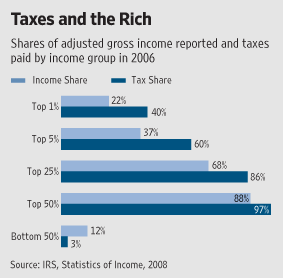
    The nearby chart shows that the top 1% of taxpayers, those who earn above $388,806, paid 40% of all income taxes in 2006, the highest share in at least 40 years. The top 10% in income, those earning more than $108,904, paid 71%. Barack Obama says he’s going to cut taxes for those at the bottom, but that’s also going to be a challenge because Americans with an income below the median paid a record low 2.9% of all income taxes, while the top 50% paid 97.1%. Perhaps he thinks half the country should pay all the taxes to support the other half.

    Wow. The Wall Street Journal against a tax cut? Well I guess if it is a tax on the poor they don’t support cutting those taxes. I think it may well make sense to reduce the social security and medicare taxes on the working poor (including the company share). Of all the taxes we have this is the one I would reduce, if I reduced any (given the huge amount of government debt any reduction may well be unwise). But reducing income taxes for those under the median income doesn’t seem like something worth doing to me.

    The top 1% earned 22% of all reported income. But they also paid a share of taxes not far from double their share of income. In other words, the tax code is already steeply progressive.

    chart of taxes by income distribution

    They seem to ignore that income inequality has drastically increased. When you have a system that puts a huge percentage of the cash in a few people’s pockets of course those people end up paying a lot of cash per person. One affect of massive wealth concentration is that the limited people all the money is flowing to naturally will pay an increasing portion of taxes.

    It is fine to argue that the rich pay too much tax, if you want. I don’t agree. I think Warren Buffett explains the issue much more clearly and truthfully when he says he, and all his fellow, billionaires (and those attempting to join the club) pay a lower percent of taxes on income than their secretaries do. He offers $1 million to any of them that prove that isn’t true.

    And I guess you can say that the top 22% of the income paying the top 40% of the taxes is “steeply progressive.” I wouldn’t call that steep, but… It is nice the graphic is at least decently honest. Saying just “top 1% of taxpayers, those who earn above $388,806, paid 40% of all income ” is fairly misleading. It is much more honest (I believe) to say that “the top 1% (that made 22% of the income) paid…” Those with the top 22% of income paid 40% of the taxes, the next 15% payed 20%, the next 31% paid 26% the next 20% 11% and the final 12% paid 3%. That is progressive. From my perspective it could be more progressive but I can see others saying it it progressive enough.

    If 22% to 40% is “steeply” progressive what is 1% to 22%? The income distribution seems to be what? very hugely massively almost asymptotently progressive? The to 1% of people, by income, take 22% of the income, the next 4% take the next 15% of the total income, the next 20% take 31%, the next 25% take 30% and the bottom 50% take 12%. This level of income inequality is much more a source of concern than any concern someone should have about a slightly progressive tax result.

    Related: House Votes to Restore Partial Estate Tax on the Very Richest: Over $7 MillionIRS Tax dataRich Americans Sue to Keep Evidence of Their Tax Evasion From the Justice Department
    (more…)