Category: quote

  • USA, China and Japan Lead Manufacturing Output in 2008

    Once again the USA was the leading country in manufacturing in 2008. And once again China grew their manufacturing output amazingly. In a change with recent trends Japan grew output significantly. Of course, the 2009 data is going to show the impact of a very severe worldwide recession.
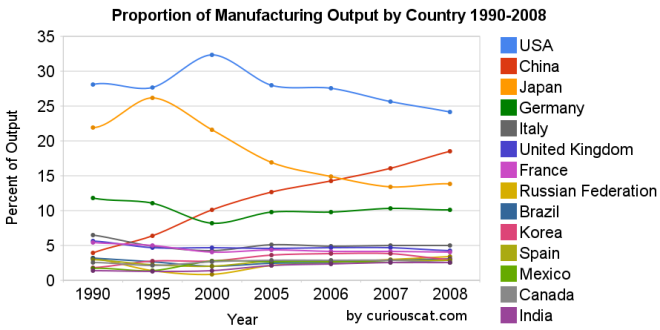
    Chart showing percent of output by top manufacturing countries from 1990 to 2008Chart showing the percentage output of top manufacturing countries from 1990-2008 by Curious Cat Management Blog, Creative Commons Attribution.

    The first chart shows the USA’s share of the manufacturing output, of the countries that manufactured over $185 billion in 2008, at 28.1% in 1990, 27.7% in 1995, 32% in 2000, 28% in 2005, 28% in 2006, 26% in 2007 and 24% in 2008. China’s share has grown from 4% in 1990, 6% in 1995, 10% in 2000, 13% in 2005, 14% in 2006, 16% in 2007 to 18% in 2008. Japan’s share has fallen from 22% in 1990 to 14% in 2008. The USA has about 4.5% of the world population, China about 20%. See Curious Cat Investment blog post” Data on the Largest Manufacturing Countries in 2008.

    Even with just this data, it is obvious the belief in a decades long steep decline in USA manufacturing is not in evidence. And, in fact the USA’s output has grown substantially over this period. It has just grown more slowly than that of China (as has every other country), and so while output in the USA has grown the percentage with China has shrunk. The percentage of manufacturing output by the USA (excluding output from China) was 29.3% in 1990 and 29.6% in 2008. The second chart shows manufacturing output over time.
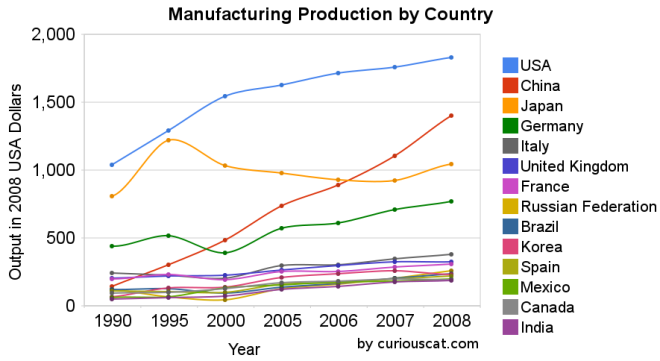
    charts showing the top manufacturing countries output from 1990-2008Chart showing the output of the top manufacturing countries from 1990-2008 by Curious Cat Management Blog, Creative Commons Attribution.

    The 2008 China data is not provided for manufacturing alone (the latest UN Data, for global manufacturing, in billions of current USA dollars). The percentage of manufacturing (to manufacturing, mining and utilities) was 78% for 2005-2007 (I used 78% of the manufacturing, mining and utilities figure provided in the 2008 data). There is a good chance this overstates China manufacturing output in 2008 (due to very high commodity prices in 2008).

    Hopefully these charts provide some evidence of what is really going on with global manufacturing and counteracts the hype, to some extent. Global economic data is not perfect. These figures are an attempt to capture the economic reality in the world but they are not a perfect proxy. This data is shown in 2008 USA dollars which is good in the sense that it shows all countries in the same light and we can compare the 1995 USA figure to 2005 without worrying about inflation. However foreign exchange fluctuations over time can show a country, for example, having a decline in manufacturing output in some year when in fact the output increased (just the decline against the USA dollar that year results in the data showing a decrease – which is accurate when measured in terms of USA dollars).

    If the dollar declines substantially between when the 2008 data was calculated and the 2009 data is calculated that will give result in the data showing a substantial increase in those countries that had a currency strengthen against the USA dollar. At this time the Chinese Renminbi has not strengthened while most other currencies have – the Chinese government is retaining a peg to a specific exchange rate.

    Korea (1.8% in 1990, 3% in 2008), Mexico (1.7% to 2.6%) and India (1.4% to 2.5%) were the only countries to increase their percentage of manufacturing output (other than China, of course, which grew from 3.9% to 18.5%).

    Related: posts on manufacturingGlobal Manufacturing Data by Country (2007)Global Manufacturing Employment Data – 1979 to 2007Top 10 Manufacturing Countries 2006Top 10 Manufacturing Countries 2005

  • Building an Emergency Fund

    Many people find personal financial planing boring. Building a cash safety net is an important part of your personal finances even though it isn’t exciting. I have written previously the very simple idea that you can just not buy what you can’t pay for. If you can’t pay for it this month, don’t buy it.

    But that leaves out one thing. Even if you do have the cash you should be building up a cash reserve before buying luxuries. The typical advice is to build up 6 months of expenses in cash (rent or mortgage, food bills, utilities, health care, etc.). Now actually building up to that level can take awhile and forgoing all non-mandatory expenses until you have that saved is not usually reasonable. But as part of your personal finances building up an cash reserve is important (even if it is boring). And I believe you really should aim at a higher level – say building to 1 year.

    A significant portion of downward spirals in personal finances are started when people have emergency expenses and have to borrow that money (since they don’t have cash reserves). And even worse when they start racking up huge fees for late payments, increased interest rates on outstanding debt, health care expenses if they fail to keep health care insurance…

    If you are over say 26 and don’t have a cash reserve yet saving for it should be part of your monthly budget. How quickly you build that up is a personal decision but I would say a 2% of the target amount (so if you are aiming for a cash reserve of $20,000 then $400/month). If you have next to nothing saved now start aiming at 6 months. As you get 3 months saved up start aiming at 9 months. As you get 6 months saved up start aiming at 1 year. And you have to also be saving for other needs – you shouldn’t raid your emergency fund savings for other things (a new car, a vacation…). This takes real discipline but it is much easier than the challenges our ancestors had to face of billions of people face financially today. So yes it is not easy, but really those that feel sorry for themselves need to realize they shouldn’t expect that they are so special the world owns them financial riches with little effort.

    Doing something is better than nothing so do what you can (even if it is less than 2% of you target). But realize that is one of the weaknesses in your personal finances and try to fix that as soon as possible.

    Very important personal financial allocations for you to put first include: current needs (food, car payment, rent/mortgage, utilities…), insurance, creating a cash reserve, retirement savings, saving for future purchases. Then there are luxuries and treats, such as: eating out, vacations, cable TV… Many people put current needs, luxuries and treats fist and then say they don’t have the ability to do what is responsible (check how rich you are – before making such claims yourself).

    Related: How to Protect Your Financial HealthSave Some of Each RaiseBuying Stuff to Feel PowerfulConsumer Debt Down Over $100 Billion So Far in 2009posts on basic personal finance matters

  • Jubak Looks at What Stocks to Hold Now

    Excellent post by James Jubak, Get your portfolio ready for the profitless global economic recovery

    the world hasn’t begun to address the problems of excess capital and the excess production capacity that it creates under current economic rules, the global economic recovery is going to turn out to be extraordinarily profitless in industry after industry as producers with excess capacity cut prices in an effort to buy market share.

    To avoid the trap of excess capacity killing even modest profits I think you have to look for sectors that have barriers that prevent excess capacity from driving down all prices as companies slit each other’s throats to acquire profitless market share.

    Cisco is the IBM of the Internet—companies can buy the company’s gear and know that it will talk to the rest of the gear in their network (because Cisco probably sold them a good part of that gear and because everybody makes sure their gear works with Cisco equipment.) Plus Cisco has used recent acquisitions to continue its transformation from a simple—but globally dominant–seller of routers into a company that builds unified digital communications systems.

    A second is Google (GOOG). Yes, Google stands a good chance of getting kicked out of China with its 1.3 billion potential Internet users (How old does a baby need to be to use the Gmail?). But no company is better positioned for the long-term trend toward distributed computing over the Internet than Google.

    Both Google and Cisco have been long term investments in my 12 stocks for 10 years portfolio. Jubak’s blog is excellent: the best investing blog I know of. He does trade quite a bit more than I do but his performance has been exceptional.

    Related: Jubak Looks at 5 Technology StocksWhy Investing is Safer Overseas10 Stocks for Income InvestorsTesco: Consistent Earnings Growth at Attractive Price

  • Statistics on Entrepreneurship

    Some statistics from the Kauffman Foundation

    • From 1980–2005, firms less than five years old accounted for all net job growth in the United States.
    • More than half of the companies on the 2009 Fortune 500 list were launched during a recession or bear market, along with nearly half of the firms on the 2008 Inc. list of America’s fastest-growing companies.
    • Contrary to popularly held assumptions, the highest rate of entrepreneurial activity belongs to the 55–64 age group over the past decade. The 20–34 age bracket has the lowest.
    • Only 16 percent of the fastest-growing and most successful companies in the United States had venture investors.
    • More than a quarter of technology and engineering companies started in the United States from 1995 to 2005 had at least one key founder who was foreign-born.
    • Foreign nationals residing in the United States were named as inventors or co-inventors in 25.6 percent of international patent applications filed in the U.S. in 2006.

    Related: Y-Combinator’s Fresh Approach to EntrepreneurshipEntrepreneur ResultsKiva Fellows Blog: Nepalese Entrepreneur Success

  • Retirement Savings Allocation for 2010

    I adjusted my future retirement account 401(k) allocations today. I do not have as favorable an opinion of investing in the stock market today as I did a year ago. I would likely have allocated 20% to a money market fund except my 401(k) actually has two options – 1 paying 0.0% and the other paying -.02%.

    They seem to believe they should make a significant profit while providing a horrible return (they are still taking over .5% of assets in fees – even though rates do not cover their fees). Those running funds have very little interest in providing value for 401(k) participants – they are mainly interested in raising fees (though supposedly they are suppose to be run by people with a fiduciary responsibility to the investors). Unfortunately most 401(k)s lock you away from the best options for an investor (such as Vanguard Funds).

    My current allocation for future funds is 40% to USA stocks, 40% to Global stocks and 20% to inflation adjusted bonds. My current allocation in this retirement account is 10% real estate, 35% global stocks, 55% USA stocks. For all my retirement savings it is probably about 5% real estate, 35% global stocks, 5% money market, 55% USA stocks (which is a fairly aggressive mix).

    As I have said many times I do not like bonds at this time. I don’t think the interest nearly justifies the risk of capital loss (due to inflation or interest rate risk). Inflation protected bonds are a much more acceptable option for someone that is worried about inflation (like I am over the next 10-20 years).

    A number of the stock fund (even bond fund) options in my 401(k) have expense ratios above 1%. That is unacceptable. The average fees on the options I chose were .5%.

    With my employee match I am adding over 10% of my income to my 401(k), which I think is a good aim for most everyone. Far too many people are unwilling to forgo luxuries to save appropriately for their retirement. This is a sign of financial illiteracy and an unwillingness to accept the responsibilities of modern life.

    Related: Investing – My Thoughts at the End of 2009401(k)s are a Great Way to Save for RetirementSaving for RetirementManaging Retirement Investment Risks

  • USA Spends Record $2.3 trillion ($7,681 Per Person) on Health Care in 2008

    Nominal health spending in the United States grew 4.4% in 2008, to $2.3 trillion or $7,681 per person. This was the slowest rate of growth since the Centers for Medicare & Medicaid Services started officially tracking expenditures in 1960, yet once again outpaced nominal GDP growth (2.6% in 2008). This brings health care spending to 16.2% of GDP. In 2003 the total health care spending was 15.3% of GDP.

    The huge amount being spent continues to grow to an even larger percentage of GDP every year. The damage to the economy of the dysfunctional health care system in the USA is huge. For comparison the total GDP per person in China is $5,970 (the closest total country per capita GDP, to the health care spending per capita in the USA, is Thailand at $7,703 – World Bank data). The average spending by OECD countries (Europe/USA/Japan…) was $2,966 per person in 2007 (the USA was at $7,290). In 2007 Canada spent $3,895; France $3,601; UK $2,992; Japan $2,581.

    • Hospital spending in 2008 grew 4.5% to $718 billion, compared to 5.9% in 2007, the slowest rate of increase since 1998.
    • Physician and clinical services’ spending increased 5.0% in 2008 to $496 billion, a deceleration from 5.8% in 2007.
    • Retail prescription drug spending growth also decelerated to 3.2% in 2008 as per capita use of prescription medications declined slightly, mainly due to impacts of the recession, a low number of new product introductions, and safety and efficacy concerns. Drug prices increased 2.5% in 2008.
    • Spending growth for both nursing home and home health services decelerated in 2008. For nursing homes, spending grew 4.6% in 2008 compared to 5.8% in 2007.
    • Total health care spending by public programs, such as Medicare and Medicaid, grew 6.5% in 2008, the same rate as in 2007.
    • Health care spending by private sources of funds grew only 2.6% in 2008 compared to 5.6 percent in 2007.
    • Private health insurance premiums grew 3.1% in 2008, a deceleration from 4.4% in 2007. Remember many people lost their jobs and did without insurance. Doing so results in reduced spending on health insurance but is far from a good sign.
    • Home health care spending growth decelerated from 11.8% in 2007 to 9.0% in 2008. Expenditures reached $64.7 billion in 2008. You can understand why investors (and companies) are looking to invest in home health care.

    At the aggregate level, the shares of financing for health services and supplies by businesses (23%), households (31%), other private sponsors (3%), and governments (42%) have remained relatively steady over time. Between 2007 and 2008; however, the federal government share increased significantly (from 23 to 25%), while the state and local government share declined (from 18 to 17%).

    Decades ago Dr. Deming included excessive health care costs as one of the seven deadly diseases of western management. We have only seen the problem get worse. Finally it seems that a significant number of people are in agreement that the system is broken.
    (more…)

  • Dollar Decline Due to Government Debt or Total Debt?

    With the dollar declining sharply, many are focused on the issue now. And the most common culprit for blame seems to be the federal debt. While I agree the dollar is likely to fall, the deficit doesn’t seem like the main reason, to me. The federal debt is large and growing quickly, which is a problem. But still the USA federal debt to GDP is lower than the OECD average. Even with a few more years of crazy federal debt growth the USA will still be below that average.

    Japan has by far the highest level of government debt in the OECD. The Yen is not collapsing. The debt is a factor but the lack of saving (USA consuming more than it produces) seems the biggest problem to me. China not only does not have large government debt it has large amounts of personal savings. People have been living far within their means in Japan and China (only by government intervention, due to desires to not have the currency appreciate has that appreciation been slowed).

    Thankfully we have been increasing savings a bit recently but it is a drop in the bucket so far (Consumer Debt Down Over $100 Billion So Far in 2009). It will have to increase in size and continue for years to begin to address the problems in a significant way.

    Related: The USA Economy Needs to Reduce Personal and Government Debt (March 2009)The Truth Behind China’s Currency PegWho Will Buy All the USA’s Debt?

  • Using Outcome Measures for Prison Management

    What is the aim of prison? To keep criminals locked up so they can’t commit crimes in society is another. Punishment, in order to deter people from committing crime is one reason they exist. And you would hope to mold prisoners so they do not commit crimes when they are freed. But the payment for services does not factor in the results of releasing productive members of society. It seems like doing so could result in improvements.

    Better Jails by Andrew Leigh, economics professor, Australian National University

    Prisons do reduce crime, but mainly because of what criminologists call ‘the incapacitation effect’ (when you’re doing time in Long Bay, it’s harder to hotwire a car). There may also be some deterrence effect, but this is small by comparison. And there is little evidence of a rehabilitation effect.

    To encourage innovation, we should start publicly reporting the outcomes that matter most. Rather than merely telling the public how many people are held in each jail, governments should publish prison-level data on recidivism rates and employment rates.

    As well as focusing on the important outcomes, Australian states should rethink the contracts they write with private providers. At present, about 16% of inmates are held in a private jail. Unfortunately, the contracts for private jails bear a remarkable similarity to sheep agistment contracts.

    Providers are penalised if inmates harm themselves or others, and rewarded if they do the paperwork correctly. Yet the contracts say nothing about life after release. A private prison operator receives the same remuneration regardless of whether released inmates lead healthy and productive lives, or become serial killers.

    A smarter way to run private jails would be to contract for the outcomes that matter most. For example, why not pay bonus payments for every prisoner who holds down a job after release, and does not reoffend? Given the right incentives, private prisons might be able to actually teach the public sector a few lessons on how to run a great rehabilitation program.

    The idea of paying for outcomes is great. It makes sense for some pay to be based on keeping prisoners housed during their terms. But providing incentives for achievement in returning productive people back to free society is something we should try.

    Related: Lean Management in PolicingUrban PlanningRich Americans Sue to Keep Evidence of Their Tax Evasion From the Justice DepartmentRandomization in SportsLA Jail Saves Time Processing CrimeMeasuring and Managing Performance in Organizations
    Quality Improvement and Government: Ten Hard Lessons From the Madison Experience by David C. Couper, Chief of Police, City of Madison, Wisconsin
    (more…)

  • The Truth Behind China’s Currency Peg

    Peter Schiff does a good job of explaining The Truth Behind China’s Currency Peg

    The peg, they argue, offers China a competitive advantage by making its products cheaper in U.S. markets, thus allowing Chinese firms to gobble up market share and steal jobs from U.S. manufacturers. The thought is that were China to allow its currency to rise, American manufactures would regain their lost edge, and both manufacturing firms and the jobs formerly associated with them would return.

    In fact, for the U.S., de-pegging would cause the economic equivalent of cardiac arrest. Our economy is currently on life support provided by an endless flow of debt financing from China. These purchases are the means by which China maintains the relative value of its currency against the dollar. As the dollar comes under even more downward pressure, China’s purchases must increase to keep the renminbi from rising. By maintaining the peg, China enables our politicians and citizens to continue spending more than they have and avoiding the hard choices necessary to restore our long-term economic health.

    As demand falls for both dollars and Treasuries, prices and interest rates in the United States will rise. Rising rates will restrict the flow of credit that is currently financing government and consumer spending. This change will finally force a long overdue decline in borrowing.

    De-pegging will force the hand of U.S. politicians toward pursuing realistic policies. The Chinese will come to their senses eventually because it is in their interest to do so. Meanwhile, the longer the peg is maintained, the more indebted we become, the more out of balance our economy grows, and the more our industrial base shrivels. In short, the longer they wait, the steeper our fall.

    I agree the largest impact of the currency peg on the USA is supporting our economy in the short run. If we didn’t go into huge debt it would actually be good for the USA for the long run too. Essentially China subsidies our purchases and borrowing. The problem is that we have taken a good thing too far and become used to living beyond our means. That is not sustainable – even with a subsidy from China.

    I disagree that the USA manufacturing base is hollowed out. It is strong in comparison to the rest of the world, except China. China’s manufacturing growth has been phenomenal, compared to that everyone looks weak. Manufacturing jobs are disappearing everywhere, not just in the USA.

    Related: Top 10 Manufacturing Countries in 2008 – China and the Sugar Industry Tax Consumers – Why the Dollar is FallingWho Will Buy All the USA’s Debt?Peter Schiff Answers Redditers Questions

  • If you Can’t Explain it, You Can’t Sell It

    Over the last few years Elizabeth Warren has become one of my favorite leaders. She is a leader in economic thought, ethical society and the law (she is a law professor at Harvard Law School). Far too many on Wall Street, Washington and in C-suites are leading us down a very bad path. She is a voice we need to heed.

    If you can’t explain it, you can’t sell it

    “We need a new model: If you can’t explain it, you can’t sell it,”

    The 1966 high school debate champion of Oklahoma may get what she wants. The House of Representatives will vote in December on her idea. She suggested a Financial Product Safety Commission in a 2007 article in the magazine Democracy [Unsafe at Any Rate]. President Barack Obama proposed it to Congress in June as the Consumer Financial Protection Agency.

    Warren won’t discuss whether she may be a candidate to lead the authority, which would have the power to regulate $13.7 trillion of debt products. A Warren nomination would tell banks that Obama is determined to force reduced checking-account fees and limit lender claims in mortgage advertising, among other measures the industry opposes, said Thomas Cooley, dean of New York University’s Stern School of Business.

    In her role overseeing the TARP, Warren has been critical of the administration, accusing the Treasury Department of undervaluing the stock warrants that were supposed to compensate taxpayers when banks repay their bailouts. A lack of transparency about how TARP functions “erodes the very confidence” it was to restore, her committee said in a report.

    I hope she can take her attempts to reduce political favors being granted huge financial institutions and those institution be forced to follow sensible rules to protect individuals and our economy. With a few more people like there we will have a much better chance of a positive economic future.

    Related: Bogle on the Retirement CrisisBankruptcies Among Seniors SoaringDon’t Let the Credit Card Companies Play You for a Foolhttp://investing.curiouscatblog.net/2009/04/08/the-best-way-to-rob-a-bank-is-as-an-executive-at-one/