Tag: curiouscat

  • Data on the Largest Manufacturing Countries in 2008

    Manufacturing is an powerful driver of economic wealth. For years I have been providing data to counter the contention that the manufacturing base of the USA is gone and the little bit left was shrinking. The latest data again shows the USA is the largest manufacturer, and manufacturing in the USA continues to grow. It is true global manufacturing has begun to grow more rapidly than USA manufacturing in the last few years. I doubt many suspect that the USA’s share of manufacturing stayed stable from 1990 to 1995 then grew to 2000 took until 2006 to return to the 1990-1995 levels and then has declined in 2007 and 2008 a bit below the 1990 level and during that entire time was growing (even in 2007 and 2008).

    The USA’s share of the manufacturing output, of the countries that manufactured over $185 billion in 2008, 28% in 1990, 28% in 1995, 32% in 2000, 28% in 2005, 28% in 2006, 26% in 2007 and 24% in 2008. China’s share has grown from 4% in 1990, 6% in 1995, 10% in 2000, 13% in 2005, 14% in 2006, 16% in 2007 to 18% in 2008. Japan’s share has fallen from 22% in 1990 to 14% in 2008 (after increasing to 26% in 1995 then steadily falling). The USA has about 4.5% of the world population, China about 20%.

    Based on the latest UN Data, for global manufacturing, in billions of current US dollars:

    Country 1990 1995 2000 2005 2006 2007 2008
    USA 1,041 1,289 1,543 1,624 1,712 1,756 1,831
    China 145 300 484 734* 891* 1,106* 1,399**
    Japan 810 1,219 1,034 979 927 923 1,045
    Germany 438 517 392 571 608 711 767
    Italy 240 226 206 295 302 345 381
    United Kingdom 206 218 226 264 295 323 323
    France 200 233 190 255 255 287 306
    Russian Federation 120 64 45 124 157 206 256
    Brazil 120 125 96 137 163 201 237
    Korea 66 131 136 211 234 260 231
    Spain 112 104 98 160 170 196 222
    Mexico 62 67 133 154 175 182 197
    Canada 92 100 129 168 182 197 195
    India 51 61 69 122 141 177 188

    * I am using the data from last year that separated the manufacturing data (this year the data does not provide separate manufacturing data for China) instead of that shown in the most recent data (which doesn’t separate manufacturing)
    ** The China data is not provided for manufacturing alone. The percentage of manufacturing (to manufacturing, mining and utilities) was 78% for 2005-2007 (I used 78% of the manufacturing, mining and utilities figure provided in the 2008 data).

    I hope to write a series of posts examining global manufacturing data including looking at manufacturing data specifically (excluding mining and utility data).
    (more…)

  • Government Debt as a Percentage of GDP

    Government debt as percent of GDPChart showing government debt as a percentage of GDP by Curious Cat Investing Economics Blog, Creative Commons Attribution, data from OECD, March 2009.
    The USA federal government debt is far too large, in my opinion. We have been raising taxes on future taxpayers for several decades, to finance our current spending. Within reason deficit spending is fine. What that reasonable level is however, is not easy to know. One big problem with the past few decades is that during very prosperous economic times we spent money that we didn’t have, choosing to raise taxes on the future (instead of either not spending as much or paying for what we were spending by raising taxes to pay for current spending).

    By not even paying for what we are spending when times were prosperous we put ourselves in a bad situation when we have poor economic conditions – like today. If we were responsible during good economic times (and at least paid for what we spent) we could have reduced our debt as a percentage of GDP. Even if we did not pay down debt, just by not increasing the outstanding debt while the economy grew the ratio of debt to GDP would decline. Then when times were bad, we could afford to run deficits and perhaps bring the debt level up to some reasonable level (maybe 40% of GDP – though it is hard to know what the target should be, 40% seems within the realm of reason to me, for now).

    There is at least one more point to remember, the figures in the chart are based on reported debt. The USA has huge liabilities that are not accounted for. So you must remember that the actually debt is much higher than reported in the official debt calculation.

    Now on to the good news. As bad as the USA has been at spending tomorrows increases in taxes today, compared to the OECD countries we are actually better than average. The OECD is made up of countries in Europe, the USA, Japan, Korea, Australia, New Zealand and Canada. The chart shows the percentage of GDP that government debt represents for various countries. The USA ended 2006 at 62% while the overall OECD total is 77%. In 1990 the USA was at 63% and the OECD was at 57%. Japan is the line way at the top with a 2006 total of 180% (that is a big problem for them). Korea is in the best shape at just a 28% total in 2006 but that is an increase from just 8% in 1990.

    Related: Federal Deficit To Double This YearPoliticians Again Raising Taxes On Your ChildrenTrue Level of USA Federal DeficitWho Will Buy All the USA’s Debt?Top 12 Manufacturing Countries in 2007Oil Consumption by Country
    (more…)

  • USA Spent $2.2 Trillion, 16.2% of GDP, on Health Care in 2007

    Health spending in the United States grew 6.1 percent in 2007, to $2.2 trillion or $7,421 per person.
    For comparison the total GDP per person in China is $6,100. This continues the trend of health care spending taking an every increasing portion of the economic output (the economy grew by 4.8 percent in 2007). This brings health care spending to 16.2% of GDP (which is yet another, in a string of record high percentages of GDP spent on health care). In 2003 the total health care spending was 15.3 of GDP.

    With the exception of prescription drugs (which grew at 1.4% in 2007, compared to the 3.5% in 2006), spending for most other health care services grew at about the same rate or faster than in 2006. Hospital spending, which accounts for about 30 percent of total health care spending, grew 7.3 percent in 2007, compared to 6.9 percent in 2006.

    Spending growth for both nursing home and home health services accelerated in 2007 (4.8% v. 4.0%). Spending growth for freestanding home health care services increased to 11.3 percent. Total health care spending by public programs, such as Medicare and Medicaid, grew 6.4% in 2007 v. 8.2% in 2006. In comparison, health care spending by private sources grew 5.8% compared to 5.4%.

    Private health insurance premiums grew 6.0 percent in 2007, the same rate as in 2006. Out-of-pocket spending grew 5.3 percent in 2007, an acceleration from 3.3 percent growth in 2006. Out-of-pocket spending accounted for 12.0 percent of national health spending in 2007. This share has been steadily declining both recently and over the long-run; in 1998, it accounted for 14.7 percent of health spending and, in 1968, out-of-pocket spending accounted for 34.8 percent of all health spending.

    The costs for health services and supplies for 2007 were distributed among businesses (25%), households (31%), other private sponsors (4%), and governments (40%).

    Decades ago Dr. Deming included excessive health care costs as one of the seven deadly diseases of western management. We have only seen the problem get worse. Finally it seems that a significant number of people are in agreement that the system is broken. Still, admitting the system is broken is not the same as agreeing on how to fix it. The way forward to workable solutions still seems very difficult.

    Full press release from the United States Department of Health and Human Services.

    Related: International Health Care System PerformancePersonal Finance Basics: Health InsuranceMany Experts Say Health-Care System Inefficient, WastefulHow to Improve the Health Care System

  • Our Capacity Remains Undiminished

    President Barack Obama’s Inaugural Address

    We remain the most prosperous, powerful nation on Earth. Our workers are no less productive than when this crisis began. Our minds are no less inventive, our goods and services no less needed than they were last week, or last month, or last year. Our capacity remains undiminished. But our time of standing pat, of protecting narrow interests and putting off unpleasant decisions — that time has surely passed. Starting today, we must pick ourselves up, dust ourselves off, and begin again the work of remaking America.

    That sounds nice I believe however, it is fairly irrelevant. Economic demand is what is down, not production capacity. We are “no less productive than when this crisis began.” Ok, that is probably true. So what. That implies that the crisis has something to do with productivity. If we say the color of our eyes is the same as when the crisis began it is obvious that is a non-sequitur. Well so is the quote by the new President, though that is less obvious.

    Our demand was definitely over stimulated using massive federal government budget deficits, massive trade deficits, massive amounts of consumer debt, massive amounts of unjustified mortgage debt and massive amounts of leverage. None of those things has anything to do with capacity in the implied sense – capacity to produce. They have to do with the capacity to consume. And while our capacity to consume has not declined. The funding that allows that consumption (foreign lending, high leverage, junk mortgages…) has decreased.
    (more…)

  • The Impact of Credit Scores and Jumbo Size on Mortgage Rates

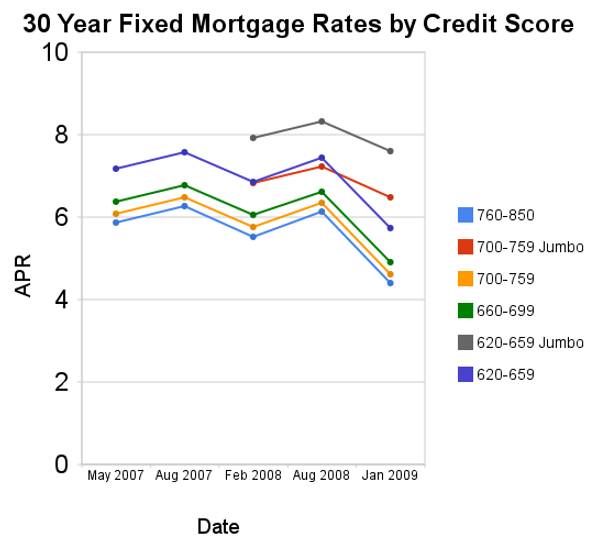
    Since August of 2008 conforming mortgage rates are have declined a huge amount. Jumbo rates have fallen a large amount also, but much less (for example for a credit score of 700-759 the jumbo rates declined 73 basis points while the conventional rate declined 172 basis points.

    chart of 30 year fixed mortgage rates by credit score from May 2007 to Jan 2009

    For scores above 620, the APRs above assume a mortgage with 1 point and 80% Loan-to-Value Ratio. For scores below 620, these APRs assume a mortgage with 0 points and 60 to 80% Loan-to-Value Ratio. You can see, with these conditions the rate difference between a credit score of 660 and 800 is not large (remember this is with 20% down-payment) and has not changed much (the difference between the rates if fairly consistent).

    Related: Low Mortgage Rates Not Available to Everyone30 Year Fixed Rate Mortgage Rate DataReal Free Credit Report (in USA)Jumbo Mortgage Shoppers Get Little Relief From Ratesposts on mortgages
    (more…)

  • Financial Planning Made Easy

    Scott Adams does a great job with Dilbert and he presents a simple, sound financial strategy in Dilbert and the Way of the Weasel, page 172, Everything you need to know about financial planning:

    • Make a will.
    • Pay off your credit cards.
    • Get term life insurance if you have a family to support.
    • Fund your 401(k) to the maximum.
    • Fund your IRA to the maximum.
    • Buy a house if you want to live in a house and you can afford it.
    • Put six months’ expenses in a money market fund. [this was wise, given the currently very low money market rates I would use “high yield” bank savings account now, FDIC insured – John]
    • Take whatever money is left over and invest 70% in a stock index fund and 30% in a bond fund through any discount broker, and never touch it until retirement.
    • If any of this confuses you or you have something special going on (retirement, college planning, tax issues) hire a fee-based financial planner, not one who charges a percentage of your portfolio.

    (more…)

  • USA Manufacturing Output Continues to Increase (over the long term)

    When looking at the long term data, USA manufacturing output continues to increase. For decades people have been repeating the claim that the manufacturing base is eroding. It has not been true. I realize the economy is on weak ground today, I am not talking about that, I am looking at the long term trends.

    The USA manufactures more than anyone else – by far. The percentage of total global manufacturing is the same today it was two decades ago (and further back as well). For decades people have been saying the USA has lost the manufacturing base – it just is not true. No matter how many times they say it does not make it true. It is true since 2000 the USA increase in manufacturing output (note not a decrease) has not kept pace with global grown in manufacturing output (global output in that period is up 47% and the USA is up 19% – Japan is down 10% for that period).

    I would guess 20 years from today the USA will have a lower percentage of worldwide manufacturing. But I don’t see any reason believe the USA will see a decline in total manufacturing output. I just think the rest of the world is likely to grow manufacturing output more rapidly.

    Looking at a year or even 2 or 3 years of manufacturing output data leaves a great deal of room to see trends where really just random variation exists. Even for longer periods trends are hard to project into the future.

    Conventional wisdom is correct about China growing manufacturing output tremendously. China has grown from 4% of the output of the largest manufacturing companies in 1990 to manufacturing 16% of the total output in China today. That 12% had to come from other’s shares. And given all you hear from the general press, financial press, politicians, commentators… you would think the USA must have much less than China today, so may 10% and maybe they had 20% in 1990. When actually in 1990 the USA had 28% and in 2007 they had 27%.

    Manufacturing jobs are not moving oversees. Manufacturing jobs are decreasing everywhere.
    (more…)

  • Easiest Countries for Doing Business 2008

    Singapore is again ranked first for Ease of Doing Business by the World Bank. For some reason they call the report issued in any given year as the report for the next year (which makes no sense to me). The data shown below is for the year they released the report.

    Country 2008 2007 2006 2005
    Singapore 1 1 1 2
    New Zealand 2 2 2 1
    United States 3 3 3 3
    Hong Kong 4 4 5 6
    Denmark 5 5 7 7
    United Kingdom 6 6 6 5
    Ireland 7 8 10 10
    Canada 8 7 4 4
    other countries of interest
    Japan 12 12 11 12
    Germany 25 20 21 21
    France 31 31 35 47
    Korea 23 30 23 23
    Mexico 56 44 43 62
    China 83 83 93 108
    India 122 120 134 138
    Brazil 125 122 121 122

    The rankings include ranking of various aspects of running a business. Some rankings for 2008: starting a business (New Zealand 1st, Singapore 10th, USA 6th, Japan 64th), Dealing with Construction Permits (St. Vincent and the Grenadines 1st, Singapore and New Zealand 2nd, USA 26th, China 176th), Employing Workers (Singapore and the USA 1st, Germany 142, Korea 152), protecting investors (New Zealand 1st, Singapore 2nd, Hong Kong 3rd, Malaysia 4th, USA 5th), enforcing contracts (Singapore 1, Hong Kong 2, USA 6, China 18), getting credit (Malaysia 1; UK and Hong Kong 2; Singapore, New Zealand and USA 5th), paying taxes (Maldives 1, Hong Kong 3, USA 46, Japan 112, China 132).

    These rankings are not the final word on exactly where each country truly ranks but they do provide a valuable source of information. With this type of data there is plenty of room for judgment and issues with the data. Several of my posts, from my other blogs, that I recommend on this topic: The Future is Engineering, Science and Engineering in Global Economics (more…)

  • Manufacturing Employment Data – 1979 to 2007

    I have had difficulty finding good economic data on manufacturing jobs. I have posted about this previously but have trouble finding much worth posting about: Worldwide Manufacturing Job DataManufacturing Jobs. The Unites States Department of Labor, Bureau of Labor Statistics has published some interesting data and so here is a look at some of that data.

    The table shows average annual productivity gains (output per hour, in USA dollars – I think it is not clear) – the 2007 output totals are from the United Nations data I posted about last week (Data on Top Manufacturing Countries).

    Average Annual Manufacturing Productivity Gains by Country
    Country 1979-1990 1990-1995 1995-2000 2000-2007 1979-2007 2007 Output
    $USA billion
    Taiwan 6.1 4.7 5.6 6.4 5.9
    Korea NA 9.4 10.8 7.6 NA 241
    USA 2.8 3.7 5.6 4.6 3.9 1,831
    France 3.8 3.4 4.6 3.5 3.8 296
    Japan 3.8 3.3 3.4 3.8 3.6 926
    United Kingdom 4.1 2.8 2.7 3.9 3.6 342
    Germany 2.1 2.9 3.7 3.8 3.0 670
    Spain 3.3 3.1 0.8 2.1 2.5 208
    Canada 2.1 3.4 3.8 1.1 2.4 218
    Italy 3.4 3.8 1.4 -.2 2.2 345

    The countries that were part of the study but are not included in the table above: Australia, Belgium, Denmark, Netherlands, Norway, Sweden.

    Manufacturing productivity increased in 14 of 16 countries in 2007, according to the study. The United States of America increase of 4.1 was the fourth largest among the 16 economies and was slightly above the 3.9 percent U.S. average annual increase since 1979. 15 of the 16 countries increased manufacturing output in 2007.

    9 countries increased manufacturing hours worked in 2007, the USA increased 2.3% (below their average increase since 1979). Hours worked decreased for all countries in the period of 2000-2007 (UK has had the largest decrease 3.9% annual average decrease, the USA in next at 3.1%).

    Manufacturing employment increased in 10 countries in 2007. From 2000-2007 the USA has experienced average annual declines of 3% in manufacturing employment (the second sharpest drop to the UK which has fallen 4%). From 1979-2007 the USA annual declines averaged 1.2% (only Taiwan.9% and Spain .1% showed increases). From 2000-2007 four countries show slight average annual increases: Spain .5%, Korea .4%, Taiwan .2% and Italy .2%. From 2000-2007 only 3 countries showed annual average decreases in output: Canada -.3%, Italy -.2% and UK – .1%.

    Hourly manufacturing compensation has increased in all countries for the period 1979-2007 (data shown for this item is in each national currency: USA 4.6% average annual increases, Spain up 7.2% annually, Taiwan up 7%, UK 6.8%, Germany 4.4%, Japan 4.2%.

    via: Canada’s Manufacturing Crisis in International Perspective

    Related: posts on employmentTop 10 Manufacturing Countries 2006

  • Top 12 Manufacturing Countries in 2007

    The updated data from the United Nations on manufacturing output by country clearly shows the USA remains by far the largest manufacturer in the world. UN Data, in billions of current US dollars:

    Country 1990 1995 2000 2005 2006 2007
    USA 1,041 1,289 1,543 1,663 1,700 1,831
    China 143 299 484 734 891 1,106
    Japan 804 1,209 1.034 954 934 926
    Germany 438 517 392 566 595 670
    Russian Federation 211 104 73 222 281 362
    Italy 240 226 206 289 299 345
    United Kingdom 207 219 228 269 303 342
    France 224 259 190 249 248 296
    Korea 65 129 134 200 220 241
    Canada 92 100 129 177 195 218
    Spain 101 103 98 164 176 208
    Brazil 120 125 96 137 170 206
    Additional countries of interest – not the next largest
    India 50 59 67 118 135 167
    Mexico 50 55 107 122 136 144
    Indonesia 29 60 46 80 102 121
    Turkey 33 38 38 75 85 101

    The USA’s share of the manufacturing output of the countries that manufactured over $200 billion in 2007 (the 12 countries on the top of the chart above) in 1990 was 28%, 1995 28%, 2000 33%, 2005 30%, 2006 28%, 2007 27%. China’s share has grown from 4% in 1990, 1995 7%, 2000 11%, 2005 13%, 2006 15%, 2007 16%.

    Total manufacturing output in the USA was up 76% in 2007 from the 1990 level. Japan, the second largest manufacturer in 1990, and third today, has increased output 15% (the lowest of the top 12, France is next lowest at 32%) while China is up an amazing 673% (Korea is next at an increase of 271%).
    (more…)