Tag: data

  • The 20 Most Valuable Companies in the World – Jan 2019

    This post lists the 20 publicly traded companies with the largest market capitalization as of today. Since my November 2017 list of the 20 most valuable stocks the value of 2 companies increased by more than $150 billion and 4 companies value decreased by over $100 billion.

    In the 20 most valuable companies list there are 13 USA companies, 4 Chinese companies and 1 each for Korea, Netherlands and Switzerland. The remaining 15 companies with market caps above $200 billion are based in: USA 10, China 2, Switzerland 2 and Japan 1.

    Company Country Market Capitalization
    1 Amazon USA $802 billion
    2 Microsoft USA $789 billion
    3 Alphabet (GOOGL) USA $737 billion
    4 Apple USA $720 billion
    5 Berkshire Hathaway USA $482 billion
    6 Facebook USA $413 billion
    7 Tencent China $404 billion*
    8 Alibaba China $392 billion
    9 Johnson & Johnson USA $348 billion
    10 China Unicom China $333 billion

    Amazon soared $220 billion since my November 2017 post and became the most valuable company in the world. Microsoft soared $147 billion and became the most valuable company in the world briefly before Amazon took the crown.

    Apple lost $178 billion since my November 2017 post (after passing $1 trillion in market capitalization during 2018, up $100 billion from the November 2017 total, before declining). Facebook lost $118 billion off their market cap. Tencent lost $104 billion and Alibaba lost $100 billion in value during the same period.

    Google increased 8 billion (since my November 2017 post).

    The next ten most valuable companies:

    Company Country Market Capitalization
    11 JPMorgan Chase USA $332 billion
    12 Visa USA $304 billion
    13 Exxon Mobil USA $304 billion
    14 Walmart USA $276 billion
    15 Industrial & Commercial Bank of China (ICBC) China $270 billion*
    16 Bank of America USA $255 billion
    17 Nestle Switzerland $255 billion
    18 Royal Dutch Shell Netherlands $250 billion
    19 Pfizer USA $249 billion
    20 Samsung Korea $240 billion

    Market capitalization shown are of the close of business November 26th, as shown on Google Finance.

    Pfizer is the only new company in the top 20, growing by $37 billion to reach $249 billion and take the 19th spot (Wells Fargo dropped out of the top 20 and into 25th place).

    Related: Global Stock Market Capitalization from 2000 to 2012Stock Market Capitalization by Country from 1990 to 2010Historical Stock Returns

    Between $255 billion (which earns 15th place) and $223 billion there are 13 companies with market caps very close to each other.

    A few other companies of interest (based on their market capitalization):
    (more…)

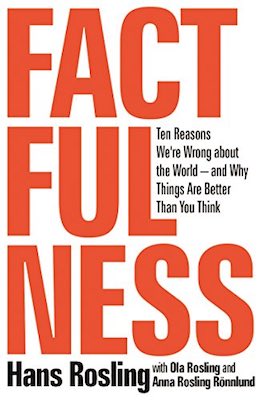
  • Factfulness – An Extremely Valuable Book

    Factfulness by Hans Rosling (of TED talks and Gapminder charts fame) is an exceptionally good book. It provides great insight into how to think more effectively and how to understand the reality of the world we live in (versus the large distortions so common in most people’s vision of the world). You can take a quick quiz to see how well you understand the world

    Today the people living in rich countries around the North Atlantic, who represent 11 percent of the world population, make up 60 percent of the Level 4* consumer market. Already by 2027, if incomes keep growing worldwide as they are doing now, then that figure will have shrunk to 50 percent. By 2040, 60 percent of Level 4 consumers will live outside the West.

    The truth of the very widespread increase in wealth around the globe has influenced my investing strategy for decades. It should be influencing yours, is it?

    book cover of Factfulness

    It is not doctors and hospital beds that save children’s lives in countries on Level 1 and 2*. Beds and doctors are easy to count and politicians love to inaugurate buildings. But almost all the increased child survival is achieved through preventative measures outside hospitals by local nurses, midwives, and well-educated parents. Especially mothers, the data shows that half the increase in child survival in the world happens because the mothers can read and write.

    Data is extremely valuable in helping us make decisions and evaluating the effectiveness of policy. However it is critical to be careful. It is very easy to focus on meeting targets that seem sensible – increasing the number of hospital beds – but that lead to less effective policy.

    Dollar street provides photos of people at all 4 income levels from around the globe. This illustrates Hans’ point that what determines how people live and what their circumstances look like is mostly a matter of income not the country they live in. It is simple idea but one that runs counter to much of the economic discussion focused so much on national boundaries. National boundaries do matter and the laws and economic reality of the national economy has a large impact but the issues for people at each level of income are much more tied to those in their level of income anywhere in the world than they are tied to their nation.

    images of families at different income levels around the world

    The book relentlessly points out the great progress that has been made globally over the last 50 years and how that progress continues today and looks to be set to continue in the future. We have plenty of areas to work on improving but we should be aware of how much progress we have been making. As he points out frequently he has continually seen huge underestimation of the economic conditions in the world today. This book does a great job of presenting the real success we have achieved and the progress we can look forward to in the future.

    * In 2017
    Level 1 has 0.75 billion people living on less than $2 per day.
    Level 2 has 3.3 billion people living on incomes between $2 to $8 per day.
    Level 3 has 2.5 billion people living on $8 to $32 per day.
    Level 4 has 0.9 billion people living on more than $32 per day.

    Related: GDP Growth Per Capita for Selected Countries from 1970 to 2010 (Korea, China, Singapore, Brazil)Stock Market Capitalization by Country from 2000 to 2016Ignorance of Capitalism Leads us AstrayWealthiest 1% Continue Dramatic Gains Compared to Everyone Else

  • Long Term Changes in Underlying Stock Market Valuation

    I have written before about one of the most important changes I believe is needed in thinking about investing over the last few decades: Historical Stock Returns.

    My belief is that there has been a fundamental change in the valuation of stocks. Long term data contains a problem in that we have generally realized that stocks are more valuable than realized 100 years ago. That means a higher based PE ratio is reasonable and it distorts at what level stocks should be seen as very overpriced.

    It also depresses expected long term returns, see my original post for details.

    Jeremy Grantham: The Rules Have Changed for Value Investors

    The market was extremely well-behaved from 1935 until 2000. It was an orderly world in which to be a value manager: there was mean reversion. If a value manager was patient, he was in heaven. The market outperformed when it was it cheap, and when it got expensive, it cracked.

    Since 2000, it’s become much more complicated. The rules have shifted. We used to say that this time is never different. I think what has happened from 2000 until today is a challenge to that. Since 1998, price-earnings ratios have averaged 60 percent higher than the prior 50 years, and profit margins have averaged 20 to 30 percent higher. That’s a powerful double whammy.

    Diehard Ben Grahamites underestimated what earnings and stock prices would do. That began to be a drag after 1998.

    I believe he is right. I believe in the value of paying attention to historical valuation and realizing markets often go to extremes. However, if you don’t account for a fundamental shift in valuation you see the market as overvalued too often.

    The price-earnings and profit margin increases. Corporations got more monopoly power and more power in government. The current market era doesn’t feel like a bubble — it’s not euphoric yet like the housing bubble of 2005. It’s more that we have been climbing the wall of worry.

    So why have prices risen so high without a hint of euphoria — at least until very recently — or a perfect economy? My answer is that the discount rate structure has dropped by two percentage points. The yield on stocks is down by that amount and bonds too. The market has adjusted, reflecting low rates, low inflation and high profit margins.

    Again I agree. Our political parties have aided big business in undermining market through monopolistic market control and that has been consistent (and increasing) for decades now. It makes stocks more valuable. They have moats due to their monopolistic position. And they extract economic rents from their customers (granted they put a large amount of those ill gotten gains into executives pockets but even so they gains are large enough to increase the value of the stocks).

    On top of these strong forces we have the incredible interest rate conditions of the last decade. This is the one that is most worrisome for stock values in my opinion. It servers to boost stock prices (due to the poor returns for interest bearing investments). And I worry at some point this will change.

    There is also likely at some point to be a political return to the value of capitalism and allowing free markets to benefit society. But for now we have strong entrenched political parties in the USA that have shown they will undermine market forces and provide monopolistic pricing power to large companies that provide cash to politicians and parties in order to have those parties undermine the capitalist market system.

    I believe the stock market in the USA today may well be overvalued. I don’t think it is quite as simple as some of the measures (CAPE – cyclical adjusted PE ratio or market value to USA GDP) make it out to be though. As I have said for several years, I believe we are currently living through one of the more challenging investment climates (for long term investors seeking to minimize long term risk and make decent returns over the long term). I still think it is best just to stick with long term portfolio diversification strategies (though I would boost cash holdings and reduce bonds). And since I am normally light on bonds and high on stocks, for someone like me reducing stock holding for cash is also reasonable I believe (but even doing this I am more in stocks than most portfolio allocations would suggest).

    Related: Monopolies and Oligopolies do not a Free Market MakeMisuse of Statistics, Mania in Financial MarketsInterview with Investing Blogger John Hunter

  • The 20 Companies With the Largest Market Capitalizations in the World – Oct 2015

    The 20 publicly traded companies with the largest market capitalizations. Since my June list of the top 20 stocks many of the market caps have declined slightly.

    Company Country Market Capitalization
    1 Apple USA $672 billion
    2 Google USA $497 billion
    3 Microsoft USA $426 billion
    4 Exxon Mobil USA $342 billion
    5 Berkshire Hathaway USA $340 billion
    6 GE USA $296 billion
    7 Facebook USA $295 billion
    8 Amazon USA $294 billion
    9 Wells Fargo USA $282 billion
    10 Johnson & Johnson USA $281 billion

    Google and Amazon were star performers in the last 4 months with Google up $127 billion and Amazon increasing $96 billion moving Amazon from outside the top 20 into 8th place. Facebook increased in value by $64 billion and moved from the 18th largest market cap to 7th. The China market declined quite rapidly since June and the largest Chinese companies saw significant drops in market cap.

    Industrial & Commercial Bank of China and China Mobile dropped from the top 10 (replaced by Facebook and Amazon). That results in USA companies holding the top 10 spots (the next 5 are either Chinese or Swiss).

    The next ten most valuable companies:

    Company Country Market Capitalization
    11 Industrial & Commercial Bank of China China $250 billion*
    12 China Mobile China $247 billion
    13 Novartis Switzerland $243 billion
    14 Petro China China $241 billion
    15 Nestle Switzerland $241 billion
    16 JPMorgan Chase USA $241 billion
    17 Hoffmann-La Roche Switzerland $231 billion
    18 Pfizer USA $214 billion
    19 Toyota Japan $211 billion
    20 Procter & Gamble USA $210 billion

    Market capitalization shown are of the close of business October 30th, as shown on Google Finance.

    The 11th to 20th most valuable companies includes 3 Chinese companies, 3 USA companies, 3 Swiss companies and 1 Japanese company. Alibaba, Tencent, China Construction Bank and Walmart dropped out of the top 20 (replaced by Amazon, Pfizer, Proctor & Gamble and Toyota). Alibaba remained above $200 in market cap making it the only company worth more than 200 billion that missed the cut. In the top 20 the USA gained 2 spots, China lost 3 and Japan gained 1.

    The total value of the top 20 has barely changed since my June post on the top 20 most valuable companies in the world: from $6.046 trillion to $6.054 trillion. Since my October 2014 post of the 20 most valuable companies in the world the total value of the top 20 companies has risen from $5.722 trillion to $6.054 trillion, an increase of $332 billion. Several companies have been replaced in the last year to create the current top 20 list.

    Related: Global Stock Market Capitalization from 2000 to 2012Stock Market Capitalization by Country from 1990 to 2010Historical Stock Returns

    A few other companies of interest (based on their market capitalization):

    (more…)

  • There is No Such Thing as “True Unemployment Rate”

    The article, What’s the Real U.S. Unemployment Rate? We Have No Idea, provides interesting information on the process for calculating the unemployment rate.

    But it also misleads in saying “real US unemployment rate.”

    As Dr. Deming said: “there is no true value” of any measured process. The results depend on the process which includes the operation definitions used.

    Over time the value of a measure (as a proxy measure for some condition you care to monitor) can change.

    It is important to update measures to avoid using proxies that lose value.

    The unemployment rate certainly has proxy issues. But there is no “true unemployment rate.” There are ways to change the process to focus on different things (make the proxy better matched to certain issues). But also it seems to me, unemployment rate needs to have other related measures that are considered in concert with the unemployment rate (such as the labor force participation rate, perhaps some measure of under-employment etc.).

    Those paying much attention do use other measures in concert but the last few years I read lots of different people complaining that the unemployment rate doesn’t capture various aspects of how the job market is poor (and often claiming the unemployment rate was “inaccurate” as though there was a platonic form of the actual rate divorced from the measure process.

    Related: What Do Unemployment Stats Mean?Economic Measurement Issues Arising from GlobalizationWhy China’s Economic Data is Questionable

  • Companies Trumpet Stock Buybacks and Act as Though Stock Givaways Don’t Matter

    One of the things that annoy me as an investor is how happy the executives are to grant themselves huge amount of pay in general and stock in particular. The love to giveaway huge amounts of stock to themselves and their buddies and then pretend that isn’t a cost.

    Thankfully the GAAP rules changed a few years ago to require making the costs of stock giveaways show up on official earnings statements. Now, the companies love to trumpet non-GAAP earnings that exclude stock based compensation to employees.

    The stock based costs are huge.

    SG Securities estimates that corporates bought back $480 billion in stock last year, and then reissued about $180 billion.

    The theme of the article is that stock buybacks have declined drastically very recently. There has been a huge bubble recently fueled by the too-big-too-fail bailout (quantitative easing). But don’t expect the executives giving themselves tons of stock to decline.

    Accounting isn’t as straight forward as people who have never looked at it would like to think. While giving away stock is definately a cost, it isn’t a cash cost. The cash flow statement is best for looking at cash anyway. And the better your company does the more the free spirited giveaway of stock costs (both in your reduced share of the well performing company and the higher cost to buy back the shares they gave away).

    They have excuses that they hire people who are not motivated enough to do their job for their pay so they need to offer stock options as a extra payment. But the main reason they like it is they can pretend that the pay to employees isn’t costing as much as it is because we gave them stock options not cash. As if paying $1 billion in cash is somehow more costly than giving away options and then spending $1 billion on buybacks of the stock they gave away.

    Options make a lot of sense for small private companies. In a very limited way they can make sense as companies grow. But the practices of executives in huge bureaucracies giving away large amounts of your equity, on top of huge paychecks, is very harmful.

    Related: Apple’s Outstanding Shares Increased from 848 to 939 million shares from 2006 to 2013 (while I think Apple’s large buyback is good, the huge share giveaways continue and are bad policy) – Google is Diluting Shareholder Equity by 1% a year (2009-2013) – Executives Again Treating Corporate Treasuries as Their Money

  • Bad Math, Bad Statistics

    Here is a good blog post showing one great feature of the blogosphere (that term seems to have fallen out of use hasn’t it): interaction. It also shows that you have to think critically. You can’t just accept what you read (you never can, but that is even more true with blogs than it is with newspapers that at least have some standards normally). I tend to agree with this posts look at the data, though I have not examined the issue closely.

    Bad Math, Bad Statistics: Trying to get a blogger to admit a mistake

    So what’s wrong with this picture? If you guessed, “he’s comparing a gross value with per capita value” you win a cookie. US population is increasing all the time, and therefore, even if per capita incomes have dropped, that doesn’t mean total income hasn’t. So if you multiply those figures by the population and then compare them, you get this (source):

    1981: 229465714 * 8476.0 = 1.944 trillion
    1992: 255029699 * 14847.0 = 3.786 trillion (94% gain)
    2005: 292892127 * 25036.0 = 7.332 trillion (93.6% gain)

    Er, doesn’t look like a lag to me. In fact, it looks like it’s doubling every 12-13 years just as much as GDP is. I also looked up total income statistics for the US, and found the following figures (source). (Note these figures are different. More on that later.)

    1981: $2,580,600,000 (2.58 / 3.1 = 83% of GDP)
    1992: $5,349,384,000 (more than double!) (5.34 / 6.2 = 86% of GDP)
    2005: $10,252,973,000 (another double!) (10.25 / 12.4 = 82% of GDP)

    Anyway it is a much more interesting argument than I would hear when I listened to TV “pundits” years ago spout meaningless talking points at each other. Granted they argument is not going to be studied as a wonderful example of how we should debate. Still it is much above what passes for debate from our politicians (yes this is more a sad commentary on how failed our politicians are than a statement of how marvelous the argument on the GDP issue is between the two bloggers).

    Here is a math question for you, what has a bigger impact moving from 15 to 18 mpg or 50 to 100 mpg?

    Related: Government Debt as a Percentage of GDPUSA Consumers Paying Down DebtIs Productivity Growth Bad?Americans are Drowning in Debt

  • S&P 500 Dividend Yield Tops Bond Yield: First Time Since 1958

    S&P 500 Payout Tops Bond Yield, a First Since 1958 (site broke the link, so I removed it):

    U.S. stocks’ dividend yields were lower than the yield on 10-year Treasury notes for half a century. Not any more. Dividends paid by Standard & Poor’s 500 Index companies in the past 12 months amounted to 3.51 percent of the benchmark’s closing value yesterday. In early trading today, the 10-year yield fell as low as 3.42 percent.

    Treasuries routinely had higher yields than stocks before 1958, according to Bernstein. When this relationship came to an end, yields were near their current levels. The S&P 500 dividend yield fell 0.58 percentage point, to 3.24 percent, in the third quarter of 1958. The 10-year yield rose about the same amount, 0.6 point, to 3.80 percent.

    Two explanations later emerged for the reversal, he wrote. One held that the economy’s recovery from the 1957-58 recession showed “investors could finally put to rest the widely held expectation of an imminent return to the Great Depression.” The second was the increasing popularity of investing in growth stocks, or shares of companies whose sales and earnings rose at a relatively fast pace. Because of their expansion, the companies often paid below-average dividends.

    Reversal of Fortunes Between Stocks and Bonds

    Even more telling was the relative movements in stock and bond yields over the years. Bernstein calculates that from 1954 to 1969 — while inflation was relatively low and stable — bond and stock yields moved mostly in tandem. But from 1970 to 1999 — the Great Inflation — bond and stock yields moved inversely. From 2000 on, bond and stock yields have been back in sync.

    Arnott takes it a step further. “In a world of deleveraging, both for the financial services arena and for the economy at large, growth is less certain,” he says. “And with the economy eroding sharply, so is inflation. If stocks don’t deliver nominal growth in dividends and earnings, then their yield ‘must’ exceed the Treasury yield, in order to give us any sort of risk premium.”

    Related: Corporate and Government Bond Rates GraphHighest Possible Returnsposts on interest ratesinvesting strategy

  • Easiest Countries for Doing Business 2008

    Singapore is again ranked first for Ease of Doing Business by the World Bank. For some reason they call the report issued in any given year as the report for the next year (which makes no sense to me). The data shown below is for the year they released the report.

    Country 2008 2007 2006 2005
    Singapore 1 1 1 2
    New Zealand 2 2 2 1
    United States 3 3 3 3
    Hong Kong 4 4 5 6
    Denmark 5 5 7 7
    United Kingdom 6 6 6 5
    Ireland 7 8 10 10
    Canada 8 7 4 4
    other countries of interest
    Japan 12 12 11 12
    Germany 25 20 21 21
    France 31 31 35 47
    Korea 23 30 23 23
    Mexico 56 44 43 62
    China 83 83 93 108
    India 122 120 134 138
    Brazil 125 122 121 122

    The rankings include ranking of various aspects of running a business. Some rankings for 2008: starting a business (New Zealand 1st, Singapore 10th, USA 6th, Japan 64th), Dealing with Construction Permits (St. Vincent and the Grenadines 1st, Singapore and New Zealand 2nd, USA 26th, China 176th), Employing Workers (Singapore and the USA 1st, Germany 142, Korea 152), protecting investors (New Zealand 1st, Singapore 2nd, Hong Kong 3rd, Malaysia 4th, USA 5th), enforcing contracts (Singapore 1, Hong Kong 2, USA 6, China 18), getting credit (Malaysia 1; UK and Hong Kong 2; Singapore, New Zealand and USA 5th), paying taxes (Maldives 1, Hong Kong 3, USA 46, Japan 112, China 132).

    These rankings are not the final word on exactly where each country truly ranks but they do provide a valuable source of information. With this type of data there is plenty of room for judgment and issues with the data. Several of my posts, from my other blogs, that I recommend on this topic: The Future is Engineering, Science and Engineering in Global Economics (more…)

  • Top 12 Manufacturing Countries in 2007

    The updated data from the United Nations on manufacturing output by country clearly shows the USA remains by far the largest manufacturer in the world. UN Data, in billions of current US dollars:

    Country 1990 1995 2000 2005 2006 2007
    USA 1,041 1,289 1,543 1,663 1,700 1,831
    China 143 299 484 734 891 1,106
    Japan 804 1,209 1.034 954 934 926
    Germany 438 517 392 566 595 670
    Russian Federation 211 104 73 222 281 362
    Italy 240 226 206 289 299 345
    United Kingdom 207 219 228 269 303 342
    France 224 259 190 249 248 296
    Korea 65 129 134 200 220 241
    Canada 92 100 129 177 195 218
    Spain 101 103 98 164 176 208
    Brazil 120 125 96 137 170 206
    Additional countries of interest – not the next largest
    India 50 59 67 118 135 167
    Mexico 50 55 107 122 136 144
    Indonesia 29 60 46 80 102 121
    Turkey 33 38 38 75 85 101

    The USA’s share of the manufacturing output of the countries that manufactured over $200 billion in 2007 (the 12 countries on the top of the chart above) in 1990 was 28%, 1995 28%, 2000 33%, 2005 30%, 2006 28%, 2007 27%. China’s share has grown from 4% in 1990, 1995 7%, 2000 11%, 2005 13%, 2006 15%, 2007 16%.

    Total manufacturing output in the USA was up 76% in 2007 from the 1990 level. Japan, the second largest manufacturer in 1990, and third today, has increased output 15% (the lowest of the top 12, France is next lowest at 32%) while China is up an amazing 673% (Korea is next at an increase of 271%).
    (more…)