Tag: economic data

  • USA Spends Record $2.3 trillion ($7,681 Per Person) on Health Care in 2008

    Nominal health spending in the United States grew 4.4% in 2008, to $2.3 trillion or $7,681 per person. This was the slowest rate of growth since the Centers for Medicare & Medicaid Services started officially tracking expenditures in 1960, yet once again outpaced nominal GDP growth (2.6% in 2008). This brings health care spending to 16.2% of GDP. In 2003 the total health care spending was 15.3% of GDP.

    The huge amount being spent continues to grow to an even larger percentage of GDP every year. The damage to the economy of the dysfunctional health care system in the USA is huge. For comparison the total GDP per person in China is $5,970 (the closest total country per capita GDP, to the health care spending per capita in the USA, is Thailand at $7,703 – World Bank data). The average spending by OECD countries (Europe/USA/Japan…) was $2,966 per person in 2007 (the USA was at $7,290). In 2007 Canada spent $3,895; France $3,601; UK $2,992; Japan $2,581.

    • Hospital spending in 2008 grew 4.5% to $718 billion, compared to 5.9% in 2007, the slowest rate of increase since 1998.
    • Physician and clinical services’ spending increased 5.0% in 2008 to $496 billion, a deceleration from 5.8% in 2007.
    • Retail prescription drug spending growth also decelerated to 3.2% in 2008 as per capita use of prescription medications declined slightly, mainly due to impacts of the recession, a low number of new product introductions, and safety and efficacy concerns. Drug prices increased 2.5% in 2008.
    • Spending growth for both nursing home and home health services decelerated in 2008. For nursing homes, spending grew 4.6% in 2008 compared to 5.8% in 2007.
    • Total health care spending by public programs, such as Medicare and Medicaid, grew 6.5% in 2008, the same rate as in 2007.
    • Health care spending by private sources of funds grew only 2.6% in 2008 compared to 5.6 percent in 2007.
    • Private health insurance premiums grew 3.1% in 2008, a deceleration from 4.4% in 2007. Remember many people lost their jobs and did without insurance. Doing so results in reduced spending on health insurance but is far from a good sign.
    • Home health care spending growth decelerated from 11.8% in 2007 to 9.0% in 2008. Expenditures reached $64.7 billion in 2008. You can understand why investors (and companies) are looking to invest in home health care.

    At the aggregate level, the shares of financing for health services and supplies by businesses (23%), households (31%), other private sponsors (3%), and governments (42%) have remained relatively steady over time. Between 2007 and 2008; however, the federal government share increased significantly (from 23 to 25%), while the state and local government share declined (from 18 to 17%).

    Decades ago Dr. Deming included excessive health care costs as one of the seven deadly diseases of western management. We have only seen the problem get worse. Finally it seems that a significant number of people are in agreement that the system is broken.
    (more…)
  • USA Housing Foreclosures Slowly Declining

    Mortgage defaults hit an all-time high in July according to RealtyTrac (the data in this post is from their survey). Last month default notices nationwide were down 8% from the previous month but still up 22% from November 2008, scheduled foreclosure auctions were down 12% from the previous month but still up 32% from November 2008, and bank repossessions were flat from the previous month and down 2% from November 2008. The housing market is currently not getting worse but it is hardly improving rapidly.

    “November was the fourth straight month that U.S. foreclosure activity has declined after hitting an all-time high for our report in July, and November foreclosure activity was at the lowest level we’ve seen since February,” said James J. Saccacio, chief executive officer of RealtyTrac.

    Four states account for 52% of national foreclosures for the second month in a row: California, Florida, Illinois and Michigan.

    Related: Mortgage Delinquencies Continue to ClimbOver Half of 2008 Foreclosures From Just 35 CountiesNearly 10% of Mortgages Delinquent or in Foreclosure

  • Hans Rosling Data on Economic Development and Health Results

    Hans Rosling uses his fascinating data-bubble software to burst myths about the developing world. Look for new analysis on China and the post-bailout world, mixed with classic data shows.

    “The worldview students have corresponds to reality the year their teachers were born”

    The software he uses, the very cool Gapminder world, developed by his son and bought by Google is available online.

    He also correctly congratulates the USA for providing free data it has collected worldwide, for decades, on world health. And correctly criticizes the World Bank for selling the data they compile using taxpayer funds.

    Related: Data Visualization Health Care ExampleEconomic Measurement Issues Arising from GlobalizationMillennium Development GoalsGovernment Debt Compared to GDP 1990-2007

  • Mortgage Delinquencies Continue to Climb

    The delinquency rate for mortgage loans rose to 9.94% of all loans outstanding at the end of the third quarter, up 108 basis points from the second quarter of 2009, and up 265 basis points from one year ago, according to the Mortgage Bankers Association’s (MBA) National Delinquency Survey. The delinquency rate breaks the record set last quarter (since 1972).

    The delinquency rate includes loans that are at least one payment past due but does not include loans somewhere in the process of foreclosure. The percentage of loans in the foreclosure process at the end of the third quarter was 4.47%, an increase of 17 basis points from the second quarter of 2009 and 150 basis points from one year ago. The combined percentage of loans in foreclosure or at least one payment past due was 14.4% on a non-seasonally adjusted basis, the highest ever recorded in the MBA delinquency survey.

    The percentages of loans 90 days or more past due, loans in foreclosure, and foreclosures started all set new record highs. The percentage of loans 30 days past due is still below the record set in the second quarter of 1985.

    “Despite the recession ending in mid-summer, the decline in mortgage performance continues. Job losses continue to increase and drive up delinquencies… Over the last year, we have seen the ranks of the unemployed increase by about 5.5 million people, increasing the number of seriously delinquent loans by almost 2 million loans,” said Jay Brinkmann, MBA’s Chief Economist.

    “The performance of prime adjustable rate loans, which include pay-option ARMs in the MBA survey, continue to deteriorate with the foreclosure rate on those loans for the first time exceeding the rate for subprime fixed-rate loans. In contrast, both subprime fixed-rate and subprime adjustable rate loans saw decreases in foreclosures.”

    This continues the bad news on housing. Though home sales have been picking up, the underlying strength of the housing market remains questionable. Without jobs increasing it is very difficult for the real estate market to recover.

    Related: Nearly 10% of Mortgages Delinquent or in Foreclosure (Dec 2008)Loan Default Rates Increased Dramatically in the 2nd QuarterAnother Wave of Foreclosures Loom (July 2009)Homes Entering Foreclosure at Record (Sep 2007)
    (more…)

  • Economic Measurement Issues Arising from Globalization

    One challenge of understanding the state of the economy is we don’t have clear measures. We attempt to gather accurate data but there is quite a bit of inaccuracy in the data (both from preliminary estimates – before all the data is in, which can take months, or longer – and just plain items we have to estimate no matter how long we have).

    Related: Manufacturing Data – Accuracy QuestionsWhy China’s Economic Data is QuestionableWhat Do Unemployment Statistics Mean?Manufacturing Jobs Data: USA and ChinaThe Long-Term USA Federal Budget OutlookIs China’s Recovery for Real?

    Economists Seek to Fix a Defect in Data That Overstates the Nation’s Vigor

    The federal agencies that compile the nation’s statistics increasingly acknowledge that they lack the detailed data needed to calculate the impact of imported goods and services as imports rise from an insignificant 5 percent of all economic activity 35 years ago to more than 12 percent today, not counting petroleum. As a result, many imports are valued as if they were made in the United States and therefore higher in price than their imported counterparts.

    The problem is particularly acute in manufacturing. Imported components constitute an ever greater share of the computers, autos, appliances and other finished merchandise that roll off assembly lines in the United States – and an ever greater share of all of the nation’s imports.

    The stated goal, among those at the conference, is to repair the statistics, but that requires several years, lots of money (from Congress) to gather more information about what companies are doing, and whole new procedures for measuring imports. Much of the conference was devoted to an analysis of the gap between existing data and reality, and ways to close that gap.

    The Measurement Issues Arising from the Growth of Globalization conference has thankfully provided open access to papers from the conference including:
    Offshoring Bias: The Effect of Import Price Mismeasurement on Manufacturing Productivity (more…)

  • 30 Year Fixed Rate Mortgage Rates Remain Low

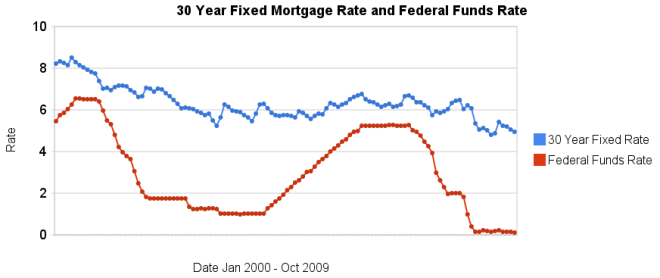
    30 year fixed mortgage rates have declined a bit over the last few months and remain at very low levels.

    30 year fixed mortgage rate chart 2000-2009

    The poor economy, Unemployment Rate Reached 10.2%, has the Fed continuing massive intervention into the economy. The Fed is keeping the fed funds rate at close to 0% (.12% in October). They also continue to hold massive amounts of long term government and mortgage debt (in order to suppress interest rates on long term bonds – by reducing the supply of such bonds in the market).

    I can’t see how lending US dollars, over the long term, at 5%, makes any sense. I would much rather borrow at those rates than lend. If you have not refinanced yet, doing so now may well make sense. And if you are looking at a new real estate purchase, financing a 30 year mortgage sure is attractive at rates close to 5%.

    Related: historical comparison of 30 year fixed mortgage rates and the federal funds rateLowest 30 Year Fixed Mortgage Rates in 37 YearsJumbo v. Regular Fixed Mortgage Rates: by Credit ScoreWhat are mortgage definitionsIgnorance of Many Mortgage Holders

    For more data, see graphs of the federal funds rate versus mortgage rates for 1980-1999. Source data: federal funds rates30 year mortgage rates

  • Consumer Debt Down Over $100 Billion So Far in 2009

    One of the few good recent results of the economy has been a continuous decline in consumer debt. Consumer debt fell for the 8th consecutive month, for the first time, in September, declining by $15 billion.

    Consumer debt grew by about $100 each year from 2004 through 2007. In 2008 it increased $40 billion. In 2009 it has fallen over $100 billion so far: from $2,559 billion to $2,456 billion. This still leaves over $8,000 in consumer debt for every person in the USA and $20,000 per family.

    The huge amount of outstanding consumer and government debt remains a burden for the economy. At least some progress is being made to decrease consumer debt.

    Those living in USA have consumed far more than they have produced for decades. That is not sustainable. You don’t fix this problem by encouraging more spending and borrowing: either by the government or by consumers. The long term problem for the USA economy is that people have consuming more than they have been producing.

    The solution to this problem is to stop spending beyond your means by even increasing levels of personal and government debt. Thankfully over the last year at least consumer debt has been declining. Government debt has been exploding so unfortunately that problem has continued to get worse.

    As we know, interest rates have fallen a great deal over the last few years. the federal funds rate sits at essentially 0% and money market funds now yield under 1%. However, credit card accounts that are charging interest increase to an interest rate of 14.9% from 13.6% in the 3rd quarter of 2008. In 2004 the credit card interest rate was 13.2%, 2005 – 14.6%, 2006 – 14.7%, 2007 – 14.7%, 2008 – 13.6%. All credit card balances should be paid off every month to avoid these excessive interest rates.

    Data from the federal reserve and census bureau.

    Related: Consumer Debt Declined a Record $21.5 Billion in JulyThe USA Economy Needs to Reduce Personal and Government DebtLet the Good Times Roll (using Credit)

  • Unemployment Rate Reached 10.2%

    The unemployment rate rose from 9.8 to 10.2% in October, and nonfarm
    payroll employment continued to decline (down another 190,000 jobs), the U.S. Bureau of Labor Statistics reported today. The largest job losses over the month were in construction, manufacturing, and retail trade.

    In October, the number of unemployed persons increased by 558,000 to 15.7
    million. The unemployment rate rose to 10.2%, the highest rate since April 1983. Since the start of the recession in December 2007, the number of unemployed persons has risen by 8.2 million, and the unemployment rate has grown by 530 basis points.

    Among the major worker groups, the unemployment rates for adult men (10.7%) rose in October. The jobless rates for adult women (8.1 percent), teenagers (27.6%), African-Americans (15.7%), and Hispanics (13.1%) were little changed over the month.

    The number of long-term unemployed (those jobless for 27 weeks and over) was little changed over the month at 5.6 million. In October, 35.6% of
    unemployed persons were long-term unemployed.

    The civilian labor force participation rate was little changed over the month
    at 65.1%. The employment-population ratio continued to decline in
    October, falling to 58.5%.

    The number of persons working part time for economic reasons (sometimes referred to as involuntary part-time workers) was little changed in October at 9.3 million. These individuals were working part time because their hours had been cut back or because they were unable to find a full-time job.

    Related: Unemployment Rate Rises to 8.1%, Highest Level Since 1983 (March 2009)posts on employmentUSA Unemployment Rate Jumps to 9.4%Unemployment Rate Increases to 9.7%
    (more…)

  • Apartment-vacancy Rate is 7.8%, a 23-year High

    Landlords Offer Incentives to Stay Put

    In the third quarter, the national apartment-vacancy rate hit 7.8%, a 23-year high, according to Reis Inc., which tracks vacancies and rents in the top 79 markets.

    One problem for landlords is that existing tenants can easily check the Web to see what deals new tenants are being offered. And new tenants are getting incentives like a waived pet deposit or two months’ free rent.

    Apartment landlords say that one benefit of the bad market is that it has practically halted new construction. New completions are expected to be 98,000 next year and 109,000 in 2011, compared with 188,000 last year and 204,000 this year, according to Green Street Advisors Inc.

    But when loss rates are taken into account—the removal of units because of obsolescence—the actual addition will be immaterial. That means that when the economy rebounds, the supply will be tight, increasing landlord profits.

    Related: Apartment Vacancy at 22-Year High in USA (July 2009)Articles on Real Estate InvestingIt’s Now a Renter’s MarketHousing Rents Falling in the USA

  • Data on the Largest Manufacturing Countries in 2008

    Manufacturing is an powerful driver of economic wealth. For years I have been providing data to counter the contention that the manufacturing base of the USA is gone and the little bit left was shrinking. The latest data again shows the USA is the largest manufacturer, and manufacturing in the USA continues to grow. It is true global manufacturing has begun to grow more rapidly than USA manufacturing in the last few years. I doubt many suspect that the USA’s share of manufacturing stayed stable from 1990 to 1995 then grew to 2000 took until 2006 to return to the 1990-1995 levels and then has declined in 2007 and 2008 a bit below the 1990 level and during that entire time was growing (even in 2007 and 2008).

    The USA’s share of the manufacturing output, of the countries that manufactured over $185 billion in 2008, 28% in 1990, 28% in 1995, 32% in 2000, 28% in 2005, 28% in 2006, 26% in 2007 and 24% in 2008. China’s share has grown from 4% in 1990, 6% in 1995, 10% in 2000, 13% in 2005, 14% in 2006, 16% in 2007 to 18% in 2008. Japan’s share has fallen from 22% in 1990 to 14% in 2008 (after increasing to 26% in 1995 then steadily falling). The USA has about 4.5% of the world population, China about 20%.

    Based on the latest UN Data, for global manufacturing, in billions of current US dollars:

    Country 1990 1995 2000 2005 2006 2007 2008
    USA 1,041 1,289 1,543 1,624 1,712 1,756 1,831
    China 145 300 484 734* 891* 1,106* 1,399**
    Japan 810 1,219 1,034 979 927 923 1,045
    Germany 438 517 392 571 608 711 767
    Italy 240 226 206 295 302 345 381
    United Kingdom 206 218 226 264 295 323 323
    France 200 233 190 255 255 287 306
    Russian Federation 120 64 45 124 157 206 256
    Brazil 120 125 96 137 163 201 237
    Korea 66 131 136 211 234 260 231
    Spain 112 104 98 160 170 196 222
    Mexico 62 67 133 154 175 182 197
    Canada 92 100 129 168 182 197 195
    India 51 61 69 122 141 177 188

    * I am using the data from last year that separated the manufacturing data (this year the data does not provide separate manufacturing data for China) instead of that shown in the most recent data (which doesn’t separate manufacturing)
    ** The China data is not provided for manufacturing alone. The percentage of manufacturing (to manufacturing, mining and utilities) was 78% for 2005-2007 (I used 78% of the manufacturing, mining and utilities figure provided in the 2008 data).

    I hope to write a series of posts examining global manufacturing data including looking at manufacturing data specifically (excluding mining and utility data).
    (more…)