Tag: economic data

  • 30 Year Mortgage Rate and Federal Funds Rate Chart

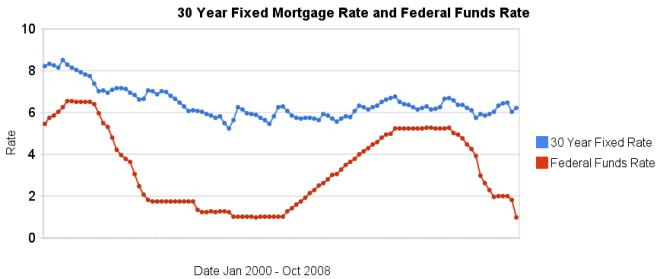
    More dramatic evidence that changing in the federal funds rate do not lead to similar changes in 30 year fixed mortgage rates. It is true the last few months are very unusual times for the credit market. However, the current lack of correlation is not the exception, the graph clearly shows there is very little correlation between changes in the two interest rates.

    30 year fixed mortgage rates and the federal funds rate 2000-2008

    Related: historical comparison of 30 year fixed mortgage rates and the federal funds rateAffect of Fed Funds Rates Changes on Mortgage Ratesposts on financial literacyJumbo v. Regular Fixed Mortgage Rates: by Credit Score

    For more data, see graphs of the federal funds rate versus mortgage rates for 1980-1999. Source data: federal funds rates30 year mortgage rates

  • Record Home Price Declines

    Since the S&P/Case-Shiller 20 city home price index peaked in June 2006 it has fallen 19.5%. In the year ending July 2008 the decline was 16.3%. That is a record drop. In that year Las Vegas declined 29.9%, Phoenix 29.3% and Miami 28.2%. For the largest cities: New York City declined 7.4%, Los Angeles 26.2%, Chicago 10% and Dallas 2.5% (the second lowest decline – Charlotte declined 1.8%); Houston and Philadelphia, the 4th and 5th largest cities are not included in the 20 city index.

    Only one city shows a decline in housing values since January, 2000: Detroit is down nearly 7%. Washington is up 95% since January, 2000 (even with a 15.8% decline in the last year), Los Angels and New York are tied for second at 93% increases. The 20 city index is up 66% from January 2000 to July 2008.

    The S&P/Case-Shiller Composite of 20 Home Price Index is a value-weighted average of the 20 metro area indices for single family homes.

    Source: Record Home Price Declines (pdf)

    Related: Housing Prices Post Record DeclinesHome Price Declines Exceeding 10% Seen for 20% of Housing MarketsFourteen Fold Increase in 31 YearsThe Ever Expanding HouseComing Collapse in Housing?

  • Manufacturing Employment Data – 1979 to 2007

    I have had difficulty finding good economic data on manufacturing jobs. I have posted about this previously but have trouble finding much worth posting about: Worldwide Manufacturing Job DataManufacturing Jobs. The Unites States Department of Labor, Bureau of Labor Statistics has published some interesting data and so here is a look at some of that data.

    The table shows average annual productivity gains (output per hour, in USA dollars – I think it is not clear) – the 2007 output totals are from the United Nations data I posted about last week (Data on Top Manufacturing Countries).

    Average Annual Manufacturing Productivity Gains by Country
    Country 1979-1990 1990-1995 1995-2000 2000-2007 1979-2007 2007 Output
    $USA billion
    Taiwan 6.1 4.7 5.6 6.4 5.9
    Korea NA 9.4 10.8 7.6 NA 241
    USA 2.8 3.7 5.6 4.6 3.9 1,831
    France 3.8 3.4 4.6 3.5 3.8 296
    Japan 3.8 3.3 3.4 3.8 3.6 926
    United Kingdom 4.1 2.8 2.7 3.9 3.6 342
    Germany 2.1 2.9 3.7 3.8 3.0 670
    Spain 3.3 3.1 0.8 2.1 2.5 208
    Canada 2.1 3.4 3.8 1.1 2.4 218
    Italy 3.4 3.8 1.4 -.2 2.2 345

    The countries that were part of the study but are not included in the table above: Australia, Belgium, Denmark, Netherlands, Norway, Sweden.

    Manufacturing productivity increased in 14 of 16 countries in 2007, according to the study. The United States of America increase of 4.1 was the fourth largest among the 16 economies and was slightly above the 3.9 percent U.S. average annual increase since 1979. 15 of the 16 countries increased manufacturing output in 2007.

    9 countries increased manufacturing hours worked in 2007, the USA increased 2.3% (below their average increase since 1979). Hours worked decreased for all countries in the period of 2000-2007 (UK has had the largest decrease 3.9% annual average decrease, the USA in next at 3.1%).

    Manufacturing employment increased in 10 countries in 2007. From 2000-2007 the USA has experienced average annual declines of 3% in manufacturing employment (the second sharpest drop to the UK which has fallen 4%). From 1979-2007 the USA annual declines averaged 1.2% (only Taiwan.9% and Spain .1% showed increases). From 2000-2007 four countries show slight average annual increases: Spain .5%, Korea .4%, Taiwan .2% and Italy .2%. From 2000-2007 only 3 countries showed annual average decreases in output: Canada -.3%, Italy -.2% and UK – .1%.

    Hourly manufacturing compensation has increased in all countries for the period 1979-2007 (data shown for this item is in each national currency: USA 4.6% average annual increases, Spain up 7.2% annually, Taiwan up 7%, UK 6.8%, Germany 4.4%, Japan 4.2%.

    via: Canada’s Manufacturing Crisis in International Perspective

    Related: posts on employmentTop 10 Manufacturing Countries 2006

  • Top 12 Manufacturing Countries in 2007

    The updated data from the United Nations on manufacturing output by country clearly shows the USA remains by far the largest manufacturer in the world. UN Data, in billions of current US dollars:

    Country 1990 1995 2000 2005 2006 2007
    USA 1,041 1,289 1,543 1,663 1,700 1,831
    China 143 299 484 734 891 1,106
    Japan 804 1,209 1.034 954 934 926
    Germany 438 517 392 566 595 670
    Russian Federation 211 104 73 222 281 362
    Italy 240 226 206 289 299 345
    United Kingdom 207 219 228 269 303 342
    France 224 259 190 249 248 296
    Korea 65 129 134 200 220 241
    Canada 92 100 129 177 195 218
    Spain 101 103 98 164 176 208
    Brazil 120 125 96 137 170 206
    Additional countries of interest – not the next largest
    India 50 59 67 118 135 167
    Mexico 50 55 107 122 136 144
    Indonesia 29 60 46 80 102 121
    Turkey 33 38 38 75 85 101

    The USA’s share of the manufacturing output of the countries that manufactured over $200 billion in 2007 (the 12 countries on the top of the chart above) in 1990 was 28%, 1995 28%, 2000 33%, 2005 30%, 2006 28%, 2007 27%. China’s share has grown from 4% in 1990, 1995 7%, 2000 11%, 2005 13%, 2006 15%, 2007 16%.

    Total manufacturing output in the USA was up 76% in 2007 from the 1990 level. Japan, the second largest manufacturer in 1990, and third today, has increased output 15% (the lowest of the top 12, France is next lowest at 32%) while China is up an amazing 673% (Korea is next at an increase of 271%).
    (more…)

  • 3 Month Treasury Bill Yield Reached .03%

    On Wednesday of last week the United States 3 month treasury bill yield reached .03%, yet another remarkable chart from the current crisis.

    chart of 3 month treasury bill yield

    via: No one wants to hold risk … – “I guess this is what a close to systemic financial crisis in the US looks like”

    Daily Treasury Yield Rates show that the rate for Friday the 12th of September 1.49%, Monday the 15th 1.02%, Tuesday .84%, Wednesday .03%, Thursday .23% and Friday .99%.

    Related: Corporate and Government Bond YieldsCurious Cat Investing and Economics SearchCredit Crisis Continues (April 2008)

  • Bad News on Jobs

    The growth in the number of jobs in the USA continues to be bad. The growth in jobs has been very poor thus far this century. The good news has been unemployment has been fairly low, it now sits at a 4 year high of 5.7% (which is not great but not horrible by historic standards).

    Update: today the labor department announced the unemployment rate increased to 6.1%.

    This year the news has been worse, with actually declining numbers of jobs and some economics see No job turnaround on horizon:

    Economists expect another weak job report when the government releases its August employment figures Friday. But many also are predicting job losses to continue deep into 2009 as well. USA employers have already trimmed 463,000 jobs from the payrolls during the first seven months of the year.

    “I’m not expecting increases in employment until next year because in the second half of this year we’ll see very lethargic economic growth,” said Joel Prakken, chairman of Macroeconomic Advisers. The Conference Board has created a new reading called the Employment Trends Index, which combines a number of different economic readings to predict when employment will turn higher or lower. The index, which typically signals three to six months before job losses will turn to job gains, has yet to show signs of a recovery.

    “We think the unemployment rate will keep growing, probably reach between 6 to 6.5% by mid 2009 and only start declining in the second half of next year,” said Gad Levanon, senior economist at The Conference Board.

    Related: What Do Unemployment Stats Mean?Economic Fault: Income Inequality

  • Salaries with a College Degree

    The Declining Value Of Your College Degree by Greg Ip:

    A degree, she says, “isn’t any big guarantee of employment, it’s a basic requirement, a step you have to take to even be considered for many professional jobs.”

    For decades, the typical college graduate’s wage rose well above inflation. But no longer. In the economic expansion that began in 2001 and now appears to be ending, the inflation-adjusted wages of the majority of U.S. workers didn’t grow, even among those who went to college. The government’s statistical snapshots show the typical weekly salary of a worker with a bachelor’s degree, adjusted for inflation, didn’t rise last year from 2006 and was 1.7% below the 2001 level.

    To be sure, the average American with a college diploma still earns about 75% more than a worker with a high-school diploma and is less likely to be unemployed. Yet while that so-called college premium is up from 40% in 1979, it is little changed from 2001

    The job market is more challenging than it was, it seems to me. Counting on being able to steadily progress during your career, without any gaps or times when you must accept much less than you hoped, is risky. This is one more reason why it is so important to spend less and save more in the good times in your career.

    Related: What Do Unemployment Stats Mean?Engineering Graduates Again in Great ShapeUSA Job GrowthThe IT Job Market

  • Inflation Up 1.1% in USA Last Month

    U.S. Consumer Prices Jumped in June by the Most in 26 Years

    The cost of living soared 1.1 percent, more than forecast, after a 0.6 percent gain the prior month, the Labor Department said today in Washington. Excluding food and energy, so-called core prices climbed 0.3 percent, also more than anticipated.

    Prices increased 5 percent in the 12 months to June, the most since May 1991. They were forecast to climb 4.5 percent from a year earlier, according to the survey median. The core rate increased 2.4 percent from June 2007, also more than forecast.

    Energy expenses jumped 6.6 percent, the biggest gain since the aftermath of Hurricane Katrina in September 2005. Gasoline prices soared 10.1 and fuel oil jumped 10.4 percent.

    Rents which, make up almost 40 percent of the core CPI, also accelerated. A category designed to track rental prices rose 0.3 percent after a 0.1 percent gain in May. Today’s figures also showed wages decreased 0.9 percent in June after adjusting for inflation, the biggest drop since August 1984, and were down 2.4 percent over the last 12 months. The drop in buying power is one reason economists forecast consumer spending will slow.

    The continued increase of inflation is a serious problem. Eventually the federal reserve needs to take serious action (raising the discount rate). And the politicians need to stop raising taxes on the future to spend more and more every year. Their continued financial irresponsibility is a large part of the reason for the declining value of the dollar – along with the voters that keep electing those proposing large increases in spending while pushing off paying for that spending to future tax increases.

    Related: inflation investment riskFood Price Inflation is Quite HighBernanke warns of inflationPoliticians Again Raising Taxes On Your ChildrenUSA Federal Debt Now $516,348 Per Household
    (more…)

  • Oil Consumption by Country

    The largest oil consuming countries (and EU), in millions of barrels per day:

    Country consumption % of oil used % of population % of World GDP
    USA 20.8 25.9 4.5 21.0
    European Union 14.6 18.1 7.4 21.9
    China 6.9 8.6 19.9 10.7
    Japan 5.4 6.7 1.9 6.5
    Russia 2.9 3.6 2.1 3.2
    Germany 2.6 3.3 1.2 4.3
    India 2.4 3.0 17.0 4.6
    Canada 2.3 2.9 0.5 1.9
    Korea 2.1 2.7 0.7 1.8
    Brazil 2.1 2.6 2.9 2.8
    Mexico 2.1 2.6 1.6 2.1

    All data is from CIA World Factbook 2008 (downloaded Jun 2008). GDP calculated using purchasing power parity.

    Related: Top 10 Manufacturing Countries 2006Country H-index Rank for Science PublicationsBest Research University Rankings (2007)

  • Corporate and Government Bond Yields

    graph of 10 year bond rates

    Over the last 2 months the yields on bonds have increased the discount rate has continued to decline.

    The spread between corporate bond yields and government bonds has decreased a bit as treasury yields have increased 37 basis points compared to just 4 and 6 basis point increased in corporate bond yields.

    Data from the federal reserve – corporate Aaacorporate Baaten year treasuryfed funds

    Related: Bond Yields 2005-200830 Year Fixed Mortgage Rates versus the Fed Funds RateInitial Retirement Account Allocations