Tag: economic data

  • Sound Canadian Banking System

    Worthwhile Canadian Initiative by Fareed Zakaria

    Guess which country, alone in the industrialized world, has not faced a single bank failure, calls for bailouts or government intervention in the financial or mortgage sectors. Yup, it’s Canada. In 2008, the World Economic Forum ranked Canada’s banking system the healthiest in the world. America’s ranked 40th, Britain’s 44th.

    Canadian banks are typically leveraged at 18 to 1—compared with U.S. banks at 26 to 1 and European banks at a frightening 61 to 1.

    Canada has been remarkably responsible over the past decade or so. It has had 12 years of budget surpluses, and can now spend money to fuel a recovery from a strong position. The government has restructured the national pension system, placing it on a firm fiscal footing, unlike our own insolvent Social Security. Its health-care system is cheaper than America’s by far (accounting for 9.7 percent of GDP, versus 15.2 percent here), and yet does better on all major indexes. Life expectancy in Canada is 81 years, versus 78 in the United States; “healthy life expectancy” is 72 years, versus 69. American car companies have moved so many jobs to Canada to take advantage of lower health-care costs that since 2004, Ontario and not Michigan has been North America’s largest car-producing region.

    Related: Canadian Banks Avoid Failures Common ElsewhereInternational Health Care System PerformanceGreenspan Says He Was Wrong On Regulation
  • Housing Rents Falling in the USA

    Apartment Rents Fall, Vacancies at 4-Year High

    U.S. apartment rents fell in the fourth quarter from the third as the national vacancy rate climbed to a four-year high of 6.6 percent

    Asking rents fell 0.1 percent from the previous quarter, to $1,052 on average, their first quarter-to-quarter decline in almost six years. They rose 2.4 percent from a year earlier. Effective rents, what tenants actually paid, fell to an average $996 last quarter, down 0.4 percent from the prior quarter and up 2.2 percent from a year earlier.

    U.S. rental market set to slow down amid housing glut

    “Unsold properties being turned into rental units are creating a shadow market that’s driving up the vacancy rate and slowing the growth of rents,” Chandan said. “Areas that saw the most speculative investing, particularly in condos, will see the biggest pressure on rents.”

    Anthony De Silva said he was not happy that he had become a landlord. He bought a two-bedroom condominium 18 months ago on the ocean in Hollywood, Florida, expecting to sell at a $100,000 profit. Instead, he is now looking for tenants at $1,700 a month.

    “Increasing vacancies does not bode well for rental incomes,” said Nabil El-Hage, a professor at Harvard Business School. “We’ve seen a softening in apartment REITs as a result.”

    So for renters nationwide this is one possible silver lining to the current economic crisis. Granted not a large one but in these times any good news is worth appreciating. For real estate investors the news is not as good. The Washington DC market is forecast to go against the trend for reduced rents in 2009.

    According to Marus and Millichap, Metrowide vacancy is expected to rise 60 basis points this year to 6.5 percent. Asking rents are projected to advance 3.1 percent to $1,410 per month in 2009, while effective rents increase 2.8 percent to $1,351 per month. Rent growth will lag slightly in Suburban Maryland. Of the 43 rental market they track they project San Francisco to see the largest increases in rent in 2009, followed by San Diego and Washington DC.

    Related: Home Values and Rental RatesRent Controls are Unwiseposts on housingHow Walkable is Your Prospective Neighborhood

  • GDP Down 3.8%, Worst Since 1982

    GDP slides 3.8%, worst since 1982

    That was the steepest drop since a 6.4% decline in 1982, easily surpassing the downturns seen during the 1990-91 and 2001 recessions. It also provided the second consecutive drop in GDP, after the 0.5% drop in the third quarter of 2008.

    “All of this points towards real GDP declining faster in the first quarter than the fourth quarter,” Levy said. Another bad portent was a sharp decline in exports. U.S. sales to other countries had been strong in recent years, boosted by high demand overseas and the relatively low value of the dollar. But that situation reversed sharply in the last three months of 2008, with exports plummeting 19.7%.

    According to the International Monetary Fund, the decline in the U.S. is matched by other leading economies, which contracted about 5.5% in the fourth quarter of 2008.

    The decline was a bit less than anticipated but obviously shows an economy in serious trouble. U.S. GDP Falls At 3.8 Percent Pace In 4th Quarter

    The figure showed how rapidly the economy was contracting. In the previous quarter, the economy slipped 0.5 percent. For all of 2008, GDP rose 1.3 percent, the slowest growth since 2001, when the economy expanded 0.8 percent. In 2007, the GDP increased by 2 percent.

    The Commerce report showed consumer spending – which accounts for a whopping two-thirds of U.S. economic activity – fell another 3.5 percent in the fourth quarter after declining 3.8 percent in the third quarter. Spending on durable goods such as cars and furniture plunged 22.4 percent, the steepest decline since the first quarter of 1987.

    As I have been saying for awhile the economy is in trouble and 2009 looks to be difficult. We should be happy if a recovery is underway in the 4th quarter of 2009 and we have not too drastically increased the burden on the future to pay for current spending.

    Related: Financial Market Meltdown (Oct 2008)Cracks in US Economy? (Dec 2006)Fed Continues Wall Street WelfareForecasting Oil PricesCrisis May Push USA Federal Deficit to Above $1 Trillion for 2009

  • The Impact of Credit Scores and Jumbo Size on Mortgage Rates

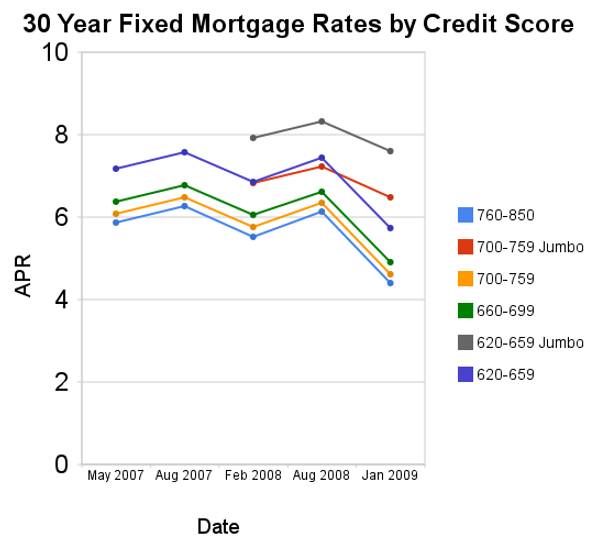
    Since August of 2008 conforming mortgage rates are have declined a huge amount. Jumbo rates have fallen a large amount also, but much less (for example for a credit score of 700-759 the jumbo rates declined 73 basis points while the conventional rate declined 172 basis points.

    chart of 30 year fixed mortgage rates by credit score from May 2007 to Jan 2009

    For scores above 620, the APRs above assume a mortgage with 1 point and 80% Loan-to-Value Ratio. For scores below 620, these APRs assume a mortgage with 0 points and 60 to 80% Loan-to-Value Ratio. You can see, with these conditions the rate difference between a credit score of 660 and 800 is not large (remember this is with 20% down-payment) and has not changed much (the difference between the rates if fairly consistent).

    Related: Low Mortgage Rates Not Available to Everyone30 Year Fixed Rate Mortgage Rate DataReal Free Credit Report (in USA)Jumbo Mortgage Shoppers Get Little Relief From Ratesposts on mortgages
    (more…)

  • Chart Shows Wild Swings in Bond Yields

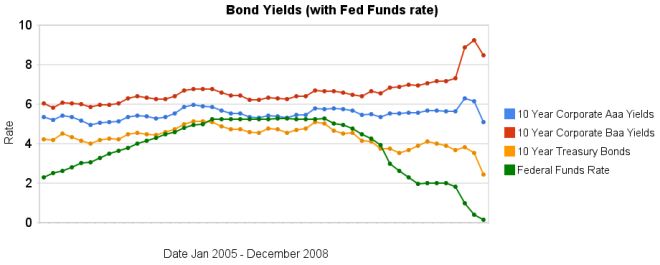
    graph of 10 year Aaa, Baa and corporate bond rates from 2008-2008

    The recent reactions to the credit and financial crisis have been dramatic. The federal funds rate has been reduced to almost 0. The increase in the spread between government bonds and corporate bonds has been dramatic also. In the last 3 months the yields on Baa corporate bonds have increased significantly while treasury bond yields have decreased significantly. Aaa bond yields have decreased but not dramatically (57 basis points), well at least not compared to the other swings.

    The spread between 10 year Aaa corporate bond yields and 10 year government bonds increased to 266 basis points. In January, 2008 the spread was 159 points. The larger the spread the more people demand in interest, to compensate for the increased risk. The spread between government bonds and Baa corporate bonds increased to 604 basis points, the spread was 280 basis point in January, and 362 basis points in September.

    When looking for why mortgage rates have fallen so far recently look at the 10 year treasury bond rate (which has fallen 127 basis points in the last 3 months). The rate is far more closely correlated to mortgage rates than the federal funds rate is.

    Data from the federal reserve – corporate Aaacorporate Baaten year treasuryfed funds

    Related: Corporate and Government Bond Rates Graph (Oct 2008)Corporate and Government Bond Yields 2005-2008 (April 2008) – 30 Year Fixed Mortgage Rates versus the Fed Funds Rateposts on interest ratesinvesting and economic charts

  • Fed Cuts Rate to 0-.25%

    Treasury bills have been providing remarkably low yields recently. And the Fed today cut their target federal funds rate to 0-.25% (what is the fed funds rate?). With such low rates already in the market the impact of a lowered fed funds rate is really negligible. The importance is not in the rate but in the continuing message from the Fed that they will take extraordinary measures to soften the recession.

    There are significant risks to this aggressive strategy (and there would be risks for acting cautiously too). But I cannot understand investing in the dollar under these conditions or in investing in long term bonds (though lower grade bonds might make some sense as a risky investment for a small portion of a portfolio as the prices have declined so much).

    The current yields, truly are amazing as this graph shows. The chart shows the yield curve in Dec 2008, 2006, 2000 and 1994 based on data from the US Treasury

    chart of yield curve in Dec 2008, 2006, 2000, 1994

    Related: Corporate and Government Bond Rates GraphDiscounted Corporate Bonds Failing to Find Buying SupportMunicipal Bonds After Tax ReturnTotal Return

  • Nearly 10% of Mortgages Delinquent or in Foreclosure

    The percentage of loans in the foreclosure process at the end of the third quarter was 2.97 percent, an increase of 22 basis points from the second quarter of 2008 and 128 basis points from one year ago. The percentage of loans in the process of foreclosure set a new record this quarter, to 1.35 million.

    Mortgages are counted as delinquent or in foreclosure (once they are in foreclosure they are not counted as delinquent). So the total percentage of mortgages not being paid by the homeowner is 2.97% (in foreclosure) + 6.99% (delinquent) = 9.96%. That is amazingly bad. In February of 2007 I wrote about this and the delinquency rate was 4.7% which sounded pretty bad to me. Amazingly 4.4% is a historic low for this figure. Can you believe 1/25 mortgages is delinquent and that is as good as we ever get? That is pretty shocking to me.

    The seasonally adjusted total delinquency rate is now the highest recorded in the Mortgage Bankers Association survey. The seasonally adjusted delinquency rate increased 41 basis points to 4.34 percent for prime loans, increased 136 basis points to 20.03 percent for subprime loans, increased 29 basis points to 12.92 percent for FHA loans, and increased 46 basis points to 7.28 percent for VA loans.

    The percent of loans in the foreclosure process increased 16 basis points to 1.58 percent for prime loans, and increased 74 basis points for subprime loans to 12.55 percent. FHA loans saw an eight basis point increase in the foreclosure inventory rate to 2.32 percent, while the foreclosure inventory rate for VA loans increased 13 basis points to 1.46 percent.

    Since loans that would have gone into foreclosure in the past are being kept out of foreclosure due to some programs ( ) the rate or seriously delinquent is a useful measure of serious problems. Seriously delinquent mortgages are 90 days past due. The rate increased 52 basis points for prime loans to 2.87 percent, increased 171 basis points for subprime loans to 19.56 percent, increased 62 basis points for FHA loans to 6.05 percent, and increased 45 basis points for VA loans percent to 3.45 percent.

    Compared to a year ago: the seriously delinquent rate was 156 basis points higher for prime loans and 818 basis points higher for subprime loans. The rate also increased 51 basis points for FHA loans and 89 basis points for VA loans.

    Related: Homes Entering Foreclosure at Record (Sep 2007)Foreclosure Filings Continue to RiseHow Much Worse Can the Mortgage Crisis Get?How Not to Convert Equity

  • Over 500,000 Jobs Disappeared in November

    Jobless Rate Rises to 6.7% in November

    With the economy deteriorating rapidly, the nation’s employers shed 533,000 jobs in November, the 11th consecutive monthly decline, the government reported Friday morning, and the unemployment rate rose to 6.7 percent.

    The decline, the largest one-month loss since December 1974, was fresh evidence that the economic contraction accelerated in November, promising to make the current recession, already 12 months old, the longest since the Great Depression. The previous record was 16 months, in the severe recessions of the mid-1970s and early 1980s.

    The manufacturing sector has been particularly hard hit, losing more than half a million jobs this year. That is nearly half the 1.2 million jobs lost since employment peaked in December and, in January, began its uninterrupted decline. The cutbacks seem likely to accelerate as the three Detroit automakers close more factories and shrink payrolls even more

    With all this in mind, and particularly the shrinking employment rolls, economists are estimating that the gross domestic product is contracting at an annual rate of 4 percent or more in the fourth quarter, after a decline of 0.3 percent in the third quarter.

    The news was even worse than the anticipated 350,000 losses. And Previous months figures were adjusted from 240,000 losses in October to 320,00 and from 284,000 in September to 403,000. And these numbers are on an already extremely poor job picture the previous 7 years. One of the great strengths of the US economy over the last 50 years has been job creation. We know we are in for serious problems, the question is how serious and how long. One of the most important gages of that will be how many jobs are lost.

    When job losses stop and job gains start (in the aggregate, for the entire economy) it will be a very positive sign. Normally jobs are a lagging indicator, meaning job data lags the actual economy. Job losses will not increases until after the economy starts to grow. Of course, economic data doesn’t always fit the conventional wisdom.

    This is one more piece of evidence that the economy is not looking good. And 2009 is likely to be a bad year for the economy overall.

    Related: Bad News on Jobs (Sep 2008)What Do Unemployment Stats Mean?The Economy is in Serious TroubleFinancial Market Meltdown

  • Personal Saving and Personal Debt in the USA

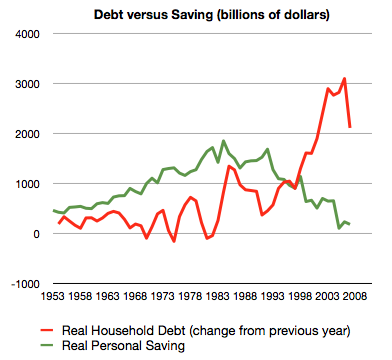
    graph of saving and debt

    The whole sorry mess in one picture (including chart) by Philip Brewer

    Take a gander at that graph. The green line is personal savings. The Bureau of Economic Analysis calculates that. It’s just income minus spending–the obvious way of figuring saving. The red line is debt. The Federal Reserve calculates that value. The value on the graph is the change from the previous year–that is, it shows each year’s new debt, just like the green line shows each year’s saving. Both values are adjusted for inflation–the graph is in billions of (year 2000) dollars.

    Starting back in about 2005, the American consumer reached the point that they could no longer service ever-increasing amounts of debt. That led to the housing bubble popping. The result is what you can see in the last datapoint on the graph–less new borrowing in 2007.

    Related: $2,540,000,000,000 in USA Consumer DebtAmericans are Drowning in Debtsave an emergency fundFinancial Illiteracy Credit Trapposts on saving money

  • S&P 500 Dividend Yield Tops Bond Yield: First Time Since 1958

    S&P 500 Payout Tops Bond Yield, a First Since 1958 (site broke the link, so I removed it):

    U.S. stocks’ dividend yields were lower than the yield on 10-year Treasury notes for half a century. Not any more. Dividends paid by Standard & Poor’s 500 Index companies in the past 12 months amounted to 3.51 percent of the benchmark’s closing value yesterday. In early trading today, the 10-year yield fell as low as 3.42 percent.

    Treasuries routinely had higher yields than stocks before 1958, according to Bernstein. When this relationship came to an end, yields were near their current levels. The S&P 500 dividend yield fell 0.58 percentage point, to 3.24 percent, in the third quarter of 1958. The 10-year yield rose about the same amount, 0.6 point, to 3.80 percent.

    Two explanations later emerged for the reversal, he wrote. One held that the economy’s recovery from the 1957-58 recession showed “investors could finally put to rest the widely held expectation of an imminent return to the Great Depression.” The second was the increasing popularity of investing in growth stocks, or shares of companies whose sales and earnings rose at a relatively fast pace. Because of their expansion, the companies often paid below-average dividends.

    Reversal of Fortunes Between Stocks and Bonds

    Even more telling was the relative movements in stock and bond yields over the years. Bernstein calculates that from 1954 to 1969 — while inflation was relatively low and stable — bond and stock yields moved mostly in tandem. But from 1970 to 1999 — the Great Inflation — bond and stock yields moved inversely. From 2000 on, bond and stock yields have been back in sync.

    Arnott takes it a step further. “In a world of deleveraging, both for the financial services arena and for the economy at large, growth is less certain,” he says. “And with the economy eroding sharply, so is inflation. If stocks don’t deliver nominal growth in dividends and earnings, then their yield ‘must’ exceed the Treasury yield, in order to give us any sort of risk premium.”

    Related: Corporate and Government Bond Rates GraphHighest Possible Returnsposts on interest ratesinvesting strategy