Tag: economic data

  • The Return of the Multi-Generational Family Household

    There are many good economic reasons to have multi-generational (at least 3 generations) households. There are some good social reasons too. There can be interpersonal benefits but also annoyances (which I think is why they decreased – plus we could afford it, the USA was living extremely richly).

    The Return of the Multi-Generational Family Household

    As of 2008, a record 49 million Americans, or 16.1% of the total U.S. population, lived in a family household that contained at least two adult generations

    This represents a significant trend reversal. Starting right after World War II, the extended family household fell out of favor with the American public. In 1940, about a quarter of the population lived in one; by 1980, just 12% did. A range of demographic factors likely contributed to this decline, among them the rapid growth of the nuclear-family-centered suburbs; the decline in the share of immigrants in the population; and the sharp rise in the health and economic well-being of adults ages 65 and older.

    Another factor has been the big wave of immigration, dominated by Latin Americans and Asians, that began around 1970. Like their European counterparts from earlier centuries, these modern immigrants are far more inclined than native-born Americans to live in multi-generational family households.

    However, the trend reversal has also played out among native-born Americans. And for all groups, the move into multi-generational family households has accelerated during the Great Recession that began at the end of 2007.

    The percentage of the population in such households now is 16%, still significantly below the high of 24.7% in 1940.

    Related: Mortgage Rates Falling on Fed Housing FocusPersonal Finance Basics: Long-term Care InsuranceBankruptcies Among Seniors Soaring (2008)
  • Good News: Credit Card Delinquencies at 17 Year Low

    The national credit card delinquency rate (the rate of borrowers 90 or more days past due) decreased for the sixth consecutive quarter, dropping to 0.6% at the end of the second quarter in 2011. This is the lowest mark observed in 17 years. Credit card debt per borrower increased $20 in the quarter to $4,699, though it remains near record-low levels (and yet still at a level that is far too high).

    Although credit card delinquencies were expected to drop, the data released today shows credit card delinquency rates improving by more than at any other time since the recovery began in 2009, both on a quarter-over-quarter basis (-18.9%) and on a year-over-year basis (-34.8%).

    “National credit card delinquency rates have fallen to levels not seen since 1994 as consumers continue to tighten their spending,” said Ezra Becker, vice president of research and consulting in TransUnion’s financial services business unit. “TransUnion believes that the recovering economy is only indirectly impacting delinquency rates. More important and impactful to the decline in bank card delinquency are that consumers are using credit cards more responsibly; a large number of delinquent accounts have moved to charge-off status; and lenders remain conservative in their underwriting.”

    The record low-level of credit card debt that has continued post recession is supported by a separate TransUnion credit card deleveraging analysis released in July. The analysis found that consumers made an estimated $72 billion more in payments on their credit cards than purchases between the first quarters of 2009 and 2010.

    This is good news. We still need to reduce pay off much more of the excessive debt we took on living beyond our means the last few decades, but at least this is a small positive step. Overall consumer debt increased in the 2nd quarter, according to the Federal Reserve, and stands at over $2.45 Trillion. Revolving debt (credit cards) decreased slightly but non-revolving debt increased more. Consumer debt peaked near $2.55 Trillion in 2009 and recently bottomed just below around $2.4 in 2010. Consumer debt totals still need a great deal of improvement.

    Related: Consumer and Real Estate Loan Delinquency Rates 2000-2010Consumer Debt Down, but Still Over $2.4 Tillion in the USA

  • USA add 117,000 Jobs in July and Adjusts Previous Growth in May and June Up 56,000 More

    The report on employment released today was not good news but it was less bad than feared. Total nonfarm payroll employment rose by 117,000 in July, and the unemployment rate was little changed at 9.1%, the United States Bureau of Labor Statistics reported today. Employment growth in July, follows little growth over the prior 2 months. Total private employment rose by 154,000 over the month. Sectors experiencing growth include: health care, retail trade, manufacturing, and mining. Government employment continued to trend down.

    Some good news is found in the adjustments to the last two months job numbers. The change in total nonfarm payroll employment for May was revised from +25,000 to +53,000, and the change for June was revised from +18,000 to +46,000. That adds 56,000 jobs to the 117,000 jobs added in July and brings to the total for this report to 173,000 additional jobs. Still not great but much better than the last 2 months. The economy needs to add 125,000 a month to keep up with population growth.

    And currently the economy needs to add much more to make up for all the jobs lost due to the too big to fail institution created credit crisis. The damage done to the economy by those institutions and continuing to be done in order to support those companies remains enormous. I believe we need to see 230,000 jobs added a month consistently (in order to be making ground up for the damage done), before we can believe we are doing well.

    Remember it was just over 2 years ago we were losing hundreds of thousands of jobs a month. We are doing much better now, but fixing how broken things were is not easy. Between January of 2008 and February of 2010, the economy lost 8.75 million jobs. Since February 2010, 1.94 million jobs have been added. That means we have still lost 6,810,000 jobs and when you consider we have to add 125,000 a month to keep up we have 43 * 125,000 = 5,375,000 we haven’t added bringing a the total of jobs needed to over 12,000,000 (the number we need to add to get back to where we were). But truthfully we probably were at a bubble induced level at the peak so 12,000,000 is probably an overestimate of how many jobs we need to gain back.
    (more…)

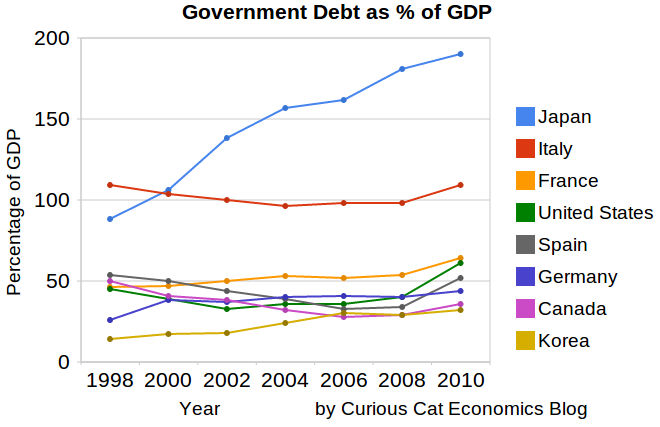
  • Government Debt as Percent of GDP 1998-2010 for OECD

    This chart shows government debt as a percent of GDP based on OECD data. The chart is limited to central government debt issuance and excludes therefore state and local government debt and social security funds.

    Economic data is always a bit tricky to understand. It makes some sense that excluding social security would reduce the USA debt percentage a bit. But these debt as a percentage of GDP are lower than other sources show. There are obviously many tricks that can be used to hide debt and my guess is the main thing going on with this data is OECD intentionally trying to make things look as good as possible.

    Still looking at historical trends in data is useful. And I believe looking at data from various sources is wise. There has been a dramatic increase from 2008-2010. The USA is up from 41% of GDP to 61%. Spain is up from 34% to 52% (but given all the concern with Spain this doesn’t seem to indicate the real debt problems they have.

    Japan and France don’t have 2010 data, so I used a rough estimate of my own based on 2009 data. Greece has been over 100% since 1998 and now stands at 148%, 2nd worst (to Japan) for any OECD country (Europe, North America, Japan and Korea), Italy is 3rd. Ireland is at 61% (up from 28% in 2008). The UK is at 86%, up from 61%.

    Related: Government Debt as Percentage of GDP 1990-2009: USA, Japan, Germany, China… (based on IMF data)Government Debt as Percentage of GDP 1990-2008Government Debt Compared to GDP 1990-2007Top 15 Manufacturing Countries in 2009

  • USA Added 244,000 Jobs in April

    Nonfarm payroll employment rose by 244,000 in April, and the unemployment rate edged up to 9.0% (from 8.8%) as the labor force grew slightly, the U.S. Bureau of Labor Statistics reported today. Also the number of jobs added is taken from the household survey while the unemployment rate is taken from the business payroll survey (they often have slightly different readings month to month). I, and many others, suspected the 8.8% figure might have been a bit low (and frankly the 9% figure may as well). In April of 2010 the unemployment rate was at 9.9%.

    The change in total nonfarm payroll employment for February was revised from +194,000 to +235,000, and the change for March was revised from +216,000 to +221,000. Bringing the total jobs added with this report to 290,000 (244,000 + 41,000 + 5,000) – which is a very good result. Now if we can keep this up for a year that would be great. Overall this provides very encouraging news on the job front.

    The number of unemployed persons stands at 13.7 million, up a little in April. Unemployment rates for several groups stood at: adult men 8.8%, adult women 7.9%, teenagers 24.9%, whites 8.0%, blacks 16.1%, Hispanics 11.8% and for Asians was 6.4%.

    In another positive sign, the number of long-term unemployed (those jobless for 27 weeks and over) declined by 283,000 to 5.8 million; their share of unemployment declined to 43.4%. This is still a serious problem, but at least it is improving a bit.

    The civilian labor force participation rate was 64.2% for the fourth consecutive month. The employment-population ratio, at 58.4%, changed little in April.

    The private sector added 268,000 jobs. Employment rose in a number of service-providing industries, manufacturing, and mining. Since a recent low in February 2010, total payroll employment has grown by 1.8 million. Private sector employment has increased by 2.1 million over the same period.

    Manufacturing employment rose by 29,000 in April. Since reaching an employment low in December 2009, manufacturing has added 250,000 jobs, including 141,000 in 2011. This is more great news. There has been real strength in manufacturing. Manufacturing is a real source of strength and if it can continue to be strong that will be very good news.

    Related: USA Adds 216,00 Jobs in March and the Unemployment Rate Stands at 8.8%USA Added 290,000 Jobs In April 2010Unemployment Rate Increased to 8.9% in April 2009USA Unemployment Rate Rises to 8.1%, Highest Level Since 1983
    (more…)

  • Inflation Shows Up in Huge Commodity Price Increases

    Gold and Silver at up dramatically in the last year. Food prices are up dramatically.

    The World Bank Development Prospects Group shows food price changes Q1 2010 to Q1 2011

    Increase
    Maize (corn) 74%
    Wheat 69%
    Soybeans 36%
    Beef 36%
    Rice -2%

    If food is 10% of your expenses and food overall has inflation of 30% that only increases your expenses 3%. If food is 50% of your income and goes up 30% that increases your expenses 15%. In the USA people spend about 10% disposable income on food (much of that though is really processing the food not the raw material). Spending in Japan on food is 19%, France 16%, China 33% and India 46%. 50% if what most of the people in the world spend. Those people are poor and don’t have the resources to pay more. This is why food prices are so critical. Governments fall from such rises in basic food prices. Also remember even in a country like the USA, where the average is 10% nearly 30% of people spend over 20% of disposable income on food. There are large variances not only between countries but within countries.

    What matter most is local food prices, but global food prices impact the prices in countries. Though many governments subsidize food prices – when food costs more than 30% of people’s income I think not doing so (when prices rise dramatically) would be crazy. When food costs 5% the government really doesn’t need to be involved.

    Inflation is a serious threat to economies in the next few years. Food inflation for non-rich countries is a huge problem now.

    Related: Food and Energy Costs July 2008Food Price Inflation is Quite HighYou Can Help Reduce Extreme PovertyCreating a World Without PovertyEthanol: Science Based Solution or Special Interest Welfare

    Food Price Watch by the World Bank
    (more…)

  • The USA Can’t Afford to Pay for the Current Health Care System

    The very frustrating aspect of the broken health care system in the USA is that it has been an enormous problem for decades. It isn’t that we have just discovered we have a fatally poor health care system in the last few years. The broken system has been obvious for decades and keeps getting worse. Thankfully in the last few years more and more of those with clout in the current economic system are standing up to demand improvement.

    Costs need to be removed from the system. Hundreds of billions a years should easily be removable by reducing paperwork and reducing waste in the system. As you say some reduction will also have to come in limiting spending that is being done now for worthwhile and worthless procedures. That should also easily save hundreds of billions a year. However in the decades of allowing this broken system to get worse and worse, it is not at all certain that merely taking $500 billion a year out of the costs will be enough.

    It might well require eliminating even more medical work and reducing the income of those that are taking from the system now. My guess is the most logical places for reducing income come from massively overpriced drugs, overpaid specialists, overpaid executives in insurance companies. I suppose some might think nurses should be paid less, that isn’t my belief, but we will see what happens.

    As sensible management of the system is adopted, over time, increasing the saving from eliminating waste should grow. Unfortunately we have wasted decades and so counting on us acting responsibly and adopting a focus on eliminating waste can’t be expected until we show a good 10-15 years of systemic effort on that front.

    In response to: Paying for health care

    Related: USA Spends Record $2.5 Trillion, $8,086 per person 17.6% of GDP on Health Care in 2009articles on improving the health care system in the USABroken Health Care System: Self-Employed InsuranceHealth Insurers Propose Pricing and Coverage Without Respect to Health

  • Apartment Vacancies Fall to Lowest in 3 Years in the USA

    Apartment Vacancies in U.S. Fall to Lowest in Almost Three Years

    The vacancy rate declined to 6.2 percent from 8 percent a year earlier and 6.6 percent in the fourth quarter of 2010, the New York-based research firm said in a report today. The rate was the lowest since it reached 6.1 percent in the second quarter of 2008.

    Effective rents, or what tenants actually pay, increased in 75 of the 82 markets Reis tracks, to an average $991 a month from $967 a year earlier and $986 in the fourth quarter. Landlords’ asking rents also climbed, to $1,047 from $1,027 a year earlier and $1,043 in the previous quarter, according to the report.

    San Jose, California, had the most growth in effective rents during the past year, with 5.2 percent, followed by suburban Virginia and New York City, according to Reis. Effective rents declined 1.5 percent in Las Vegas during the year and grew the least in Orlando, Florida; and Colorado Springs, Colorado.

    Rents have been slowly recovering the last year, after the economic shocks of the credit crisis. People, moved back into parents house and more people started sharing apartments and houses in the last few years as people where thrown out of jobs due to the after effects of the financial actions by large financial institutions. Slowly the economy has been recovering and jobs have been slowly growing and as a result the rental market has been strengthening .

    Also the decline in construction the last few years has decreased the normal addition to supply. At the same time the population has continued growing. Some areas of the country seem to still have a large overcapacity in housing but areas that are adding jobs (such as Northern Virginia and New York City) are seeing increasing rents.

    I have 2 properties for rent in Arlington, Virginia.

    Related: Landlords See Increase in Apartment Rentals (July 2010)USA Housing Inventory Puts Pressure on Prices (Sep 2010)Apartment Rents Rise, Slightly, for First Time in 5 Quarters (Apr 2010)It’s Now a Renter’s Market (Apr 2009)Housing Rents Falling in the USA (Feb 2009)

  • USA Adds 216,00 Jobs in March and the Unemployment Rate Stands at 8.8%

    Nonfarm payroll employment increased by 216,000 in March, and the unemployment rate stands at 8.8%, the U.S. Bureau of Labor Statistics reported today. Revisions for January and February were very small (adding 5,000 jobs to the January totals and 2,000 to February). Since a recent low in February 2010, total payroll employment has grown by 1.5 million.

    This is more good news though the economy needs to add jobs more quickly to make a significant dent in the jobs lost since the misdeeds of large financial institutions precipitated the credit crisis and threw so many people out of work.

    Job gains occurred in professional and business services, health care, leisure and hospitality, and mining. Employment in manufacturing continued to trend up.

    Household Survey Data

    The number of unemployed persons (13.5 million) and the unemployment rate (8.8%) changed little in March. Since November 2010, the jobless rate has declined 100 basis points. Among the major worker groups, the unemployment rates are, for adult men, 8.6%; adult women, 7.7%; and for teenagers 24.5%.

    The number of long-term unemployed (those jobless for 27 weeks or more) was 6.1 million in March; their share of the unemployed increased from 43.9 to 45.5% over the month. In November of 2010 they accounted for 41.9% of the unemployed. In March of 2010 there were 6.5 million, which was 44.1% of all unemployed.

    In March, the civilian labor force participation rate held at 64.2%, which was down from 64.9% in March of 2010, and 65.8% in April of 2009.

    Related: Another 663,000 Jobs Lost in March, 2009Global manufacturing employment data 1979-2007Unemployment Rate Increased to 8.9% (May 2009)USA Added 162,000 Jobs in March, 2010

    Establishment Survey Data
    (more…)

  • Top Countries For Renewable Energy Capacity

    I believe it is wise from an environmental and economic viewpoint to invest in renewable energy projects. I believe the costs of fossil fuel based energy will continue to increase. Renewable energy is continuing to improve and when considering the negative externalities caused by oil, gas and coal and the continuing improvement in wind, solar and geothermal generation investment in renewable energy are going to payoff well for countries.

    Top countries for installed renewable energy capacity
    Rank Country Capacity (GigaWatts)
    1 China 103.4
    2 USA 58.0
    3 Germany 48.9
    4 Spain 27.8
    5 Japan 26.0
    6 India 18.7
    7 Italy 16.7
    8 Brazil 13.8
    9 France 9.6

    The largest increases in renewable energy capacity by country from 2005 to 2010 are: China (up 106%), South Korea (up 88%), Turkey (up 85%), Germany (up 67%), Italy and Japan (up 45%). All the data is from the Pew Clean Engery Program report: Who’s Winning the Clean Energy Race? (pdf).

    In 2010, [China] accounted for almost 50 percent of global clean energy superpower. The nation’s all manufacturing of solar modules and wind ascendance has been steady and steep. In turbines. China’s installation of less than 1 GW of 2005, China attracted less than $3 billion worth of private investments in clean energy. In 2009, solar energy capacity demonstrates that most of its production is for export markets. In contrast, 17 GW of wind energy was installed in China in 2010 helping the nation move quickly toward its 2020 target for installing 150 GW of wind. In fact, China accounted for 47 percent of all wind energy investments globally, with $45 billion tallied. Similarly, China led the world in asset financing, with $47.3 billion in private investments directed toward installation of clean energy generating capacity.

    India is poised to take a leadership role in the solar sector, with a target of deploying 20 GW by 2020. In 2010, the country set about getting its National Solar Mission in place by permitting 0.5 GW worth of large solar thermal capacity and a modest 150 MW worth of photovoltaic (PV) solar.

    My guess is that the stimulus packages in several countries contributed greatly to the increases (notably Germany and Italy targeted green investments – as did China to some extent, in Wind Energy). Spain took a hit as debt levels caused the government to cut spending. I would imagine this is likely to happen in Italy (and was expected to happen in Germany – the extent of decreases is less certain after the earthquake in Japan).

    Related: Chart of oil consumption by country from 1990-2009Wind Power Capacity Up 170% Worldwide from 2005-2009Japan to Add Personal Solar Subsidies (2008)Chart of Top Nuclear Power Generating Countries from 1985 to 2009Wind Power has the Potential to Produce 20% of Electricity Supply by 2030

    (more…)