Tag: economic data

  • Consumer and Real Estate Loan Delinquency Rates 2000-2010

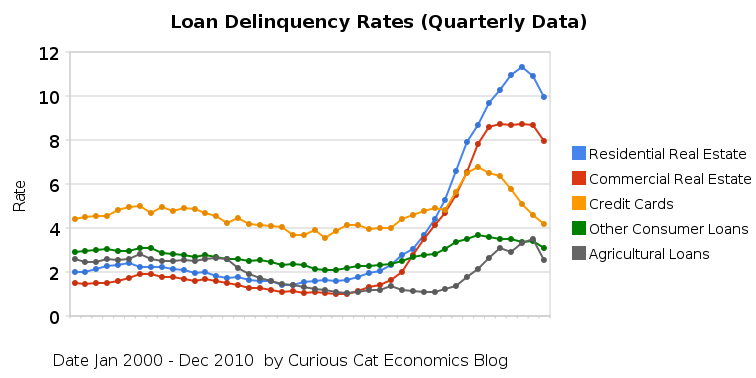
    The chart shows the total percent of delinquent loans by commercial banks in the USA.

    chart showing consumer and real estate loan delinquency rates from 2000 to 2010

    The second half of 2010 saw real estate, agricultural, credit card and other loan delinquencies decrease. The rates are still quite high but at least are moving in the right direction. Residential real estate delinquencies decreased 138 basis points in the second half of 2010, to 9.94%, which brought them to just below the rate at the end of 2009. In the second half of 2010, commercial real estate delinquencies decreased 77 basis points to 7.97% (which was also exactly 77 basis points less than at the end of 2009. Agricultural loan delinquencies decreased 76 basis points, to 2.55% (down 53 basis points from the end of 2009). Consumer loan delinquencies decreased, with credit card delinquencies down 90 basis points to 4.17% and other consumer loan delinquencies down 27 basis points to 3.1%. The credit card delinquency rate decreased a very impressive 219 basis points in 210.

    Related: Real Estate and Consumer Loan Delinquency Rates 2000 through June 2010Real Estate and Consumer Loan Delinquency Rates 1998-2009Bond Rates Remain Low, Little Change in Late 2009posts with charts showing economic data
    (more…)

  • Nuclear Power Production by Country from 1985-2009

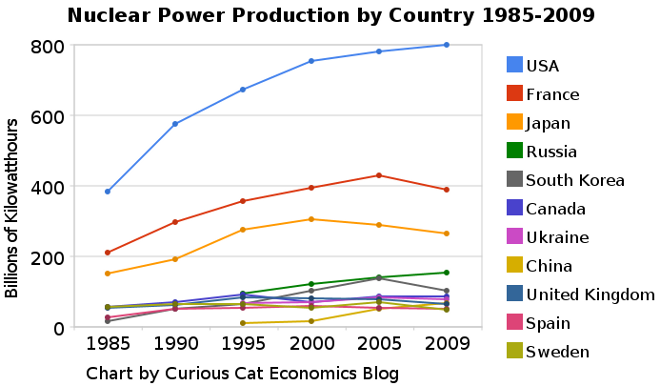
    chart of nuclear power production: 10 largest countries 1985-2009The chart shows the leading nuclear power producing countries from 1985-2009. The chart created by Curious Cat Investing and Economics Blog may be used with attribution. Data from US Department of Energy.

    ___________________

    Nuclear power provided 14% of the world’s electricity in 2009. Wind power capacity increased 170% Worldwide from 2005-2009, to a total of 2% of electricity used (38,025 Megawatts of capacity). The USA produced nearly twice as much electricity using nuclear power than any other country, which surprised me.

    Another view of data on nuclear power shows which of the leading nuclear producing countries have the largest percentages of their electrical generating capacity provided by nuclear power plants (as of 2009). France has 75% of all electricity generated from nuclear power. Ukraine had the second largest percentage at 49%, then Sweden at 37% and South Korea at 35%. Japan is at 28% compared to 20% for the USA (I am surprised these are so close _ would have thought France and Japan would be much closer). Russia is at 18% and China was at just 2%. As of January 2011, 29 countries worldwide are operating 442 nuclear reactors for electricity generation and 65 new nuclear plants are under construction in 15 countries. Source, Nuclear Energy Institute.

    From 1985 to 2009, USA production increased 108%, France 84% and Japan up 77%. South Korea is up 550% (from a very low starting point). Globally nuclear power production increased 80% from 1985 to 2009. From 2000-2009 production increased 5% in the USA and decreased by 1% in France and 13% in Japan. China was up 318% (from a very low level) from 2000-2009 (they did not have nuclear power capacity prior to 1995.

    The global capacity of nuclear power was scheduled to increase more rapidly in the future before the earthquake in Japan and the crisis at the Kashiwazaki-Kariwa Nuclear Power Plant. China was going to add a great deal of capacity and is likely to over the next few years (nuclear power plants take many year to bring online so those coming online in the next few years have already had hundreds of millions invested in building them). Several European countries have already announced temporary closing of some plants (especially some plants nearing the end of their originally scheduled lives – which those countries had been in the process of extending).

    As a comparison global oil production increased by 10.5% from 1999-2009, while nuclear global production increased by 5% from 2000-2009. From 1999-2009 USA oil production decreased 7%. Russia increased production 62% in the decade, moving it into first place ahead of Saudi Arabia that increased production 10%.

    Related: Oil Production by Country 1999-2009Oil Consumption by Country 1990-2009Japan to Add Personal Solar SubsidiesSolar Thermal in Desert, to Beat Coal by 2020

  • Oil Production by Country 1999-2009

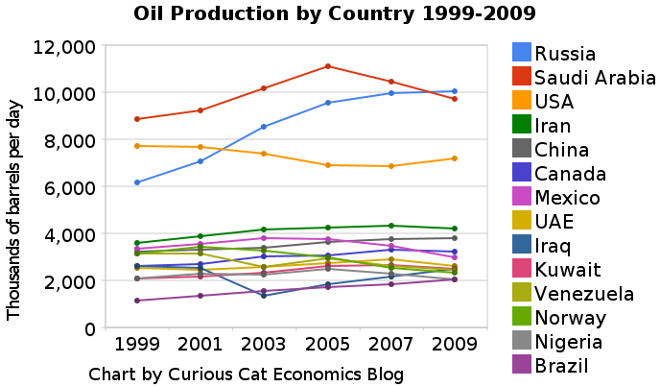
    The chart shows the oil production over the last decade by the top oil producing countries. Production totals include crude oil, shale oil, oil sands and NGLs (the liquid content of natural gas where this is recovered separately). Excludes liquid fuels from other sources such as biomass and coal derivatives.

    chart showing oil production by top producing countries (1999-2009)The chart shows the leading oil producing countries from 1999-2009. The chart created by Curious Cat Investing and Economics Blog may be used with attribution.

    ___________________
    The chart show 3 clear leaders in production Russia, Saudi Arabia and the USA (with the USA firmly in 3rd place). Those 3 were responsible for approximately a third of the total oil production in 2009. Russia greatly increased production. During the last decade world production increased from 72 million barrels a day to 80 million barrels a day. Russia accounted for 51% of the increase, close to 4 million barrels a day.

    The next 11 countries are pretty closely grouped, with slightly increasing production over the period as a group. Brazil, the last country with over 2 million barrels of production a day in 2009, has the largest percentage increase in the period, producing 79% more in 2009 than they did in 1999. Russia increase production 62% over the period. The other countries ranged from a 23% increase (Canada) to a 25% decrease (Norway). The USA increased production 7% and China increased production 18%. World production increased 11%.

    Last year I posted a chart showing oil consumption by the top oil consuming countries over the last 2 decades; showing all countries using over 2 million barrels of oil a day. The USA consumed 18.7 million barrels a day in 2009. Only China was also over 5 million barrels, using 8.2 million in 2009. Japan was next at 4.4 million.
    (more…)

  • USA Added 192,000 Jobs in February

    Nonfarm payroll employment increased by 192,000 in February, and the unemployment rate decreased to 8.9%, the U.S. Bureau of Labor Statistics reported today. Job gains occurred in manufacturing, construction, professional and business services, health care and transportation. Revisions also added 58,000 jobs added in the previous two months. The change in total nonfarm payroll employment for December was revised from +121,000 to +152,000, and the change for January was revised from +36,000 to +63,000.

    The job gains are good news, but job growth has to sustain gains over 175,000 a month for at least 6 months (and gains over 250,000 would be much better) to begin to make a serious dent in the millions of jobs lost in the recession (weather likely restrained January job growth that showed up in the February figures if you take the average for the 2 months you get a gain of 127,500 jobs a month). Since a recent low in February 2010, total payroll employment has grown by 1.3 million, or an average of 106,000 per month. Approximately 125,000 jobs have to be added just to keep up with growth in the population. Until we are consistently adding 230,000+ jobs a months the employment picture is not improving strongly enough given the large number of recent job losses. Adding over 150,000 jobs a month is good, but more is needed to provide jobs for the large number of unemployed.

    The number of long-term unemployed (those jobless for 27 weeks or more) was 6.0 million and accounted for 43.9% of the unemployed. Decreasing the number of long term unemployed is a key measure, as significant gains are made it is a sign pointing to better economic conditions.

    Manufacturing employment rose by 33,000 in February. Almost all of the gain occurred in durable goods industries, including machinery (+9,000) and fabricated metal products (+7,000). Manufacturing has added 195,000 jobs since its most recent trough in December 2009; durable goods manufacturing added 233,000 jobs during this period.

    Construction employment grew by 33,000 in February, following a decline of 22,000 in January that may have reflected severe winter weather. Within construction, specialty trade contractors accounted for the bulk of the February job gain (+28,000).

    Related: USA Economy Adds 151,000 Jobs in October 2010, and Revisions Add 110,000 MoreUSA Unemployment Rate Remains at 9.7% (Feb 2010)USA Unemployment Rate Rises to 8.1% (Feb 2009), Highest Level Since 1983
    (more…)
  • USA Spends Record $2.5 Trillion, $8,086 per person 17.6% of GDP on Health Care in 2009

    U.S. health care spending increased yet again in 2009, increasing 4%. Total health expenditures reached $2.5 trillion, which translates to $8,086 per person or 17.6% of the nation’s Gross Domestic Product (GDP). This represents yet another record high percentage of GDP taken by health care – for decades, year after year, health care takes more and more of the economic resources of the country. The broken USA health care system costs twice as much as other rich countries for worse results. And those are just the direct accounting costs – not the costs of millions without preventative health care, sleepness nights worrying about caring for sick children without health coverage, millions of hours spent on completing forms to try and comply with the requirements of the health care system’s endless demand for paperwork, lives crippled by health care bankruptcies…

    Medicare spending grew 7.9% in 2009 to $502.3 billion. The senior citizen and health care lobbies have continued to increase spending on medicare. Too bad they can’t work on improvement instead of increased spending. Spending for fee-for-service (FFS) Medicare accelerated in 2009, increasing 5.5%. Medicare Advantage (MA) spending increased 15.8% in 2009 following 21.4% growth in 2008 and was primarily attributable to a continuation of significant increases in MA enrollment. Total Part D spending (which includes spending for benefits, government administration, and the net cost of health insurance) increased 9.3% to $54.5 billion in 2009.

    Medicaid (which is a line item for the cost of medical treatment for the un-insured, though far from the only cost): Total Medicaid spending grew 9.0% in 2009 to $373.9 billion was driven by a 7.4% increase in Medicaid enrollment. Federal Medicaid expenditures increased 22%, while state Medicaid expenditures declined 9.8%. This difference in growth is due to a significant increase in the Federal Medical Assistance Percentages (FMAP) used to determine federal Medicaid payments to states—a provision of the American Recovery and Reinvestment Act of 2009 (ARRA). Essentially the federal government funded the spending since the states were almost all out of money.

    Private Health Insurance: Private health insurance premiums grew 1.3% in 2009 (actually a pretty great figure by itself – unfortunately one lone good piece of data is not enough). Benefit payment growth increased 2.8% in 2009. These trends were heavily influenced by the recession, which resulted in private health insurance enrollment declines (which reminds you why looking at 1 piece of data isn’t a good idea). In 2009, spending for benefits increased faster than premiums, and as a result, the net cost of private health insurance (or the difference between premiums and benefits) fell to an 11.1% share of total private health insurance spending.

    The burden of the large costs of the health care system in the USA are financed by businesses (21%), households (28%), governments (44%), and other private sponsors [foundations, charities and the like] (7%).

    Read the complete National Health Expenditure Data report.

    Related: USA Spends Record $2.3 trillion ($7,681 Per Person) on Health Care in 2008USA Heath Care System Needs ReformResources to Help Improve the Health Care SystemCEOs Want Health-Care Reform

  • China Grows GDP 10.3% in 2010

    China’s GDP grew 10.3% in 2010, 9.8% in the 4th quarter. China’s economy grew 9.2% in 2009. China likely became the 2nd largest economy in 2010, surpassing Japan. Inflation continues to be a worry with consumer inflation standing at 4.6% and producer inflation standing at 5.9%. Excessive real estate investing (pushing up prices and leading to what many see as overbuilding) also continues to be a worry that is growing.

    China quarterly growth surges, inflation eases

    industrial production grew 13.5% in December from a year earlier, up from a 13.3% rise in the prior month. Lu said industrial-production growth figures were among the most important of Thursday’s data batch, as it was barometer of the strength of underlying capital spending.

    “We expect GDP growth in year-on-year terms to moderate a bit from here,” Lu said. Tighter monetary conditions should see some easing in growth this year, forecasting full year growth expected at 9% and consumer inflation of 4%, according to Merrill’s estimates.

    RBC revised its outlook for China’s growth this year to 9.5% from 8.8%, after trade data earlier this month showed imports and exports at record levels.

    Related: China GDP up 8.7% in 2009Rodgers on the US and Chinese Economies (2008)

  • Top 15 Manufacturing Countries in 2009

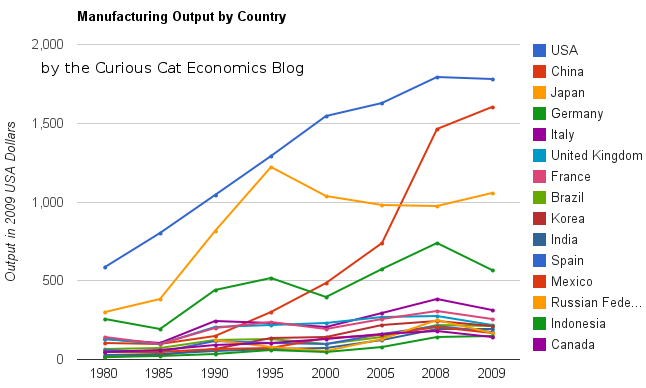
    China continues to grow manufacturing is output. In 2009, the USA, and most countries saw declines in manufacturing production. China, however, continued to grow. China is now finally approaching the level of manufacturing done in USA. The latest data again shows the USA is the largest manufacturer but China looks poised to take over the number one spot soon.

    chart of manufacturing production by leading manufacturing countries
    The chart showing manufacturing output by country was created by the Curious Cat Economics Blog based on UN data (in 2009 USA dollars). You may use the chart with attribution.

    The large decline in Germany was 23%. This was a 18% decline in Euro terms, and when you added the decline of the Euro the total USA dollar decline was 23%. Quite extraordinary. Most European countries were down over 15%. In fact, so extraordinary it makes me question the data. World economic data is useful and interesting but it isn’t perfect. USA manufacturing declined just .5%. China increased manufacturing production by 9%.

    The last 2 years, China has stopped separating out mining and utilities from manufacturing. The percentage of manufacturing (to manufacturing, mining and utilities) was 78% for 2005-2007 (I used 78% of the manufacturing, mining and utilities figure provided in the 2008 and 2009 data – but that could be wrong). The unadjusted 2009 China total was $2.05 trillion and for the USA the total manufacturing, mining and utilities was $2.33 trillion. In 2009, the manufacturing total was 76% of USA manufacturing, mining and utilities. The percentage varies significantly between countries (the Russian federation is about 55% and Japan about 91%) and various over time as a countries economy changes.

    The big, long term story remains the same. China has continued to grow manufacturing output tremendously. I see very little data to support the stories about manufacturing having to leave China to go elsewhere (especially when you look at the “lower wages” counties mentioned in news stories – they are not growing at any significant rate). The USA is still manufacturing a huge amount and that production has steadily grown over time.

    When you look back over the period from 1980 to today you can see

    1. The biggest story is the growth in Chinese manufacturing
    2. The USA started out the largest and has grown significantly
    3. Japan did very well from 1980 to 1995, and since they have struggled
    4. The USA, China, Japan are really far ahead of other countries in total manufacturing output, and Germany is solidly in 4th place.
    5. After that the countries are fairly closely grouped together. Though there are significant trends hidden by the scale of this graph, which I will explore in future posts. South Korea has growth significantly over this period, for example.
    6. The biggest macro trend that the data shows, but is not so visible in this chart (other than China’s growth), is the very strong performance of emerging markets (and in fact some counties have fully become manufacturing powerhouses during this period, most notably China but also, South Korea and Brazil). And I see that continuing going forward (though that is speculation).

    Two more interesting pieces of data. Italy is the 5th largest manufacturing country, I don’t think many people would guess that. Since 1980 Italy surpassed the UK and France but China rocketed passed them. And Indonesia has moved into 14th place, edging out Canada in 2009.

    I plan to take more time in 2011 to look at global manufacturing and other global economic data more closely and to write about it here.

    Related: Data on the Largest Manufacturing Countries in 2008Top 12 Manufacturing Countries in 2007Top 10 Manufacturing Countries 2006Leading global manufacturers in 2004

  • USA Unemployment Rate Rises to 9.8%

    The unemployment rate grew to 9.8% in November, and nonfarm payroll employment increased by 39,000 (less than the expected 150,000), the U.S. Bureau of Labor Statistics reported today. Temporary help services and health care continued to add jobs over the month, while employment fell in retail trade. The change in total nonfarm payroll employment for September was revised from -41,000 to -24,000, and the change for October was revised from +151,000 to +172,000.

    The unemployment rate has now remained above 9% for more consecutive months since data has been gathered since 1940.

    There are now 15.1 million unemployed in the USA. Among the major worker groups, the unemployment rates for adult men (10.0 %), adult women (8.4%), and teenagers (24.6%).

    The number of long-term unemployed (those jobless for 27 weeks and over) was little changed at 6.3 million and accounted for 41.9%. The number of persons employed part time for economic reasons (sometimes referred to as involuntary part-time workers) was little changed over the month at 9.0 million. These individuals were working part time because their hours had been cut back or because they were unable to find a full-time job.

    Among the marginally attached, there were 1.3 million discouraged workers in November, an increase of 421,000 from a year earlier. (The data are not seasonally adjusted.) Discouraged workers are persons not currently looking for work because they believe no jobs are available for them. The remaining 1.2 million persons marginally attached to the labor force had not searched for work in the 4 weeks preceding the survey for reasons such as school attendance or family responsibilities.

    Total nonfarm payroll employment changed little in November (+39,000). Job gains continued in temporary help services and in health care, while employment fell in retail trade. Since December 2009, total payroll employment has increased by an average of 86,000 per month.

    Within professional and business services, employment in temporary help services continued to increase in November (+40,000) and has risen by 494,000 since September 2009.

    Related: USA Economy Adds 151,000 Jobs in October and Revisions Add 110,000 MoreOver 500,000 Jobs Disappeared in November, 2008Manufacturing Employment Data – 1979 to 2007
    (more…)

  • Consumer Debt Down, but Still Over $2.4 Tillion in the USA

    Consumers debt decreasing very slowly. In the 3rd quarter it decreased at an annual rate of 1.5%, after decreasing at a 3.25% rate in the second quarter. Revolving credit (credit card debt) decreased at an annual rate of 8.5% (compared to 9.5% in the second quarter), and nonrevolving credit (car loans…, not including mortgages) was up 2.5% (versus essentially unchanged).

    Revolving consumer debt now stands at $814 billion down $52 billion this year. That is on top of a $92 decline in 2009. Hopefully we can increase the size of the decrease going forward. As individuals we should aim to have no consumer debt and build up cash reserves instead (the way the debt figures are calculated though, even if you don’t really have any debt, say you pay off your credit card bill each month, I believe your balance is still seen as “debt”, it is credit extended to you).

    On September 30, 2010 total outstanding consumer debt was $2,411 billion (a decline of just $8 billion in the 3rd quarter, after a decline of $21 billion in the 2nd quarter). This still leaves over $8,000 in consumer debt for every person in the USA and $20,000 per family.

    Consumer debt grew by about $100 billion each year from 2004 through 2007. In 2009 consumer debt declined over $100 billion: from $2,561 billion to $2,449 billion. For the first 3 quarters of 2010 it has declined just $38 billion.

    The huge amount of outstanding consumer and government debt remains a burden for the economy. At least some progress is being made to decrease consumer debt. Credit card delinquency rates have actually been decreasing the last couple of year (from a high of 6.75% in the 2nd quarter of 2009 to 5% in the 2nd quarter of 2010 (I would guesstimate the average for the decade was 4.5%).

    Those living in USA have consumed far more than they have produced for decades. That is not sustainable. You don’t fix this problem by encouraging more spending and borrowing: either by the government or by consumers. The long term problem for the USA economy is that people have consuming more than they have been producing.

    We can’t afford to seek even more short term spending powered by more debt. Government debt has been exploding so unfortunately that problem has continued to get worse.

    Data from the federal reserve.

    Related: Consumers Continue to Slowly Reduce Their Debt LevelThe USA Economy Needs to Reduce Personal and Government DebtConsumer debt needs to decline much more.

  • USA Economy Adds 151,000 Jobs in October and Revisions Add 110,000 More

    Nonfarm payroll employment increased by 151,000 in October, and the unemployment rate was unchanged at 9.6%, the U.S. Bureau of Labor Statistics reported today. Since December 2009, nonfarm payroll employment has risen by 874,000.

    The BLS also increased previous estimates by 110,000 jobs in adjustments to August and September. The change in total nonfarm payroll employment for August was revised from -57,000 to -1,000, and the change for September was revised from -95,000 to -41,000.

    Adding 151,000 jobs last month (especially with a revision that adds 110,000to our previous estimates) is good news but not great news. We really need to be adding at least 250,000 and hopefully 400,000 for many months in a row. Both to keep up with population growth and restore some of the 8 million job losses from the credit crisis recession. The fears of a depression that some had a few years ago though are decreasing as we provide slow but real growth. However those gains are far from certain to continue, but overall things look much better than than did 2 years ago.

    In November of 2008 the economy lost over 500,000 Jobs and in October 2009 the unemployment Rate Reached 10.2%.

    The number of unemployed persons, at 14.8 million, was little changed in October. Among the major worker groups, the unemployment rate for adult men (9.7%), adult women (8.1%), teenagers (27.1%). The number of long-term unemployed (those jobless for 27 weeks and over) was about unchanged over the month at 6.2 million.

    Both the civilian labor force participation rate, at 64.5 percent, and the employment-population ratio, at 58.3 percent, edged down over the month.

    About 2.6 million persons were marginally attached to the labor force in October, up from 2.4 million a year earlier. (The data are not seasonally adjusted.) These individuals were not in the labor force, wanted and were available for work, and had looked for a job sometime in the prior 12 months. They were not counted as unemployed because they had not searched for work in the 4 weeks preceding the survey.
    (more…)