Tag: Economics

  • Can Bankers Avoid Taking Responsibility Again?

    Banks continue to pay our politicians well to make sure they continue doling out special favors to the large banks. It is up to you, and your neighbors whether you hold politicians accountable for the actions they took to create the climate for the credit crisis and the huge favors granted (with your money) by politicians to those investment bankers. The bankers count on their money buying the politicians. I would have to say they are smart to believe that, though there is a small chance the invulnerability they feel is possible to pierce with enough foolish moves by the bankers and their friends (but in order for that to happen people would have to actually vote to elect ethical, intelligent and patriotic politicians instead of those who play the public for fools). I would put my money on the public again using their votes to elect those that will enrich special interests that pay the politicians at the expense of the country.

    Banks Say No. Too Bad Taxpayers Can’t

    Fannie and Freddie helped grease the nation’s housing machinery before and during the boom years, scooping up loans from all corners of the country. The more of these that Fannie and Freddie bought, the easier it was for banks to write new mortgages.

    To protect themselves from getting piles of garbage loans shoveled their way when they buy mortgages, Fannie and Freddie require lenders or loan servicers to sign contracts requiring those firms to repurchase loans that don’t meet certain standards relating to borrower incomes, job status or assets. Loans that were extended fraudulently, or deemed to have been predatory, are also candidates for buybacks.

    Surprise, surprise: banks don’t want to repurchase these loans. So when Fannie or Freddie identify problem mortgages and request repayment, a battle royal begins. Banks may argue, for example, that the repayment requests have flaws of their own.

    But for us as taxpayers, watching this battle from the sidelines, one growing concern is how aggressively Fannie and Freddie will pursue their requests. If banks refuse to buy back flawed loans, taxpayers will have to cover more of the losses.

    According to March 31 figures from Freddie, for instance, the amount of problem loans that it has asked other firms to buy back stood at $4.8 billion — up 26 percent from $3.8 billion just three months earlier.

    Banks have been unwilling to mark all of the bad loans they have and mortgage securities they hold to their true values because that would require a loss,” said Kurt Eggert, a professor at the Chapman University School of Law. “But this is about banks trying to avoid losses and having the taxpayers absorb them.”

    Michael Cosgrove, a Freddie spokesman, said that the company is aggressive about enforcing its right to recover on questionable loans because it has a duty to be a good steward of taxpayer dollars. “These reviews are more important than ever; there is no reason why taxpayers should pay for decisions that led to the sale of bad loans to Freddie Mac,” he said.

    $4.8 billion? That seems amazingly low for all the fraudulent activity these banks are suppose to have engaged in. But so long as they can foist the problem loans into the taxpayers hands they can claim to deserve billions in bonuses for themselves. The staggering magnitude of the special favors bought by the bankers is amazing. The politicians have shown they are supporting their banking friends while saying a few tough words. And most likely the politicians and bankers will be celebrating another successful election this fall. If we want to change the outcome we can. But we don’t seem interested in doing so.

    Related: Paying Back Direct Cash from Taxpayers Does not Excuse Bank MisdeedsThe Best Way to Rob a Bank is as An Executive at OneSabotaging Regulated Financial Markets Leads to Predictable ConsequencesCongress Eases Bank Laws – 1999

  • Fiscal Irresponsibility Results from Financial Illiteracy

    Failing to pay for the deferred costs of current expenditures gets all those practicing credit card budget thinking in trouble. That includes lots of individuals. But it also includes many governments. They pay huge rewards to special interests and act like they think the cost doesn’t exist. Only an extremely financially illiterate society could elect so many of these people. We have not learned that in the modern financial economies financial illiteracy is a huge societal problem (along with scientific illiteracy).

    Padded Pensions Add to New York Fiscal Woes

    In Yonkers, more than 100 retired police officers and firefighters are collecting pensions greater than their pay when they were working. One of the youngest, Hugo Tassone, retired at 44 with a base pay of about $74,000 a year. His pension is now $101,333 a year.

    Such poor financial management by public sector organization (California is horrible also) are causing huge damage to those living in such poorly managed states.

    the cost of public pensions has been systemically underestimated nationwide for more than two decades, say some analysts. By these estimates, state and local officials have promised $5 trillion worth of benefits while thinking they were committing taxpayers to roughly half that amount.

    The use of public money for outsize retirement pay really stings when budgets don’t balance, teachers are being laid off, furloughs are being planned

    Roughly one of every 250 retired public workers in New York is collecting a six-figure pension, and that group is expected to grow rapidly in coming years, based on the number of highly paid people in the pipeline.

    Thirteen New York City police officers recently retired at age 40 with pensions above $100,000 a year; nine did so in their 30s.

    Before Yonkers adopted a richer pension formula for police in 2000, for instance, it was told the maximum cost would be $1.3 million a year. But instead, the yearly cost is now $3.75 million and rising. David Simpson, a spokesman for the mayor of Yonkers, said pension cost projections were “often lowballs,” so the city could get stuck. “Once you give something, you can’t take it away,” he said.

    It isn’t complicated. So long as you elect people that are financial illiterate and only care about granting favors to special interests, not the consequences of doing so, you are setting yourself up for a great deal of pain once your credit card bill comes due.

    Related: NY State Raises Pension Age to Save $48 BillionCharge It to My KidsBogle on the Retirement CrisisPoliticians Again Raising Taxes On Your Children

  • Charlie Munger’s Thoughts on the Credit Crisis and Risk

    Charlie Munger’s Thoughts on Just About Everything by Morgan Housel

    The academic elites failed us with their utterly asinine ideas of risk control. It was grounded on the idea that all risk took Gaussian distributions, which is just totally wrong. Very high IQ people can be completely useless. And many of them are.

    Benjamin Graham used to say, “It’s not the bad investment ideas that fail; it’s the good ideas that get pushed into excess.” And that’s a lot of what happened here.

    Some economic distortions come from the masses believing that other people are right. Others come from the need to make a living through behavior that may be less than socially desirable. I’ve always been skeptical of conventional wisdom. You have to be able to keep your head on when everyone else is losing theirs.

    Take soccer as an example. It’s a tremendously competitive sport, and often times one team tries to work mayhem on the other team’s best player. The referee’s job is to limit this mayhem and rein in extreme forms of competition.

    Regulation is similar. Most ambitious young men will be more aggressive than they should. That’s what happened with investment banking. I mean, look at Lehman Brothers. Everyone did what they damn well wanted until the whole place was pathological about its extremeness.

    A lot of this [financial collapse] can be blamed on accountants. Accountants as a whole have been trained with too much math and not enough horse sense. If some of these insane accounting practices were never allowed, huge messes could have been avoided. Bankers have become quite good at manipulating accountants

    Learning has never been work for me. It’s play. I was born innately curious. If that doesn’t work for you, figure out your own damn system.

    More good thoughts from Warren Buffett’s partner at Berkshire Hathaway.

    Related: Buffett and Munger’s 2009 Q&A With ShareholdersBerkshire Hathaway Annual Meeting 2008Misuse of Statistics, Mania in Financial MarketsLeverage, Complex Deals and Mania

  • Is the Euro Going to Survive in the Long Run?

    To me, the prospects of a Euro currency surviving over the long term were not helped this week. The markets have behaved as though some great solutions have been adopted but it seems to me the fundamental problems if anything are worse now. It is true the short term is more stable. But at what cost?

    Bailout Is ‘Nail in the Coffin’ for Euro, Rogers Says

    The 16-nation currency weakened for a second day against the dollar after rallying as much as 2.7 percent on May 10, when the governments of the 16 euro nations agreed to make loans of as much as 750 billion euros ($962 billion) available to countries under attack from speculators and the European Central Bank pledged to intervene in government securities markets.

    “I was stunned,” Rogers, chairman of Rogers Holdings, said in a Bloomberg Television interview in Singapore. “This means that they’ve given up on the euro, they don’t particularly care if they have a sound currency, you have all these countries spending money they don’t have and it’s now going to continue.”

    “It’s a political currency and nobody is minding the economics behind the necessities to have a strong currency,” Rogers said. “I’m afraid it’s going to dissolve. They’re throwing more money at the problem and it’s going to make things worse down the road.”

    This makes sense to me. The problems with the Euro also explain why the dollar hasn’t fallen more over the last few years. The only significant alternative is the Yen. The BRIC countries (Brazil, Russia, India and China) are looking to increase the profile of their currencies supposedly – or even forming their version of the Euro (I can’t see how that could happen).

    Greece’s budget deficit of 13.6 percent of gross domestic product is the second-highest in the euro zone after Ireland’s 14.3 percent. As part of the bailout plan, Spain and Portugal also pledged deeper deficit reductions than previously planned.

    [Rogers suggests] Investors should instead buy precious metals including gold or currencies of countries that have large natural resources, Rogers said. Among other asset classes, he favors agricultural commodities as the best bet for the next decade as well as silver because prices haven’t rallied.

    It is very difficult for the politicians in the USA, United Kingdom and other countries to behave fiscally responsible when their taxpayers will eventually have to pay the bill. When you can hope to have others bail you out it seems that much less likely people will behave responsibly. Then again I was skeptical the Euro would be created without first having more consolidation of European governments. There are lots of good things about having the Euro, but in the long run there are very challenging issues to deal with.

    Related: Jim Rogers on the Financial Market MessWhy the Dollar is FallingA Bull on China

  • Middle Class Families from 1970-2005

    As I have said before, Elizabeth Warren is one of the people I find most informative on the economy we have created. This lecture (from January 31, 2008) is very interesting: The Coming Collapse of the Middle Class: higher risks, lower rewards and a shrinking safety net. It is important for us to realize that the decisions we make have consequences. If we allow corruption to grow and grow in the USA we will suffer more and more. If we continue to elect people that give away society wealth to those the pay them to the detriment of society (investment banks, drug companies, “intellectual property” lawyers, retail banks, farmers, trial lawyers, hedge fund managers, trust fund babies, physicians…) that naturally means their is less wealth for the rest of society.

    Interesting data. Looking at standard family (Mom, Dad and 2 kids from 1970 to 2005), in inflation adjusted dollars: earnings increased a great deal (due to women working much more) but disposable income decreased. This is because basic expenses increased: health care, housing, transportation… (and this is with assuming employer provided health care – which has really been decreasing in likelihood over time). Those families are also more deeply in debt and reliant on 2 incomes. And if either income producer losses their jobs the economics of the family fail. Which means the family is much more at risk.

    It really is great that lectures like this are available to us now.

    Related: Elizabeth Warren Webcast On Failure to Fix the SystemIn the USA 43% Have Less Than $10,000 in Retirement SavingsFailure to Regulate Financial Markets Leads to Predictable ConsequencesLobbyists Keep Tax Off Billion Dollar Private Equities Deals and On For Our Grandchildren

  • Government Debt, Greece is a Very Small Part of the Problem

    Roubini Says Rising Sovereign Debt Leads to Inflation, Defaults

    Credit-rating cuts on Greece, Portugal and Spain this week are spurring investors’ concern that the European deficit crisis is spreading and intensifying pressure on policy makers to widen a bailout package. Roubini’s remarks underscore statements by officials such as Dominique Strauss-Kahn, managing director of the IMF, that the global economy still faces risks.

    “The thing I worry about is the buildup of sovereign debt,” said Roubini

    If the problem isn’t addressed, he said, nations will either fail to meet obligations or experience higher inflation as officials “monetize” their debts, or print money to tackle the shortfalls.

    “While today markets are worried about Greece, Greece is just the tip of the iceberg, or the canary in the coal mine for a much broader range of fiscal problems,”

    Greece “could eventually be forced to get out” of the 16- nation euro region, he said in a Bloomberg Television interview yesterday. That would lead to a decline in the euro and make it “less of a liquid currency,” he said. While a smaller euro zone “makes sense,” he said, “it could be very messy.”

    [Roubini supports] a carbon tax on gasoline, with Roubini saying it would reduce American dependence on oil from overseas, shrink the trade deficit and carbon emissions, and help pay down the U.S. budget deficit.

    I agree that the damage done by those (which is nearly all of them) countries living beyond their means is significant. The USA and many countries in Europe and Asia (South Korea and China are two exceptions) have raised taxes on the future (by default – spending more than you have necessarily increases taxes later) to consume today. The strong emerging markets are another exception, many having learned their lessons and stopped spending money they didn’t have in the 1990’s.

    However the richest countries have been spending money they don’t have for decades and the increase in government debt as a portion of GDP is an increasingly serious problem. It would be nice if the government of the rich countries could behave responsibly but it does not look like many of them have citizens who will elect honest and competent leaders. As long as they elect leaders that insist on raising taxes on the future (and lying to the populace by claiming they cut taxes – because they eliminate taxes today) those countries will pay severely for the irresponsible spending.

    Saying you cut taxes when you just delay them is equivalent to saying I paid off my credit card bill when all I did was get 2 new credit cards, borrow all the money I owed on my original card, pay that one off, and then borrow more to increase my debt even more. Yes it is true I did pay off my original credit card, but that is hardly the salient point. My credit card debt increase. All that has happened in the USA since the Clinton administration had a balanced budget is politicians used a credit card thinking to lower taxes while necessarily increasing them in the future. You don’t reduce debt by spending money you don’t have.
    (more…)

  • Taxes – Slightly or Steeply Progressive?

    The Wall Street Journal wrote “Their Fair Share” in July of 2008 claiming that the rich are paying their fair share of taxes.

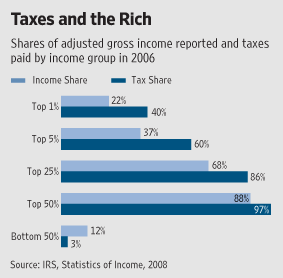
    The nearby chart shows that the top 1% of taxpayers, those who earn above $388,806, paid 40% of all income taxes in 2006, the highest share in at least 40 years. The top 10% in income, those earning more than $108,904, paid 71%. Barack Obama says he’s going to cut taxes for those at the bottom, but that’s also going to be a challenge because Americans with an income below the median paid a record low 2.9% of all income taxes, while the top 50% paid 97.1%. Perhaps he thinks half the country should pay all the taxes to support the other half.

    Wow. The Wall Street Journal against a tax cut? Well I guess if it is a tax on the poor they don’t support cutting those taxes. I think it may well make sense to reduce the social security and medicare taxes on the working poor (including the company share). Of all the taxes we have this is the one I would reduce, if I reduced any (given the huge amount of government debt any reduction may well be unwise). But reducing income taxes for those under the median income doesn’t seem like something worth doing to me.

    The top 1% earned 22% of all reported income. But they also paid a share of taxes not far from double their share of income. In other words, the tax code is already steeply progressive.

    chart of taxes by income distribution

    They seem to ignore that income inequality has drastically increased. When you have a system that puts a huge percentage of the cash in a few people’s pockets of course those people end up paying a lot of cash per person. One affect of massive wealth concentration is that the limited people all the money is flowing to naturally will pay an increasing portion of taxes.

    It is fine to argue that the rich pay too much tax, if you want. I don’t agree. I think Warren Buffett explains the issue much more clearly and truthfully when he says he, and all his fellow, billionaires (and those attempting to join the club) pay a lower percent of taxes on income than their secretaries do. He offers $1 million to any of them that prove that isn’t true.

    And I guess you can say that the top 22% of the income paying the top 40% of the taxes is “steeply progressive.” I wouldn’t call that steep, but… It is nice the graphic is at least decently honest. Saying just “top 1% of taxpayers, those who earn above $388,806, paid 40% of all income ” is fairly misleading. It is much more honest (I believe) to say that “the top 1% (that made 22% of the income) paid…” Those with the top 22% of income paid 40% of the taxes, the next 15% payed 20%, the next 31% paid 26% the next 20% 11% and the final 12% paid 3%. That is progressive. From my perspective it could be more progressive but I can see others saying it it progressive enough.

    If 22% to 40% is “steeply” progressive what is 1% to 22%? The income distribution seems to be what? very hugely massively almost asymptotently progressive? The to 1% of people, by income, take 22% of the income, the next 4% take the next 15% of the total income, the next 20% take 31%, the next 25% take 30% and the bottom 50% take 12%. This level of income inequality is much more a source of concern than any concern someone should have about a slightly progressive tax result.

    Related: House Votes to Restore Partial Estate Tax on the Very Richest: Over $7 MillionIRS Tax dataRich Americans Sue to Keep Evidence of Their Tax Evasion From the Justice Department
    (more…)

  • Curious Cat Investing and Economics Carnival #8

    The Curious Cat Investing and Economics Carnival highlight recent interesting personal finance, investing and economics blog posts.

    • The money made by Microsoft, Apple and Google, 1985 until today – “In terms of profit Apple was ahead of Microsoft in the 1980s, but was then passed and left behind. This chart actually reveals that Apple’s upswing the last few years is the first time the company’s profits have really taken off in a big way. Another interesting observation is how closely the profits of Apple and Google match, even though Apple’s revenues are significantly higher.”
    • Real Estate and Consumer Loan Delinquency Rates 1998-2009 by John Hunter – “That last half of 2009 saw residential real estate delinquencies increased 143 basis points to 10.14% and commercial real estate delinquencies increase 98 basis points to 8.81%. Consumer loan delinquencies decreased with credit card delinquencies down 18 basis points to 6.4% and other consumer loan delinquencies down 19 basis points to 3.49%.”
    • The Principle That Can Make You Rich or Keep You Broke by David Weliver – “Unfortunately, inertia can also keep us at rest; the same principle that helps us achieve positive goals can make it increasingly difficult to escape bad habits.” (John: Very true, see my post on habits).
    • Why do we work so much? – “The countries that consistently rank as having the world’s “happiest people” also tend to work fewer hours than people in the U.S… Most corporate ladders are designed to reward employees with money instead of time. Assuming we only want money to use as a tool for happiness, this makes no sense.”
    • How Does Apple Become a $300 Billion Company? by Eric Bleeker – “The more Apple can look like the Microsoft of the mobile world, the more it will be worth. Commanding a market with even half the dominance Microsoft did with operating systems is a once-in-a-generation opportunity, but I’m not so sure the mobile world is built in a way that’ll allow that.”
    • Top Fed Official Wants To Break Up Megabanks, Stop The Fed From Guaranteeing Wall Street’s Profits by Shahien Nasiripour – “I don’t think we have any business guaranteeing Wall Street spreads,” Hoenig said. “We need to recognize that and address it by removing these guaranteed extremely low rates. I think it’s extremely important that we do that, and not create the conditions for speculative activity and a new crisis down the road.”
    • Evaluating Microfinance by Michael Frank – “I decided to use a variation on the “waiting list-control group” method regularly used in medical studies. My evaluation design requires a call for loan applicants in the most similar nearby community that does not have a similar microfinance program already present.”
    • (more…)

  • Making Debt Holders into Unpaid Regulators

    The credit crisis has shown the lack of political (or regulatory) skill, ethics and character that the USA has now. The solutions are not simple. Some are obvious, like limiting leverage, not providing huge favors to those that pay politicians huge amounts of cash… While Canadian banking regulators actually did their jobs well it is hard to believe most any American regulators will do well given the last 20 years of failures. Raghuram Rajan provides some interesting thoughts on potential improvement in: Making Debt Holders into Watchdogs

    The type of risks that put banks in the greatest jeopardy – and led to the recent crisis – are called tail risks. They have a small probability of turning out badly but are extremely costly if they do. Banks took on two kinds of tail risks prior to the crisis. One was economywide default risk, the risk that a broad portfolio of assets, such as mortgages, would suffer deep losses. The other was liquidity risk, essentially the way they financed the first kind of risk.

    Some banks – such as Citibank, Lehman Brothers, and Royal Bank of Scotland – loaded up on both risks, holding enormous quantities of mortgage-backed securities on the asset side and paying for them with short maturity debt on the liability side. Why did they do it? The simple answer: It was very profitable, provided the tail events did not materialize. Think of insurers that write a lot of earthquake policies (another tail risk). If you didn’t know they were writing earthquake insurance and not setting aside reserves, you would think they were enormously profitable until there’s a quake. For banks, there was always the threat of a day of reckoning when liquidity dried up and defaults skyrocketed. But they set aside few reserves against that happening.

    Particularly worrisome, as my colleague Douglas Diamond and I have argued, is that once banks are leveraged enough that they will be severely distressed if economywide liquidity dries up, they double down on risky bets.

    Here’s the drill: To make it harder for tail-risk-taking banks to grow, all banks should be required to issue a minimum level of debt (say, 10% of assets) that is automatically impaired – either converted to equity or written down – if the bank suffers sufficient losses. This will quickly change debt holders’ views on risky expansion. Moreover, no financial institution should be allowed to hold this debt.

    Related: Why Congress Won’t Investigate Wall StreetScientists Say Biotechnology Seed Companies Prevent ResearchDrug Prices in the USA

  • Paying Back Direct Cash from Taxpayers Does not Excuse Bank Misdeeds

    Many people are ignoring huge costs (to the economy) and benefits (to those financial companies that ruined so many people’s lives and severely damaged the economy. Paying back money the government paid you is not that same as being innocent. While several of the too big to fail banks have paid back the direct cash they were given that is not an indication they are now off the hook for their disastrous behavior.

    First we know that much of the money “sent to AIG” just went directly to Goldman Sachs and others. Those big banks had taken risks and the only way those risks paid off was with billions from taxpayers. Without that they would have been bankrupt. And then when they paid the money they received directly they still haven’t paid back the billions they got from taxpayers (via AIG). And this money was paid back at 100 cents on the dollar though those instruments were trading for much less in the market (the government certainly would have found a less costly solution but for ignorance or a desire to reward their former company and friends at Goldman Sachs.

    Second, rates have been kept artificially low, to among other things, allow the big banks to make tens of billions (and costing savers tens of billions). Those savers have not been reimbursed for the losses caused by the big banks.

    And third if I gamble with money from my company and win my bet on the Super Bowl and then put the money back, I am still not innocent. Just because many of the big banks have paid back the money they were given directly by taxpayers does not mean they didn’t get huge benefits from the government. Pretending they are not bad guys because after ruining the economy, costing millions of people their jobs and savings, getting many benefits from the government, they then pay back the direct cash payments is not accurate.

    Response to: The New Bank Tax

    Related: Elizabeth Warren Webcast On Failure to Fix the SystemThe Best Way to Rob a Bank is as An Executive at OneFailure to Regulate Financial Markets Leads to Predictable ConsequencesJim Rogers on the Financial Market MessCongress Eases Bank Laws (1999)