Tag: Economics

  • Curious Cat Investing, Economics and Personal Finance Carnival #19

    Welcome to the Curious Cat Investing and Economics Carnival: find useful recent personal finance, investing and economics blog posts and articles.

  • How Economic Inequality Harms Societies

    The increases in income inequality creates problems and increases serious risks. Some people have a political ideology that drives their thoughts on any economic policy. I instead, look to economic issues if they benefit society. The reason capitalism is great is because society benefits. The policies that create huge income inequality are bad for society and should be changed.

    Sadly the strong support for policies to elevate trust fund babies in the USA have created a society where economic wealth in the USA is now greatly defined by how rich your parents are instead of your ability and effort. The USA used to have great social mobility now we have changed society to become more like feudal Europe, while Scandinavia has become more like the USA used to be for social mobility.

    Related: Economic Fault, Income InequalityMiddle Class Families from 1970-2005Income Inequality in the USA (2006)The Widening “Marriage Gap” is Breeding Income Inequality

  • Curious Cat Investing, Economics and Personal Finance Carnival #18

    Welcome to the Curious Cat Investing, Economics and Personal Finance Carnival: find useful recent personal finance, investing and economics blog posts and articles. If you want to have an post considered for the next carnival please submit it to quixperito: money.

    • How I live on $7,000 per year by Jacob Lund Fisker – “If I had to venture a guess, I’d say I’m more frugal (the way your grandparents were frugal—in fact what I do wouldn’t be considered very extreme by your grandparents or great grandparents—I’d probably be average from their perspective) and I adhere more to a do-it-your-self ethics.”
    • Invest in Communities to Advance Capitalism by Howard Schultz (CEO of Starbucks) – “It is no longer enough to serve customers, employees, and shareholders. As corporate citizens of the world, it is our responsibility — our duty — to serve the communities where we do business by helping to improve, for example, the quality of citizens’ education, employment, health care, safety, and overall daily life, plus future prospects.” [similar to Dr. Deming ideas from decades ago on the purpose of organizations, which I share – John].
    • My dad taught me cashflow with a soda machine by Rob Fitzpatrick – “The vending machine didn’t magically make me want to be an entrepreneur. I wanted to be a video game designer, then an engineer, then a video game designer again, and then an academic. I get the impression kids are a bit slippery in that regard.
      But when I stumbled into the startup world two decades later, the dots began to connect. Cashflow wasn’t a new concept.”
    • photo of path up through the Forest Glen Preserve
      Forest Glen Preserve, Illinois, Illinois by John Hunter
    • Disability Insurance is Very Important by John Hunter – “When I would have had gaps in coverage from work, I have purchased disability insurance myself. I am all in favor of saving money. About the only 2 things I don’t believe in saving money being very important are health and disability insurance.”
    • What Other Dividend Lists Exist Besides the Dividend Aristocrats? – “companies that have increased their annual regular dividends for at least the past 10 consecutive years and have met specific liquidity screening criteria… The members of the Dividend Champions List include, those stocks (not limited to the S&P 500) that have increased their dividend for the past 25 years.”
    • Buying a New Home and Converting Your Current Home Into a Rental Property by Philip Taylor – “By refinancing our mortgage, we reduced our mortgage payment by enough to allow us to rent out the property by at least a hundred more per month than all of our expenses: mortgage, property taxes, insurance, home owners association dues, repairs, and property management fees.”
    • The perils of near monopoly by Joshua Gans – “Had Qantas had market shares akin to airlines in more competitive markets, the shut down would not have had the external spillovers, publicity and also the ability to shield Qantas — both managers and workers — from personal long-term consequences of such brinkmanship.”
    • (more…)

  • The USA Doesn’t Understand that the 1950s and 1960s are Not a Reasonable Basis for Setting Expectations

    After World War II essentially the only significantly large industrial base was in the USA. The USA was emerging as a national power in the early 1900’s. The wake of World War I and World War II left a very odd situation. You had many formerly very rich countries that were devastated and one rich country that wasn’t. Devastation is not easy to overcome in even 20 years. So for a good 2 decades the USA got wealthier and wealthier even while other formerly rich countries were re-developing their countries rapidly.

    This made the USA even richer as selling to all those around the world was pretty easy, just creating enough stuff was the hardest part. Almost none of the current emerging markets were doing much of anything economically. This resulted in the USA being able to live incredibly well and generate enormous wealth.

    The main legacy of this is a huge benefit to the USA – enormous wealth and experience. However, it seems to have left people thinking the USA is just suppose to be enormously wealthy always no matter if we throw away hundreds of billions a year on a broken health care system, provide huge benefits to political donors (farmers or bankers or phone oligopolists or robbers of the public domain [preventing innovation through repressive, outdated “intellectual property” regimes]), spending many hundreds of billions yearly on military expenditures far beyond those of any other country… It doesn’t work that way.

    You can waste huge amounts of economic benefit when you are the dominant economic power globally. And when you were as rich as the USA was in the 1950s and 1960s more and more people felt they deserved to be favored with economic gifts. So for a a few decades the USA used the excess wealth to pay off all sorts of special interests and still do very well economically. The only thing surprising is how long we have been able to keep this up.

    It isn’t rational to base expectations on periods when we were granted economic wealth largely by virtue of the world industrial production, other than ours, being destroyed. This isn’t the only reason we were wealthy, we do many things very well (compared to other countries) entrepreneurship, less corruption (still way too much but less than average), from 1950 to about 1990 an equitable distribution of economic gains, until recently a good advanced education system, a brilliant system to turn science and engineering breakthroughs into economic profit (that in the last few decades other countries are starting to do, but they are still way behind)…

    From 1970s until say the 2000s we could use our accumulated wealth to live off and allow huge inefficiencies to continue (lousy job of regulating banks, lousy job of subsidizing farming, lousy job of subsidizing lousy food [making it cheap to eat unhealthy food and expensive to eat healthy food], lousy job of controlling the costs of higher education, lousy job of getting people to realize they cannot expect to live far beyond most everyone else in the world just because they were born in the USA…
    (more…)

  • Political and Corporate Cronyism are not Capitalism

    Many talking heads and politicians try to sell their policies of allowing large market players to take profits by prevent markets from functioning properly as capitalist. They are not. Unless liaise-fare capitalism throws out the primacy of free markets being used to aid society by allocating economic resources efficiently it isn’t either. If it does, using the word capitalism is just obfuscation, because it isn’t capitalist.

    Crony capitalism is a better phrase for what we have been practicing. Though using the word capitalism is misleading. Even better would be politically supported corporate cronyism. We have elected those that pursue this anti-market approach. And we watch them in great numbers on TV based on what is supposedly popular. But I really hope we can turn away the claims of capitalism somehow being consistent with the crazy things people have done.

    Pushing a political desire that anti-government and calling it capitalism doesn’t make it so. Capitalism at the core is about a system that allows markets to efficiently allocate resources to provide the greatest societal good. It is based on markets working. Capitalists know market players will try to prevent markets from working to gain themselves. To support capitalism you need to design systems that deal with this weakness otherwise you are not talking about capitalism you are talking about something else. Something that where anti-market forces which undermine the basis for why capitalism is a useful method for societies to gain economically is subverted to a desire to support those that can buy political power.

    I have written about this some, as I care about it: Economic Consequences Flow from Failing to Follow Real Capitalist Model and Living Beyond Our MeansA Free Market is not One with Monopolies and OligopoliesMis-representing Capitalism

  • Anti-Market Policies from Our Talking Head and Political Class

    It is very simple. Adam Smith understood it and commented on it. If you allow businesses to have control of the market they will take benefits they don’t deserve at the expense of society. And many business will seek every opportunity to collude with other businesses to stop the free market from reducing their profits and instead instituting anti-competitive practices. Unless you stop this you don’t get the benefits of free market capitalism. Free markets (where perfect competition exists, meaning no player can control the market) distribute the gains to society by allowing those that provide services in an open market efficiently and effectively to profit.

    Those that conflate freedom in every form and free markets don’t understand that free markets are a tool to and end (economic well being for a society) not a good in and of themselves. Politically many of these people just believe in everyone having freedom to do whatever they want. Promoting that political viewpoint is fine.

    When we allow them to discredit free market capitalism by equating anti-market policies as being free market capitalism we risk losing a great benefit to society. People, see the policies that encourage allowing a few to collude and take “monopoly rents” and to disrupt markets, and to have politicians create strong special interest policies at the expense of society are bad (pretty much anyone, conservative liberal, anything other than those not interested in economics see this).

    When people get the message that collusion, anti-competitive markets, political special interest driven policies… are what free market capitalism is we risk losing even more of the benefits free markets provide (than we are losing now). That so few seem to care about the benefit capitalism can provide that they willingly (I suppose some are so foolish they don’t understand, but that can’t be the majority) sacrifice capitalism to pay off political backers by supporting anti-market policies.

    Allowing businesses to buy off politicians (and large swaths of the “news media” talking heads that spout illogical nonsense) to give them the right to tap monopoly profits based on un-free markets (where they use market power to extract monopoly rents) is extremely foolish. Yet the USA has allowed this to go on for decades (well really a lot longer – it is basically just a modification of the trust busting that Teddy Roosevelt tried). It is becoming more of an issue because we are allowing more of the gains to be driven by anti-competitive forces (than at least since the boom trust times) and we just don’t have nearly as much loot to allow so much pilfering and still have plenty left over to please most people.

    I am amazed and disgusted that we have, for at least a decade or two, allowed talking head to claim capitalist and market support for their special interest anti-market policies. It is an indictment of our educational system that such foolish commentary is popular.

    Free Texts Pose Threat to Carriers

    At 20 cents and 160 characters per message, wireless customers are paying roughly $1,500 to send a megabyte of text traffic over the cell network. By comparison, the cost to send that same amount of data using a $25-a-month, two-gigabyte data plan works out to 1.25 cents.

    This is exactly the type of behavior supported by the actions of the politicians you elect (if you live in the USA).

    It is ludicrous that we provide extremely anti-market policies to help huge companies extract monopoly profits on public resources such as the spectrum of the airwaves. It is an obvious natural monopoly. It obviously should be managed as one. Several bandwidth providers provide bandwidth and charge a regulated rate. And let those using it do as they wish. Don’t allowing ludicrous fees extracted by anti-free-market forces such as those supporting such companies behavior at Verizon, AT&T…

    Related: Financial Transactions Tax to Pay Off Wall Street Welfare DebtExtremely Poor Broadband for the USA (brought to us by the same bought and paid for political and commentary class)Ignorance of CapitalismMonopolies and Oligopolies do not a Free Market Make

    (more…)

  • Protect Yourself from Credit Card Fraud

    I have written about the importance of protecting yourself against the companies that provide you financial services. There are few (if any) industries that as systemically try to trick and deceive customers out of large amounts of money as the financial services sector does. In addition to watching them, you it also makes sense to watch your credit card charges. For some reason attorneys general let large scale financial fraud go with much less policing than petty theft by juveniles (if some kids come in and take your TV they will be in trouble, if some large bank does the same thing to all of the household goods of many people that never even were their customers criminal charges are ignored for everyone involved – one of many such examples of bad decisions by attorneys general).

    Because financial fraudsters are allowed to continue without much fear of prosecution: thousands, or tens or thousands, or hundreds of thousands and then maybe something will be done, of course that is a lot of people to suffer before action is taken. For that reason we are subject to long standing schemes to take money fraudulently go on for a long time. I wouldn’t even be surprised if most companies found to have taken money that isn’t theirs are left off when they refund money to those people that caught them and that is seen as ok.

    Given this state of affairs, many have discovered just sending bills to people and companies and billing your credit card for things you didn’t order is a good way to steal money. Since law enforcement is extremely lax about stopping this. It is in your interest to protect yourself.

    Bill Guard is one new service to watch your credit card charges and alert you to potentially fraudulent charges. It seems like a pretty good idea. Like Google flagging spam email for you. I really would think credit card companies should do this (they do but I guess not nearly well enough – no surprise there). I don’t so much love the idea of sharing credit card info with these people. And I don’t charge much so I can review my bill easily, myself. I can imagine lots of others though have difficulty remember every charge. If so, this may well be wise.
    (more…)

  • Economic Consequences Flow from Failing to Follow Real Capitalist Model and Living Beyond Our Means

    The current frustration with economic conditions in the USA and Europe has at its core two main elements. First the anti-capitalist concentration of power in a few monopolistic and oligopolistic corporations (along with the support and encouragement of governments and the governments failure to regulate markets to encourage capitalist practices). And second the consequences of living beyond our means finally becoming much more challenging.

    What we have had has been very questionably capitalist. The largest reason for this “questionable” nature is not related to labor but instead to the inordinate power given to a limited number of large corporations. The corporations are suppose to not have “market power” in real capitalism. They have huge and growing market power. To me the main problem is that power disruption to the functioning of capitalist free markets.

    There is also the problem that we have been living far beyond our means. This has nothing to do with capitalism or not capitalism. It is as simple as you produce 100 units of goods and use 110 that can’t continue forever. The USA started building a surplus in the 1940’s, I imagine Europe did in the 1950’s. Since about the 1980’s both areas have been living far beyond their means. While they were consuming what they saved over the previous decades it wasn’t so bad. While they mortgaged their future to live lavishly today that was worse. We continue to live beyond our means and are beginning to see some consequences but we haven’t come close to accepting the lavish lifestyles we enjoyed (while Europe and the USA lived off past gains and off very advantageous trade with the rest of the world) is not possible any longer. We can’t just have everyone in Europe and the USA live exceeding well and the rest of the world support us. Eventually we have to realize this (or in any event we will experience it, even if we don’t realize it).

    Those 2 factors need to be addressed for our economic future to be as bright as it should be.

    Related: Too big too fail, too big to existUsing Capitalism in Mali to Create Better LivesCreating a World Without Poverty

  • Curious Cat Investing and Economic Carnival #14

    Welcome to the Curious Cat Investing and Economics Carnival: find useful recent personal finance, investing and economics blog posts and articles. If you want to have an post considered for the next carnival please submit it to quixperito: money.

    • A Retailer’s Perspective on Amazon’s Amazingly Awesome Quarter by Scot Wingo – “This quarter provided more mounting evidence that Amazon is essentially running away with market share in e-commerce. Consequently, we believe retailers urgently need to think of an Amazon Strategy – partner, compete, co-opetition? Amazon is becoming so big and growing so fast, you almost can’t afford not get on this train.”
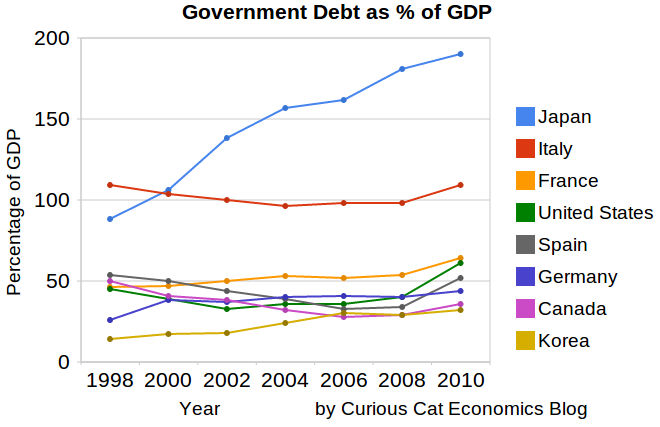
    • Government Debt as Percent of GDP 1998-2010 for OECD countries by John Hunter – There has been a dramatic increase from 2008-2010. The USA is up from 41% of GDP to 61%. Spain is up from 34% to 52% (but given all the concern with Spain this doesn’t seem to indicate the real debt problems they have. Economic data contains quite of bit of noise, unfortunately.

      graph of government debt for OECD countries from 1998-2010

    • Cause of Decline in U.S. Financial Position by Barry Ritholtz – “The Pew Center reported in April 2011 the cause of a $12.7 trillion shift in the debt situation, from a 2001 CBO forecast of $2.3 trillion cumulative surplus by 2011 versus the estimated $10.4 trillion public debt in 2011. The major drivers were:
      Revenue declines due to two recessions, separate from the Bush tax cuts of 2001 and 2003: 28%
      Defense spending increases: 15%
      Bush tax cuts of 2001 and 2003: 13%
      Increases in net interest: 11%
      Other non-defense spending: 10%
    • How This Blog Earns Full-Time Income from Part-Time Work by David Weliver – “for the most part, I’ve tried to focus on simply writing on topics that are unique, helpful, that answer specific questions. (It’s easy enough to be helpful, I think, but with billions of web pages out there, being unique is a never-ending challenge).”
    • How to live off investment income – 1. Set up a cash buffer account between your regular monthly spending, and your income-spewing engines. 2. Work out how much of your annual investment income you will/can spend. The rest of the money you will reinvest…
    • A Risky Investment Isn’t a Bad Investment by Kevin McKee – “If you want all the potential for Apple-esque gains, you need to be prepared to accept Enron-esque results. That’s the magic of risk; it goes both ways. Would I hold 100% of my portfolio in company stock? No.”
    • (more…)

  • Extremely Poor Broadband for the USA

    The USA has extremely poor broadband service (compared to other rich countries). It is slow and expensive. Those that support economic policies more in line with the USA than other nations have a great deal of explaining to do about why the options are so bad. It is similar to the broken health care system.

    Those that support politicians leading to this state for broadband say they support “free markets.” In actuality, they support anti-competitive practices by extremely large companies (oligopolistic behavior). Free market theory (the original form) requires that no individual company can dictate to the market. You have free competition – no barrier to entry, no restraint on entry, customers can buy where they want… But the politicians we elect instead support policies and practices that restrain free trade and prohibit good solutions in order to benefit those that pay the politicians well. And then we vote for those politicians.

    Those wanting the anti-competitive markets have won in our political system. The main thing I wish was clearer was that we stop pretending these people have some capitalist leaning. They are anti-capitalist. If they want to support the policies they do I wish they would be required by the voters to at least be honest. Unfortunately the voters elect them with their dis-honest representations. If the politicians were honest they would have a more difficult time being elected (because voters want to pretend they like capitalism even while voting for politicians that just seek to give special benefits to those that pay the politicians. And then the politicians claim to support markets, and business and consumers when really they just favor making anti-market legislation and regulation to favor their contributors. As long as we vote for people that claim to support capitalism but undermine it at every step to help their friends we do deserve to suffer. I just wish we could convince enough of our fellow citizens that flashy propaganda and repeating lies over and over isn’t the same as facts and truth.

    1Gbps fiber for $70—in America? Yup.

    Where I live in Chicago, Comcast’s 105Mbps service goes for a whopping $199.95 (“premium installation” and cable modem not included). Which is why it was so refreshing to see the scrappy California ISP Sonic.net this week roll out its new 1Gbps, fiber-to-the-home service… for $69.99 a month.

    Given the anti-competitive policies in the USA, if they have much success they will probably just be bought (or maybe as others suggest fought in other anti-competitive ways, but buyouts are normally easiest for actually strong competitor) to allow anti-competitive pricing and service to continue. The only real hope is someone with actual power sees it in their interest to fight against the entrenched interests. Google is the best hope I think. It isn’t that Google has nearly as much political power as those interests but they are smart and have the advantage of just having to expose the anti-competitive behavior and apply pressure.

    The narrative the politicians and voters say they support is capitalism. But the reality is just those with the gold make the rules. But when this is made obvious and continually pressed by someone with power, clout, intelligence and political savvy it makes politicians and regulators hesitant to continue business as usual. Normally they just delay for a few months and then continue the corrupt practices. Google, plus others, plus lots of individual interest can fight that off – but it takes perseverance.

    Related: USA Broadband is Slow. Really Slow.Plugging America’s Broadband GapEliminate Your Phone BillNet Neutrality: This is serious