Tag: housing

  • Apartment-vacancy Rate is 7.8%, a 23-year High

    Landlords Offer Incentives to Stay Put

    In the third quarter, the national apartment-vacancy rate hit 7.8%, a 23-year high, according to Reis Inc., which tracks vacancies and rents in the top 79 markets.

    One problem for landlords is that existing tenants can easily check the Web to see what deals new tenants are being offered. And new tenants are getting incentives like a waived pet deposit or two months’ free rent.

    Apartment landlords say that one benefit of the bad market is that it has practically halted new construction. New completions are expected to be 98,000 next year and 109,000 in 2011, compared with 188,000 last year and 204,000 this year, according to Green Street Advisors Inc.

    But when loss rates are taken into account—the removal of units because of obsolescence—the actual addition will be immaterial. That means that when the economy rebounds, the supply will be tight, increasing landlord profits.

    Related: Apartment Vacancy at 22-Year High in USA (July 2009)Articles on Real Estate InvestingIt’s Now a Renter’s MarketHousing Rents Falling in the USA

  • Lying to Customers – No Surprise A Bank Does It

    It is a shame that it is no surprise when a bank lies to you. I got a “priority notice” from my mortgage company that my 30 year fixed load could be reduced. They show big huge figures showing current interest rate, new interest rate, potential yearly savings of over $5,000… Complete lies. They are claiming savings with a completely different mortgage, a 5/30 year adjustable rate mortgage (which you have to turn over the paper and note they list “mortgage product: 5/1 ARM” and then know what that means).

    Then they go on for a page with all sorts of text seemingly designed to confuse fools. Obviously they try to claim the savings are what is important and the different mortgages, risks of rising interest rates etc. are not important [why don’t they just make it a 30 year mortgage at the low rate, if they think the interest rate risk they try to stick the client with is such an unimportant detail that isn’t even mentioned on the front page with the “comparison” mortgage rates]).

    Anyone that trusts any company that so blatantly tries to fool you is crazy. When they are not shy about using such obviously deceitful tactics you can’t trust them to do much much worse in ways that are very difficult to protect yourself from.

    As I have said before, don’t trust your bank. More than any other companies I see, financial institution, treat customers as fools to be fleeced not customers to provide value to. It really is amazing people defend banks paying obscene bonuses to those that are able to fool financial illiterates into stupid decisions. The company trying to deceive in this case, did indeed fail (and was saved by the FDIC). Financial institutions have decided that they will just focus on tricking those that are not financially literate out of as much money as they possibly can. If you don’t educate yourself you are at great risk to be taken advantage of by financial institutions focused on finding people they can take advantage of.

    Related: FDIC Study of Bank Overdraft FeesIgnorance of Many Mortgage HoldersDon’t Let the Credit Card Companies Play You for a FoolCustomer Hostility from Discover CardLegislation to Address the Worst Credit Card Fee Abuse – Maybe

  • House Prices Seem to be Stabilizing

    Home prices in the United States rose 0.3% on a seasonally-adjusted basis from June to July, according to the Federal Housing Finance Agency’s monthly House Price Index. The previously reported 0.5% increase in June was revised downward to a 0.1% increase. For the 12 months ending in July, U.S. prices fell 4.2%. The U.S. index is 10.5% below its April 2007 peak.

    The FHFA monthly index is calculated using purchase prices of houses backing mortgages that have been sold to or guaranteed by Fannie Mae or Freddie Mac. Read the full press release. The Case-Shiller Home Price Indices also have increased (10 and 20 city indices) for June and July.

    I am still not convinced we have seen the bottom of the housing price declines nationwide. The economy is still in very fragile territory. But the data does show the declining prices have been stopped in many locations, at least for a while. If job losses continue housing prices may well resume the decline. The commercial real estate market seems to be even weaker than housing.

    Related: The Value of Home OwnershipHousing Prices Post Record Declines (April 2008)posts on economic datareal estate articles

  • Buffett: Economy Stable, But Residential Real Estate Has Improved

    Warren Buffet on the economy:

    Warren Buffett tells CNBC that while the economy “hasn’t gotten worse” but also hasn’t “gotten much better” over the past three months, he doesn’t expect a ‘double-dip’ recession and sees significant improvement in residential real estate.

    BECKY: All right. Let me go at this another way. Let’s pretend you’re on a desert island for a month. There’s only one set of numbers you can get. What would it be?

    BUFFETT: Well, I would probably look at– perhaps freight car loadings and– perhaps– and– and truck tonnage moved and– but I’d want to look at a lot of figures.

    BUFFETT: Well, I think that– unfortunately, I think that the — what– what– we’re really talking about reforming health insurance more than health care. So I– the incentives that produce the 16 or so percent of GDP that’s going to health care, I think unfortunately they’re getting– they’re going to get changed. But– so I think that we really– and I’m talking as much about reforming health care as we’re talking about reforming the insurance. And I think that will be an opportunity missed if we don’t do more about looking at what– what the incentives are in the present system and what they would be in an ideal system.

    Related: Buffett’s Fix for the Economy (Oct 2008)Warren Buffett Webcast on the Credit CrisisWarren Buffett on TaxesMany Experts Say Health-Care System Inefficient, Wasteful

  • 30 Year Mortgage Rate and Federal Funds Rate Chart

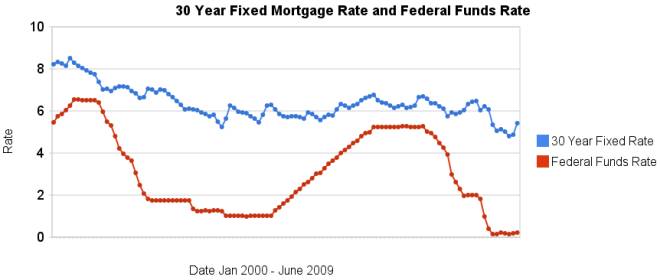
    Once again the data shows that the 30 year fixed mortgage rates are not directly related to federal funds rates. In June the fed funds rate increased 3 basis points, 30 year mortgage rates increased 56 basis points. Since January the fed funds rate is up 6 basis points is up while 30 year mortgage rates are up 36 basis points. Home prices have continued to fall even with the very low mortgage rates.

    30 year fixed mortgage rates and the federal funds rate 2000-2009

    Related: Mortgage Rates: 6 Month and 5 Year Chartshistorical comparison of 30 year fixed mortgage rates and the federal funds rateposts on financial literacyGM and Citigroup Replaced by Cisco and Travelers in the DowJumbo v. Regular Fixed Mortgage Rates: by Credit Score

    For more data, see graphs of the federal funds rate versus mortgage rates for 1980-1999. Source data: federal funds rates30 year mortgage rates

  • Another Wave of Foreclosures Loom

    Another wave of foreclosures is poised to strike

    loan defaults are up sharply. And with many government and banks’ self-imposed foreclosure moratoriums expiring, the biggest lenders indicate that they are likely to move more aggressively to clear up a backlog of troubled mortgages.

    Mark Zandi of Moody’s Economy.com estimates that 15.4 million homeowners — or about 1 in 5 of those with first mortgages — owe more on their homes than they are worth.

    Government and company reports show that the number of completed foreclosures nationwide slowed sharply late last year and into early this year, largely because of various moratoriums in effect during much of the first quarter.

    But anecdotal reports indicate that foreclosure sales have started to climb again in the second quarter. And the pipeline is clearly getting fuller. In the first quarter, some 1.8 million homeowners nationwide fell behind on their loans by 60 to 90 days, a 15% increase from the prior quarter, according to Moody’s Economy.com. The research firm said that loan defaults rose sharply as well, to 844,000 in the first three months of this year.

    Even as defaults among subprime borrowers have trended lower this year, newly initiated foreclosures involving prime mortgage loans saw a significant increase in the first quarter, jumping 21.5% from the fourth quarter, according to a government report of loan data from national banks and federally regulated thrifts.

    This is more bad news for the economy. As I have been saying the economy is still in serious trouble. Cleaning up the damage caused by living beyond our means for decades does not get cleaned up quickly. This are actually going as well as could be hoped for, I think. We need to hope the remainder of this year sees the economy stabilize and then hope 2010 brings some good news.

    Related: Nearly 10% of Mortgages Delinquent or in ForeclosureOver Half of 2008 Foreclosures From Just 35 CountiesHow Much Worse Can the Mortgage Crisis Get? (March 2008)Mortgage Rates Falling on Fed Housing Focus

  • Home Prices Fall by Record 19%

    Home prices fall by record 19.1 percent in 1Q

    The National Index, which is released quarterly and covers a broader area than the monthly 20- and 10-city indexes, posted a 19% drop in the first quarter from a year earlier and a 7.5% decline from the fourth quarter.

    New York still is up 73.4% from January 2000, though down 19.7% from its June 2006 peak. The Detroit index is 29% lower than in January 2000. Detroit home prices are back to their mid-1995 levels.

    Phoenix, Las Vegas and San Francisco continued to lead year-over-year decliners, with drops over 30%. Minneapolis led month-to-month decliners, as the rate of decline accelerated there. The rates of decline also accelerated in Boston, Detroit, Las Vegas, Miami, New York, Portland, San Diego and Seattle.

    Dallas, Denver, Cleveland, Boston and Charlotte managed to avoid double-digit year-over-year declines. Measuring from each market’s peak, Dallas has suffered the least, down 11.1% from its peak in June 2007; while Phoenix is down 53% from its peak in June of 2006. All of the 20 metro areas are in double digit declines from their peaks, with two — Phoenix and Las Vegas — in excess of 50%.

    Related: Home Price Declines Exceeding 10% Seen for 20% of Housing Markets (Sep 2007)Nearly 10% of Mortgages Delinquent or in ForeclosureRecord Home Price Declines (Sep 2008)

  • Mortgage Rates: 6 Month and 5 Year Charts

    mortgage rate chart - late 2008 to May 2009Showing mortgage rates over the last 6 months. Red: 30 year fixed rate. Blue: 15 year fixed rate. Tan: 1 year adjustable rate.

    mortgage rate chart - May 2004 to May 2009Showing mortgage rates over the last 5 years. Red: 30 year fixed rate. Blue: 15 year fixed rate. Tan: 1 year adjustable rate. From Yahoo Finance, for conventional loans in Virginia.

    The 6 month chart shows that mortgage rates have been declining ever so slightly. Rates on a 1 year adjustable mortgage fell from 5.5 to 4% and have stayed near 4% for all of 2009. 30 and 15 year rates (15 year rates staying about 25 basis points cheaper) have declined from 6.5%, 6 months ago to about 5% at the start of the year and have moved around slightly since. This is while the yield 10 year government treasuries have been rising (normally 30 year fixed rate mortgages track moves in the 10 year government bond). The federal reserve has been buying bonds in order to push down the yield (and stimulate mortgage financing and other borrowing).

    Mortgage rates certainly could fall further but the current rates are extremely attractive and I just locked in a mortgage refinance for myself. I am getting a 20 year fixed rate mortgage; I didn’t want to extend the mortgage period by getting another 30 year fixed rate mortgage. For me, the risk of increasing rates outweigh the benefits of picking up a bit lower rate given the current economic conditions. But I can certainly understand the decision to hold out a bit longer in the hopes of getting a better rate. If I had to guess I would say rates will be lower during the next 3 months, but I am not confident enough to hold off, and so I decided to move now.

    Related: Mortgage Rates Falling on Fed Housing Focusposts on mortgages30 Year Fixed Mortgage Rates and the Fed Funds RateContinued Large Spreads Between Corporate and Government Bond YieldsLowest 30 Year Fixed Mortgage Rates in 37 Years

  • Mortgage Rates Falling on Fed Housing Focus

    Mortgages Falling to 4% Become Bernanke Housing Focus by Brian Louis and Kathleen M. Howley

    Home loans may go as low as 4 percent if the economy worsens, said Robert Edelstein, a professor at the Haas School of Business at the University of California, Berkeley. Record foreclosures, falling home prices and an economy that has lost 5.1 million jobs since December 2007 will pressure Bernanke to further reduce borrowing costs. “The Fed will have to do whatever it takes,” Edelstein said. “People will buy cheaper houses at very low interest rates.”

    Conventional mortgages averaged 4.61 percent in 1951, 4 percent when backed by the Veterans Administration, and 4.25 percent by the Federal Housing Administration, according to The Postwar Residential Mortgage Market, a 1961 book written by Saul Klaman and published by Princeton University Press. Rates during the 1930s were as high as 7 percent.

    Mortgages were cheaper through most of the 1940s, ranging from about 4 percent to 5.7 percent, depending on whether the lender was a life insurer, a commercial bank or a savings and loan. In that era, most loans were for 14 years and less.

    The central bank has purchased more than $300 billion of mortgage-backed securities in 2009 through the week ended April 8, helping to cut home-loan rates to 4.82 percent last week from 5.1 percent at the start of the year, according to Freddie Mac data.

    The difference between 30-year mortgage rates and 10-year Treasury yields has narrowed to about 2.2 percent from 3.1 percent in December, which was the widest since 1986. The spread remains almost 0.7 percentage point above the average of the past decade, data compiled by Bloomberg show. Rates for 15-year mortgages are about 1.8 percent above 10-year Treasury yields, compared with an average 1.4 percent since 1999.

    Excellent article with interesting historical information. I don’t believe mortgage rates will fall to 4% but differences of opinion about the future is one function of markets. Those that predict correctly can make a profit. I am thinking of refinancing a mortgage and I think I am getting close to pulling the trigger. If I was confident they would keep falling I would wait. It just seems to me the huge increase in federal debt and huge outstanding consumer debt along with very low USA saving will not keep interest rates so low. However, as I have mentioned previously, it is interesting that the Fed is directly targeting mortgage rates and possible they can push them lower. The 10 year bond yield has been increasing lately so the slight fall in mortgage rates over the last month are due to the reduced spread (that I can see decreasing – the biggest question for me is how much that spread can decrease).

    Related: Fed to Start Buying Treasury Bonds TodayFederal Reserve to Buy $1.2T in Bonds, Mortgage-Backed SecuritiesLow Mortgage Rates Not Available to Everyonewhat do mortgage terms mean?

  • The Value of Home Ownership

    Home Ownership Shelter, or Burden?

    The collapse in house prices matters most directly to two overlapping groups: those who bought property at the peak of the market and now face “negative equity”; and those (in America) who took out subprime mortgages. Roughly 10m Americans are in negative equity—ie, the cost of their mortgage exceeds the value of their home. In Britain about 3% of households are in negative equity. For homeowners, negative equity makes houses more like a trap than a piggy bank. Those who cannot meet their payments lose their house, their savings and (in America, usually) their credit rating for seven years.

    The other area of concentrated distress is subprime mortgages, which increased their share of the American mortgage market from 7% in 2001 to over 20% in 2006. According to the Mortgage Bankers Association, the delinquency rate was 22% in the fourth quarter of 2008, compared with only 5% for prime loans.

    “Perhaps the most compelling argument for housing as a means of wealth accumulation”, argues Richard Green of the University of Southern California, “is that it gives households a default mechanism for savings.” Because people have to pay off a mortgage, they increase their home equity and save more than they otherwise would. This is indeed a strong argument: social-science research finds that people save more if they do so automatically rather than having to choose to set something aside every month.

    Yet there are other ways to create “default savings”, such as companies offering automatic deductions to retirement plans. In any case, some of the financial snake oil peddled at the height of the housing bubble was bad for saving.

    The debate over whether home ownership is a wise investment or not, is contentious (more so in the last year than it was several years ago). I believe in most cases it probably is wise, but there are certainly cases where it is not. If you put yourself in too much debt that is often a big problem. I also think you should save a down payment first. If you are going to move (or have good odds you may want to) then renting is often the better option.

    The “default saving” feature is one of the large benefits of home ownership. That benefit is destroyed when you take out loans against the rising value of the house. And in fact this can not just remove the benefit but turn into a negative. If you spend money you should have (increasing your debt) that can not only remove you default saving benefit but actual make your debt situation worse than if you never bought.

    Related: Your Home as an InvestmentNearly 10% of Mortgages Delinquent or in ForeclosureHousing Rents Falling in the USAIgnorance of Many Mortgage Holders