Tag: housing

  • It’s Now a Renter’s Market

    It’s Now a Renter’s Market by Prashant Gopal

    Effective rents fell in 64 of 79 markets that Reis tracks. Effective rents in San Francisco dropped 2.8% in the first quarter of this year, compared with the previous quarter—the nation’s largest quarterly decline. Rents fell 2.6% in New York City (all five boroughs), 1.3% in Charlotte, 2.5% in San Jose, 0.9% in San Antonio, 0.9% in Cleveland, 1.2% in Chicago, and 2.3% on Long Island.

    Oklahoma City, where people spent just 12% of their income on rent, was the most affordable. Other cheap markets included Indianapolis, Denver, Fort Worth, and Cleveland. The least affordable market was New York, where people spent 57% of their income on rent.

    Rental markets are driven largely by 2 factors, vacancy rates and jobs. If jobs in a metropolitan area are increasing rents usually increase. If more new apartments are added to the market than jobs (which then increases vacancy rates) this will push down rates. Other factors influence vacancy rates (such as people moving back in with parent, people sharing apartments…). Those factors often are largely influenced by losing jobs in an area.

    D.C. apartment market remains strong

    The D.C. area continues to boast one of the best apartment markets in the U.S., with a vacancy rate well below the national number

    Rent increases over the past 12 months for all investment grade apartments kept under the long-term average of 4.2 percent per annum, at 0.5 percent since March 2008.

    Related: Housing Rents Falling in the USAHome Values and Rental RatesReal estate investing articlesUrban PlanningLonger Commutes Translate to Larger Housing Price Declines
    (more…)
  • The Best Way to Rob a Bank is as An Executive at One

    William Black wrote The Best Way to Rob a Bank Is to Own One: How Corporate Executives and Politicians Looted the S&L. I think he a bit off on the “owning one,” being the best way to loot. The looters are not owners, they are executives that loot from owners, taxpayers, customers… And those looters pay politicians a great deal of money to help them. He appeared on Bill Moneys Journal discussing the huge mess we know are in and how little is being done to hold those responsible for the enormous crisis created by them.

    Fraud is deceit. And the essence of fraud is, “I create trust in you, and then I betray that trust, and get you to give me something of value.” And as a result, there’s no more effective acid against trust than fraud, especially fraud by top elites, and that’s what we have.

    The FBI publicly warned, in September 2004 that there was an epidemic of mortgage fraud, that if it was allowed to continue it would produce a crisis at least as large as the Savings and Loan debacle. And that they were going to make sure that they didn’t let that happen. So what goes wrong? After 9/11, the attacks, the Justice Department transfers 500 white-collar specialists in the FBI to national terrorism. Well, we can all understand that. But then, the Bush administration refused to replace the missing 500 agents. So even today, again, as you say, this crisis is 1000 times worse, perhaps, certainly 100 times worse, than the Savings and Loan crisis. There are one-fifth as many FBI agents as worked the Savings and Loan crisis.

    Well, certainly in the financial sphere, I am. I think, first, the policies are substantively bad. Second, I think they completely lack integrity. Third, they violate the rule of law. This is being done just like Secretary Paulson did it. In violation of the law. We adopted a law after the Savings and Loan crisis, called the Prompt Corrective Action Law. And it requires them to close these institutions. And they’re refusing to obey the law.

    In the Savings and Loan debacle, we developed excellent ways for dealing with the frauds, and for dealing with the failed institutions. And for 15 years after the Savings and Loan crisis, didn’t matter which party was in power, the U.S. Treasury Secretary would fly over to Tokyo and tell the Japanese, “You ought to do things the way we did in the Savings and Loan crisis, because it worked really well. Instead you’re covering up the bank losses, because you know, you say you need confidence. And so, we have to lie to the people to create confidence. And it doesn’t work. You will cause your recession to continue and continue.”

    And their ideologies, which swept away regulation. So, in the example, regulation means that cheaters don’t prosper. So, instead of being bad for capitalism, it’s what saves capitalism. “Honest purveyors prosper” is what we want. And you need regulation and law enforcement to be able to do this. The tragedy of this crisis is it didn’t need to happen at all.

    Related: Fed Continues Wall Street WelfareCredit Crisis the Result of Planned Looting of the World EconomyLobbyists Keep Tax Off Billion Dollar Private Equities DealsPoll: 60% say Depression LikelyCanadian Banks Avoid Failures Common ElsewhereToo Big to FailWhy Pay Taxes or be Honest

  • Fed to Start Buying Treasury Bonds Today

    Fed to start buying T-bonds today, hoping to move rates

    The Federal Reserve will try to get long-term interest rates moving down again when the central bank today launches its first purchases of Treasury bonds. The Fed triggered a stunning drop in Treasury bond yields on March 18 when policymakers surprised Wall Street by announcing a plan to buy up to $300 billion of Treasuries over the next six months.

    The yield on the 10-year T-note plunged to 2.53% on March 18 from 3% the previous day, the biggest one-day drop in decades. But since then, Treasury bond yields have been creeping higher. The 10-year T-note ended Tuesday at 2.65%. Conventional mortgage rates have flattened or inched up, although they remain historically low, in the range of 4.75% to 5%.

    On Tuesday the Treasury sold $40 billion of new two-year T-notes at a yield of 0.95%, which was lower than expected, indicating healthy investor demand. The government will auction $34 billion in five-year notes today and $24 billion in seven-year notes on Thursday. Against numbers like those in just one week, the Fed’s commitment to buy $300 billion of Treasuries over six months doesn’t look like much.

    there’s nothing to stop the Fed from suddenly announcing that its $300-billion commitment will get substantially bigger: The central bank can, in effect, print as much money as it wants to buy bonds — at least, until the day that global investors stop wanting dollars.

    The original announcement caused a dramatic move but since then yields have been drifting up, every day, including today. Rates are already very low. And the huge amount of increased federal borrowing is a potential serious problem for lowering rates. And potentially an even more serious problem is foreign investors deciding the yield does not provide a good investment given the risks of inflation (I know that is how I feel). It will be interesting to see what happens with rates.

    Related: Who Will Buy All the USA’s Debt?Lowest 30 Year Fixed Mortgage Rates in 37 Yearsmortgage terms

  • Over Half of 2008 Foreclosures From Just 35 Counties

    More than half of the nation’s foreclosures last year took place in 35 counties

    Those counties, spread over a dozen states, accounted for more than 1.5 million foreclosure actions last year, a USA TODAY analysis of figures compiled by the real estate listing firm RealtyTrac shows — more than were recorded in the entire United States just two years earlier.

    A few of the 35 counties leading the foreclosure boom are in already-distressed areas around Detroit and Cleveland. But most are clustered in places such as Southern California, Las Vegas, Phoenix, South Florida and Washington, where home values shot up dramatically in the first half of the decade, then began to crumble.

    The worst-hit counties are home to about 20% of U.S. households, but accounted for just over 50% of the nation’s foreclosure actions last year, driving most of the national increase. And even among those places, a few stand out: Eight counties in Arizona, California, Florida and Nevada were the source of about a quarter of the nation’s foreclosures last year.

    In more than 650 other counties – about a fifth of the nation – the number of foreclosure actions actually dropped since 2006.

    Related: Freezing Mortgage RatesNearly 10% of Mortgages Delinquent or in ForeclosureJumbo Loan Defaults Rise at Fast PaceIgnorance of Many Mortgage Holders

  • Low Mortgage Rates But High Eligibility Requirements

    Low Mortgage Rates a Mirage as Fees Climb, Eligibility Tightens

    The average rate on a 30-year fixed mortgage dropped to 5.07 percent for the week ending Feb. 26 from 6.63 percent for the one ending July 24

    “A score of 700 was once near perfect,” said Gwen Muse Evans, vice president of credit policy at Fannie Mae, the government-controlled company that helps set lending standards. “Today, a 700 performs more like a 660 did. We have updated our policy to take into account the drift in credit scores.”

    Consumer credit scores, called FICOs after creator Fair Isaac Corp., range from 300 to 850. The average FICO score on mortgages bought by Freddie Mac and Fannie Mae rose to 747.5 in the fourth quarter of last year from 722.3 in 2005, according to Inside Mortgage Finance.

    Accunet’s Wickert said that a 660 FICO score would have qualified most borrowers for loans with no upfront fees in the past. Now, someone trying to borrow $200,000 with a 660 score would have to pay a 2.8 percent fee, or $5,600, he said. Even someone with a 719 score would have to pay $1,750 in cash.

    The low mortgage rates are attractive but a decision to re-finance (or buy) must consider the long term implications. Also if you are re-financing to take advantage of the low rates consider a 20 year or 15 year loan if you are already well into your 30 year loan. A fixed rate loan is the most sensible option at this time.

    Related: Low Mortgage Rates Not Available to Everyone30 Year Fixed Mortgage Rates and the Fed Funds Rate ChartIgnorance of Many Mortgage HoldersFed Plans To Curb Mortgage ExcessesHow Not to Convert Home Equity

  • Housing Rents Falling in the USA

    Apartment Rents Fall, Vacancies at 4-Year High

    U.S. apartment rents fell in the fourth quarter from the third as the national vacancy rate climbed to a four-year high of 6.6 percent

    Asking rents fell 0.1 percent from the previous quarter, to $1,052 on average, their first quarter-to-quarter decline in almost six years. They rose 2.4 percent from a year earlier. Effective rents, what tenants actually paid, fell to an average $996 last quarter, down 0.4 percent from the prior quarter and up 2.2 percent from a year earlier.

    U.S. rental market set to slow down amid housing glut

    “Unsold properties being turned into rental units are creating a shadow market that’s driving up the vacancy rate and slowing the growth of rents,” Chandan said. “Areas that saw the most speculative investing, particularly in condos, will see the biggest pressure on rents.”

    Anthony De Silva said he was not happy that he had become a landlord. He bought a two-bedroom condominium 18 months ago on the ocean in Hollywood, Florida, expecting to sell at a $100,000 profit. Instead, he is now looking for tenants at $1,700 a month.

    “Increasing vacancies does not bode well for rental incomes,” said Nabil El-Hage, a professor at Harvard Business School. “We’ve seen a softening in apartment REITs as a result.”

    So for renters nationwide this is one possible silver lining to the current economic crisis. Granted not a large one but in these times any good news is worth appreciating. For real estate investors the news is not as good. The Washington DC market is forecast to go against the trend for reduced rents in 2009.

    According to Marus and Millichap, Metrowide vacancy is expected to rise 60 basis points this year to 6.5 percent. Asking rents are projected to advance 3.1 percent to $1,410 per month in 2009, while effective rents increase 2.8 percent to $1,351 per month. Rent growth will lag slightly in Suburban Maryland. Of the 43 rental market they track they project San Francisco to see the largest increases in rent in 2009, followed by San Diego and Washington DC.

    Related: Home Values and Rental RatesRent Controls are Unwiseposts on housingHow Walkable is Your Prospective Neighborhood

  • The Impact of Credit Scores and Jumbo Size on Mortgage Rates

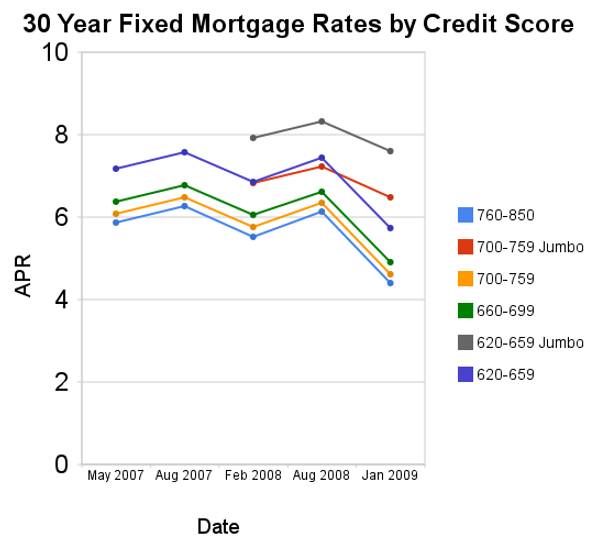
    Since August of 2008 conforming mortgage rates are have declined a huge amount. Jumbo rates have fallen a large amount also, but much less (for example for a credit score of 700-759 the jumbo rates declined 73 basis points while the conventional rate declined 172 basis points.

    chart of 30 year fixed mortgage rates by credit score from May 2007 to Jan 2009

    For scores above 620, the APRs above assume a mortgage with 1 point and 80% Loan-to-Value Ratio. For scores below 620, these APRs assume a mortgage with 0 points and 60 to 80% Loan-to-Value Ratio. You can see, with these conditions the rate difference between a credit score of 660 and 800 is not large (remember this is with 20% down-payment) and has not changed much (the difference between the rates if fairly consistent).

    Related: Low Mortgage Rates Not Available to Everyone30 Year Fixed Rate Mortgage Rate DataReal Free Credit Report (in USA)Jumbo Mortgage Shoppers Get Little Relief From Ratesposts on mortgages
    (more…)

  • Low Mortgage Rates Not Available to Everyone

    The lowest 30 Year fixed mortgage rates in 37 years is great news for those looking to buy a house or to re-finance. However, that truth (the lowest rate) masks another truth, that it is available to a somewhat limited pool of borrowers. The rates for jumbo 30 year fixed mortgages and for regular 30 year fixed mortgages, for those with lower credit ratings, are not at the lowest rates they have ever reached. And getting mortgage rates that don’t require a 10-20% down payment and fully documented financial position are not as low as they have ever been. 15 year fixed rates are also low, but are not at all time lows. FHA loans still allow very low down payments, but others have moved away from this practice (which is a wise move).

    Current rates, national average, from Bankrate: 30 year fixed 5.26%, 30 year fixed jumbo 6.96% (a full 170 basis points higher rate), 15 year fixed 5.07%. Jumbo rates have been less than 40 basis points higher than conventional rates most of time (based on my memory – I am looking for a source to confirm). The site does not present the credit score but my guess is these rates are based on a credit score of 700, or higher. Last week the jumbo rates increased by 11 basis points and regular 30 year rates fell by 3 basis points.

    Related: Jumbo v. Regular Fixed Mortgage Rates: by Credit Scorehistorical mortgage rate chartNearly 10% of Mortgages Delinquent or in Foreclosuremisinterpreting data

    Changes in the Market For Jumbo Mortgages

    During the period May 4, 2007 to November 7, 2008, the spread in wholesale interest rates between a $417,000 loan eligible for purchase by Fannie Mae and Freddie Mac, and a $418,000 loan that is not eligible, increased from 0.28% to 2.97%.

    On Nov 12, 2008 I shopped for an $800,000 30-year fixed-rate mortgage on Mortgage Marvel, an on-line site that I reviewed earlier in 2008 (see A Look at Mortgage Marvel). The mortgage companies on the site quoted rates of 8.125% to 8.375%. The credit unions and banks, in contrast, quoted rates ranging from 5.875% to 7.875%. I have never before seen rate differences on the same transaction this large. They no doubt reflect wide differences in lender access to funding, which is symptomatic of a market in turmoil.

    Mortgage Q&A

    For example, I see from today’s rate sheet that a homeowner with 40 percent equity and an excellent credit score of 740 would receive a quote of 5.125 percent with no points or origination fees for a 30-year fixed-rate mortgage. A borrower with a credit score of 670 who has 20 percent equity would receive the same rate but would be charged two points. On a $300,000 loan, this makes the 5.25 percent rate $6,000 more expensive. If the homeowner with the lower credit score wanted to pay zero points, the rate would be well north of 6 percent.
  • Lowest 30 Year Fixed Mortgage Rates in 37 Years

    We now have the lowest 30 year fixed mortgage rates since data has been collected (37 years) in the USA. Is this due to the Fed cutting the discount rate? I do not think so. As I have said previously 30 year fixed rates are not correlated with federal reserve rates. But this time the government is actively seeking to reduce mortgage rates.

    U.S. Treasury Secretary Henry Paulson said the Bush administration was looking at ways to lower mortgage rates because it was essential to stem the drop in home prices to foster an economic recovery.

    Mortgage Rate Hits 37-Year Low

    The benchmark 30-year fixed-rate home mortgage in the U.S. fell to a national average of 5.17% this week, the lowest since Freddie Mac began its weekly rate survey in 1971.

    The 15-year fixed-rate mortgage averaged 4.92%, down from last week when it averaged 5.20%. A year ago the 15-year loan averaged 5.79%. The 15-year mortgage hasn’t been lower since April 1, 2004, when it averaged 4.84%.

    Homeowners refinance, put savings under mattress

    This time around, lenders say up to a third of the callers seeking to refinance simply can’t. And if they can, the future savings are headed straight for the piggy bank.

    These rates sure are fantastic if you are in the market. I was not in the market, but I am considering re-financing now. You need to be careful and not just withdraw money because you can. If you can refinance and reduce your payments it may well be a wise move though. One problem can be extending the date you will finally be free of mortgage debt. If you re-finance a current 30 year loan, that you got 5 years ago, you will now be paying 5 more years. One option is to see if you can get a 25 or 20 year loan. Or if you can make a 15 year loan work, do that (15 and 30 year fixed rate mortgages are common).
    (more…)

  • Nearly 10% of Mortgages Delinquent or in Foreclosure

    The percentage of loans in the foreclosure process at the end of the third quarter was 2.97 percent, an increase of 22 basis points from the second quarter of 2008 and 128 basis points from one year ago. The percentage of loans in the process of foreclosure set a new record this quarter, to 1.35 million.

    Mortgages are counted as delinquent or in foreclosure (once they are in foreclosure they are not counted as delinquent). So the total percentage of mortgages not being paid by the homeowner is 2.97% (in foreclosure) + 6.99% (delinquent) = 9.96%. That is amazingly bad. In February of 2007 I wrote about this and the delinquency rate was 4.7% which sounded pretty bad to me. Amazingly 4.4% is a historic low for this figure. Can you believe 1/25 mortgages is delinquent and that is as good as we ever get? That is pretty shocking to me.

    The seasonally adjusted total delinquency rate is now the highest recorded in the Mortgage Bankers Association survey. The seasonally adjusted delinquency rate increased 41 basis points to 4.34 percent for prime loans, increased 136 basis points to 20.03 percent for subprime loans, increased 29 basis points to 12.92 percent for FHA loans, and increased 46 basis points to 7.28 percent for VA loans.

    The percent of loans in the foreclosure process increased 16 basis points to 1.58 percent for prime loans, and increased 74 basis points for subprime loans to 12.55 percent. FHA loans saw an eight basis point increase in the foreclosure inventory rate to 2.32 percent, while the foreclosure inventory rate for VA loans increased 13 basis points to 1.46 percent.

    Since loans that would have gone into foreclosure in the past are being kept out of foreclosure due to some programs ( ) the rate or seriously delinquent is a useful measure of serious problems. Seriously delinquent mortgages are 90 days past due. The rate increased 52 basis points for prime loans to 2.87 percent, increased 171 basis points for subprime loans to 19.56 percent, increased 62 basis points for FHA loans to 6.05 percent, and increased 45 basis points for VA loans percent to 3.45 percent.

    Compared to a year ago: the seriously delinquent rate was 156 basis points higher for prime loans and 818 basis points higher for subprime loans. The rate also increased 51 basis points for FHA loans and 89 basis points for VA loans.

    Related: Homes Entering Foreclosure at Record (Sep 2007)Foreclosure Filings Continue to RiseHow Much Worse Can the Mortgage Crisis Get?How Not to Convert Equity