Tag: Investing

  • The Impact of Credit Scores and Jumbo Size on Mortgage Rates

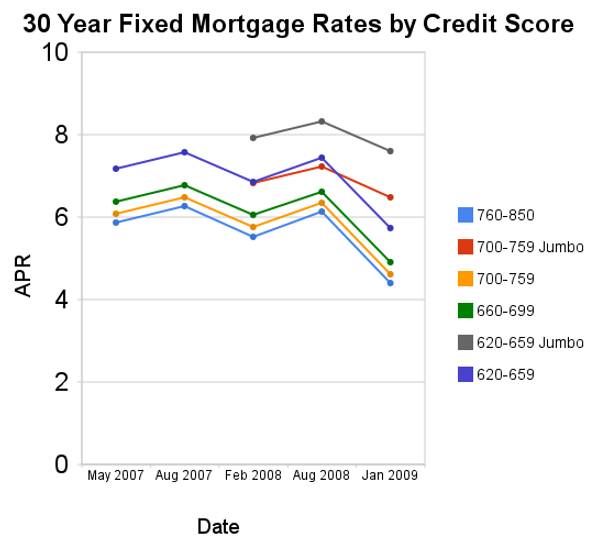
    Since August of 2008 conforming mortgage rates are have declined a huge amount. Jumbo rates have fallen a large amount also, but much less (for example for a credit score of 700-759 the jumbo rates declined 73 basis points while the conventional rate declined 172 basis points.

    chart of 30 year fixed mortgage rates by credit score from May 2007 to Jan 2009

    For scores above 620, the APRs above assume a mortgage with 1 point and 80% Loan-to-Value Ratio. For scores below 620, these APRs assume a mortgage with 0 points and 60 to 80% Loan-to-Value Ratio. You can see, with these conditions the rate difference between a credit score of 660 and 800 is not large (remember this is with 20% down-payment) and has not changed much (the difference between the rates if fairly consistent).

    Related: Low Mortgage Rates Not Available to Everyone30 Year Fixed Rate Mortgage Rate DataReal Free Credit Report (in USA)Jumbo Mortgage Shoppers Get Little Relief From Ratesposts on mortgages
    (more…)

  • Madoff ‘victims’ do math, realize they profited

    Madoff ‘victims’ do math, realize they profited

    The many Bernard Madoff investors who withdrew money from their accounts over the years are now wrestling with an ethical and legal quandary. What they thought were profits was likely money stolen from other clients in what prosecutors are calling the largest Ponzi scheme in history. Now, they are confronting the possibility they may have to pay some of it back.

    The issue came to the forefront this week as about 8,000 former Madoff clients began to receive letters inviting them to apply for up to $500,000 in aid from the Securities Investor Protection Corp. Lawyers for investors have been warning clients to do some tough math before they apply for any funds set aside for the victims, and figure out whether they were a winner or loser in the scheme.

    Hundreds and maybe thousands of investors in Madoff’s funds have been withdrawing money from their accounts for many years. In many cases, those investors have withdrawn far more than their principal investment.

    Jonathan Levitt, a New Jersey attorney who represents several former Madoff clients, said more than half of the victims who called his office looking for help have turned out to be people whose long-term profits exceeded their principal investment.

    I discussed this aspect last month, the SPIC covers actual losses, not losses based upon false gains you didn’t have, I don’t think. So if you invested $100,000 and were told (falsely) it was worth $300,000 after years of gains you are not covered for $300,000. And I certainly hope the SPIC fund doesn’t payoff people who already had gains based on false accounting from Madoff.

    This whole situation also points out the value of diversification. Diversification is important not just in asset classes (stocks, bonds, cash, real estate…) but in the accounts and companies with which you are dealing (I have always been a bit paranoid in this feeling, compared to others that think this level of diversification is not really needed but this is an example of the risks investments face that diversification can help manage). This is a very difficult situation for investors that had counted on assess they believed they had earned but in fact they had not.

    Related: Bail us Out, say Madoff VictimsHow to Protect Your Financial HealthReal Free Credit Reportidentity theft links

  • Bail us Out, say Madoff Victims

    As I suspected those (who are not earning minimum wage you can be sure) that have lost money on the Madoff case would expect others to bail them out: well paid lawyers (I am sure) are making their case for just such a bailout of their wealthy clients.

    Lawyers representing the victims of Bernard Madoff’s alleged $50bn fraud are calling on the US government to bail them out with billions of taxpayers’ dollars.

    The SIPC has little more than $1.6bn of funds and has promised $500,000 to each Madoff victim who had an account with his firm in the past 12 months.

    The debate needs to be about what is the proper role for government. Not about this instance. What type of losses do we want secured? How large of payments do we want to insure? That amount has been $500,000 if we are changing the rules after the fact for a few is that really the best course of action)? How should these payments be funded? Do we really want to raise taxes on our grand children (many of which who will earn less than the equivalent of $50,000 today)? I don’t think so. This SIPC fund should be paid for by fees on investments just like the FDIC is paid for based on fees on covered deposits (as the SIPC is now – but no taxpayer funding should occur).

    If we decide we want to pay back people several million each then the fees just need to be raised to fund such a system. Just as with the FDIC if we want the government to backstop the fund by guaranteeing they will loan the fund money if it runs short of cash is fine with me. Then the SIPC fund just pays back the taxpayers with interest.
    (more…)

  • How Much Will I Need to Save for Retirement?

    Retirement Myths and Realities provides some ideas from former Boeing President, Henry Hebeler:

    Hebeler says all Americans should become self-educated about retirement issues, even if they have a financial planner.

    My father used to tell me to save 10 percent of my wages all the time for retirement. And so I did. I never looked at any retirement plan; we didn’t have retirement planning tools in those days.

    I think the number is closer to 15 (percent) to 20 percent — that’s from the time when you’re a relatively young person, say, 30 years old or something like that.

    A retiree’s inflation rate is about 0.2 percent higher than the normal Consumer Price Index. When you retire, you have medical expenses that continually increase. You have more need for this service and the unit cost is increasing much faster than inflation.

    Now, if you’re going to retire at 80 years old, you could actually have a bigger number than 4 percent. If you’re going to retire around 65 or so, 4 percent is not a bad number. Some people are now saying 3.5 percent instead of 4 percent. If you’re going to retire at 55, you’d better spend a lot less than 4 percent because you’ve got another 10 years of life that you’re going to have to support.

    He makes some interesting points. I agree it is very important for people to become financially literate and take the time to understand their retirement plans. Just hoping it will work out or trusting that just doing what someone told you are very bad ideas. You need to educate yourself and learn about financing your retirement.

    I am not really convinced by his idea that you need to start saving 15-20% for retirement at age 30. But that is a decision each person has to make for themselves. Of course there are many factors including how much risk you are willing to accept, when you plan on retiring, what standard of living you want in retirement…

    Related: How Much Retirement Income?posts on retirementSaving for RetirementOur Only Hope: Retiring Later

  • Investing – What I am Doing Now

    The economy (in the USA and worldwide) continues to struggle and the prospects for 2009 do not look good. My guess is that the economy in 2009 will be poor. If we are lucky, we will be improving in the fall of 2009, but that may not happen. But what does that mean for how to invest now?

    I would guess that the stock market (in the USA) will be lower 12 months from now. But I am far from certain, of that guess. I have been buying some stocks over the last few months. I just increased my contributions to my 401(k) by about 50% (funded by a portion of my raise). I changed the distribution of my future contributions in my 401(k) (I left the existing investments as they were).

    My contributions are now going to 100% stock investments (if I were close to retirement I would not do this). I had been investing 25% in real estate. I also moved into a bit more international stocks from just USA stocks. I would be perfectly fine continuing to the 25% in real estate, my reason for switching was more that I wanted to buy more stocks (not that I want to avoid the real estate). The real estate funds have declined less than 3% this year. I wouldn’t be surprised for it to fall more next year but my real reason for shifting contributions to stocks is I really like the long term prospects at the current level of the stock market (both globally and in the USA). The short term I am much less optimistic about – obviously.

    I will also fully fund my Roth IRA for 2009, in January. I plan to buy a bit more Amazon (AMZN) and Templeton Emerging Market Fund (EMF). And will likely buy a bit of Danaher (DHR) or PetroChina (PTR) with the remaining cash.

    Related: 401(k)s are a Great Way to Save for RetirementLazy Portfolio ResultsStarting Retirement Account Allocations for Someone Under 40

  • Fed Cuts Rate to 0-.25%

    Treasury bills have been providing remarkably low yields recently. And the Fed today cut their target federal funds rate to 0-.25% (what is the fed funds rate?). With such low rates already in the market the impact of a lowered fed funds rate is really negligible. The importance is not in the rate but in the continuing message from the Fed that they will take extraordinary measures to soften the recession.

    There are significant risks to this aggressive strategy (and there would be risks for acting cautiously too). But I cannot understand investing in the dollar under these conditions or in investing in long term bonds (though lower grade bonds might make some sense as a risky investment for a small portion of a portfolio as the prices have declined so much).

    The current yields, truly are amazing as this graph shows. The chart shows the yield curve in Dec 2008, 2006, 2000 and 1994 based on data from the US Treasury

    chart of yield curve in Dec 2008, 2006, 2000, 1994

    Related: Corporate and Government Bond Rates GraphDiscounted Corporate Bonds Failing to Find Buying SupportMunicipal Bonds After Tax ReturnTotal Return

  • Stocks Still Overpriced?

    I don’t actually agree with the contention in this post, but the post is worth reading. I will admit I am more certain of I like the prospect of investing in certain stocks (Google, Toyota, Danaher, Petro China, Templeton Dragon Fund, Amazon [I don’t think Amazon looks as cheap as the others, so their is a bit more risk I think but I still like it]) for the next 5 years than I am in the overall market. But I am also happy to buy into the S&P 500 now in my 401(k).

    Stocks Still Overpriced even after $6 Trillion in Market Cap gone from the Index

    Looking at data since 1936 the average P/E for the S & P 500 is 15.79. The current P/E for the market looking at second quarter data is 24.92. Since that time, the P/E has started to look more attractive but you have to be cautious as to why this is occurring. First, the current P/E ratios are betting that earnings will not take hits in 2009 which they clearly are.

    Even if we assumed a healthy economy, the price is no bargain. Throw in the fact that we are in recession and you can understand why the S & P 500 is still overvalued. We haven’t even come close to the historical P/E of 15.79 which includes good times as well.

    Just to be clear current PE ratios have nothing to do with next year. It would be accurate to say someone making the argument that the S&P 500 is cheap now because of the current PE ratio, is leaving out an important factor which is what will earning be like next year. It does seem likely earnings will fall. But I also am not very concerned about earning next year, but rather earning over the long term. I see no reason to be fearful the long term earning potential of say Google is harmed today.

    Related: S&P 500 Dividend Yield Tops Bond Yield for the First Time Since 195810 Stocks for 10 YearsStarting Retirement Account Allocations for Someone Under 40Books on Investing

  • 10 Stocks for Income Investors

    Recent market collapses have made it even more obvious how import proper retirement planning is. There are many aspects to this (this is a huge topic, see more posts on retirement planning). One good strategy is to put a portion of your portfolio in income producing stocks (there are all sorts of factors to consider when thinking about what percentage of your portfolio but 10-20% may be good once you are in retirement). They can provide income and can providing growing income over time (or the income may not grow over time – it depends on the companies success).

    10 picks for income investors

    Strategy #1: Stocks with current yields at 10% or higher where the dividend payout is sustainable at current levels for a decade or more. If the stock market recovers, of course, the dividend yield will drop, but you don’t care. All you want to know is that if you buy $10,000 in annual cash flow now, you’ll get at least $10,000 of annual cash flow in retirement.

    Strategy #3: Buy common stocks with solid dividends and a history of raising dividends for the long haul. That way you let time and compounding work for you. While you may be buying $1 per share in dividends today with stocks like these, you’re also buying, say, 8% annual increases in dividends. In 10 years, that turns a $1-a-share dividend into $2.16 a share in dividends.

    3 of this picks are: Enbridge Energy Partners (EEP), dividend yield of 15.5%, dividend history; Energy Transfer Partners (ETP), 11.2%, dividend history; Rayonier (RYN), yielding 6.7%, dividend history.

    Of course those dividends may not continue, these investments do have risk.

    Related: S&P 500 Dividend Yield Tops Bond Yield: First Time Since 1958
    Discounted Corporate Bonds Failing to Find Buying SupportAllocations Make A Big Difference

  • Companies Beg Congress to Allow Them to Avoid Paying Into Pension Funds

    Pension Funds Beg Congress to Suspend Billions in Contributions

    Pension funds at Pfizer Inc., International Business Machines Corp., United Parcel Service Inc. and dozens of other companies have joined the parade of businesses seeking relief from Congress amid this year’s economic meltdown.

    Instead of money, they want legislation to suspend a federal law that would make them pump billions of dollars into retirement plans to offset stock-market losses as many struggle to find enough cash just to stay in business.

    So lets see, you minimally fund the pension plan for your workers and make optimistic projections about investing returns. The market goes down, and you are now so far underfunding your pension that the law requires you to add funds to the pension. Your solution, go cry to the politicians. How sad. If Pfizer or IBM are having cash flow problems that is amazing. They really should be able to manage their cash better than that. Their most recent quarterly reports do not indicate cash flow problems. Yes I understand we have a credit crisis so if GM were having problems I wouldn’t be surprised (but you know what – they aren’t, in this area).

    “Without relief, plan sponsors must shoulder the immediate burden of sudden, unexpected, large increases in plan contributions at a time when cash may be difficult to generate internally or to obtain in the credit markets,” Mercer’s Hartshorn says.

    GM was notably absent from the five-page list of companies and organizations asking Congress for relief from the asset thresholds. GM said its pension plans had a $1.8 billion deficit as of Oct. 31, down from a $20 billion surplus 10 months earlier. At that level, GM’s plans would top the pension law’s 2008 asset threshold.

    I think companies need to meet their obligations. If they choose to minimally fund their pensions without understanding that financial market are volatile, then they will have to pay up as required by law. When times are good you see all these CEOs taking advantage of pension fund “excesses” to reward themselves. They need to learn that you don’t raid your pension funds (either by taking cash out or not funding current investments – because you claim the assets are already sufficient). Pension funds are long term investments and you cannot manage as though the target value is the minimum amount allowed by law (unless you are willing to pay up cash every time your investments don’t meet your predicted returns). This is very simple stuff.

    (more…)
  • Google’s Energy Interests

    I believe in the management at Google is doing as good a job as the management at any company. They are not afraid to pursue their convictions even if conventional wisdom says they should not. I believe in Google more than the conventional wisdom. And I have been buying Google stock as it has declined the last 6 months.

    I am perfectly happy for Google’s stock price to continue declining: I will continue to buy. I have no intention of selling for decades. Things could change, that would lead me to sell but right now I am firmly a believer in owning a piece of Google for the long term. I am thrilled to have very smart engineers effectively guiding a company (including sustaining a culture where engineers can provide value without the amount of pointy haired boss behavior found elsewhere) to provide value to customers and users of their services while profiting quite nicely. And at these prices the investment opportunity looks great to me. I still believe in following prudent diversification practices (far less than 10% of my investments are in Google stock)

    Google CEO defiant in defending energy interests

    When he was asked whether financial markets and Google’s shareholders wouldn’t prefer that he focus more on the company’s core businesses, and less on big thoughts on energy use, Schmidt countered, “Why don’t we work on the important problems of the world?”

    He was quick to add that Google has a material interest in lower energy costs to help power its crucial data centers. “We’re going to likely consume more [energy], and we’d like the prices to go down,” he said.

    Schmidt said the bulk of spending on necessary research and development for Google’s ambitious energy plan will have to come from the government. The CEO added that he’s almost certain that an opportunity to tap government largesse is now at hand, as he believes a “stimulus package” will follow the $700 billion Wall Street bailout

    I have written about Google’s focus on energy previously: Google Investing Huge Sums in Renewable Energy and is HiringGoogle.org Invests $10 million in Geothermal EnergyReduce Computer Waste.

    With most companies I would be very skeptical delving into area pretty far removed from their core business would likely not prove an effective strategy. But I believe Google can be successful with such efforts. Some will certainly fail but Google will manage that fine and have at least one or two payoff in such a large way that all the investments are paid off quite well.

    Related: Google Believes in EngineersGoogle’s Underwater CablesData Center Energy Needs12 Stocks for 10 Years Update – June 2008