Tag: Investing

  • Profiting from Self Driving Cars

    I believe a huge amount of money will be made due to self driving cars. Figuring out who will make that money is not easy.

    The value of being able to use the time you are moving to your destination instead of concentrating on driving is huge. And the reduction in deaths, serious injuries, injuries, damages, frustration and waste of time caused by accidents will be a huge benefit to society. Many people attempting to focus on phone calls or whatever else instead of driving create lots of that damage due to accidents.

    There will also be big restructuring in how the economy works. Car sharing (such as Zipcar) will greatly increase I think and Uber and Lyft will likely be big players in a move to driverless cars. It sure seems like fewer cars will be needed. Space wasted on parking cars should be greatly reduced. Deliveries will likely see big changes. The impact on the economy will be huge. Even the health care system may see billions in savings.

    Toyota is an amazingly well managed company. They should capitalize on any important shifts in the auto industry. But will they do so for driverless cars? Will there be a decrease in demand for cars so large that Toyota losses more than it wins? My guess is the decrease in demand globally will not be huge for the next 10 years (of course I could be wrong). My guess is Toyota will do well, but may be caught a bit behind, but then will come back strongly.

    For those that don’t think Toyota can innovate, remember the Prius. Also they have been big investors in robots. That they haven’t turned robots into a big business yet though may be a sign of weakness (related to turning innovation into business profits).

    I think Toyota will do the best of the large traditional car companies at taking advantage of this opportunity. Honda would be my second pick.

    Google has been at the forefront of the driverless car efforts; I first wrote about self driving cars in 2010 about Google’s efforts (on my Curious Cat Engineering Blog). They are willing to take big gambles. They have a very good engineering culture. They are very profitable. They haven’t done much at creating profitable businesses outside of search and ads though. Still I think they may be huge winners in this area. I would guess by licensing technology to others, but things are involving quickly we will see how it plays out.

    Tesla has a great engineering culture with a priority given on innovation and customer focus. They are in the car industry though I don’t lump them with the “traditional car companies.” I give weight to the value Elon Musk will bring them. They have big potential to be one of the big winners in a self driving car future. But they have yet to create much profit. Will they be able to turn promising engineering and leadership into a huge business? I think the odds are good but that is still a difficult challenge. Others have much more money than Tesla. Apple has so much money they could even buy Tesla easily.

    Elon Musk recently spoke about the current state and near term future:

    “maybe five or six years from now I think we’ll be able to achieve true autonomous driving where you could literally get in the car, go to sleep and wake up at your destination,” Musk said. He added that it may take a few years beyond the point when the technology is ready for regulators to sign off on it.

    Musk also stressed that the new Tesla autopilot system, which uses radar, ultrasonic sensing and cameras to create a sort of super-smart cruise control, obstacle avoidance and lane-keeping system, is not the same as a self-driving car.

    Apple seems like a long shot to me. It doesn’t seem like the type of business Apple has gone into in the past. The argument for doing so is the huge pile of cash they have (over $170 billion which is an absolutely huge number – it is also a bit fake in that they have started borrowing tens of billions instead of spending that cash). The moves with the cash are based on 2 circumstances. First they would have to pay large amounts of taxes to use that cash in the USA (taxes are delayed as long as they hold it overseas). And second interest rates are so low, borrowing money hardly costs them anything.

    (more…)

  • Interview with Investing Blogger John Hunter

    I was recently interviewed on equities.com, read the full interview – Financial Blogger Profile: John Hunter. Some quotes from the interview:

    What is your strategy when choosing stocks and investments?

    John Hunter: I look for good individual investments, but I also weigh my guesses about long term macroeconomic conditions in making investment commitments. I think there is much more risk to the drastic measures central banks have been making for the past few years than the market is factoring in. I think the poor job regulating risk in the financial system is also very risky at the macroeconomic level.

    I don’t have any real idea of what the chance of massive economic failure is, but I am much more worried today than I have been. Pretty much, my worry has remained the same over the last few years. We did avoid an immediate meltdown, though we still had plenty of economic pain. Yet, in my opinion, the risk has remained very high for the last few years, but people seem to think central banks can continue this extraordinary behavior without consequences; I see a great deal of risk in the economy.

    Three macro-economic factors make healthcare an appealing investment. First, the aging population should provide a booming market. Second, the huge increase in rich people globally that can afford very expensive medicine again provides an ever-growing market. Third, the broken healthcare system in the USA results in exceedingly high-priced medical care in a very large and rich market.

    I also close out the interview with some tips I have shared on this blog over the years

    If there was one piece of advice you’d like to impart to your readers, what would it be?
    John Hunter: I can’t pick one, but I can pick a few short pieces of advice:

    • Save 15%, or more, of your income and invest it wisely. If you want to buy more, then earn more, or save extra until you can pay for it with the extra savings.
    • Minimize costs on investments, use Vanguard or similar low fee funds. Buying individual stocks reduces even the costs of Vanguard. There are tradeoffs to diversity of your portfolio when buying individual stocks.
    • Pay attention to the overall risk of the portfolio, and even beyond that, your entire financial picture. For example, in the USA we have extra healthcare expense risk that is outside our portfolio risk, but is part of our entire financial picture. Building your portfolio with extra-portfolio risks in mind is wise. Don’t get fooled into thinking about the risks of investments taken individually, even though that is what you will continually be bombarded with.

    I think those that find this blog worthwhile will also enjoy the interview so I hope you read the full interview.

    Related: more interviews with John HunterInvestment Options Are Much Less Comforting Than Normal These DaysHow to Protect Your Financial Health

  • Historical Stock Returns

    One thing for investors consulting historical data to remember is we may have had fundamental changes in stock valuations over the decades (and I suspect they have). Just to over simplify the idea if lets say the market valued the average stock at a PE of 11 and everyone found stocks a wonderful investment. And so more and more people buy stocks and with everyone finding stocks wonderful they keep buying and after awhile the market is valuing the average stock at a PE of 14.

    Within the market there is tons of variation those things of course are not nearly that simple, but the idea I think holds. Well if you look back at historical data the returns will include the adjustment of going from a PE of 11 to a PE of 14. Now maybe the new few decades would adjust from PE of 14 to PE of 17 but maybe not. At some point that fundamental re-adjustment will stop.

    And therefore future returns would be expected to be lower than historically due to this one factor. Now maybe other factors will increase returns to compensate but if not the historical returns may well provide an overly optimistic view.

    And if there is a short term bubble that lets say pushes the PR to 16 while the “fair” long term value is 14, then there will be a negative impact on the returns going forward bringing the PE from 16 to 14. That isn’t necessarily a drop (though it could be) in stock prices, it could just be very slow increases as earning growth slowly pushes PE back to 14.

    Monument to the People's Heroes with the Shanghai skyline in the background
    Monument to the People’s Heroes with the Shanghai skyline in the background. See more photos by John Hunter

    Another thing to consider is another long term macro-economic factor may also be giving long term historical returns an extra boost. The type of economic growth from the end of World War I to 1973 (just to pick a specific time, there was a big economic slowdown after OPEC drastically increased the price of oil). While that period includes the great depression and World War II, which massively distorts figures, from the end of WW I through the 1960s Europe and the USA went through an amazing amount of economic growth.

    (more…)

  • Spread Betting and Contracts for Difference

    I am largely a fundamental investor with the long term time horizon that fits such investing. I however am also a believer in using some more speculative investing for a portion of a portfolio if it fits the risk profile of an investor.

    If you are not comfortable with the risk of an investment most of the time you shouldn’t make that investment. There is a bit of a conflict, for example, where an investor is scared of any loss from say an investment in a stock market index and trying to save for retirement on a median level income. It is nearly impossible to save for retirement without investing in stocks if you are not already rich, so as with most investment advice there is a bit of difficulty at the extremes but in general investors shouldn’t take on risk they are not comfortable with.

    For experienced investors with a high level of financial literacy more speculative options can have a useful role in a portfolio. Though you should realize most people fail with speculation, so you have to be realistic about your prospects. I have used speculative investments including naked short selling, leverage (margin) and options.

    Spread betting is another speculative strategy that can play a part in an investment portfolio. Spread betting is not allowed in the USA (with our highly regulated personal investing environment but is available in most other countries). They are somewhat similar to binary options (which are allowed in the USA) and to futures contracts (they are not the same, just those are comparable to get some idea of how you would use them in a portfolio).

    Spread betting really is a bet on what will happen. You don’t buy a financial instrument. You place a bet with a company and if the prices move for you and you close the position with a gain they pay out a gain to you and if you close out the position with a loss your capital held with them is reduced by your loss amount.

    Since the price to control a position is much less than the notional position size there is a large degree of leverage which increases the affect of gains and loses. Since positions can move against you and must be settled if the loss exceed your deposit with the company you are trading with having a substantial cash cushion is the way I would use such a speculative account. If I decided I could afford to risk losing $5,000 I would deposit that amount.

    My purchases would about 10% of the capital in the account (so $500 at first). If that is leveraged at 20 to 1 (just requiring 5% down on margin), that would make my effective leverage just 2 to 1. But if I added other positions that would increase my leverage, say 2 more purchases and my leverage would be 6 to 1.

    The way I have managed the speculative portion of my portfolio is to fund it and then pull off part of the gains to my long term portfolio and retain part of the gains to build my speculative account. It isn’t really quite that clear as I have different level of speculation in my portfolio. Options are speculative but have a limit of 100% loss. Selling stocks short (naked shorting) is speculative but has theoretically unlimited losses. Using margin on regular stocks has the potential to lose more than you have invested though most of the time you should be stopped out before the losses are too much beyond your entire account value.

    So I don’t really have a clear cut speculative portfolio but I roughly follow that procedure. I have added to the speculative portion when I have had very large gains in a particular portion of my main portfolio.

    Another factor with spread betting, shorting and options is that they can actually be used to reduce the risk of your overall portfolio using certain strategies. If you believe there is a risk for a market downturn but don’t want to sell any of your stock holdings you can use spread betting to create a position that will gain if the market declines. That gain then will offset the likely loss on your stock positions thus reducing you risk in a market decline.

    Of course, if you do that and the market moves up you will create a loss on you spread betting position that offsets your gains on your stock positions. You could also bet against specific stocks that you think will decline more in a market decline and seek to increase your return of course that has risks (including the market declining along with your stocks but that stocks you bet against could move against you anyway). I have used this strategy with selling stocks short occasionally.

    An additional risk to consider with spread betting is you need to find a company you trust to be around to pay off your gains. You would want to examine the safety of your funds and that (in the UK) the account is covered by the Financial Conduct Authority (FCA) and complies with the FCA’s Client Assets provisions (and in other countries they have similar coverage). To be safe you should consider whether holding more than the covered amount is wise in your account. The last 10 years have provided examples of the riskiness of financial companies going out of business; that your funds wouldn’t be accessible is a risk that must be considered.

    Related: Shorting Using Inverse FundsBooks on Trading and Speculating in Financial MarketsSelling Covered Call Options

  • 20 Most Popular Posts on Our Blog in 2014

    Most popular posts on the Curious Cat Investing and Economics blog in 2014 (by page views).

    Related: 20 Most Popular Post on Curious Cat Science and Engineering Blog in 201410 Most Popular Posts on the Curious Cat Management Blog in 2014Most Popular Posts on the Curious Cat Management Comments Blog

  • More Than Half of Those in the USA are at Risk of Not Saving Enough for Retirement

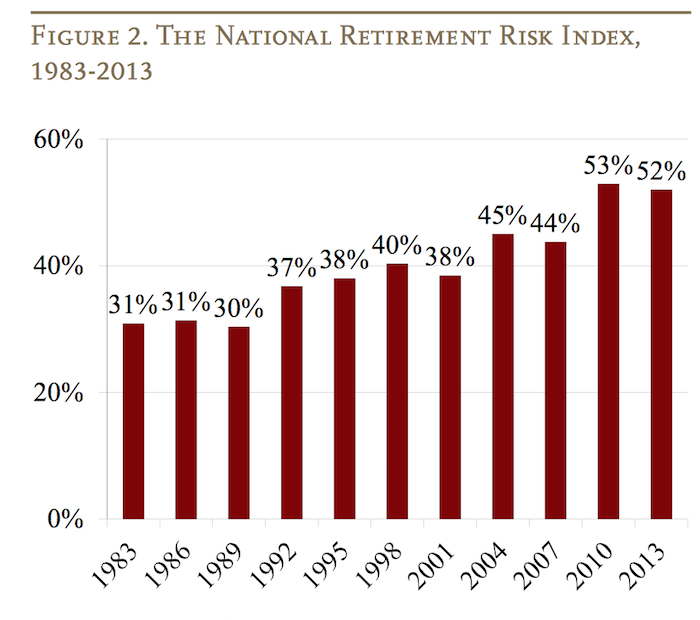
    The Center for Retirement Research at Boston College is a tremendous resource for those planning for, or in, retirement. The center created the National Retirement Risk Index (NRRI) to capture a macroeconomic level measure of how those in the USA are progressing toward retirement.

    Based on the Federal Reserve’s 2013 Survey of Consumer Finances the Center updated the NRRI results (the entire article is a very good read).

    The NRRI shows that, as of 2013, more than half of today’s households will not have enough retirement income to maintain their pre-retirement standard of living, even if they work to age 65 – which is above the current average retirement age – and annuitize all their financial assets, including the receipts from a reverse mortgage on their homes. The NRRI clearly indicates that many Americans need to save more and/or work longer.
    chart of USA retirement risk index from 1983 to 2013
    from the NRRI report.

    The lower the risk number in the chart the better, so things have not been going well since the 1990s for those in the USA saving for retirement.

    As the report discusses their are significant issues with retirement planning that defy easy prediction; this makes things even more challenging for those saving for retirement. The report discusses the difficulty placed on retirees by the Fed’s extremely low interest rate policy (a policy that provides billions each year to too-big-too-fail banks – hardly the reward that should be provided for bringing the world to economic calamity but never-the-less that transfer of wealth from retirees to too-big-to-fail banks is the policy the Fed has chosen).

    That exacerbates the problems of too little savings during the working career for those in the USA. The continued evidence is that those in the USA continue to spend too much today and save too little. Also you have to expect the Fed and politicians will continue to make policy that favors their friends at too-big-fail banks and hedge funds and the like. You can’t expect them to behave differently than they have been the last 50 years. That means the likely actions by the government to take from median income people to aid the richest 1% (such as bailing out the bankers with super low interest rate policies and continue to subsidize losses and privatize their winning bets) will continue. You need to have extra savings to support those policies. Of course we could change to do things differently but there is no realistic evidence of any move to do so. Retirement planning needs to be based on evidence, not hopes about how things should be.

    Related: How Much of Current Income to Save for RetirementSave What You Can, Increase Savings as You Can Do SoDon’t Expect to Spend Over 4% of Your Retirement Investment Assets AnnuallyRetirement Planning: Looking at Assets (2012)How Much Will I Need to Save for Retirement? (2009)

  • The 20 Most Valuable Companies in the World

    The 10 publicly traded companies with the largest market capitalizations.

    Company Country Market Capitalization
    1 Apple USA $626 billion
    2 Exxon Mobil USA $405 billion
    3 Microsoft USA $383 billion
    4 Google USA $379 billion
    5 Berkshire Hathaway USA $337 billion
    6 Johnson & Johnson USA $295 billion
    7 Wells Fargo USA $270 billion
    8 GE USA $260 billion
    9 Wal-Mart USA $246 billion
    10 Alibaba China $246 billion

    Alibaba makes the top ten, just weeks after becoming a publicly traded company. The next ten most valuable companies:

    Company Country Market Capitalization
    11 China Mobile China $240 billion*
    12 Hoffmann-La Roche Switzerland $236 billion
    13 Procter & Gamble USA $234 billion
    14 Petro China China $228 billion
    15 ICBC (bank) China $228 billion**
    16 Royal Dutch Shell Netherlands $227 billion
    17 Novartis Switzerland $224 billion
    18 Nestle Switzerland $224 billion***
    19 JPMorgan Chase USA $224 billion
    20 Chevron USA $210 billion

    Petro China reached to top spot in 2010. I think NTT (Japan) also made the top spot (in 1999); NTT’s current market cap is $66 billion.

    Market capitalization shown are of the close of business today, as shown on Yahoo Finance.

    According to this March 2014 report the USA is home to 47 of the top 100 companies by market capitalization. From 2009 to 2014 that total has ranged from 37 to 47.

    The range (during 2009 to 2014) of top 100 companies by country: China and Hong Kong (8 to 11), UK (8 to 11), Germany (2 to 6), France (4 to 7), Japan (2 to 6), Switzerland (3 to 5).

    Related: Stock Market Capitalization by Country from 1990 to 2010Global Stock Market Capitalization from 2000 to 2012Investing in Stocks That Have Raised Dividends ConsistentlyThe Economy is Weak and Prospects May be Grim, But Many Companies Have Rosy Prospects (2011)

    A few other companies of interest:
    Facebook, USA, current market cap is $210 billion.
    Pfizer, USA, $184 billion.
    Toyota, Japan, $182 billion.
    (more…)

  • Could Amazon Significantly Impact Google’s Adsense Income?

    Amazon Prepares Online Advertising Program

    The people familiar with the matter said Amazon’s offering would resemble Google’s AdWords, the engine that Google uses to place keyword-targeted ads alongside Google search results and on more than two million other websites. AdWords is the foundation of Google’s roughly $50 billion-a-year advertising business, and Google counts Amazon as one of its biggest buyers of text link ads.

    This is potentially a real risk to Google. The odds of such a huge success it decreases Google’s profits are tiny (I think). But there is a real risk that the increase in Google’s profits going forward are materially affected by a well done competitor to Adsense.

    Adwords is Google’s platform for buying ads. Those ads are then displayed on Google’s websites and on millions of other websites. Other websites can host ads via the Adsense program. It seems to me what is really at risk is better seen as Adsense business. The business on Google’s own websites is not at risk (Google’s profit from its sites are double I think all the other sites [via Adsense] combined).

    If Amazon took away 10% of what Google’s Adsense business 4 years would have been that is likely material to Google’s earning. Not huge but real.

    Even losing the ads on Amazon’s web site is likely noticeable (though not a huge deal, for Google, for many companies it would be significant, I would guess).

    There is even the potential Google has to reduce their profitability, on Adsense, to compete – giving web sites a better cut of revenue.

    (more…)

  • Index Fund Beats Hedge Funds

    Hedge funds seek to pay the managers extremely well and claim to justify enormous paydays with claims of superior returns. Markets provide lots of volatility from which lots of different performances will result. Claiming the random variation that resulted in the superior performance of there portfolio as evidence the deserve to take huge payments for themselves from the current returns is not sensible. But plenty of rich people fall for it.

    As I have written before: Avoiding Hedge Fund Investments is One of the Benefits of Being in the 99%.

    This is pretty well understood by most knowledgeable investors, financial planners and investing experts. But funds that charge huge fees continue to get away with it. If you are smart you will avoid them. A few simple investing rules get you well into the top 10% of investors

    From a personal finance perspective, saving money is a key. Most people fail at being decent investors before they even get a chance to invest by spending more than they can afford and failing to save, and even worse going into debt (other than to some extent for college education and house). Consistently putting aside 10-20% of your income and investing wisely will put you in good shape over the long term.

    (more…)

  • All-weather Portfolio

    Brett Arends writes about the investment portfolio he uses?

    what is in this all-weather portfolio?

    It’s 10% each in the following 10 asset classes:

    • U.S. “Minimum Volatility” stocks
    • International Developed “Minimum Volatility” stocks
    • Emerging Markets “Minimum Volatility” stocks
    • Global natural-resource stocks
    • US Real Estate Investment Trusts
    • International Real Estate Investment Trusts
    • 30-Year Zero Coupon Treasury bonds
    • 30-Year TIPS
    • Global bonds
    • 2-Year Treasury bonds (cash equivalent)

    This is another interesting portfolio choice. I have discussed my thoughts on portfolio choices several times. This one is again a bit bond heavy for my tastes. I like the global nature of this one. I like real estate focus – though as mentioned in previous articles how people factor in their personal real estate (home and investments) needs to be considered.

    Related: Cockroach PortfolioLazy Golfer PortfolioInvestment Risk Matters Most as Part of a Portfolio, Rather than in IsolationLooking for Dividend Stocks in the Current Extremely Low Interest Rate Environment