Tag: Investing

  • Solar Direct Investing Bonds

    Mosaic offers a new investment option to easily invest in solar energy projects. Mosaic connects investors seeking steady, reliable returns to high quality solar projects. To date, over $2.1 million has been invested through Mosaic and investors have received 100% on-time repayments.

    The site provides full prospectives on each project. The yields have been between 4.5% and 5% for 8 to 10 year projects. The funds pay for solar installation and then the locations that take the loans pay them back with the saving on their electricity bill (sometimes selling power to the utility based on the organizations electricity needs and amount generated at any specific time).

    The bonds have risks, of course. And I am pretty sure they are very illiquid. But for those looking for some decent yield alternatives they may offer a good choice. They also provide the benefit of supporting green energy

    The current bond being offered, 657 kW on Pinnacle Charter School in Federal Heights, Colorado offers a yield of 5.4%. The public offerings have only been available for a few months and they have sold out quickly so far.

    Mosaic has done a good job creating a simple process to invest online. You create your account and if you chose to invest and are allocated a portion of an offering it is funded from your bank account. You can invest as little as $25.

    Related: Looking for Yields in Stocks and Real EstateTaking a Look at Some Dividend AristocratsPay as You Go Solar in Indiaposts on solar energy on Curious Cat Science and Engineering blog

  • 12 Stocks for 10 Years – May 2013 Update

    The 12 stock for 10 years portfolio consists of stocks I would be comfortable putting into an IRA for 10 years. The main criteria is for companies with a history of large positive cash flow, that seemed likely to continue that trend.

    Since April of 2005 the portfolio Marketocracy* calculated annualized rate or return (which excludes Tesco) is 7.5% (the S&P 500 annualized return for the period is 6.8%).

    Marketocracy subtracts the equivalent of 2% of assets annually to simulate management fees – as though the portfolio were a mutual fund – so without that (it is not like this portfolio takes much management), the return beats the S&P 500 annual return by about 270 basis points annually (9.5% to 6.8%). And I think the 270 basis point “beat” of the S&P rate is really under-counting as the 200 basis point “deduction” removes what would be assets that would be increasing (so the gains that would have been made on the non-existing deductions in the real world – are missing). Tesco reduces the return, still I believe the rate would stay close to a 200 basis point advantage.

    I make some adjustments (selling of buying a bit of the stocks depending on large price movements – this rebalances and also lets me sell a bit if I think things are getting highly priced and buy a bit if they are getting to be a better bargin). So I have sold some Amazon and Google as they have increased greatly and bought some Toyota as it declined (and now sold a bit of Toyota as it soared). This purchases and sales are fairly small. Those plus changes (selling Dell and buying Apple for example) have resulted in a annual turnover rate under 5%.

    I am strongly considering buying ABBV and maybe ABT. Abbot recently split into these 2 separate companies. I probably would have added this last year but I wasn’t sure what to do given the breakup so I waited (luckily I bought it, personally, as they have performed quite well) I may also sell some or all of Tesco and PetroChina.

    The current stocks, in order of return:

    Stock Current Return % of sleep well portfolio now % of the portfolio if I were buying today
    Amazon – AMZN 486% 8% 8%
    Google – GOOG 311% 17% 15%
    PetroChina – PTR 104% 6% 6%
    Templeton Dragon Fund – TDF 89% 4% 4%
    Danaher – DHR 78% 9% 9%
    Toyota – TM 70% 13% 11%
    Templeton Emerging Market Fund – EMF 50% 6% 8%
    Apple – AAPL 22% 12% 15%
    Pfizer – PFE 20% 7% 7%
    Cisco – CSCO 19% 4% 5%
    Intel – INTC 9% 7% 7%
    Cash 7%* 4%
    Tesco – TSCDY -5%** 0%* 4%

    The current marketocracy results can be seen on the Sleep Well marketocracy portfolio page.

    Related: 12 Stocks for 10 Years: Oct 2012 Update12 Stocks for 10 Years, July 2011 Update12 Stocks for 10 Years, July 2009 Updatehand selected articles on investing

    (more…)

  • Real Estate Tax Compared to Rental Income in Several Cities in the USA

    I was just taking a look at a couple of properties in Zillow and found it interesting how big the real estate tax bite can be. I have 2 rental properties and the real estate tax cost is 15% and 12% of the rental income. At least for my area Zillow underestimate rent rates (the vacancy rate is very low and properties in general rent within days or weeks – at rates 10%+ higher than Zillow estimates on average -based on my very limited sample of just what I happen to notice).

    I thought I would look at the real estate tax to property value estimate and rent estimate by Zillow in Various locations.

    Arlington, Virginia – real estate taxes were 1% of estimated property value and 17.5% of rental estimate.
    Chapel Hill, North Carolina – 1.5% of value and 41% of rental estimate.
    Madison, Wisconsin – 2.4% of value and 39% of rental estimate.
    Flagstaff, Arizona – .7% of value and 9.5% of rental estimate.
    Grand Junction, Colorado – .4% of value and 6% of rental estimate.

    This is just an anecdotal look, I didn’t try to get a basket of homes in each market I just looked at about 1-5 homes so there is plenty of room for misleading information. But this is just a quick look and was interesting to me so I thought I would share it. While the taxes are deductible (from the profit of the rental property) they are a fixed expense, whether the house is rented or not that expense must be paid.

    A high tax rate to rental rate is a cash flow risk – you have to make that payment no matter what.

    In my opinion one of the most important aspects of rental property is keeping the units rented. The vacancy rate for similar properties is an extremely important piece of data. Arlington, Virginia has an extremely low vacancy rate. I am not sure about the other locations.

    I wanted to use Park Slope, Brooklyn, NYC but the data was confusing/limited… so I skipped it; the taxes seemed super low.

    Related: USA Housing Rents Increased 5.4% in the Last Year (Sep 2012)USA Apartment Market in 2011Top Markets in the USA for Buying Rental Property (2011)
    Home Values and Rental Rates

  • Is it Time to Sell Apple?

    No, it is not time to sell Apple, if your portfolio is not already too heavily overweighted in Apple it would make sense to buy. There is about as much wrong with Apple today as Toyota 3 years ago, which means essentially nothing is wrong. Yes, neither company is perfect. Maybe people were carried away with how awesome Apple was, but I don’t think the stock price every was.

    Apple was a great buy at $700. Of course in the same situation buying it at $500 would be even better. I think it is a great buy at $500 today. I think Apple is going to move ahead just as Toyota has the last few years. The people jumping around at every single rumor of a data point are going beyond reacting to each data point they are reacting to rumors of data points.

    I could be wrong. If Apple’s earnings cave over the next 5 years people can claim they say early signals. After a long time watching investors react to data and rumors and speculation I think they are just being foolish. Even if Apple is deteriorating, there needs to be a much better explanation for why investors should believe that than I have seen.

    The best reason to question Apple is how long of a run they are on. Figuring the “law” of convergence in mean should make investors wary. That isn’t really true but that idea – that you just don’t stay on such a run (especially when you are huge and the have the largest market capitalization in the world).

    But that is more just saying Toyota can’t keep being awesome. There is some sense that most likely they will stumble. But the problem is it is more likely about every other company will stumble first. The winners keep winning more than they start failing. But they also do often start failing. 100 years from now there is a decent chance Apple doesn’t exist. But there is a greater change most of the other companies you can invest in won’t. And there is a greater chance most other investments will do worse than Apple. That is my guess. Other investors get to place their money where there mouth is and we will see in 5 and 10 years how things stand.

    I’ll stick with Apple and Toyota and Google and Danaher and Intel and….

    Related: Apple’s Earning are Again Great, Significantly Exceeding High Expectations (April 2012)Apple Tops Google (Aug 2008)12 Stocks for 10 Years: Oct 2010 Update

  • Withdrawing Huge Amounts of Cash From Companies You Saddle with Debt is Despicable Behavior

    Bain Capital is a product of the Great Deformation by David Stockman

    Bain’s billions of profits were not rewards for capitalist creation; they were mainly windfalls collected from gambling in markets that were rigged to rise.

    Except Mitt Romney was not a businessman; he was a master financial speculator who bought, sold, flipped, and stripped businesses. He did not build enterprises the old-fashioned way—out of inspiration, perspiration, and a long slog in the free market fostering a new product, service, or process of production. Instead, he spent his 15 years raising debt in prodigious amounts on Wall Street so that Bain could purchase the pots and pans and castoffs of corporate America, leverage them to the hilt, gussy them up as reborn “roll-ups,” and then deliver them back to Wall Street for resale—the faster the better.

    That is the modus operandi of the leveraged-buyout business, and in an honest free-market economy, there wouldn’t be much scope for it because it creates little of economic value. But we have a rigged system—a regime of crony capitalism—where the tax code heavily favors debt and capital gains, and the central bank purposefully enables rampant speculation by propping up the price of financial assets and battering down the cost of leveraged finance.

    So the vast outpouring of LBOs in recent decades has been the consequence of bad policy, not the product of capitalist enterprise.

    I abhor the subsidies provided to those that saddle corporations (that build up value through decades of hard work by employees) with huge debt. The actions of leveraged by out firms are atrocious. They seek to pretend that business is once again the land of the amoral behavior, as the robber barron’s sought to convince society of long ago. Those that saddle corporations (that have an obligation to those that built them up) with huge debt are despicable.

    Those same despicable people then take huge amounts of cash (for themselves) from the debt they saddled the corporation with.

    Quite a few smart people have figured out how to pay congress to allow those smart people to take huge profits out of businesses. By being smart enough to have congress create laws to allow their behavior they can say it was just doing what the law allowed. When you conspire with the authorities to create a system to drain cash from legitimate businesses into your pocket you can claim you are acting legally (if you do so by having them change the law, instead of having them just ignore the existing laws). But what is being done (for decades by both parties) by those we continue to elect to allow this behavior shows just how corrupt the system is.

    It is sad we allow those politicians who payoff those that give them large amount of cash, at the expense of our society, to remain in office. But we don’t even discuss the issues in any significant sense. Those using this cronyism and corruption know they are continuing to be given the open door to continue their very destructive ways. These are smart people. They know how to use public apathy and rhetoric to keep from discussing the important issues. It is going to take us to stop the corrupting cronyism that has taken over our political parties.

    Related: Too Much Leverage Killed MervynsFailed Executives Use Leverage to Increase Their Pay, Let Others Bailouts LaterExecutives Treating Corporate Treasuries as Their Money, A Sad State of AffairsCEOs Plundering Corporate CoffersLeverage, Complex Deals and ManiaLooting: Bankruptcy for Profit

  • 12 Stocks for 10 Years – October 2012 Update

    The 12 stock for 10 years portfolio consists of stocks I would be comfortable putting into an IRA for 10 years. The main criteria is for companies with a history of large positive cash flow, that seemed likely to continue that trend.

    Since April of 2005 the portfolio Marketocracy* calculated annualized rate or return (which excludes Tesco) is 7.1% (the S&P 500 annualized return for the period is 5.4%).

    Marketocracy subtracts the equivalent of 2% of assets annually to simulate management fees – as though the portfolio were a mutual fund – so without that (it is not like this portfolio takes much management), the return beats the S&P 500 annual return by about 370 basis points annually (9.1% – 5.4%). And I think the 370 basis point “beat” of the S&P rate is really under-counting as the 200 basis point “deduction” removes what would be assets that would be increasing (so the gains that would have been made on the non-existing deductions in the real world – are missing). Tesco reduces the return, still I believe the rate would stay above a 300 basis point advantage.

    The current stocks, in order of return:

    Stock Current Return % of sleep well portfolio now % of the portfolio if I were buying today
    Amazon – AMZN 473% 11% 8%
    Google – GOOG 252% 18% 15%
    PetroChina – PTR 104% 6% 6%
    Apple – AAPL 94% 15% 13%
    Templeton Dragon Fund – TDF 84% 6% 4%
    Danaher – DHR 60% 10% 10%
    Templeton Emerging Market Fund – EMF 43% 5% 8%
    Pfizer – PFE 6% 6% 7%
    Toyota – TM 5% 7% 12%
    Intel – INTC 1% 5% 7%
    Cisco – CSCO -3% 3% 4%
    Cash 8%* 4%
    Tesco – TSCDY -18%** 0%* 5%

    The current marketocracy results can be seen on the Sleep Well marketocracy portfolio (the site broke the link, so I removed the link).

    Related: 12 Stocks for 10 Years: Jan 2012 Update12 Stocks for 10 Years, July 2011 Update12 Stocks for 10 Years, July 2009 Updatehand picked articles on investing
    (more…)

  • US Treasury Yield Fall to New Record Low

    Us treasury yield hit a incredibly low level years ago and they have continued to fall further. Granted this is mainly due to the bailout of the economy necessitated by the politicians favors to the too-big-too-fail financial institutions that have given those politicians so much cash over the years. Other factors are at play but the extent of the excessive punishment of savers is mainly due to political bailouts of bankers and bailouts of the economy caused by the bankers actions.

    This extremely low rate environment is crippling to many retirees. The small percentage that actually did what they were told to have been blindsided by years of artificially low rates (and it is likely to continue for years). This has pushed some that would have been comfortable in retirement into an uncomfortable one an has pushed some from a challenging balancing act to essentially having to eliminate every possible expense (and even that may not be enough).

    I can’t believe long term bonds are a sensible investment now. Of course I haven’t thought they were for 10 years, but they are even worse now. Bonds of “strong” governments (USA, Germany, Japan) are paying less than inflation (sometimes even less than 0 nominally – I think this has just been for short term issues so far).

    I cannot see putting more than token amounts into long term bonds at these rates. Corporate bonds are not much better. The economic damaged caused by out of control too-big-too-fail institution is huge and continuing. And the politicians that have been paid lots of cash by those too-big-too-fail institutions continue to treat the too-big-too-fail players are favored friends. The yields are corporate bonds are not good for companies that are strong.

    The alternatives are not great. But real assets, strong dividend stocks, strong company stocks, and short term bonds seem like better options to me in many cases. And hope we elect people that will put the economic interest of the country ahead of a few well paid friends at too-big-too-fail institution. They also need to eliminate the captured “regulators” that have facilitated the continued wrecking of the global economy. I don’t hold out much hope for this though. We keep re-electing those given lots of cash by the too-big-too-fail crowd and they continue giving them favors. We are getting what we deserve given this poor performance on our part but it is pretty annoying having to watch us vote ourselves into economic calamity.

    Related: Buffett Cautions Against Buying Long Term USD BondsIs Adding More Banker and Politician Bailouts the Answer?Bill Gross Warns Bond InvestorsCongress Eases Bank Laws (1999)

  • Curious Cat Investing, Economics and Personal Finance Carnival #34

    Welcome to the Curious Cat Investing, Economics and Personal Finance Carnival. This carnival is different than many blog carnivals: I select posts on those topics from what I read (instead of posting those that submit to the carnival as many carnivals do). If you would like to host the carnival add a comment below.

    photo of a mushroom and a bed of moss
    Mushroom, Rocky Gap State Park, Maryland, USA by John Hunter
    • The U.S. Content of “Made in China” by Galina Hale and Bart Hobijn (SF Federal Reserve) – “Goods and services from China accounted for only 2.7% of U.S. personal consumption expenditures in 2010, of which less than half reflected the actual costs of Chinese imports. The rest went to U.S. businesses and workers transporting, selling, and marketing goods carrying the “Made in China” label.”
    • 7 equations to build a secure retirement by Robert Powell – the equations are not complex but might scare those that don’t like math. Even without really understanding the equations the text is useful.
    • Stock Market Capitalization by Country from 1990 to 2010 by John Hunter – The USA was 32.5% of the total stock market capitalization of the global stock markets in 1990. The USA grew to 46.9% as the tech, finance and housing bubbles were all underway (also Japan was stagnating and the Chinese stock market hadn’t started booming to a significant extent) in 2000. By 2010 the USA was back down to 31.4%.
    • 5 stages of retirement crisis–and what to do about yours by Jim Jubak – “Certainly you weren’t planning for three-month Treasury bills to be paying you 0.08% or 10-year Treasuries 1.61%. And you’re worried by projections that say the real return on stocks going forward is going to be more like 5% (if we’re lucky) than the 7.5% real return that has been the assumption of choice recently. (That assumption replaces the 10% assumption that was the common wisdom in the years before the 2000 bear market.)
    • (more…)

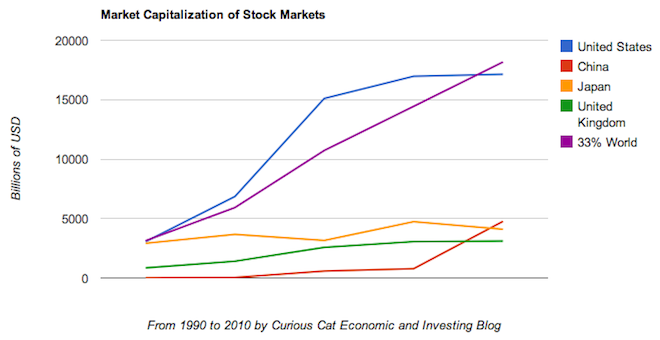
  • Stock Market Capitalization by Country from 1990 to 2010

    The stock market capitalization by country gives some insight into how countries, and stocks, are doing. Looking at the total market capitalization by country doesn’t equate to the stock holdings by individuals in a country or the value of companies doing work in a specific country.

    Chart of largest stock market capitalizations by country from 1990 to 2010
    Chart of largest stock market capitalizations by country from 1990 to 2010

    In the chart, I divided the world total by 3: just to make the chart look better. The USA was 32.5% of the total in 1990. The USA grew to 46.9% as the tech, finance and housing bubbles were all underway (also Japan was stagnating and the Chinese stock market hadn’t started booming to a significant extent). In 2010 the USA was back down to 31.4%. This will likely continue to decrease (at a much slower pace – I wouldn’t be surprised to see the USA at 25% in 2020) as the rest of the world’s markets continue to grow more quickly.

    As with so much recent economic data China’s performance here is remarkable and Japan’s is distressing. China grew from nothing in 1990 to the 2nd largest country in 2010. Hong Kong add another $1 trillion to China’s $4.5 trillion. Canada is the only country above $2 trillion not included on this chart. China grew by $4 trillion from 2005 to 2010.

    Related: Don’t Expect to Spend Over 4% of Your Retirement Investment Assets AnnuallyTop 10 Countries for Manufacturing Production from 1980 to 2010
    Investment Risk Matters Most as Part of a Portfolio, Rather than in IsolationGovernment Debt as Percent of GDP 1998-2010

    (more…)

  • Curious Cat Investing, Economics and Personal Finance Carnival #33

    Welcome to the Curious Cat Investing, Economics and Personal Finance Carnival. The carnival is published twice each month with links to new, related, interesting content online. Greece just voted for the party that wants to attempt to keep Greece in the Eurozone. We will see how that works. I don’t think the odds are great unless Greece is willing to substantially change their recent (last few decades) running of their economy.

    • Big Investors Don’t Know Where to Put Their Cash by Sven Böll and Martin Hesse – “‘In the past, we searched for risk-free returns.’ He pauses for effect. ‘Today we know that what we mainly have are investments with return-free risk.’… Corporate bonds and the sovereign debt of emerging economies, once something for the intrepid, are suddenly seen as safe havens.”
    • Are More Bailouts to Banker and Politicians the Answer to the Credit Crisis Aftermath? by John Hunter – “It feels to me similar to a situation where I have maxed out 8 credit cards and have a little bit left on my 9th. You can say that failing to approve my 10th credit card will lead to immediate pain. Not just to me, but all those I owe money to. That is true. But wasn’t the time to intervene likely when I maxed out my 2nd credit card and get me to change my behavior of living beyond my means then?”
    • my parents in front of the Acropolis in Athens, Greece
      My parents in front of the Acropolis in Athens, Greece. Photo by John Hunter, see more of my photos.
    • The Great Recession is changing our behavior–in ways that point to slower growth for a longer period of time by Jim Jubak – “The third, most powerful in its effects and the least obvious, is the way that the Great Recession has undermined existing belief in financial security. That decline in real and perceived security is likely to change where people put their money, what kinds of returns they think they can count on, and, therefore, how much money they think they can spend and how much they have to put away.”
    • A Global Perfect Storm by Nouriel Roubini – “To prevent a disorderly outcome in the eurozone, today’s fiscal austerity should be much more gradual, a growth compact should complement the EU’s new fiscal compact, and a fiscal union with debt mutualization (Eurobonds) should be implemented. In addition, a full banking union, starting with eurozone-wide deposit insurance, should be initiated, and moves toward greater political integration must be considered, even as Greece leaves the eurozone.
      CommentsUnfortunately, Germany resists all of these key policy measures…”
    • (more…)