Tag: mortgage

  • Fed to Start Buying Treasury Bonds Today

    Fed to start buying T-bonds today, hoping to move rates

    The Federal Reserve will try to get long-term interest rates moving down again when the central bank today launches its first purchases of Treasury bonds. The Fed triggered a stunning drop in Treasury bond yields on March 18 when policymakers surprised Wall Street by announcing a plan to buy up to $300 billion of Treasuries over the next six months.

    The yield on the 10-year T-note plunged to 2.53% on March 18 from 3% the previous day, the biggest one-day drop in decades. But since then, Treasury bond yields have been creeping higher. The 10-year T-note ended Tuesday at 2.65%. Conventional mortgage rates have flattened or inched up, although they remain historically low, in the range of 4.75% to 5%.

    On Tuesday the Treasury sold $40 billion of new two-year T-notes at a yield of 0.95%, which was lower than expected, indicating healthy investor demand. The government will auction $34 billion in five-year notes today and $24 billion in seven-year notes on Thursday. Against numbers like those in just one week, the Fed’s commitment to buy $300 billion of Treasuries over six months doesn’t look like much.

    there’s nothing to stop the Fed from suddenly announcing that its $300-billion commitment will get substantially bigger: The central bank can, in effect, print as much money as it wants to buy bonds — at least, until the day that global investors stop wanting dollars.

    The original announcement caused a dramatic move but since then yields have been drifting up, every day, including today. Rates are already very low. And the huge amount of increased federal borrowing is a potential serious problem for lowering rates. And potentially an even more serious problem is foreign investors deciding the yield does not provide a good investment given the risks of inflation (I know that is how I feel). It will be interesting to see what happens with rates.

    Related: Who Will Buy All the USA’s Debt?Lowest 30 Year Fixed Mortgage Rates in 37 Yearsmortgage terms

  • Federal Reserve to Buy $1.2T in Bonds, Mortgage-Backed Securities

    I make a point of showing the discount rate changes by the Fed don’t translate to mortgage rate changes. I do so because many people think the discount rate does directly effect mortgage rates. But the Fed announced today, actions that actually do impact mortgage rates.

    Federal Reserve to Buy $1.2T in Bonds, Mortgage-Backed Securities

    The central bank will increase its purchases of mortgage-backed securities by $750 billion, on top of a previously announced $500 billion. It also will double its purchases of debt in Fannie Mae and Freddie Mac to $200 billion. Those steps are intended to lower mortgage rates. The announcement of the previous purchases pushed mortgage rates down a full percentage point.

    If you are looking at refinancing your mortgage now (or soon) might be a good time, rates were already very low and will be declining. And if you own long term bonds you just got a nice increase in your value (bond prices move up when interest rates move down).

    Related: Lowest 30 Year Fixed Mortgage Rates in 37 YearsLow Mortgage Rates Not Available to EveryoneWhy do we Have a Federal Reserve Board?

  • Over Half of 2008 Foreclosures From Just 35 Counties

    More than half of the nation’s foreclosures last year took place in 35 counties

    Those counties, spread over a dozen states, accounted for more than 1.5 million foreclosure actions last year, a USA TODAY analysis of figures compiled by the real estate listing firm RealtyTrac shows — more than were recorded in the entire United States just two years earlier.

    A few of the 35 counties leading the foreclosure boom are in already-distressed areas around Detroit and Cleveland. But most are clustered in places such as Southern California, Las Vegas, Phoenix, South Florida and Washington, where home values shot up dramatically in the first half of the decade, then began to crumble.

    The worst-hit counties are home to about 20% of U.S. households, but accounted for just over 50% of the nation’s foreclosure actions last year, driving most of the national increase. And even among those places, a few stand out: Eight counties in Arizona, California, Florida and Nevada were the source of about a quarter of the nation’s foreclosures last year.

    In more than 650 other counties – about a fifth of the nation – the number of foreclosure actions actually dropped since 2006.

    Related: Freezing Mortgage RatesNearly 10% of Mortgages Delinquent or in ForeclosureJumbo Loan Defaults Rise at Fast PaceIgnorance of Many Mortgage Holders

  • Making Money Buying Distressed Mortgages

    Ex-Leaders at Countrywide Start Firm to Buy Bad Loans

    PennyMac, whose full legal name is the Private National Mortgage Acceptance Company, also received backing from BlackRock and Highfields Capital, a hedge fund based in Boston. It makes its money by buying loans from struggling or failed financial institutions at such a huge discount that it stands to profit enormously even if it offers to slash interest rates or make other loan modifications to entice borrowers into resuming payments.

    Its biggest deal has been with the Federal Deposit Insurance Corporation, which it paid $43.2 million for $560 million worth of mostly delinquent residential loans left over after the failure last year of the First National Bank of Nevada. Many of these loans resemble the kind that Countrywide once offered, with interest rates that can suddenly balloon. PennyMac’s payment was the equivalent of 38 cents on the dollar, according to the full terms of the agreement.

    Under the initial terms of the F.D.I.C. deal, PennyMac is entitled to keep 20 cents on every dollar it can collect, with the government receiving the rest. Eventually that will rise to 40 cents.

    Phone operators for PennyMac — working in shifts — spend 15 hours a day trying to reach borrowers whose loans the company now controls. In dozens of cases, after it has control of loans, it moves to initiate foreclosure proceedings, or to urge the owners to sell the house if they do not respond to calls, are not willing to start paying or cannot afford the house. In many other cases, operators offer drastic cuts in the interest rate or other deals, which PennyMac can afford, given that it paid so little for the loans.

    But a PennyMac representative instead offered to cut the interest rate on their $590,000 loan to 3 percent, from 7.25 percent, cutting their monthly payments nearly in half, Ms. Laverde said.

    This is one way the economy cleans up messes. A foolish organization lends money (or buys mortgages, loans…) to lots of people that couldn’t pay back and they then sell those loans at a big discounts. The new owners of the loans now have this mortgage that the homeowner can’t afford. But the cost of the mortgage to them wasn’t anywhere near the amount the homeowner owes. So the new buyer can make a great deal of money just by getting the homeowner to start paying again (even if it is at a much lower rate). They can also make money by foreclosing and then selling the property but truthfully if they can get the homeowner to pay that is likely a much better quick profit for them (and they can then sell the performing loan to someone else – I would imagine). Who knows if PennyMac will make a ton of money this way, but I fully expect many organizations to do so.

    Related: Nearly 10% of Mortgages Delinquent or in ForeclosureLearning About MortgagesHow Much Further Will Housing Prices Fall?Jumbo v. Regular Fixed Mortgage Rates: by Credit Score

  • House of Cards – Mortgage Crisis Documentary

    A documentary of the mortgage crisis by CNBC: House of Cards. It is a bit slow and simple but still for people that don’t really understand the basics of what happened it is interesting.

    Related: Nearly 10% of Mortgages Delinquent or in ForeclosureIgnorance of Many Mortgage Holders (2007)How Not to Convert Equitymortgage terms

  • Low Mortgage Rates But High Eligibility Requirements

    Low Mortgage Rates a Mirage as Fees Climb, Eligibility Tightens

    The average rate on a 30-year fixed mortgage dropped to 5.07 percent for the week ending Feb. 26 from 6.63 percent for the one ending July 24

    “A score of 700 was once near perfect,” said Gwen Muse Evans, vice president of credit policy at Fannie Mae, the government-controlled company that helps set lending standards. “Today, a 700 performs more like a 660 did. We have updated our policy to take into account the drift in credit scores.”

    Consumer credit scores, called FICOs after creator Fair Isaac Corp., range from 300 to 850. The average FICO score on mortgages bought by Freddie Mac and Fannie Mae rose to 747.5 in the fourth quarter of last year from 722.3 in 2005, according to Inside Mortgage Finance.

    Accunet’s Wickert said that a 660 FICO score would have qualified most borrowers for loans with no upfront fees in the past. Now, someone trying to borrow $200,000 with a 660 score would have to pay a 2.8 percent fee, or $5,600, he said. Even someone with a 719 score would have to pay $1,750 in cash.

    The low mortgage rates are attractive but a decision to re-finance (or buy) must consider the long term implications. Also if you are re-financing to take advantage of the low rates consider a 20 year or 15 year loan if you are already well into your 30 year loan. A fixed rate loan is the most sensible option at this time.

    Related: Low Mortgage Rates Not Available to Everyone30 Year Fixed Mortgage Rates and the Fed Funds Rate ChartIgnorance of Many Mortgage HoldersFed Plans To Curb Mortgage ExcessesHow Not to Convert Home Equity

  • Jumbo Loan Defaults Rise at Fast Pace

    Jumbo Loan Defaults Rise at Fast Pace as Rich Suffer

    About 2.57 percent of prime borrowers who took out jumbo loans last year were at least 60 days delinquent

    2.57% of homeowners with jumbo mortgage are 60 days late, of those that just got loan last year! That is crazy. These kinds of figures are astounding to me. I am still (posted Feb 2007) amazed that 4.4% is the historic low for mortgages over a month late.

    About 1.92 percent of homeowners with 2008 mortgages backed by Fannie Mae and Freddie Mac fell at least 60 days behind, LPS Applied Analytics said. Jumbo loans are bigger than what the two government-controlled agencies buy or guarantee, and Obama’s plan focuses on shoring up mortgages eligible to be bought by Fannie and Freddie.

    The top five U.S. jumbo lenders — Chase Home Finance LLC, Bank of America Corp., Washington Mutual Inc., Wells Fargo & Co. and Citigroup Inc. — originated a combined $55.3 billion in jumbos in 2008. They lent just $4.3 billion of that during the last three months of the year, according to Inside Mortgage Finance.

    The national average for a 30-year fixed-rate jumbo mortgage was 6.57 percent this week compared with 5.34 percent for a conforming loan, according to White Plains, New York-based financial data provider BanxQuote.

    Related: The Impact of Credit Scores and Jumbo Size on Mortgage RatesLow Mortgage Rates Not Available to Everyone30 Year Fixed Mortgage Rates and the Fed Funds Rateposts about mortgages

  • The Impact of Credit Scores and Jumbo Size on Mortgage Rates

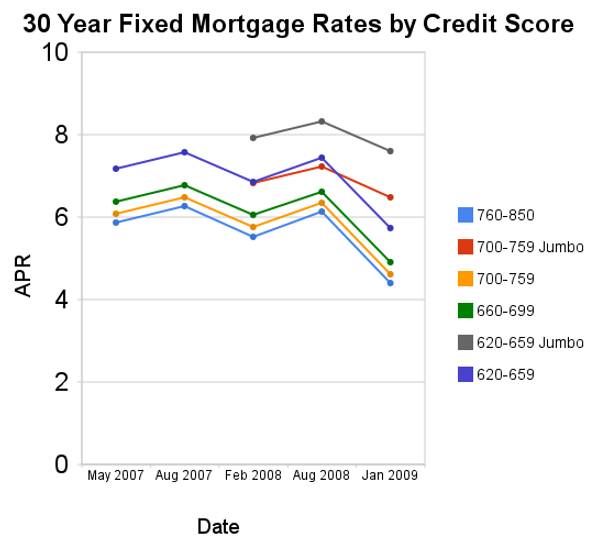
    Since August of 2008 conforming mortgage rates are have declined a huge amount. Jumbo rates have fallen a large amount also, but much less (for example for a credit score of 700-759 the jumbo rates declined 73 basis points while the conventional rate declined 172 basis points.

    chart of 30 year fixed mortgage rates by credit score from May 2007 to Jan 2009

    For scores above 620, the APRs above assume a mortgage with 1 point and 80% Loan-to-Value Ratio. For scores below 620, these APRs assume a mortgage with 0 points and 60 to 80% Loan-to-Value Ratio. You can see, with these conditions the rate difference between a credit score of 660 and 800 is not large (remember this is with 20% down-payment) and has not changed much (the difference between the rates if fairly consistent).

    Related: Low Mortgage Rates Not Available to Everyone30 Year Fixed Rate Mortgage Rate DataReal Free Credit Report (in USA)Jumbo Mortgage Shoppers Get Little Relief From Ratesposts on mortgages
    (more…)

  • Low Mortgage Rates Not Available to Everyone

    The lowest 30 Year fixed mortgage rates in 37 years is great news for those looking to buy a house or to re-finance. However, that truth (the lowest rate) masks another truth, that it is available to a somewhat limited pool of borrowers. The rates for jumbo 30 year fixed mortgages and for regular 30 year fixed mortgages, for those with lower credit ratings, are not at the lowest rates they have ever reached. And getting mortgage rates that don’t require a 10-20% down payment and fully documented financial position are not as low as they have ever been. 15 year fixed rates are also low, but are not at all time lows. FHA loans still allow very low down payments, but others have moved away from this practice (which is a wise move).

    Current rates, national average, from Bankrate: 30 year fixed 5.26%, 30 year fixed jumbo 6.96% (a full 170 basis points higher rate), 15 year fixed 5.07%. Jumbo rates have been less than 40 basis points higher than conventional rates most of time (based on my memory – I am looking for a source to confirm). The site does not present the credit score but my guess is these rates are based on a credit score of 700, or higher. Last week the jumbo rates increased by 11 basis points and regular 30 year rates fell by 3 basis points.

    Related: Jumbo v. Regular Fixed Mortgage Rates: by Credit Scorehistorical mortgage rate chartNearly 10% of Mortgages Delinquent or in Foreclosuremisinterpreting data

    Changes in the Market For Jumbo Mortgages

    During the period May 4, 2007 to November 7, 2008, the spread in wholesale interest rates between a $417,000 loan eligible for purchase by Fannie Mae and Freddie Mac, and a $418,000 loan that is not eligible, increased from 0.28% to 2.97%.

    On Nov 12, 2008 I shopped for an $800,000 30-year fixed-rate mortgage on Mortgage Marvel, an on-line site that I reviewed earlier in 2008 (see A Look at Mortgage Marvel). The mortgage companies on the site quoted rates of 8.125% to 8.375%. The credit unions and banks, in contrast, quoted rates ranging from 5.875% to 7.875%. I have never before seen rate differences on the same transaction this large. They no doubt reflect wide differences in lender access to funding, which is symptomatic of a market in turmoil.

    Mortgage Q&A

    For example, I see from today’s rate sheet that a homeowner with 40 percent equity and an excellent credit score of 740 would receive a quote of 5.125 percent with no points or origination fees for a 30-year fixed-rate mortgage. A borrower with a credit score of 670 who has 20 percent equity would receive the same rate but would be charged two points. On a $300,000 loan, this makes the 5.25 percent rate $6,000 more expensive. If the homeowner with the lower credit score wanted to pay zero points, the rate would be well north of 6 percent.
  • Lowest 30 Year Fixed Mortgage Rates in 37 Years

    We now have the lowest 30 year fixed mortgage rates since data has been collected (37 years) in the USA. Is this due to the Fed cutting the discount rate? I do not think so. As I have said previously 30 year fixed rates are not correlated with federal reserve rates. But this time the government is actively seeking to reduce mortgage rates.

    U.S. Treasury Secretary Henry Paulson said the Bush administration was looking at ways to lower mortgage rates because it was essential to stem the drop in home prices to foster an economic recovery.

    Mortgage Rate Hits 37-Year Low

    The benchmark 30-year fixed-rate home mortgage in the U.S. fell to a national average of 5.17% this week, the lowest since Freddie Mac began its weekly rate survey in 1971.

    The 15-year fixed-rate mortgage averaged 4.92%, down from last week when it averaged 5.20%. A year ago the 15-year loan averaged 5.79%. The 15-year mortgage hasn’t been lower since April 1, 2004, when it averaged 4.84%.

    Homeowners refinance, put savings under mattress

    This time around, lenders say up to a third of the callers seeking to refinance simply can’t. And if they can, the future savings are headed straight for the piggy bank.

    These rates sure are fantastic if you are in the market. I was not in the market, but I am considering re-financing now. You need to be careful and not just withdraw money because you can. If you can refinance and reduce your payments it may well be a wise move though. One problem can be extending the date you will finally be free of mortgage debt. If you re-finance a current 30 year loan, that you got 5 years ago, you will now be paying 5 more years. One option is to see if you can get a 25 or 20 year loan. Or if you can make a 15 year loan work, do that (15 and 30 year fixed rate mortgages are common).
    (more…)