Tag: mortgage

  • Nearly 10% of Mortgages Delinquent or in Foreclosure

    The percentage of loans in the foreclosure process at the end of the third quarter was 2.97 percent, an increase of 22 basis points from the second quarter of 2008 and 128 basis points from one year ago. The percentage of loans in the process of foreclosure set a new record this quarter, to 1.35 million.

    Mortgages are counted as delinquent or in foreclosure (once they are in foreclosure they are not counted as delinquent). So the total percentage of mortgages not being paid by the homeowner is 2.97% (in foreclosure) + 6.99% (delinquent) = 9.96%. That is amazingly bad. In February of 2007 I wrote about this and the delinquency rate was 4.7% which sounded pretty bad to me. Amazingly 4.4% is a historic low for this figure. Can you believe 1/25 mortgages is delinquent and that is as good as we ever get? That is pretty shocking to me.

    The seasonally adjusted total delinquency rate is now the highest recorded in the Mortgage Bankers Association survey. The seasonally adjusted delinquency rate increased 41 basis points to 4.34 percent for prime loans, increased 136 basis points to 20.03 percent for subprime loans, increased 29 basis points to 12.92 percent for FHA loans, and increased 46 basis points to 7.28 percent for VA loans.

    The percent of loans in the foreclosure process increased 16 basis points to 1.58 percent for prime loans, and increased 74 basis points for subprime loans to 12.55 percent. FHA loans saw an eight basis point increase in the foreclosure inventory rate to 2.32 percent, while the foreclosure inventory rate for VA loans increased 13 basis points to 1.46 percent.

    Since loans that would have gone into foreclosure in the past are being kept out of foreclosure due to some programs ( ) the rate or seriously delinquent is a useful measure of serious problems. Seriously delinquent mortgages are 90 days past due. The rate increased 52 basis points for prime loans to 2.87 percent, increased 171 basis points for subprime loans to 19.56 percent, increased 62 basis points for FHA loans to 6.05 percent, and increased 45 basis points for VA loans percent to 3.45 percent.

    Compared to a year ago: the seriously delinquent rate was 156 basis points higher for prime loans and 818 basis points higher for subprime loans. The rate also increased 51 basis points for FHA loans and 89 basis points for VA loans.

    Related: Homes Entering Foreclosure at Record (Sep 2007)Foreclosure Filings Continue to RiseHow Much Worse Can the Mortgage Crisis Get?How Not to Convert Equity

  • FDIC Details Plan To Alter Mortgages

    FDIC Details Plan To Alter Mortgages

    Officials at the Federal Deposit Insurance Corp. yesterday detailed a plan to prevent 1.5 million foreclosures in the next year by offering financial incentives to companies that agree to sharply reduce monthly payments on mortgage loans.

    Agency officials estimated the cost to the government at $22.4 billion.

    The mortgage industry is concerned that any new modification plan will persuade some people to stop making mortgage payments in addition to helping people who already have stopped making payments. The industry argues this will translate into higher interest rates because investors will demand compensation for the increased risk of loan defaults. That, in turn, would limit the number of people who can afford mortgage loans.

    FDIC estimates that 1.4 million borrowers with such loans are at least two months late on their payments, and another 3 million borrowers will miss at least two payments by the end of next year. The agency estimates that half those borrowers, or about 2.2 million people, would receive a loan modification under the program, and that about 1.5 million will successfully avoid foreclosure.

    Under the terms of the proposed FDIC program, lenders would reduce monthly payments primarily by cutting the borrower’s interest rate to a minimum rate of 3 percent. If necessary, the company could also extend the repayment period on the loan beyond 30 years, reducing each monthly payment. Finally, in some cases, companies could defer repayment of some principal. The borrower still would be on the hook for the full value of the loan.

    Officials said their experience at IndyMac showed that principal reductions were not necessary. So far, FDIC has modified about 20,000 IndyMac loans. In 70 percent of the cases, FDIC was able to create an affordable payment solely by reducing the interest rate. In 21 percent of the cases, the agency also extended the life of the loan. In 9 percent of the cases, it delayed repayment of some principal.

    An interesting proposal I would support. Ideally this type of action would not be necessary but since banks were allowed to degrade their standards so far and allowed to grow so large their failures threaten the economy some radical actions are being taken. Compared to many others this is sensible.

    Related: How Much Worse Can the Mortgage Crisis Get?JPMorgan Chase Freezes Mortgage ForeclosuresFed Plans To Curb Mortgage Excesses (Dec 2007)

  • 30 Year Mortgage Rate and Federal Funds Rate Chart

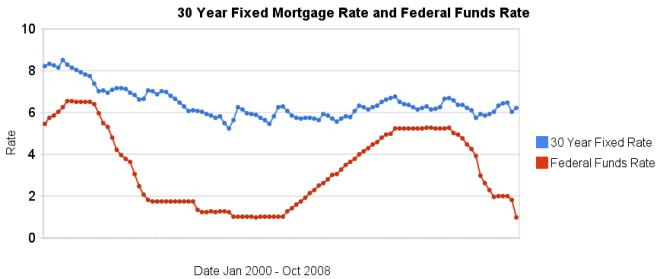
    More dramatic evidence that changing in the federal funds rate do not lead to similar changes in 30 year fixed mortgage rates. It is true the last few months are very unusual times for the credit market. However, the current lack of correlation is not the exception, the graph clearly shows there is very little correlation between changes in the two interest rates.

    30 year fixed mortgage rates and the federal funds rate 2000-2008

    Related: historical comparison of 30 year fixed mortgage rates and the federal funds rateAffect of Fed Funds Rates Changes on Mortgage Ratesposts on financial literacyJumbo v. Regular Fixed Mortgage Rates: by Credit Score

    For more data, see graphs of the federal funds rate versus mortgage rates for 1980-1999. Source data: federal funds rates30 year mortgage rates

  • JPMorgan Chase Freezes Mortgage Foreclosures

    JPMorgan Chase Freezes Foreclosures

    For the next 90 days, JPMorgan will not place any new homes into foreclosure. The banking behemoth, which acquired troubled lender Washington Mutual on Sept. 25, says it hopes to modify terms for 400,000 homeowners, accounting for $70 billion in loans. Among the steps it is taking: eliminating toxic “pay option” loans, offering new loan terms to homeowners before they default

    According to the most recent data compiled by the Hope Now Alliance of lenders, counselers, and other industry players, lenders started the foreclosure process on 565,000 homeowners in this year’s third quarter. Some 265,000 homes were actually foreclosed on, nearly twice the number from the third quarter of 2007. Moreover, more than 2.2 million homeowners are more than 60 days delinquent in their mortgage payments, also a near doubling from last year.

    FDIC Chairman, Sheila Bair, has been encouraging banks to take such action and instituted such action on the mortgages the FDIC acquired when they took over Indymac – Loan Modification Program for Distressed Indymac Mortgage Loans

    IndyMac Federal Bank, FSB (“Indymac Federal”) will implement a new program to systematically modify troubled mortgages. The program is designed to achieve affordable and sustainable mortgage payments for borrowers and increase the value of distressed mortgages by rehabilitating them into performing loans. This in turn will maximize value for the FDIC, as well as improve returns to the creditors of the former IndyMac Bank and to investors in those mortgages.

    Related: Ignorance of Many Mortgage Holders (July 2007)Foreclosure Filings Continue to RiseHistorical 30 Year Fixed Mortgage RatesHomes Entering Foreclosure at Record (Sep 2007)2nd Largest Bank Failure in USA History

  • More Bad News on Inflation

    Wholesale Prices Rising at Fastest Pace Since 1981

    Wholesale prices jumped in July at the fastest rate in more than a quarter century, furthering concern about a continued increase in inflation at a time when economic activity has ebbed.

    New federal government data showed that the cost of materials used by businesses increased 1.2 percent in July and have risen 9.8 percent during the past 12 months. It was the largest yearly increase since 1981, as businesses absorbed sharp increases in energy and other commodity costs.

    Today’s report follows recent news that consumer prices are also rising faster than expected — and faster than the Federal Reserve’s generally accepted target rate of around 2 percent.

    Inflation can cause serious damage to your personal finances. As prices increase if you don’t get a raise (or your investments don’t raise) to match the increased costs you must pay your financial situation deteriorates. One benefit, to those with 30 year fixed rate mortgages, is that you get to pay back your loan with inflated dollars. This can be a huge advantage for some, and a huge loss for whoever holds the mortgage.

    Related: inflation risk for investmentsInflation is a Real ThreatFood Price Inflation is Quite Highposts on inflation

  • Mortgage Costs Rising

    Fannie Mae (the quasi government mortgage giant) is raising fees for mortgages it buys. Banks and mortgage lenders often sell the mortgage to Fannie Mae shortly after completing the loan. Mortgages get more expensive – again

    Fannie increased fees for some loans by a quarter of a percentage point, based on borrowers’ credit scores and the amount of their down payments. It will charge, for example, 1% (up from 0.75%) for a buyer with a credit score of 680 paying 20% down.

    And Fannie doubled its “adverse market delivery charge” to 0.5%. That is an across-the-board fee assessed against every loan Fannie buys, according to a Fannie spokeswoman. Fannie first instituted the charge this spring.

    The added fees will be passed on to borrowers and could mean quarter-point increases in interest rates.

    Fannie will also eliminate buying Alt-A loans by the end of 2008. Alt-A loans, a category between prime and subprime, accounted for about 11% of the company’s loans during the last years of the boom. They have been used mostly by people who couldn’t or wouldn’t document their incomes, their assets or both. These buyers will find it harder to obtain financing once Fannie stops buying the loans.

    According to Yun, however, the cutback in Alt-A will hurt people buying second homes to rent out or resell, rather than first time homeowners. “These are people who often rely on their good credit to buy investment properties putting little or no money down,” he said.

    Related: Mortgage Rates RisingFed Funds Rate Changes Don’t Indicate Mortgage Rate ChangesJumbo and Regular Mortgage Rates By Credit ScoreHomes Entering Foreclosure at Record

  • Jumbo v. Regular Fixed Mortgage Rates: by Credit Score

    Example 30 year mortgage rates (from myfico.com – see site for current rate estimates). Previous posts on this topic: Feb 2008August 2007May 2007. Since the last post both jumbo and conforming mortgages rates are up (and are up most for high credit scores).

    FICO score APR Aug 2008 APR Aug 2008 – jumbo APR Feb 2008 APR Feb 2008 – jumbo APR Aug 2007 APR May 2007
    760-850 6.12% 7.00% 5.53% 6.61% 6.27% 5.86%
    700-759 6.34% 7.22% 5.75% 6.83% 6.49% 6.08%
    660-699 6.62% 7.50% 6.04% 7.12% 6.77% 6.37%
    620-659 7.43% 8.31% 6.85% 7.93% 7.58% 7.18%
    580-619 9.45% 9.63% 9.22% 9.40% 9.32% 8.82%
    500-579 10.31% 10.49% 10.20% 10.37% 10.31% 9.68%

    For scores above 620, the APRs above assume a mortgage with 1.0 points and 80% Loan-to-Value Ratio. For scores below 620, these APRs assume a mortgage with 0 points and 60 to 80% Loan-to-Value Ratio.

    Since February the premium for jumbo loans has decreased to 88 basis points (from 108) for all credit scores above 620 (the combination of higher down payment and higher regular interest rates below 620 result in very little premium from Jumbo loans, under 20 basis points.

    Related: 30 Year Fixed Rate Mortgage Rate DataLearning About MortgagesHow Much Worse Can the Mortgage Crisis Get?Real Free Credit Report (in USA)

  • 2nd Largest Bank Failure in USA History

    I commented on, WaMu Free Checking: The High 3.3% APY May Be Worth A Look, yesterday:

    I agree it is worth considering. It has FDIC insurance. But the bank is not very stable. The stock price, for example, was above 40 in the last year. It is below 5 now. But as long as your entire deposit is covered by FDIC you are in safe (though if a bank goes under – not that likely – there can be a delay in getting your money). Normally a bank’s assets would be bought out by another bank.

    And today I read of the second largest bank failure in the history of the USA, IndyMac Bank seized by federal regulators:

    The Office of Thrift Supervision in Washington, the chief regulator of IndyMac, said it transferred control of the $32-billion bank to the Federal Deposit Insurance Corp. Branches will be closed over the weekend, but the FDIC will reopen the bank Monday as IndyMac Federal Bank, the OTS said.

    Regulators said depositors would have no access to banking services online and by telephone this weekend, but could continue to use ATMs, debit cards and checks. Online banking and phone banking services are to resume operations Monday.

    Federal authorities said based on a preliminary analysis, the takeover of IndyMac would cost the FDIC between $4 billion and $8 billion.

    It is important to make sure your deposits are FDIC insured (in the USA), and to know the limits of the coverage.

    FDIC Failed Bank Information Information for IndyMac Bank, F.S.B., Pasadena, CA

    Principal and interest on insured accounts, through July 11, 2008, are fully insured by the FDIC, up to the insurance limit of $100,000. You will receive full payment for your insured account. Certain entitlements and different types of accounts can be insured for more than the $100,000 limit. IRA funds are insured separately from other types of accounts, up to a $250,000 limit.

    IndyMac was a huge mortgage focused bank. Their stock price had fallen from a high of nearly $30 in the last year to below $5 in April, $2 in May and $1 in June. It is a very good thing we have the FDIC.

    Related: Credit Crisis (August 2007)Credit Crisis ContinuesHomes Entering Foreclosure at Record

  • Foreclosure Filings Continue to Rise

    Foreclosure Filings Continue to Rise

    Foreclosure filings last month were up nearly 50 percent compared with a year earlier, according to one company’s count released yesterday. Nationwide, 261,255 homeowners received at least one foreclosure-related filing in May, up 48 percent from the same month last year, and up 7 percent from April, foreclosure listing service RealtyTrac said.

    last week the Mortgage Bankers Association reported that about 2.47 percent of home mortgages were in foreclosure during the first quarter of the year, almost double the 1.28 percent rate of a year earlier, and the highest point since the group began compiling such figures in 1979. A Credit Suisse report this spring predicted that 6.5 million loans will fall into foreclosure over the next five years, reaching more than 8 percent of all U.S. homes.

    There numbers really are astounding. How lame were the decisions of banks and mortgagees that nearly 1 in 40 mortgages are in default (and that number likely increasing in the next year to much more?

    Related: Homes Entering Foreclosure at Record (Sep 2007)Homes Entering Foreclosure at RecordIgnorance of Many Mortgage Holders

  • 30 Year Conventional Fixed Mortgage Rates Increase

    This year, the average discount rate has fallen every month while the average 30 year mortgage rate has climbed all but 1 month (a 5 basis point drop). In January, 2008 the discount rate averaged 3.94% and 30 year conventional fixed rate mortgages averaged 5.76%. In May, 2008 the discount rate had fallen to 1.98% (for a 196 basis point drop) and 30 year conventional fixed rates had risen to 6.04% (for a 28 basis point increase).

    The chart shows the federal funds rate and the 30 year conventional fixed rate mortgage rate from January 2000 through May 2008 (for more details see: historical comparison of 30 year fixed mortgage rates and the federal funds rate).

    30 year fixed mortgage rates and the federal funds rate 2000 to May 2008

    Related: Affect of Fed Funds Rates Changes on Mortgage Ratesreal estate articlesBond Yields 2005-2008Jumbo and Regular Mortgage Rates By Credit Score
    (more…)