Tag: Personal finance

  • Supplemental Income: Consulting by the Minute

    Trying to create significant supplementary income is not easy. There are lots of people selling get rich quick schemes and ways to earn big money for little effort. But those schemes don’t offer what they claim (they just don’t work for any, but a few people).

    In trying to figure out a good way to create another income stream I thought of the idea of consulting over the internet in very small chunks of time. I explored the options to be a consultant that way and they were not good. But the idea seemed excellent to me and I worked with a friend to develop the idea of us creating such a online service. The potential was great I think. The end service would provide value to those seeking answers and those providing consultation (and to us).

    We did get a domain and plan out the service and begin coding the application but didn’t progress very far. It was still a great idea and something I planned to consider if I had a bit more time. Well there is now an offering that appears to actually be fairly decent (on first glance): Minute Box.

    Minute Box allows you several of the things we planned on offering (but not all of them – at least not yet). You can register as an expert and then be available for those wanting advice. You sign in when you are available to answer questions (and people can send you a note while you are offline). You set your rate. Essentially IM is used for consultation and the billing is taken care of by Minute Box.

    One of the keys is matching people to experts well. Minute Box does one thing we planned on doing, which is to emphasize the experts tapping those that already value their advice. This would work very well for bloggers and those with an online presence and reputation.

    portrait of John Hunter

    I signed up and created my expert account, so if you want to get some advice from me you can get consulting by the minute from John Hunter.

    I think this consulting by the minute model is a great way to create a secondary income stream for those that have a positive online reputation. You can adjust your pay to manage demand. If you have a free week and want to make some extra income you can reduce your rate and offer your readers a special discount. This is potentially a great way to capitalize on your expertise. I haven’t had much experience with Minute Box yet so it isn’t certain they are the answer (but I haven’t seen any other solution that is very good). And no matter the service provider used, I believe the internet enabled micro consulting is a great way to provide some extra income and make your personal finances more robust.

    The range of advice you can offer is huge. For nearly anything there are people that need advice: how to cook thanksgiving dinner, helping a child with math homework, fashion advice, editing a resume, which mortgage offer is better in a specific situation, fixing a bug in a WordPress blog, what are good plants for a shady area… The list is nearly endless.

    I wish I had been able to create a web site to facilitate this process. I believe the potential is huge. That is why I was so interested in making this idea work. It is the only web business I have seriously considered (and even started). I have numerous web sites but they involve providing content online not any software as service businesses.

    Related: Earning More MoneySave Some of Each RaiseIf you can’t pay cash, earn more money or save until you have the cash
  • Curious Cat Investing, Economics and Personal Finance Carnival #19

    Welcome to the Curious Cat Investing and Economics Carnival: find useful recent personal finance, investing and economics blog posts and articles.

  • Looking at the Value of Different College Degrees

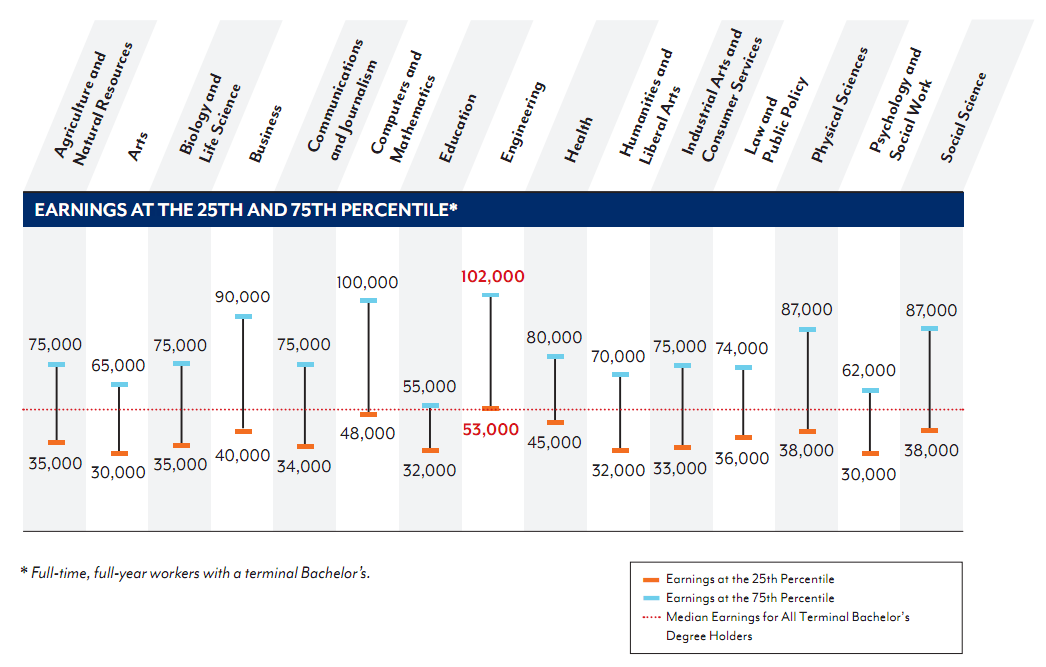
    Georgetown University Center on Education and the Workforce has produced a new report looking at the value of different college degrees in the USA. I have seen a great increase in discussions of the “bubble” in education. Those articles often say a college degree doesn’t assure the success it used to. The data I review seems to show extremely large benefits for those with a college degree (higher salaries but, much more importantly, in my opinion, they also have much lower unemployment rates).

    Those benefits are greatest for several majors including science, math and engineering. The problem I see is not so much that significant benefits are lacking for college degrees but the huge increases in costs of getting a degree are so large that for some majors the cost is just so large that even with the benefits it is arguable whether it is worth the cost (while a few decades ago the benefits were universal and so large the economic benefit was not debatable).

    The authors of the report found that all undergraduate majors are worthwhile, even taking into account the cost of college and lost earnings. However, the lifetime advantage ranges from $1,090,000 for Engineering majors to $241,000 for Education majors. As I have written frequently on the Curious Cat Science and Engineering blog, engineering degrees are very financially rewarding.

    The top 10 majors with the highest median earnings for new graduates are:

    • Petroleum Engineer ($120,000)
    • Pharmacy/pharmaceutical Sciences and Administration ($105,000)
    • Mathematics and Computer Sciences ($98,000)
    • Aerospace Engineering ($87,000)
    • Chemical Engineering ($86,000)
    • Electrical Engineering ($85,000)
    • Naval Architecture and Marine Engineering ($82,000)
    • Mechanical Engineering, Metallurgical Engineering and Mining and Mineral Engineering (each with median earnings of $80,000)
    chart showing the salaries by major in the USA (2009)
    Chart of salaries (25th and 75th percentile) by major in the USA based on data from 2009

    Related: 10 Jobs That Provide a Great Return on InvestmentMathematicians Top List of Best OccupationsNew Graduates Should Live Frugally

    (more…)

  • Curious Cat Investing, Economics and Personal Finance Carnival #18

    Welcome to the Curious Cat Investing, Economics and Personal Finance Carnival: find useful recent personal finance, investing and economics blog posts and articles. If you want to have an post considered for the next carnival please submit it to quixperito: money.

    • How I live on $7,000 per year by Jacob Lund Fisker – “If I had to venture a guess, I’d say I’m more frugal (the way your grandparents were frugal—in fact what I do wouldn’t be considered very extreme by your grandparents or great grandparents—I’d probably be average from their perspective) and I adhere more to a do-it-your-self ethics.”
    • Invest in Communities to Advance Capitalism by Howard Schultz (CEO of Starbucks) – “It is no longer enough to serve customers, employees, and shareholders. As corporate citizens of the world, it is our responsibility — our duty — to serve the communities where we do business by helping to improve, for example, the quality of citizens’ education, employment, health care, safety, and overall daily life, plus future prospects.” [similar to Dr. Deming ideas from decades ago on the purpose of organizations, which I share – John].
    • My dad taught me cashflow with a soda machine by Rob Fitzpatrick – “The vending machine didn’t magically make me want to be an entrepreneur. I wanted to be a video game designer, then an engineer, then a video game designer again, and then an academic. I get the impression kids are a bit slippery in that regard.
      But when I stumbled into the startup world two decades later, the dots began to connect. Cashflow wasn’t a new concept.”
    • photo of path up through the Forest Glen Preserve
      Forest Glen Preserve, Illinois, Illinois by John Hunter
    • Disability Insurance is Very Important by John Hunter – “When I would have had gaps in coverage from work, I have purchased disability insurance myself. I am all in favor of saving money. About the only 2 things I don’t believe in saving money being very important are health and disability insurance.”
    • What Other Dividend Lists Exist Besides the Dividend Aristocrats? – “companies that have increased their annual regular dividends for at least the past 10 consecutive years and have met specific liquidity screening criteria… The members of the Dividend Champions List include, those stocks (not limited to the S&P 500) that have increased their dividend for the past 25 years.”
    • Buying a New Home and Converting Your Current Home Into a Rental Property by Philip Taylor – “By refinancing our mortgage, we reduced our mortgage payment by enough to allow us to rent out the property by at least a hundred more per month than all of our expenses: mortgage, property taxes, insurance, home owners association dues, repairs, and property management fees.”
    • The perils of near monopoly by Joshua Gans – “Had Qantas had market shares akin to airlines in more competitive markets, the shut down would not have had the external spillovers, publicity and also the ability to shield Qantas — both managers and workers — from personal long-term consequences of such brinkmanship.”
    • (more…)

  • Kiva Loans Give Entrepreneurs a Chance to Succeed

    photo of Manuel De Jesus in front of his milling equipment
    Manuel De Jesus, miller and farmer in El Salvador, will use his loan to buy parts for this milling euipment.

    There is a great deal focus recently on the “99%” (via occupy wall street and the like). The truth is these are mainly about the 5% or 10% (those rich, but not quite as rich as the richest 1% – and much further from the richest than they were a few decades ago). As I have written before, most of those in the USA (also Europe, Japan…) are rich (though this is changing, a greater percentage of the USA is not rich, looking globally, than maybe any point since the 1930s).

    We get confused because many near us are even richer and think that means the rest of us are very poor. But those in the USA are often in the 5% or 10% – not the 30% or 60% or 90% they seem to think they are. $50,000 in annual income puts you in the top 1% globally. $25,000 puts you in the top 10%.

    I agree with the desire to reduce the political and market corruption, as I have written for years.

    For the 99% (or the 90% anyway), I really think the best things are government policies that reduce corruption and increase market forces. Letting actually capitalism work instead of political and corporate cronyism failing to let markets work as they should. Also giving education and the chance to build a better life for yourself are important. Thankfully many countries have been doing very well on this front: Singapore, Korea, Brazil, Ghana, China… That doesn’t mean there are not huge issues to still address for most of the 90%, there are.

    Microfinance in general, and Kiva in particular, are one great way to help. Again it isn’t perfect. And those getting the loans are not given an easy life. They are given a chance to try and build there business to improve there economic condition. This isn’t a certain success. And I do worry that taking on too high an interest rate, or loan amount, can leave people worse off than before. But when looking at the system of microfinance I really like the opportunity it gives people, who haven’t been given many.

    Those getting loans have to make smart personal finance and business decisions. If they do well they can greatly improve their financial situation. I made several more loans today, using money repaid by previous borrowers. I try to find loans where I am able to help fund a investment that will improve capacity (but that isn’t always possible) – a new machine that makes them more efficient for example. I also try to avoid loans where the interest rate is over 30% (which might seem very high, but rates below 20% are very rare given the economics of these loans – they are very costly to service). What Kiva does is provide the funds people like me lend as interest free loans to the partner banks. The idea is that this allows partner banks to provide more capital for loans (obviously) and at a lower rate because the bank isn’t having to pay interest on the funds.

    My loans today went to: Mali, Honduras, Senegal, Ecuador, Togo, Philippines and in the photo above El Salvador. The Curious Cat Kivans group has now lent $12,925 in 320 loans. We now have 11 members, join up and help give people an opportunity to improve their economic condition.

    Related: More Kiva Entrepreneur Loans: Kenya, Honduras, Armenia…Using Capitalism in Mali to Create Better LivesFunding Entrepreneurs in Nicaragua, Ghana, Viet Nam, Togo and Tanzania

  • Disability Insurance is Very Important

    I believe long term disability insurance is a must for a safe personal financial plan. The risk of not being covered isn’t worth it. An office worker should have a very low risk of something happening that qualifies you for receiving benefits (even with fairly serious injuries for a hunter-gatherer or farmer they can earn a living).

    That is actually the perfect situation for insurance. Insurance should be cheap when the risk is small. You want insurance for unlikely but very costly events. You don’t want insurance for likely and inexpensive events (paying the middle man just adds to the cost).

    I believe, other than health insurance it is the most important insurance. For someone with dependents life insurance can be important too. And auto and homeowners insurance are also important. Insurance if an important part of a smart personal finance. It is wise to chose high deductibles (to reduce cost).

    In many things I believe you can chose what you want to do and just deal with the results. Forgoing health or disability insurance I think don’t fall into that category. Just always have those coverages. I think doing without is just a bad idea.

    When I would have had gaps in coverage from work, I have purchased disability insurance myself.

    I am all in favor of saving money. About the only 2 things I don’t believe in saving money being very important are health and disability insurance. Get high deductible insurance in general (you should insure against small loses). And with disability insurance you can reduce the cost by having the insurance only start after 6 or 12 months (I chose 12). As you get close to retirement (say 5 years) the risk is much less, you only have so many earning years left. If you wanted to save some money at that point it might be ok if you have saved well for retirement and have a cushion (in case you have to retire 3 year early). Long term care insurance may well be wise to get (if you didn’t when it was cheaper and you were younger. Long term care insurance is really tricky and very tied to whatever our politicians decide not to do (or do) about the broken health care system we have in the USA. The cost also becomes higher as it is moving toward a likely event, instead of a unlikely event (as you age you are more frail).

    Related: How to Protect Your Financial HealthPersonal Finance Basics: Avoid Debt

  • Curious Cat Investing, Economics and Personal Finance Carnival #17

    We collect useful recent personal finance, investing and economics blog posts to help you find useful information.

    • How to Create a Million-Dollar Business This Weekend (Examples: AppSumo, Mint, Chihuahuas) by Tim Ferriss – “Don’t get me wrong–I’m not opposed to you trying to build a world-changing product that requires months of fine-tuning. All I’m going to suggest is that you start with a much simpler essence of your product over the course of a weekend, rather than wasting time building something for weeks… only to discover no one wants it.”
    • photo of Penang, Malaysia
      Penang, Malyasia by John Hunter
    • The True Cost of Commuting – “In other words, a logical person should be willing to pay about $15,900 more for a house that is one mile closer to work, and $477,000 more for a house that is 30 miles closer to work. For a double-commuting couple, these numbers are $31,800 and $954,000.”
    • Looking for Dividend Stocks in the Current Extremely Low Interest Rate Environment by John Hunter – “A huge advantage of dividends stocks is they often increase the dividend over time. And this is one of the keys to evaluate when selected these stock investments. So you can buy a stock that pays a 4% yield today and 5 years down the road you might be getting 5.5% yield (based on increased dividend payouts and your original purchase price).”
    • I Stand With the Protesters by Lee Adler – “Stop the fraud, return to the rule of law, prosecute the bankers, punish the guilty, figure out what our assets are really worth and pay us a fair return, and most importantly, return basic standards of fairness and ethical behavior, something that many in society must relearn.”
    • The Depression: If Only Things Were That Good by David Leonhardt – “In the short term, finance, health care and housing provide jobs, as their lobbyists are quick to point out. But it is hard to see how the jobs of the future will spring from unnecessary back surgery and garden-variety arbitrage. They differ from the growth engines of the past, which delivered fundamental value — faster transportation or new knowledge — and let other industries then build off those advances.”
    • Banks Have a Right to Make a Profit; Customers Have the Right of Choice by Ryan Guina – “I encourage you to explore your options and find the bank which meets your needs, and won’t nickel or dime you with fees. I use USAA, which is an incredible bank. And there are a variety of fee free online savings accounts, free checking accounts, and hundreds of credit unions which don’t charge as many fees as some of the larger banks.”
    • Remember when rare earth stocks were hotter than magma? Well, they’re 50% cheaper now by Jim Jubak – “The growing demand for rare earths from new technologies plus China’s moves had two immediate effects. First, prices for rare earth minerals, especially the rarer heavy rare earth elements soared with prices for some rare earth elements climbing ten times from 2009 into 2011. Second, the scramble was on for alternative sources of supply. Suddenly there was plenty of capital available to restart mines that had closed because of low prices and stricter environmental regulation outside of China.”
    • Fighting Civil Forfeiture Abuse – “The net effect of these three factors [profit motive, standard of proof, innocent owner burden] is to increase the use of forfeiture by law enforcement agencies by incentivizing forfeiture through making it profitable for the agencies that engage in it, by making it easier to keep seized property (by lowering the standard of proof) and by making it more expensive and difficult for owners to challenge the action (by shifting the burden of proof to the innocent owner).”
  • Investing Return Guesses While Planning for Retirement

    In my opinion is has never been more difficult to plan for retirement. It is extremely difficult to guess what rates of return should be expected in the next 10-30 years. It might have actually been as difficult 10 years ago, but it seemed that it wasn’t. Estimating a 7-8% return for your portfolio seemed a pretty reasonable thing to do, and evening considering 10% wasn’t unthinkable, if you wanted to be optimistic and took more risk.

    Today it is very hard to guess, going forward, what is reasonable. It is also hard to find any very safe decent yields. Is 4% a good estimate for your portfolio? 6%? 8%? What about inflation? I know inflation isn’t a huge concern of people right now, but I still think it is a very real risk. I think trying to project is helpful (even with all the uncertainty). But it is more important than ever to look at various scenarios and consider the risks if things don’t go as well as you hope. The best way to deal with that is to save more.

    In the USA save at least 10% of your income for retirement in your own savings (in addition to social security) and it would be better to save 12% and you might even need to be saving 15%. And if you waited beyond 30 to start doing this you have to save substantially more, to have a comfortable retirement plan (obviously if you are willing to live at a much lower standard of living in retirement than before, you can save less).

    Other factors matter too. If you don’t own your house with no more mortgage payments you will need to save more. Ideally you will have not debts at retirement, if you do, again you need to save more.

    That Retirement Calculator May Be Lying to You

    According to Ibbotson data, the long-term annualized gain for the Standard & Poor’s 500-stock index dating back to 1926 is 9.9 percent. For bonds, it’s 5.4 percent. (From 1970 to 2010, the Barclays Capital Aggregate Bond index average was 8.3 percent.) Plug those numbers into a portfolio of 60 percent stocks and 40 percent bonds and the return is about 8 percent, which is precisely the number most financial planners — and retirement calculators — were using up until recently.

    Vanguard founder Jack Bogle has a slightly more upbeat assessment. He expects stock returns of 7 percent to 7.5 percent over the next decade. He assumes no expansion in the market’s price-earnings ratio, dividend yields of 2.2 percent, and earnings growth of at least 5 percent. Bogle expects bond returns to be about 3 percent. For a balanced portfolio, that produces a net nominal return of slightly more than 6 percent. A higher forecast is T. Rowe Price’s estimate of 7 percent; until this year it had used 8 percent.

    I also suggest using high quality high yield dividend stocks for more of the bond portfolio. I wouldn’t hold bonds with maturities over 5 years at these yields (or if I did, they would be an extremely small portion of the portfolio). I would also have a fair amount of the bond portfolio in inflation protected bonds.

    I also invest in emerging economies like China, Brazil, India, Malaysia, Indonesia, Thailand, the continent of Africa… To some extent you get that with large companies like Google, Intel, Tesco, Toyota, Apple… that are making lots of money in emerging economies and continuing to invest more in emerging markets. VWO (.22% expense ratio) is a good exchange traded fund (ETF) for emerging markets. I also believe investing in real estate is wise as part of a retirement portfolio.

    Related: 401(k) Options, Select Low ExpensesHow Much Will I Need to Save for Retirement?Investment Risk Matters Most as Part of a Portfolio, Rather than in Isolation

  • Mortgage Rates Fall Under 4%

    For the first time ever average 30 year fixed mortgage rates have fallen under 4%. My guess about interests rates have not been very good the last decade or so. I can’t believe people actually want to lend at these rates but obviously I have been wrong. The risks of lending at these rates over the long term just seem way too high to take a paltry 4%. But obviously I have been wrong.

    So if you didn’t refinance when I suggested it (and refinance, myself), previously, you may want to look at doing so now. Or you may believe that listen to me about interest rates doesn’t seem very wise.

    I have even read that banks are reducing fees in order to encourage refinancing. Seems crazy to me, but what do I know.

    You do need to have a decent loan to value ratio (certainly no more than 90%, and probably 80% would be better). That can be difficult for those that have had large decreases in their homes value. Also you need a great credit rating and a stable job situation. But if you qualify refinancing at these rates should be a great financial move for many. I’m perfectly happen to have done so earlier, I didn’t quite pick the bottom but I still think over 30 years these rates (the current rates and earlier rates of 4 1/4% or 4 3/8%) will seem like a dream.

    Related: Fixed Mortgage Rates Reach New Low (August 2010)Lowest 30 Year Fixed Mortgage Rates in 37 Years (Dec 2008)The Impact of Credit Scores and Jumbo Size on Mortgage Rates (Jan 2009)

  • Don’t Pay Debit Card Fees

    In the first place debit cards are a bad idea. They don’t have the same protection as credit cards. Banks pushed them in the USA because of the huge fees they charged (hidden from users). Now those banks are not allowed to charge the hugely excessive fees (compared to any other country) they had been charging retailers. And the banks are now trying to push huge fees onto those using the cards. Just dump any debit card you have.

    Secondly, you should have long ago severed any ties with the large banks (that not surprisingly are the ones announcing the huge fees, so far). They provide lousy service and extract exorbitant fees whenever they can sneak them by you. Choosing to do business with companies that you must remain hyper vigilante to abuse from is just not sensible. Small banks unfortunately get bought out by the large banks to prevent competition. So while using small banks is ok, you keep having to go to a new one as the large ones buy out your bank to prevent the competition.

    So it is more sensible to just pick a credit union. Credit unions are decent overall. Some can still be bad choices but it is almost impossible to do worse than any of the large banks. If you use ATMs a good deal make sure you minimize ATM fees when selecting a credit union (their policies in that area – waived fees, network ATM access… are significantly different between your options).

    The free checking we have grown accustom to may well be on the way out. That seems fine to me. Essentially the government’s subsidy to the large banks and financial institutions in repressing short term interest rates (at the expense of course of savers and retirees) has greatly reduced the value of checking and savings balances at banks. I am sure the large banks will be the most customer unfriendly as fees are added to accounts, based on their track record.

    Obviously you should not carry credit card balances, with high interest rates.

    There really is almost no excuse for dealing with the large banks (other than a mortgage that was sold to them without your permission where you have no option but to put up with their behavior as their customer). Many of the other extremely bad customer service industries (cable TV, internet access providers, airlines) have monopolistic powers than often make it extremely difficult to avoid dealing with them. Of course the large banks make huge anti-competitive moves that shouldn’t allowed in any capitalistic system. But then our system is more about what you can buy with your cash payments to congress than capitalism. And you can’t accept the proponents claims of capitalism as a reason to do what they ask; more often then not those playing the capitalism over government argument are asking for anti-capitalist measures (allowing anti-competitive practices etc.) in support of special interest at the expense of society (markets require regulation to have the benefits of competition provide a dividend to society).

    Related: Credit Card Regulation Has Reduced Abuse By BanksCredit Card Issuers Still Seeking to Take Your MoneyMore Outrageous Credit Card Fees