Tag: Personal finance

  • Looking for Dividend Stocks in the Current Extremely Low Interest Rate Environment

    My preference is for a lower use of bonds than the normal portfolio balancing strategies use. I just find the risks greater than the benefits. This preference increases as yields decline. Given the historically low interest rates we have been experiencing the last few years (and low yields even for close to a decade) I really believe bonds are not a good investment. Now for someone approaching or in retirement I do think some bonds are probably wise to balance the portfolio (or CDs). But I would limit maturities/duration to 2 or 3 years. And really I would pursue high yielding stocks much more than normal.

    In general I like high yielding stocks for retirement portfolios. Many are very good long term investments overall and I prefer to put a portion of the portfolio others would place in bonds in high yielding stocks. Unfortunately 401(k) [and 403(b)] retirement accounts often don’t offer an option to do this. Luckily IRAs give you the options to invest as you chose and by placing your IRA in a brokerage account you can use this strategy. In a limited investing option retirement account [such as a 401(k)] look for short term bond funds, inflation protected bonds and real estate funds – but you have to evaluate if those funds are good – high expenses will destroy the reasons to invest in bond funds.

    There are actually quite a few attractive high yield stocks now. I would strive for a very large amount of diversity in high yield stocks that are meant to take a portion of the bonds place in a balanced portfolio. In the portion of the portfolio aimed at capital appreciation I think too much emphasis is placed on “risk” (more concentration is fine in my opinion – if you believe you have a good risk reward potential). But truthfully most people are better off being more diversified but those that really spend the time (it takes a lot of time and experience to invest well) can take on more risk.

    A huge advantage of dividends stocks is they often increase the dividend over time. And this is one of the keys to evaluate when selected these stock investments. So you can buy a stock that pays a 4% yield today and 5 years down the road you might be getting 5.5% yield (based on increased dividend payouts and your original purchase price). Look for a track record of increasing dividends historically. And the likelihood of continuing to do so (this is obviously the tricky part). One good value to look at is the dividend payout rate (dividend/earnings). A relatively low payout (for the industry – using an industry benchmark is helpful given the different requirement for investing in the business by industry) gives you protection against downturns (as does the past history of increasing payouts). It also provides the potential for outsized increases in the future.

    There are a number of stocks that look good in this category to me now. ONEOK Partners LP pays a dividend of 5.5% an extremely high rate. They historically have increased the dividend. They are a limited partnership which are a strange beast not quite a corporation and you really need to read up and understand the risks with such investments. ONEOK is involved in the transportation and storage of natural gas. I would limit the exposure of the portfolio to limited partnerships (master limited partnerships). They announced today that the are forecasting a 20% increase in 2012 earnings so the stock will likely go up (and the yield go down – it is up 3.4% in after hours trading).

    Another stock I like in this are is Abbott, a very diversified company in the health care field. This stock yields 3.8% and has good potential to grow. That along with a 3.8% yield (much higher than bond yields, is very attractive).

    My 12 stocks for 10 year portfolio holds a couple investments in this category: Intel, Pfizer and PetroChina. Intel yields 3.9% and has good growth prospects though it also has the risk of deteriorating margins. There margins have remains extremely high for a long time. Maybe it can continue but maybe not. Pfizer yeilds 4.6% today which is a very nice yield. At this time, I think I prefer Abbott but given the desire for more diversification in this portion of the portfolio both would be good holdings. Petro China yields 4% today.

    When invested in a retirement portfolio prior to retirement I would probably just set up automatic reinvesting of the dividends. Once in retirement as income is needed then you can start talking the dividends as cash, to provide income to pay living expenses. I would certainly suggest more than 10 stocks for this portion of a portfolio and an investor needs to to educate themselves evaluate the risks and value of their investments or hire someone who they trust to do so.

    Related: Retirement Savings Allocation for 2010S&P 500 Dividend Yield Tops Bond Yield: First Time Since 195810 Stocks for Income Investors

  • Curious Cat Investing, Economics and Personal Finance Carnival #16

    Welcome to the Curious Cat Investing and Economics Carnival: find useful recent personal finance, investing and economics blog posts.

    • A 401k With Employer Matching is More Liquid Than You Think by Kevin McKee – “If your employer offers 401k matching, it’s simple: max it out. The one thing you’ll want to check is when the money is vested. All 401k money is immediately vested at my company, so once the match is in the account, it’s yours.”
    • Potential Euro Collapse & Rapid Redistribution Of Personal Wealth – “When we look at these two situations, what we can plainly see is that there is a massive redistribution of wealth that goes on when we have monetary crises. Millions of innocent people who’ve been playing by the rules and responsibly saving and investing are financially devastated. Other millions of people are enjoying lucrative profits and tax-advantaged surges in their personal net worth.”
    • 3 Dividend Growth Stocks selected by Gordon Model by Norman Tweed – “What this tells you is that constant future dividend growth is additional yield. Gordon speaks about earnings growth also in the paper. However, this is a highly conservative usage, leaving out pure growth stocks and concentrating on yield only. It is most applicable for utilities and slow growth rate stocks.”
    • 6 Online Retirement Planning Tools You Need to Know by Ryan Guina – “if your situation is more complicated, then it may be worth looking into a tool such as Maximize My Social Security, which costs $40 annually. This tool can help you determine the best strategy for maximizing your social security benefit. This tool can be especially helpful when you may need to decide when to collect retiree, spousal, survivor, divorcee, parent, or child benefits.”
    • (more…)

  • Protect Yourself from Credit Card Fraud

    I have written about the importance of protecting yourself against the companies that provide you financial services. There are few (if any) industries that as systemically try to trick and deceive customers out of large amounts of money as the financial services sector does. In addition to watching them, you it also makes sense to watch your credit card charges. For some reason attorneys general let large scale financial fraud go with much less policing than petty theft by juveniles (if some kids come in and take your TV they will be in trouble, if some large bank does the same thing to all of the household goods of many people that never even were their customers criminal charges are ignored for everyone involved – one of many such examples of bad decisions by attorneys general).

    Because financial fraudsters are allowed to continue without much fear of prosecution: thousands, or tens or thousands, or hundreds of thousands and then maybe something will be done, of course that is a lot of people to suffer before action is taken. For that reason we are subject to long standing schemes to take money fraudulently go on for a long time. I wouldn’t even be surprised if most companies found to have taken money that isn’t theirs are left off when they refund money to those people that caught them and that is seen as ok.

    Given this state of affairs, many have discovered just sending bills to people and companies and billing your credit card for things you didn’t order is a good way to steal money. Since law enforcement is extremely lax about stopping this. It is in your interest to protect yourself.

    Bill Guard is one new service to watch your credit card charges and alert you to potentially fraudulent charges. It seems like a pretty good idea. Like Google flagging spam email for you. I really would think credit card companies should do this (they do but I guess not nearly well enough – no surprise there). I don’t so much love the idea of sharing credit card info with these people. And I don’t charge much so I can review my bill easily, myself. I can imagine lots of others though have difficulty remember every charge. If so, this may well be wise.
    (more…)

  • The Return of the Multi-Generational Family Household

    There are many good economic reasons to have multi-generational (at least 3 generations) households. There are some good social reasons too. There can be interpersonal benefits but also annoyances (which I think is why they decreased – plus we could afford it, the USA was living extremely richly).

    The Return of the Multi-Generational Family Household

    As of 2008, a record 49 million Americans, or 16.1% of the total U.S. population, lived in a family household that contained at least two adult generations

    This represents a significant trend reversal. Starting right after World War II, the extended family household fell out of favor with the American public. In 1940, about a quarter of the population lived in one; by 1980, just 12% did. A range of demographic factors likely contributed to this decline, among them the rapid growth of the nuclear-family-centered suburbs; the decline in the share of immigrants in the population; and the sharp rise in the health and economic well-being of adults ages 65 and older.

    Another factor has been the big wave of immigration, dominated by Latin Americans and Asians, that began around 1970. Like their European counterparts from earlier centuries, these modern immigrants are far more inclined than native-born Americans to live in multi-generational family households.

    However, the trend reversal has also played out among native-born Americans. And for all groups, the move into multi-generational family households has accelerated during the Great Recession that began at the end of 2007.

    The percentage of the population in such households now is 16%, still significantly below the high of 24.7% in 1940.

    Related: Mortgage Rates Falling on Fed Housing FocusPersonal Finance Basics: Long-term Care InsuranceBankruptcies Among Seniors Soaring (2008)

  • Curious Cat Investing and Economic Carnival #15

    The global economy continue to be fragile and chaotic. At the same time companies continue to make large, and often increasing, profit. Here are some good blog posts on investing, personal finance and the economy.

    • The Economy is Weak and Prospects May be Grim, But Many Companies Have Rosy Prospects by John Hunter – “the prospects in emerging markets look incredibly good to me. Yes they will slow their growth a bit if the large economies stall, but I think it is foolish to avoid investments in China, Singapore, Brazil, Korea, India, Ghana, Malaysia, Indonesia. In fact that is where companies like Google, Tesco, Apple, Toyota and Amazon are going to be making lots of money. Emerging markets are volatile and the companies in them are too. This will continue.”
    • Extreme Early Retirement in Practice: How Two People Did It by Robert Brokamp – “We recently spent three months in Guatemala nestled between three volcanoes, on the shores of beautiful Lake Atitlan, and our average spending was $40 per day for the two of us, which equates to $14,600 per year. Our hotel price included daily cleaning, wi-fi, room service, cable TV, and a view.”
    • Are stocks cheap yet? Not if the economy is slowing, these numbers say by James Jubak – “A 20% drop in forecast earnings—the rough equivalent of an economic slowdown instead of a recession—would put the price-to-earnings ratio of the S&P 500 at 13. That’s below the average of 15 but not really very cheap given the degree of economic risk that an investor is taking on right now.”
    • Private Pensions: Another Gradual Catastrophe by Evan Tarte – “Despite the arguably noble intent of defined benefit plans and the PBGC, these plans demand crippling contributions from employers and inevitably the taxpayer, and make little sense in today’s market environment. PBGC’s current deficit stands at $22 billion”
    • Emergency Savings: is 6 Months Still Enough? by GE Miller – “with the average unemployment duration at 40.4 weeks, 6 months (or 26 weeks) is no longer enough, particularly when you take into account the possibility of medical emergency, pet operations, or other unforeseen circumstances. What is a good length these days? 1 year, at a minimum.”
    • (more…)

  • Good News: Credit Card Delinquencies at 17 Year Low

    The national credit card delinquency rate (the rate of borrowers 90 or more days past due) decreased for the sixth consecutive quarter, dropping to 0.6% at the end of the second quarter in 2011. This is the lowest mark observed in 17 years. Credit card debt per borrower increased $20 in the quarter to $4,699, though it remains near record-low levels (and yet still at a level that is far too high).

    Although credit card delinquencies were expected to drop, the data released today shows credit card delinquency rates improving by more than at any other time since the recovery began in 2009, both on a quarter-over-quarter basis (-18.9%) and on a year-over-year basis (-34.8%).

    “National credit card delinquency rates have fallen to levels not seen since 1994 as consumers continue to tighten their spending,” said Ezra Becker, vice president of research and consulting in TransUnion’s financial services business unit. “TransUnion believes that the recovering economy is only indirectly impacting delinquency rates. More important and impactful to the decline in bank card delinquency are that consumers are using credit cards more responsibly; a large number of delinquent accounts have moved to charge-off status; and lenders remain conservative in their underwriting.”

    The record low-level of credit card debt that has continued post recession is supported by a separate TransUnion credit card deleveraging analysis released in July. The analysis found that consumers made an estimated $72 billion more in payments on their credit cards than purchases between the first quarters of 2009 and 2010.

    This is good news. We still need to reduce pay off much more of the excessive debt we took on living beyond our means the last few decades, but at least this is a small positive step. Overall consumer debt increased in the 2nd quarter, according to the Federal Reserve, and stands at over $2.45 Trillion. Revolving debt (credit cards) decreased slightly but non-revolving debt increased more. Consumer debt peaked near $2.55 Trillion in 2009 and recently bottomed just below around $2.4 in 2010. Consumer debt totals still need a great deal of improvement.

    Related: Consumer and Real Estate Loan Delinquency Rates 2000-2010Consumer Debt Down, but Still Over $2.4 Tillion in the USA

  • The Economy is Weak and Prospects May be Grim, But Many Companies Have Rosy Prospects

    The fundamental truth right now is that the overall economy in Europe, the USA and Japan is weak and has some serious long term problems. But the connection between that and company weakness is not incredibly strong. Many companies have huge cash hoards, built up through the large profits they continue to make. Yes, the economy entering a serious downturn will hurt many companies. A railroad is going to lose some sales if retail sales decline (and so they don’t have to be shipped). Airlines (historically problematic companies to begin will) will struggle. Banks that pay exorbitant amounts to senior staff have trouble making money without handouts of taking huge risks that then result in more handouts once the risks fail (as usually a bad economy will expose the risks they have taken). Companies that can only do well based on large top line growth will suffer. But that isn’t all companies.

    When you look at companies like Google, Apple, Tesco, Danaher, Amazon even Toyota I really don’t see many problems looking forward. They seem perfectly capable of staying profitable, even growing profits, even in the face of economic decline in Europe, the USA and Japan (if that happens: it is possible, but not certain – very low growth is possible). Companies that have very good prospects at staying profitable, even getting more profitable going forward are hardly the type of investment I want to sell. Especially not to put it in the bank and get 0%, or a money market fund and pay someone for the privilege of having my money.

    The options for investing today don’t look so great. But I really don’t see any reason to be concerned about owning stocks that have good prospects to do well even if the quite a few large economies do poorly in the next decade. In fact I am happy to own them. Frankly the biggest worry I have is that the senior executives will loot the owners profits with exorbitant pay (this is not a worry at Toyota and less of one at Amazon). I would worry more about owning index funds in such an environment. But even as bad as things look now, I am not sure they will really turn out as bad as we fear – especially for many companies, for some yes, but many are well prepared for change).

    And the prospects in emerging markets look incredibly good to me. Yes they will slow their growth a bit if the large economies stall, but I think it is foolish to avoid investments in China, Singapore, Brazil, Korea, India, Ghana, Malaysia, Indonesia. In fact that is where companies like Google, Tesco, Apple, Toyota and Amazon are going to be making lots of money. Emerging markets are volatile and the companies in them are too. This will continue.
    (more…)

  • Curious Cat Investing and Economic Carnival #14

    Welcome to the Curious Cat Investing and Economics Carnival: find useful recent personal finance, investing and economics blog posts and articles. If you want to have an post considered for the next carnival please submit it to quixperito: money.

    • A Retailer’s Perspective on Amazon’s Amazingly Awesome Quarter by Scot Wingo – “This quarter provided more mounting evidence that Amazon is essentially running away with market share in e-commerce. Consequently, we believe retailers urgently need to think of an Amazon Strategy – partner, compete, co-opetition? Amazon is becoming so big and growing so fast, you almost can’t afford not get on this train.”
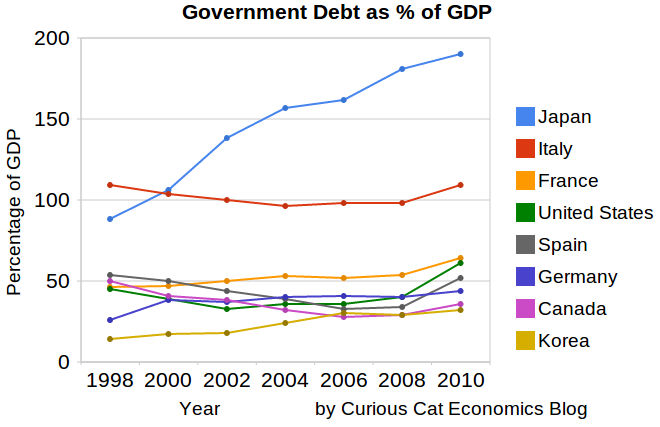
    • Government Debt as Percent of GDP 1998-2010 for OECD countries by John Hunter – There has been a dramatic increase from 2008-2010. The USA is up from 41% of GDP to 61%. Spain is up from 34% to 52% (but given all the concern with Spain this doesn’t seem to indicate the real debt problems they have. Economic data contains quite of bit of noise, unfortunately.

      graph of government debt for OECD countries from 1998-2010

    • Cause of Decline in U.S. Financial Position by Barry Ritholtz – “The Pew Center reported in April 2011 the cause of a $12.7 trillion shift in the debt situation, from a 2001 CBO forecast of $2.3 trillion cumulative surplus by 2011 versus the estimated $10.4 trillion public debt in 2011. The major drivers were:
      Revenue declines due to two recessions, separate from the Bush tax cuts of 2001 and 2003: 28%
      Defense spending increases: 15%
      Bush tax cuts of 2001 and 2003: 13%
      Increases in net interest: 11%
      Other non-defense spending: 10%
    • How This Blog Earns Full-Time Income from Part-Time Work by David Weliver – “for the most part, I’ve tried to focus on simply writing on topics that are unique, helpful, that answer specific questions. (It’s easy enough to be helpful, I think, but with billions of web pages out there, being unique is a never-ending challenge).”
    • How to live off investment income – 1. Set up a cash buffer account between your regular monthly spending, and your income-spewing engines. 2. Work out how much of your annual investment income you will/can spend. The rest of the money you will reinvest…
    • A Risky Investment Isn’t a Bad Investment by Kevin McKee – “If you want all the potential for Apple-esque gains, you need to be prepared to accept Enron-esque results. That’s the magic of risk; it goes both ways. Would I hold 100% of my portfolio in company stock? No.”
    • (more…)

  • Curious Cat Investing and Economics Carnival #13

    photo of house in green valley in Norway
    Photo of house in Norway, 1977 by Bill Hunter.

    The Curious Cat Investing and Economics Carnival has been published infrequently over the last few years. My plan is to start publishing it much more frequently starting now.

    • Personal Finance Basics: Long Term Disability Insurance by John Hunter – “people are much less aware of the importance of long term disability insurance. The census bureau estimates that you have a 20% chance you will be disabled in your lifetime.”
    • Fed’s Low Interest Rates Crack Retirees’ Nest Eggs by Mark Whitehouse – “A long spell of low interest rates has created a windfall worth billions to banks, mortgage borrowers and others it was designed to benefit. But for many people who were counting on their nest eggs, those same low rates can spell trouble.”
    • How to profit from the coming Greek default by Matthew Lynn – “Sell the U.S. banks but buy the dollar. If everyone knows Greece will have to default, what’s keeping them from pulling the plug? That’s easy. The Germans and the French won’t want to ‘re-profile’ all that Greek debt until they know their banks have largely sold both the debt and the credit-default swaps associated with it to someone else.”
    • Buy Cheap Bonds with Safe Spread by Bill Gross – “Investors shouldn’t give their money away, and at the moment, the duration component of a bond portfolio comes close to doing just that – not because a bear market is just around the corner come July 1, but because it doesn’t yield enough relative to inflation.”
    • How to retire with no savings – “Once you hit age 50, your chances of being jobless start to rise rapidly. You don’t get to choose when you retire. The job market or your ailing body will decide for you. Most retired Americans are getting by on incomes that you’d probably consider appropriate for the Third World. And even if they wanted to work until they died, they can’t.”
    • Words of wisdom from Warren Buffett’s legendary sidekick – “You have to be a lifelong learner to appreciate this stuff. We think of it as a moral duty. Increasing rationality and improving as much as you can no matter your age or experience is a moral duty. Too many people graduate from Wharton today and think they know how to do everything. It’s a considerable mistake.
    • (more…)

  • Truly Free Credit Report

    You should review your credit reports annually (at least) to correct any errors. Also doing so can be a tool to help you spot identity theft.

    The real free credit report site (for those in the USA), annualcreditreport.com, is provided by government regulation (so those that don’t believe in regulation would maybe rather use one of the sites advertising “free” credit reports). But I suggest using the government provided reports and I would suggest spreading the requests out during the year (you get 3 a year, 1 from each of the nationwide consumer credit reporting companies).

    The site also has a large frequently asked question section including:

    How do I request a “fraud alert” be placed on my file?
    You have the right to ask that nationwide consumer credit reporting companies place “fraud alerts” in your file to let potential creditors and others know that you may be a victim of identity theft. A fraud alert can make it more difficult for someone to get credit in your name because it tells creditors to follow certain procedures to protect you. It also may delay your ability to obtain credit. You may place a fraud alert in your file by calling just one of the three nationwide consumer credit reporting companies. As soon as that agency processes your fraud alert, it will notify the other two, which then also must place fraud alerts in your file.

    Where can I find out more about credit reports, my rights as a consumer, the Fair Credit Reporting Act and the FACT Act?
    Please visit www.ftc.gov/credit

    Related: Credit Card TipsPersonal Finance Basics: Avoid DebtSave Some of Each RaisePersonal Finance Basics: Long Term Disability Insurance