Tag: Real Estate

  • Jumbo Loan Defaults Rise at Fast Pace

    Jumbo Loan Defaults Rise at Fast Pace as Rich Suffer

    About 2.57 percent of prime borrowers who took out jumbo loans last year were at least 60 days delinquent

    2.57% of homeowners with jumbo mortgage are 60 days late, of those that just got loan last year! That is crazy. These kinds of figures are astounding to me. I am still (posted Feb 2007) amazed that 4.4% is the historic low for mortgages over a month late.

    About 1.92 percent of homeowners with 2008 mortgages backed by Fannie Mae and Freddie Mac fell at least 60 days behind, LPS Applied Analytics said. Jumbo loans are bigger than what the two government-controlled agencies buy or guarantee, and Obama’s plan focuses on shoring up mortgages eligible to be bought by Fannie and Freddie.

    The top five U.S. jumbo lenders — Chase Home Finance LLC, Bank of America Corp., Washington Mutual Inc., Wells Fargo & Co. and Citigroup Inc. — originated a combined $55.3 billion in jumbos in 2008. They lent just $4.3 billion of that during the last three months of the year, according to Inside Mortgage Finance.

    The national average for a 30-year fixed-rate jumbo mortgage was 6.57 percent this week compared with 5.34 percent for a conforming loan, according to White Plains, New York-based financial data provider BanxQuote.

    Related: The Impact of Credit Scores and Jumbo Size on Mortgage RatesLow Mortgage Rates Not Available to Everyone30 Year Fixed Mortgage Rates and the Fed Funds Rateposts about mortgages

  • Housing Rents Falling in the USA

    Apartment Rents Fall, Vacancies at 4-Year High

    U.S. apartment rents fell in the fourth quarter from the third as the national vacancy rate climbed to a four-year high of 6.6 percent

    Asking rents fell 0.1 percent from the previous quarter, to $1,052 on average, their first quarter-to-quarter decline in almost six years. They rose 2.4 percent from a year earlier. Effective rents, what tenants actually paid, fell to an average $996 last quarter, down 0.4 percent from the prior quarter and up 2.2 percent from a year earlier.

    U.S. rental market set to slow down amid housing glut

    “Unsold properties being turned into rental units are creating a shadow market that’s driving up the vacancy rate and slowing the growth of rents,” Chandan said. “Areas that saw the most speculative investing, particularly in condos, will see the biggest pressure on rents.”

    Anthony De Silva said he was not happy that he had become a landlord. He bought a two-bedroom condominium 18 months ago on the ocean in Hollywood, Florida, expecting to sell at a $100,000 profit. Instead, he is now looking for tenants at $1,700 a month.

    “Increasing vacancies does not bode well for rental incomes,” said Nabil El-Hage, a professor at Harvard Business School. “We’ve seen a softening in apartment REITs as a result.”

    So for renters nationwide this is one possible silver lining to the current economic crisis. Granted not a large one but in these times any good news is worth appreciating. For real estate investors the news is not as good. The Washington DC market is forecast to go against the trend for reduced rents in 2009.

    According to Marus and Millichap, Metrowide vacancy is expected to rise 60 basis points this year to 6.5 percent. Asking rents are projected to advance 3.1 percent to $1,410 per month in 2009, while effective rents increase 2.8 percent to $1,351 per month. Rent growth will lag slightly in Suburban Maryland. Of the 43 rental market they track they project San Francisco to see the largest increases in rent in 2009, followed by San Diego and Washington DC.

    Related: Home Values and Rental RatesRent Controls are Unwiseposts on housingHow Walkable is Your Prospective Neighborhood

  • The Impact of Credit Scores and Jumbo Size on Mortgage Rates

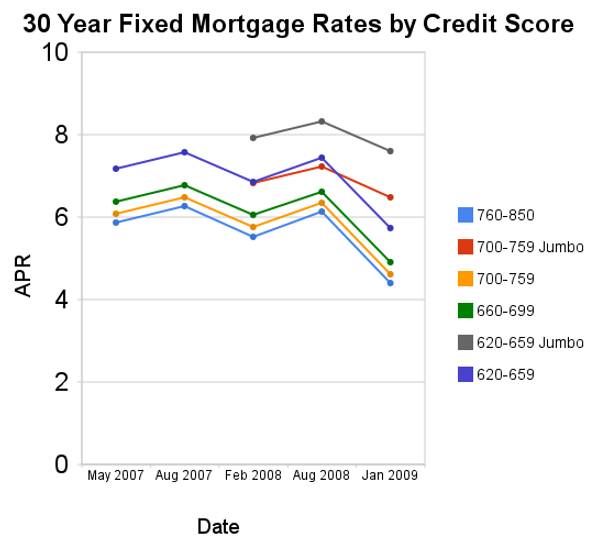
    Since August of 2008 conforming mortgage rates are have declined a huge amount. Jumbo rates have fallen a large amount also, but much less (for example for a credit score of 700-759 the jumbo rates declined 73 basis points while the conventional rate declined 172 basis points.

    chart of 30 year fixed mortgage rates by credit score from May 2007 to Jan 2009

    For scores above 620, the APRs above assume a mortgage with 1 point and 80% Loan-to-Value Ratio. For scores below 620, these APRs assume a mortgage with 0 points and 60 to 80% Loan-to-Value Ratio. You can see, with these conditions the rate difference between a credit score of 660 and 800 is not large (remember this is with 20% down-payment) and has not changed much (the difference between the rates if fairly consistent).

    Related: Low Mortgage Rates Not Available to Everyone30 Year Fixed Rate Mortgage Rate DataReal Free Credit Report (in USA)Jumbo Mortgage Shoppers Get Little Relief From Ratesposts on mortgages
    (more…)

  • Low Mortgage Rates Not Available to Everyone

    The lowest 30 Year fixed mortgage rates in 37 years is great news for those looking to buy a house or to re-finance. However, that truth (the lowest rate) masks another truth, that it is available to a somewhat limited pool of borrowers. The rates for jumbo 30 year fixed mortgages and for regular 30 year fixed mortgages, for those with lower credit ratings, are not at the lowest rates they have ever reached. And getting mortgage rates that don’t require a 10-20% down payment and fully documented financial position are not as low as they have ever been. 15 year fixed rates are also low, but are not at all time lows. FHA loans still allow very low down payments, but others have moved away from this practice (which is a wise move).

    Current rates, national average, from Bankrate: 30 year fixed 5.26%, 30 year fixed jumbo 6.96% (a full 170 basis points higher rate), 15 year fixed 5.07%. Jumbo rates have been less than 40 basis points higher than conventional rates most of time (based on my memory – I am looking for a source to confirm). The site does not present the credit score but my guess is these rates are based on a credit score of 700, or higher. Last week the jumbo rates increased by 11 basis points and regular 30 year rates fell by 3 basis points.

    Related: Jumbo v. Regular Fixed Mortgage Rates: by Credit Scorehistorical mortgage rate chartNearly 10% of Mortgages Delinquent or in Foreclosuremisinterpreting data

    Changes in the Market For Jumbo Mortgages

    During the period May 4, 2007 to November 7, 2008, the spread in wholesale interest rates between a $417,000 loan eligible for purchase by Fannie Mae and Freddie Mac, and a $418,000 loan that is not eligible, increased from 0.28% to 2.97%.

    On Nov 12, 2008 I shopped for an $800,000 30-year fixed-rate mortgage on Mortgage Marvel, an on-line site that I reviewed earlier in 2008 (see A Look at Mortgage Marvel). The mortgage companies on the site quoted rates of 8.125% to 8.375%. The credit unions and banks, in contrast, quoted rates ranging from 5.875% to 7.875%. I have never before seen rate differences on the same transaction this large. They no doubt reflect wide differences in lender access to funding, which is symptomatic of a market in turmoil.

    Mortgage Q&A

    For example, I see from today’s rate sheet that a homeowner with 40 percent equity and an excellent credit score of 740 would receive a quote of 5.125 percent with no points or origination fees for a 30-year fixed-rate mortgage. A borrower with a credit score of 670 who has 20 percent equity would receive the same rate but would be charged two points. On a $300,000 loan, this makes the 5.25 percent rate $6,000 more expensive. If the homeowner with the lower credit score wanted to pay zero points, the rate would be well north of 6 percent.
  • Lowest 30 Year Fixed Mortgage Rates in 37 Years

    We now have the lowest 30 year fixed mortgage rates since data has been collected (37 years) in the USA. Is this due to the Fed cutting the discount rate? I do not think so. As I have said previously 30 year fixed rates are not correlated with federal reserve rates. But this time the government is actively seeking to reduce mortgage rates.

    U.S. Treasury Secretary Henry Paulson said the Bush administration was looking at ways to lower mortgage rates because it was essential to stem the drop in home prices to foster an economic recovery.

    Mortgage Rate Hits 37-Year Low

    The benchmark 30-year fixed-rate home mortgage in the U.S. fell to a national average of 5.17% this week, the lowest since Freddie Mac began its weekly rate survey in 1971.

    The 15-year fixed-rate mortgage averaged 4.92%, down from last week when it averaged 5.20%. A year ago the 15-year loan averaged 5.79%. The 15-year mortgage hasn’t been lower since April 1, 2004, when it averaged 4.84%.

    Homeowners refinance, put savings under mattress

    This time around, lenders say up to a third of the callers seeking to refinance simply can’t. And if they can, the future savings are headed straight for the piggy bank.

    These rates sure are fantastic if you are in the market. I was not in the market, but I am considering re-financing now. You need to be careful and not just withdraw money because you can. If you can refinance and reduce your payments it may well be a wise move though. One problem can be extending the date you will finally be free of mortgage debt. If you re-finance a current 30 year loan, that you got 5 years ago, you will now be paying 5 more years. One option is to see if you can get a 25 or 20 year loan. Or if you can make a 15 year loan work, do that (15 and 30 year fixed rate mortgages are common).
    (more…)

  • Nearly 10% of Mortgages Delinquent or in Foreclosure

    The percentage of loans in the foreclosure process at the end of the third quarter was 2.97 percent, an increase of 22 basis points from the second quarter of 2008 and 128 basis points from one year ago. The percentage of loans in the process of foreclosure set a new record this quarter, to 1.35 million.

    Mortgages are counted as delinquent or in foreclosure (once they are in foreclosure they are not counted as delinquent). So the total percentage of mortgages not being paid by the homeowner is 2.97% (in foreclosure) + 6.99% (delinquent) = 9.96%. That is amazingly bad. In February of 2007 I wrote about this and the delinquency rate was 4.7% which sounded pretty bad to me. Amazingly 4.4% is a historic low for this figure. Can you believe 1/25 mortgages is delinquent and that is as good as we ever get? That is pretty shocking to me.

    The seasonally adjusted total delinquency rate is now the highest recorded in the Mortgage Bankers Association survey. The seasonally adjusted delinquency rate increased 41 basis points to 4.34 percent for prime loans, increased 136 basis points to 20.03 percent for subprime loans, increased 29 basis points to 12.92 percent for FHA loans, and increased 46 basis points to 7.28 percent for VA loans.

    The percent of loans in the foreclosure process increased 16 basis points to 1.58 percent for prime loans, and increased 74 basis points for subprime loans to 12.55 percent. FHA loans saw an eight basis point increase in the foreclosure inventory rate to 2.32 percent, while the foreclosure inventory rate for VA loans increased 13 basis points to 1.46 percent.

    Since loans that would have gone into foreclosure in the past are being kept out of foreclosure due to some programs ( ) the rate or seriously delinquent is a useful measure of serious problems. Seriously delinquent mortgages are 90 days past due. The rate increased 52 basis points for prime loans to 2.87 percent, increased 171 basis points for subprime loans to 19.56 percent, increased 62 basis points for FHA loans to 6.05 percent, and increased 45 basis points for VA loans percent to 3.45 percent.

    Compared to a year ago: the seriously delinquent rate was 156 basis points higher for prime loans and 818 basis points higher for subprime loans. The rate also increased 51 basis points for FHA loans and 89 basis points for VA loans.

    Related: Homes Entering Foreclosure at Record (Sep 2007)Foreclosure Filings Continue to RiseHow Much Worse Can the Mortgage Crisis Get?How Not to Convert Equity

  • Dazzling Diversification

    Diversification overrated? Not a chance [the broken link has been removed] by Jason Zweig

    A diversified portfolio always has, and always will, underperform the hottest investment of the moment.

    For anyone with a sustainable ability to identify the hottest investment of the moment, diversification is a mistake. But if you really believe you’ve got that ability, you’re not just mistaken. You need to be hauled off in a straitjacket to the Institute for the Treatment of Investment Insanity.

    Exactly right. As we posted previously Warren Buffett’s diversification thoughts are similar

    If you are a professional and have confidence, then I would advocate lots of concentration. For everyone else, if it’s not your game, participate in total diversification. The economy will do fine over time. Make sure you don’t buy at the wrong price or the wrong time. That’s what most people should do, buy a cheap index fund and slowly dollar cost average into it.

    You have to remember when Warren Buffett says “professional and have confidence” he doesn’t really mean just what those words say. He mean if you are Charlie Munger, George Soros, Jimmy Rodgers and maybe 10 other people alive today (maybe I am too restrictive, maybe he would include 50 more people alive today, but I doubt it).

    Related: Dilbert on Investinginvestment risksCurious Cat Investing and Economics Search Engine

  • FDIC Details Plan To Alter Mortgages

    FDIC Details Plan To Alter Mortgages

    Officials at the Federal Deposit Insurance Corp. yesterday detailed a plan to prevent 1.5 million foreclosures in the next year by offering financial incentives to companies that agree to sharply reduce monthly payments on mortgage loans.

    Agency officials estimated the cost to the government at $22.4 billion.

    The mortgage industry is concerned that any new modification plan will persuade some people to stop making mortgage payments in addition to helping people who already have stopped making payments. The industry argues this will translate into higher interest rates because investors will demand compensation for the increased risk of loan defaults. That, in turn, would limit the number of people who can afford mortgage loans.

    FDIC estimates that 1.4 million borrowers with such loans are at least two months late on their payments, and another 3 million borrowers will miss at least two payments by the end of next year. The agency estimates that half those borrowers, or about 2.2 million people, would receive a loan modification under the program, and that about 1.5 million will successfully avoid foreclosure.

    Under the terms of the proposed FDIC program, lenders would reduce monthly payments primarily by cutting the borrower’s interest rate to a minimum rate of 3 percent. If necessary, the company could also extend the repayment period on the loan beyond 30 years, reducing each monthly payment. Finally, in some cases, companies could defer repayment of some principal. The borrower still would be on the hook for the full value of the loan.

    Officials said their experience at IndyMac showed that principal reductions were not necessary. So far, FDIC has modified about 20,000 IndyMac loans. In 70 percent of the cases, FDIC was able to create an affordable payment solely by reducing the interest rate. In 21 percent of the cases, the agency also extended the life of the loan. In 9 percent of the cases, it delayed repayment of some principal.

    An interesting proposal I would support. Ideally this type of action would not be necessary but since banks were allowed to degrade their standards so far and allowed to grow so large their failures threaten the economy some radical actions are being taken. Compared to many others this is sensible.

    Related: How Much Worse Can the Mortgage Crisis Get?JPMorgan Chase Freezes Mortgage ForeclosuresFed Plans To Curb Mortgage Excesses (Dec 2007)

  • 30 Year Mortgage Rate and Federal Funds Rate Chart

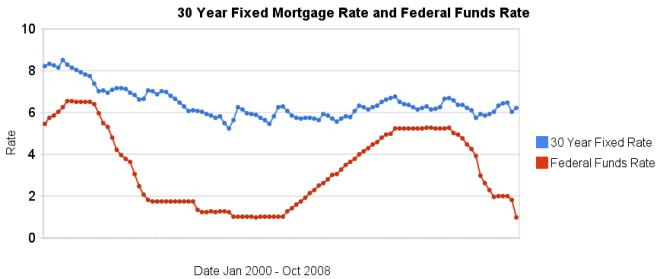
    More dramatic evidence that changing in the federal funds rate do not lead to similar changes in 30 year fixed mortgage rates. It is true the last few months are very unusual times for the credit market. However, the current lack of correlation is not the exception, the graph clearly shows there is very little correlation between changes in the two interest rates.

    30 year fixed mortgage rates and the federal funds rate 2000-2008

    Related: historical comparison of 30 year fixed mortgage rates and the federal funds rateAffect of Fed Funds Rates Changes on Mortgage Ratesposts on financial literacyJumbo v. Regular Fixed Mortgage Rates: by Credit Score

    For more data, see graphs of the federal funds rate versus mortgage rates for 1980-1999. Source data: federal funds rates30 year mortgage rates