Tag: Stocks

  • Reconsidering Tesco as an Investment

    Tesco is in my 12 stocks for 10 years portfolio. One of the big reasons I bought is management’s commitment to using good management practices, in particular lean thinking (based on Toyota’s management principles). These principles include: investing in the long term, customer focus, respect for employees.

    With those practices in place and the good international expansion potential (including the USA) the opportunities are good (thus I liked the investment). Short term hiccups don’t really bother me. I would rather avoid them but I can accept them. The think that worries me about Tesco is I am becoming less and less convinced they are committed to lean management principles. Instead they seem to just be practicing the same lame management that so many companies employ. They can still be successful that way but the lost value to shareholders is great and makes me very close to deciding to eliminate my investment. I already sold half of the position, last year.

    I now live in Malaysia and the Tesco’s here are horrible. There is no evidence of customer focus. They have lousy “fresh” (often not) vegetables. It is very easy to be sloppy as you expand. They obviously are not concerned enough to practice lean thinking in Malaysia. That is a concern. But large organizations often struggle to manage themselves competently and one small area ignoring lean thinking principles isn’t enough to say Tesco is ignoring them completely. More and more evidence is pointing to Tesco being sloppy and ignore lean thnking, however.

    The main current financial problems are in the home market issues not directly related to lean thinking. Those I could easily chose to wether, if I believe the company is committed to smart lean management principle, but I am not any longer (sadly). For me, I need to see more evidence of commitment to lean principles or I will likely sell out my investment.

    Another problem I have is Amazon was my other retail investment and I have significant valuation concerns – I am closer to selling more than buying more (I have sold some). I have long been looking at Costco – I would have been much better off buying it over Tesco 🙁 I am still considering it (I would love to buy Costco, it is just a valuation concern that holds me back, the company and the future prospects look great).

    I lost no faith in Toyota (another stock in my sleep well portfolio) during the recent struggles. There were some slip-ups. Toyota’s responses were great – just as I would expect. Mainly the stories were greatly overblown.

    Related: Tesco: Consistent Earnings Growth at Attractive PriceApple’s Impossibly Good QuarterTaking a Look at Some Dividend Aristocrats
  • Don’t Expect to Spend Over 4% of Your Retirement Investment Assets Annually

    Pitfalls in Retirement (pdf) is quite a good white paper from Meril Lynch, I strongly recommend it.

    A survey asked investors at least 41 years of age how much of their retirement savings they can safely spend each year without running the risk of exhausting their assets. Forty percent had no idea; an additional 29% said they
    could safely spend 10% or more of their savings each year.

    But, as explained below, the respondents most on target were the one in 10 who estimated sustainable spending rates to be 5% or less. This is significantly impacted by life expectancy; if you have a much lower life expectancy due to retiring later or significant health issues perhaps you can spend more. But counting on this is very risky.

    This is likely one of the top 5 most important things to know about saving for retirement (and just 10% of the population got the answer right). You need to know that you can safely spend 5%, or likely less, of your investment assets safely in retirement (without dramatically eating into your principle.

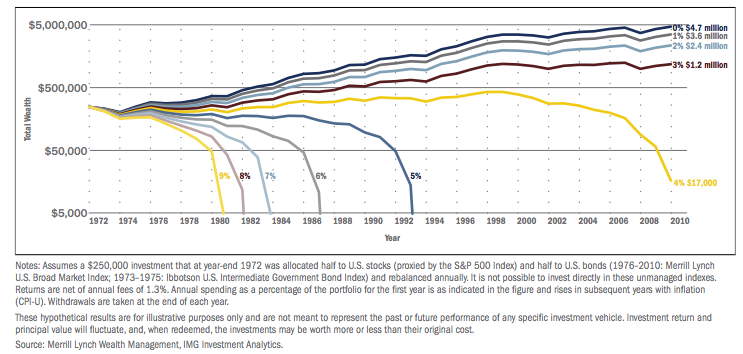
    chart showing retirement assets over time based on various spending levels
    Chart showing retirement assets over time based on various spending levels, from the Merill Lynch paper.

    The chart is actually quite good, the paper also includes another good example (which is helpful in showing how much things can be affected by somewhat small changes*). One piece of good news is they assume much larger expense rates than you need to experience if you choose well. They assume 1.3% in fees. You can reduce that by 100 basis points using Vanguard. They also have the portfolio split 50% in stocks (S&P 500) and 50% in bonds.

    Several interesting points can be drawn from this data. One the real investment returns matter a great deal. A 4% withdrawal rate worked until the global credit crisis killed investment returns at which time the sustainability of that rate disappeared. A 5% withdrawal rate lasted nearly 30 years (but you can’t count on that at all, it depends on what happens with you investment returns).

    Related: What Investing Return Projections to Use In Planning for RetirementHow Much Will I Need to Save for Retirement?Saving for Retirement

    (more…)

  • Warren Buffett’s 2011 Letter to Shareholders

    Warren Buffett continues to write his excellent annual shareholder letter. It is a pleasure to read them every year. I have selected a few passages to include:

    The logic is simple: If you are going to be a net buyer of stocks in the future, either directly with your own money or indirectly (through your ownership of a company that is repurchasing shares), you are hurt when stocks rise. You benefit when stocks swoon. Emotions, however, too often complicate the matter: Most people, including those who will be net buyers in the future, take comfort in seeing stock prices advance. These shareholders resemble a commuter who rejoices after the price of gas increases, simply because his tank contains a day’s supply.

    Charlie and I don’t expect to win many of you over to our way of thinking – we’ve observed enough human behavior to know the futility of that – but we do want you to be aware of our personal calculus. And here a confession is in order: In my early days I, too, rejoiced when the market rose. Then I read Chapter Eight of Ben Graham’s The Intelligent Investor, the chapter dealing with how investors should view fluctuations in stock prices. Immediately the scales fell from my eyes, and low prices became my friend. Picking up that book was one of the luckiest moments in my life.

    Investors face challenges within their own psychology. This is one, but not the only one.

    At bottom, a sound insurance operation needs to adhere to four disciplines. It must (1) understand all exposures that might cause a policy to incur losses; (2) conservatively evaluate the likelihood of any exposure actually causing a loss and the probable cost if it does; (3) set a premium that will deliver a profit, on average, after both prospective loss costs and operating expenses are covered; and (4) be willing to walk away if the appropriate premium can’t be obtained.

    Many insurers pass the first three tests and flunk the fourth. They simply can’t turn their back on business that their competitors are eagerly writing. That old line, “The other guy is doing it so we must as well,” spells trouble in any business, but in none more so than insurance. Indeed, a good underwriter needs an independent mindset akin to that of the senior citizen who received a call from his wife while driving home. “Albert, be careful,” she warned, “I just heard on the radio that there’s a car going the wrong way down the Interstate.” “Mabel, they don’t know the half of it,” replied Albert, “It’s not just one car, there are hundreds of them.”

    Tad has observed all four of the insurance commandments, and it shows in his results. General Re’s huge float has been better than cost-free under his leadership, and we expect that, on average, it will continue to be. In the first few years after we acquired it, General Re was a major headache. Now it’s a treasure.

    The insurance business is explained well in this, and his other shareholder letter.

    Related: Warren Buffett’s 2010 Letter to ShareholdersWarren Buffett’s Q&A With Shareholders 2009Warren Buffett’s 2007 Letter to Shareholders

    (more…)

  • Apple’s Impossibly Good Quarter

    Apple has been performing amazingly well for years. They keep producing blockbuster hits over and over. Not only are these hits enormously popular they are enormously profitable.

    The only real objections to Apple’s stock I can see are: the overall market value is so huge it just has to collapse (over $400 billion – the largest in the world) or it has to be time for a huge reversal of fortunes.

    The problem with the view that it will fall is that the stock is very cheap by any rational measure. You are not paying much for all the earnings. Even if Apple does not continue the trend of the last 5 years, if it just stopped growing altogether, it is still cheap (if it does continue that trend it will break $1 trillion by 2014 – but I don’t think it will). The biggest risk is the profit margin shrinks drastically. That is possible. It is even somewhat likely to shrink a fair amount. But there isn’t much reason to think revenues will not grow. And to me, the current price makes sense only if revenues fall and profit margins fall. It takes the worst case scenario to make this stock seem overpriced.

    The data on the last quarter (and for 2011 overall) are impossible (except they actually happened).

    • record quarterly revenue of $46.33 billion ($26.74 billion in 2010)
    • record quarterly net profit of $13.06 billion ($6 billion in 2010)
    • Gross margin was 44.7 percent compared to 38.5 percent in the year-ago quarter
    • $17.5 billion in cash flow from operations during the quarter (and $38 billion in the last year)
    • $100 billion in cash now ($97.6 billion to be exact but since the data was gathered they probably passed $100 billion anyway). That is more than the market cap of all but 52 companies in the world.

    You can’t grow quarterly sales from $26.7 billion to $46.3 billion. $26 million to $46 million, fine that is possible, billions however – not possible. Except Apple did. You can’t grow a $6 billion quarterly profit to $13 billion in 1 year. Except Apple did. You can’t generate a cash flow of $17.5 billion in a quarter. Except Apple did. You can’t have a stockpile of $100 billion in cash. Except Apple does. These figures would not have been seen as unlikely just 3 years ago. They were impossible. But Apple achieved them.

    These figures are not short term blips. They are the latest in a long stream of amazingly results.

    Related: How Apple Can Grow from $200 Billion to $300 Billion In Market CapApple Tops Google (August 2008)

    Apple has numerous, incredibly strong businesses. Each could be the linchpin of an extremely valuable company.

    • iPhone initial sales and reoccurring income (over 50% of Apple’s revenue)
    • app sales (for iPhones, iPads and Macs)
    • iPads
    • iTunes
    • Macs
    • Their retail store business – selling all their products

    (more…)

  • 12 Stocks for 10 Years: January 2012 Update

    The 12 stock for 10 years portfolio consists of stocks I would be comfortable putting into an IRA for 10 years. The main criteria is for companies with a history of large positive cash flow, that seemed likely to continue that trend. I am considering adding Abbot to the portfolio, and maybe dropping Cisco.

    Since April of 2005 the portfolio Marketocracy* calculated annualized rate or return (which excludes Tesco) is 5.7% (the S&P 500 annualized return for the period is 3.9%). Marketocracy subtracts the equivalent of 2% of assets annually to simulate management fees – as though the portfolio were a mutual fund – so without that (it is not like this portfolio takes much management), the return beats the S&P 500 annual return by about 380 basis points annually (it would be a bit less with Tesco, but still close above 3%, I would think – calculating rates of return with purchases and sales and dividends is a complete pain, which is one reason Marketocracy is so nice).

    The current stocks, in order of return:

    Stock Current Return % of sleep well portfolio now % of the portfolio if I were buying today
    Amazon – AMZN 350% 9% 7%
    Google – GOOG 187% 17% 14%
    PetroChina – PTR 115% 8% 6%
    Templeton Dragon Fund – TDF 85% 8% 7%
    Templeton Emerging Market Fund – EMF 44% 5% 7%
    Danaher – DHR 43% 10% 10%
    Apple – AAPL 42% 9% 9%
    Intel – INTC 18% 6% 6%
    Cash (likely to be ABT soon) 4% 6%
    Cisco – CSCO -2% 5% 4%
    Toyota – TM -8% 8% 12%
    Pfizer – PFE -9% 6% 7%
    Tesco – TSCDY -13%** 0%* 5%

    The current marketocracy results can be seen on the Sleep Well marketocracy portfolio page.

    Related: 12 Stocks for 10 Years: Feb 2011 Update12 Stocks for 10 Years, July 2011 Update12 Stocks for 10 Years, July 2009 Updatehand picked articles on investing
    (more…)

  • Taking a Look at Some Dividend Aristocrats

    See the full list of Dividend Aristocrats below. The stocks in this index are companies within the S&P 500 that have increased dividends every year for at least 25 consecutive years. After 10 were added and 1 removed, this month, there are now 51 companies included (so just over 10% of all S&P 500 stocks) – and remember many S&P 500 stocks haven’t existed for 25 years, or pay no dividend today, or didn’t 10 or 20 years ago (Google, Apple, Intel, …). It is surprising so many companies have successfully done this.

    I’ll take a look at a few of them here (I looked at the new additions in my previous post: Investing in stocks that have raised dividends consistently).

    Stock Yield
       
    div/share 2011 div/share 2000 % increase
    3M (MMM) 2.8% $2.20 $1.16 90%
    Aflac (AFL) 3.2% $1.23 $0.165 645%
    Abbott Laboratories (ABT) 3.5% $1.92 $0.74 159%
    Cincinnati Financial (CINF) 5.3% $1.60 $0.69 132%
    Coca-Cola Co (KO) 2.8% $1.88 $0.68 176%
    Exxon Mobil Corp (XOM) 2.4% $1.85 $0.88 110%
    Johnson & Johnson (JNJ) 3.6% $2.25 $0.62 263%
    Kimberly-Clark (KMB) 3.9% $2.80 $1.08 159%
    Medtronic (MDT) 2.8% $0.94 $0.18 417%
    Procter & Gamble (PG) 3.2% $2.06 $.67 207%

    Just looking at this data Aflac sure looks appealing. Having both a high yield and strong growth is an appealing combination. And Warren Buffet agree (he owns quite a bit) which is also reassuring (he also owns a large stake in Coke). Of course strong growth over the last 11 years won’t necessarily repeat (in fact it gets much harder). On the other had some slow growth companies would likely continue slow growth (at best): Exxon Mobil, 3M…

    Really almost all of these stocks are pretty attractive. Medtronic, Johnson & Johnson and Abbot Laboratories look particularly appealing to me (along with Aflac and Kimberly-Clark). I would have to do more research on any of these (other than Abbot Laboratories, which I already own) before deciding to buy, but they sure look good as safe long term investments. Health care is a growing need (in the USA and globally). It is true the costs in the USA have to be reduced, and this could make things more difficult for companies in the health care industry.

    Related: Sleep well investing portfolioLooking for Dividend Stocks in the Current Extremely Low Interest Rate EnvironmentIs the Stock Market Efficient?

    Full list of Dividend Aristocrats, an index measures the performance of large cap, blue chip companies within the S&P 500 that have followed a policy of increasing dividends every year for at least 25 consecutive years.

    (more…)

  • Investing in Stocks That Have Raised Dividends Consistently

    The Dividend Aristocrats index measures the performance of S&P 500 companies “that have followed a policy of increasing dividends every year for at least 25 consecutive years.” S&P makes additions and deletions from the index annually. This year 10 companies were added and 1 was deleted.

    Stock Yield
       
    div/share 2011 div/share 2000 % increase
    AT&T (T) 6% $1.72 $1.006 72%
    HCP Inc (HCP) 4.9% $1.92 $1.47 31%
    Sysco (SYY) 3.7% $1.04 $0.24 333%
    Nucor (NUE) 3.7% $1.45 $0.15 867%
    Illinois Tool Works (ITW) 3.1% $1.40 $0.38 268%
    Genuine Parts (GPC) 3.1% $1.80 $1.10 64%
    Medtronic (MDT) 2.8% $0.936 $0.181 417%
    Colgate-Palmolive (CL) 2.6% $2.27 $0.632 259%
    T-Rowe Price (TROW) 2.9% $1.24 $0.27 359%
    Franklin Resources (BEN) 1.2% $1.00 $.0245 308%

    You can’t expect members of the Dividend Aristocrats to match the dividend increases shown here. As companies stay in this screen of companies the rate of growth often decreases as they mature. Also some have already increased the payout rate (so have had an increasing payout rate boost dividend increases) significantly.

    The chart also shows that a smaller current yield need not dissuade investing in a company even when your target is dividend yield, giving the large dividend increase in just 10 years. Nucor yielded just 1.5% in 2000 (at a price of $10). Ignoring reinvested dividends your current yield on that investment would be 14.5%. To make the math easy 10 shares in 2000 cost $100, and they paid $1.50 in dividends (%1.5). Dividends have now increase so those 10 shares are paying $14.50 in dividends (14.5%). Of course Nucor worked out very well; that type of return is not common. But the idea to consider is that the long term dividend yield is not only a matter of looking at the current yield.

    The period from 2000 to 2011 was hardly a strong one economically. Yet look at how many of these companies dramatically increased their dividend payouts. Even in tough economic times many companies do well.

    Related: Looking for Dividend Stocks in the Current Extremely Low Interest Rate EnvironmentWhere to Invest for Yield Today10 Stocks for Income Investors

  • Where are Profit Margins Headed?

    Where is the economy headed? With the troubles of huge debt (by governments and consumers) and the possible collapse of the Euro it is very hard to be certain. And where is the stock market headed? That is also difficult to predict. Of course, where the stock market is headed in the short term is never easy to predict. If you can predict, you should be rich (though it likely takes a bit more, knowing how much to risk…).

    At least by knowing what has happened you can be ahead of where many people are. The USA economy has not been in a recession, we have actually been growing. Just doing so very slowly. And doing so without many added jobs. Companies however, have been doing very well.

    U.S. companies’ ability to squeeze more profit from each dollar of sales is pushing earnings higher, even as the economy has grown at a below-average clip since the recession ended in June 2009.

    For investors knowing if this is a positive trend that can be expected to continue or an aberration is key. But I have no way of knowing. My guess is it is at least partially something that will continue (but maybe a portion of the gains are an aberration) – but this is just a guess. This bloomberg article looks more at the issue.

    Grantham, who called corporate profits “freakishly high” in an August commentary, sees wide margins as an aberration. Some of his competitors say changes in the economy and the way firms operate could keep them near peak levels for another year or two. “We don’t think they have to fall,” Doll, whose New York- based firm is the world’s largest asset manager, said in a phone interview. BlackRock oversees $3.35 trillion.

    The margins of non-financial companies in the U.S., a widely used measure of profitability, reached 15 percent in the third quarter, according to data from Moody’s Analytics Inc. in West Chester, Pennsylvania. That was the highest level since 1969. When the recession ended in the second quarter of 2009, the comparable number was 8.7 percent.

    The most compelling data supporting my belief is the long term trend.

    Profit margins have been trending higher since the mid-1980s, said Chris Christopher, an economist at IHS (IHS) Global Insight, who has written on the subject. Quarterly margins peaked at 11.9 percent in the 1980s, 13.6 percent in the 1990s and 14.5 percent in the most recent decade, Moody’s data show.

    But where this trend ends and starts reversing won’t be obvious until years after it happens. But investors that can predict (or guess) margin changes will likely be rewarded financially.

    Related: The Economy is Weak and Prospects May be Grim, But Many Companies Have Rosy ProspectsIs the Stock Market Efficient?Investment Risk Matters Most as Part of a Portfolio, Rather than in Isolation

  • High Frequency Trading

    High frequency trading is rightly criticized. It isn’t bad because rich people are getting richer. It is bad because of the manipulation of markets. Those being

    • Front running – having orders executed milliseconds in advance to gain an edge (there is no market benefit to millisecond variation). In the grossest for it is clearly criminal: putting in orders prior to known orders from a customer to make money at the expense of your customer and others in the market. My understanding is the criminal type is not what they are normally accused of, of course, who knows but… Instead they front run largely by getting information very quickly and putting in orders to front run based on silly price difference (under 1/10 of a cent).
    • Putting in false orders to fake out the market – you are not allowed to put in false orders. It is clear from the amount of orders placed and immediately withdrawn they are constantly doing this. Very simply any firm doing this should be banned from trading. It wouldn’t take long to stop. Of course the SEC should prosecute people doing this, but don’t hold your breath.

    Several things should be done.

    • Institute a small new financial transaction tax – adding a bit of friction to the system will reduce the ludicrous stuff going on now. Use this tax to fund investigation and prosecution of bad behavior.
    • Redo the way matching of orders is done to promote real market activity not minute market arbitrage and manipulation – I don’t know exactly what to do but something like putting in a timing factor along with price. An order that is within 1/10 of cent for less than 1,000 shares are executed in order of length of time they have been active (or something like that).
    • Institute rules that if you cancel more than 20% of your order (over 10 in a day) in less than 15 minutes you can’t enter an order for 24 hours. Repeated failures to leave orders in place create longer bans.
    • Don’t let those using these strategies get their money back when they do idiotic things like sell bull chip companies down to 20% of their price at the beginning of the day. You don’t get to say, oh I didn’t really mean to buy this stock that lost me 50% the day I bought it, give me money back. There is no reason high frequency traders should be allowed to take their profits and then renege on trades they don’t like later.

    Speculation is fine, within set rules for a fair market. Traders making money by manipulating the system instead of through beneficial activities such as making a market shouldn’t be supported.

    To the extent high frequency trading creates fundamental buying opportunities take advantage of the market opportunity. Just realize the high frequency traders may be able to reverse you gains (and if you lose you are not going to be granted the same favors).

    Related: Naked Short SellingMisuse of Statistics, Mania in Financial MarketsFailure to Regulate Financial Markets Leads to Predictable ConsequencesFed Continues Wall Street Welfare

    The truth is the billions of dollars high frequency traders steal from others market returns matters much less to true investors. For long terms holdings the less than a cent they steal from other market participants is small. It is still bad. Just people really get more excited about it than they need to. I would love to just get 1/1000 of cent on every trade made in the markets, I could retire. But they are mainly stealing very small amounts from tons of different people. Now the fake orders and trades that go against them that they then get reversed are a different story.

  • Looking for Dividend Stocks in the Current Extremely Low Interest Rate Environment

    My preference is for a lower use of bonds than the normal portfolio balancing strategies use. I just find the risks greater than the benefits. This preference increases as yields decline. Given the historically low interest rates we have been experiencing the last few years (and low yields even for close to a decade) I really believe bonds are not a good investment. Now for someone approaching or in retirement I do think some bonds are probably wise to balance the portfolio (or CDs). But I would limit maturities/duration to 2 or 3 years. And really I would pursue high yielding stocks much more than normal.

    In general I like high yielding stocks for retirement portfolios. Many are very good long term investments overall and I prefer to put a portion of the portfolio others would place in bonds in high yielding stocks. Unfortunately 401(k) [and 403(b)] retirement accounts often don’t offer an option to do this. Luckily IRAs give you the options to invest as you chose and by placing your IRA in a brokerage account you can use this strategy. In a limited investing option retirement account [such as a 401(k)] look for short term bond funds, inflation protected bonds and real estate funds – but you have to evaluate if those funds are good – high expenses will destroy the reasons to invest in bond funds.

    There are actually quite a few attractive high yield stocks now. I would strive for a very large amount of diversity in high yield stocks that are meant to take a portion of the bonds place in a balanced portfolio. In the portion of the portfolio aimed at capital appreciation I think too much emphasis is placed on “risk” (more concentration is fine in my opinion – if you believe you have a good risk reward potential). But truthfully most people are better off being more diversified but those that really spend the time (it takes a lot of time and experience to invest well) can take on more risk.

    A huge advantage of dividends stocks is they often increase the dividend over time. And this is one of the keys to evaluate when selected these stock investments. So you can buy a stock that pays a 4% yield today and 5 years down the road you might be getting 5.5% yield (based on increased dividend payouts and your original purchase price). Look for a track record of increasing dividends historically. And the likelihood of continuing to do so (this is obviously the tricky part). One good value to look at is the dividend payout rate (dividend/earnings). A relatively low payout (for the industry – using an industry benchmark is helpful given the different requirement for investing in the business by industry) gives you protection against downturns (as does the past history of increasing payouts). It also provides the potential for outsized increases in the future.

    There are a number of stocks that look good in this category to me now. ONEOK Partners LP pays a dividend of 5.5% an extremely high rate. They historically have increased the dividend. They are a limited partnership which are a strange beast not quite a corporation and you really need to read up and understand the risks with such investments. ONEOK is involved in the transportation and storage of natural gas. I would limit the exposure of the portfolio to limited partnerships (master limited partnerships). They announced today that the are forecasting a 20% increase in 2012 earnings so the stock will likely go up (and the yield go down – it is up 3.4% in after hours trading).

    Another stock I like in this are is Abbott, a very diversified company in the health care field. This stock yields 3.8% and has good potential to grow. That along with a 3.8% yield (much higher than bond yields, is very attractive).

    My 12 stocks for 10 year portfolio holds a couple investments in this category: Intel, Pfizer and PetroChina. Intel yields 3.9% and has good growth prospects though it also has the risk of deteriorating margins. There margins have remains extremely high for a long time. Maybe it can continue but maybe not. Pfizer yeilds 4.6% today which is a very nice yield. At this time, I think I prefer Abbott but given the desire for more diversification in this portion of the portfolio both would be good holdings. Petro China yields 4% today.

    When invested in a retirement portfolio prior to retirement I would probably just set up automatic reinvesting of the dividends. Once in retirement as income is needed then you can start talking the dividends as cash, to provide income to pay living expenses. I would certainly suggest more than 10 stocks for this portion of a portfolio and an investor needs to to educate themselves evaluate the risks and value of their investments or hire someone who they trust to do so.

    Related: Retirement Savings Allocation for 2010S&P 500 Dividend Yield Tops Bond Yield: First Time Since 195810 Stocks for Income Investors