Tag: Stocks

  • Is the Stock Market Efficient?

    I believe in weak stock market efficiency. And recently the market is making me think it is weaker than I believed :-/ I believe that the market does a decent job of factoring in news and conditions but that the “wisdom of crowds” is far from perfect. There are plenty of valuing weaknesses that can lead to inefficient pricing and opportunities for gain. The simplest of those are spotted and then adopted by enough money that they become efficient and don’t allow significant gains.

    And a big problem for investors is that while I think there are plenty of inefficiencies to take advantage of finding them and investing successfully is quite hard. And so most that try do not succeed (do not get a return that justifies their time and risk – overall trying to take advantage of inefficiencies is likely to be more risky). Some Inefficiencies however seem to persist and allow low risk gains – such as investing in boring undervalued stocks. Read Ben Graham’s books for great investing ideas.

    There is also what seems like an increase in manipulation in the market. While it is bad that large organizations can manipulate the market they provide opportunities to those that step in after prices reflect manipulation (rather than efficient markets). It is seriously annoying when regulators allow manipulators to retroactively get out of bad trades (like when there was that huge flash crash and those engaging in high frequency “trading” front-running an manipulation in reality but not called that because it is illegal). Those that were smart enough to buy stocks those high frequency traders sold should have been able to profit from their smart decision. I definitely support a very small transaction tax for investment trades – it would raise revenue and serve reduce non-value added high frequency trading (which just seems to allow a few speculators to siphon of market gains through front running). I am fine with speculation within bounds – I don’t like markets where more than half of the trades are speculators instead of investors.

    Related: Market Inefficiencies and Efficient Market TheoryLazy Portfolios Seven-year Winning Streak – investing in stocksNaked Short Selling

  • The Economy is Weak and Prospects May be Grim, But Many Companies Have Rosy Prospects

    The fundamental truth right now is that the overall economy in Europe, the USA and Japan is weak and has some serious long term problems. But the connection between that and company weakness is not incredibly strong. Many companies have huge cash hoards, built up through the large profits they continue to make. Yes, the economy entering a serious downturn will hurt many companies. A railroad is going to lose some sales if retail sales decline (and so they don’t have to be shipped). Airlines (historically problematic companies to begin will) will struggle. Banks that pay exorbitant amounts to senior staff have trouble making money without handouts of taking huge risks that then result in more handouts once the risks fail (as usually a bad economy will expose the risks they have taken). Companies that can only do well based on large top line growth will suffer. But that isn’t all companies.

    When you look at companies like Google, Apple, Tesco, Danaher, Amazon even Toyota I really don’t see many problems looking forward. They seem perfectly capable of staying profitable, even growing profits, even in the face of economic decline in Europe, the USA and Japan (if that happens: it is possible, but not certain – very low growth is possible). Companies that have very good prospects at staying profitable, even getting more profitable going forward are hardly the type of investment I want to sell. Especially not to put it in the bank and get 0%, or a money market fund and pay someone for the privilege of having my money.

    The options for investing today don’t look so great. But I really don’t see any reason to be concerned about owning stocks that have good prospects to do well even if the quite a few large economies do poorly in the next decade. In fact I am happy to own them. Frankly the biggest worry I have is that the senior executives will loot the owners profits with exorbitant pay (this is not a worry at Toyota and less of one at Amazon). I would worry more about owning index funds in such an environment. But even as bad as things look now, I am not sure they will really turn out as bad as we fear – especially for many companies, for some yes, but many are well prepared for change).

    And the prospects in emerging markets look incredibly good to me. Yes they will slow their growth a bit if the large economies stall, but I think it is foolish to avoid investments in China, Singapore, Brazil, Korea, India, Ghana, Malaysia, Indonesia. In fact that is where companies like Google, Tesco, Apple, Toyota and Amazon are going to be making lots of money. Emerging markets are volatile and the companies in them are too. This will continue.
    (more…)

  • Ken Fisher Disputes Some Investing Tips

    His point on dollar cost averaging is sensible. Markets go up, more than down, overall [the statistically best approach] if you have a lump sum to invest the best strategy would be to invest it all now. There is added risk with this however, which he would accept. Also it doesn’t change the main reason people end up dollar cost averaging (by default, with retirement savings from each paycheck).

    over long time horizons bonds are actually riskier than stocks… [also] there are more rolling 3 year periods where bonds lose money than there are where stocks lose money.

    He discusses these ideas, and many more in his book: Debunkery: Learn It, Do It, and Profit from It-Seeing Through Wall Street’s Money-Killing Myths.

    Related: Curious Cat investment booksInvestment Risk Should be Evaluated as Part of a Portfolio, Rather than Risk of Each Individual InvestmentSave Some of Each Raise

  • 12 Stocks for 10 Years: July 2011 Update

    The 12 stock for 10 years portfolio consists of stocks I would be comfortable putting into an IRA for 10 years. The main criteria is for companies with a history of large positive cash flow, that seemed likely to continue that trend. I continue to be very satisfied with the portfolio and don’t see any reason for changes.

    The current Marketocracy* calculated annualized rate or return (which excludes Tesco) is 7.2% (the S&P 500 annualized return for the period is 4.7%). Marketocracy subtracts the equivalent of 2% of assets annually to simulate management fees – as though the portfolio were a mutual fund – so without that (it is not like this portfolio takes much management), the return beats the S&P 500 annual return by about 4.5% annually (it would be a bit less with Tesco, but still close to 4%, I would think).

    The current stocks, in order of return:

    Stock Current Return % of sleep well portfolio now % of the portfolio if I were buying today
    Amazon – AMZN 410% 11% 7%
    Google – GOOG 184% 16% 14%
    PetroChina – PTR 125% 8% 6%
    Templeton Dragon Fund – TDF 100% 9% 9%
    Templeton Emerging Market Fund – EMF 74% 6% 6%
    Danaher – DHR 47% 9% 10%
    Apple – AAPL 40% 6% 7%
    Toyota – TM 14% 10% 11%
    Intel – INTC 6% 5% 6%
    Tesco – TSCDY -3%** 0%* 10%
    Cisco – CSCO -15% 4% 5%
    Pfizer – PFE -17% 5% 7%

    The current marketocracy results can be seen on the Sleep Well marketocracy portfolio page.

    Related: 12 Stocks for 10 Years: Feb 2011 Update11 Stocks for 10 Years, July 2010 Update12 Stocks for 10 Years, July 2009 Updatehand picked articles on investing
    (more…)

  • Google up 13% on Great Earnings Announcement

    Google is up over 13% in after hours trading on the great earnings announced last night.

    We had a great quarter, with revenue up 32% year on year for a record breaking over $9 billion of revenue,’ said Larry Page, CEO of Google. “I’m super excited about the amazing response to Google+ which lets you share just like in real life.”

    That is the start of the earnings release. You can sure tell Larry Page is interested in Google+ success.

    More significantly, Google web site revenue up 39% increase over second quarter 2010 revenues of $4.50 billion. Google Network Revenues (Google’s partner sites, through AdSense programs), $2.48 billion, which was 28% of total revenues, in the second quarter of 2011 (up 20% from 2010 – good, but, Google up 39% on their own sites is amazing).

    GAAP earnings per share increased 35% compared to 2010. Margins did decrease, but not a huge amount: and less than many feared (Google continues to invest large amounts in future prospects).

    GAAP operating income in the second quarter of 2011 was $2.88 billion, or 32% of revenues. This compares to GAAP operating income of $2.37 billion, or 35% of revenues, in the second quarter of 2010.

    Those are great results anytime. When you remember that money in saving accounts get less than 1% now that type of growth is even more impressive. And when you consider how large Google is now it is even more impressive. Apple is achieving similarly impressive growth as a huge company – but it is very rare.

    Google ended the last quarter with over $39 billion in cash. I do think they should pay a dividend (I worry they will feel pressure to spend the cash they have and due to the large amount of cah make some foolish decisions). I continue to own Google stock. And it is the largest holding in my 12 stocks for 10 years portfolio.

    Related: Google’s Earnings Grow 17%, but Investors Unhappy (last quarter)Google Posts Good Earning But Not Good Enough for ManyGreat Google Earnings (March 2007)

  • Amazon Keeps Spending, Sales Growing But Not Income

    I think Amazon is a great company and Jeff Bezos is a great leader. I sold the stock I had in Amazon hoping that prices would fall and I could buy it back (I sold a small portion held in my 12 stock for 10 year portfolio). So far that hasn’t worked. The latest earnings from Amazon were more of the same. Very good revenue growth (up 38% to $9.86 billion). Very large increases in spending. And bad earnings news (net income down 33% year over year). I think this is due to smart choices by Amazon (I would be a bit more focused on current earnings but I understand the vision of Bezos and it is very wise and support it).

    Normally the stock market punishes this type of pattern. Even Google, that has a similar pattern (but with much better earnings growth), has a stock price that has been held back much more. This quarter investors again punished Google for good earning growth but also high expense growth. Amazon avoided that response, even with shrinking earnings and guidance of lower earnings. Jeff Bezos wrote about these decisions to invest in increasing expenses in Amazon’s shareholder letter

    The advances in data management developed by Amazon engineers have been the starting point for the architectures underneath the cloud storage and data management services offered by Amazon Web Services (AWS). For example, our Simple Storage Service, Elastic Block Store, and SimpleDB all derive their basic architecture from unique Amazon technologies.

    All the effort we put into technology might not matter that much if we kept technology off to the side in some sort of R&D department, but we don’t take that approach. Technology infuses all of our teams, all of our processes, our decision-making, and our approach to innovation in each of our businesses. It is deeply integrated into everything we do.

    And we like it that way. Invention is in our DNA and technology is the fundamental tool we wield to evolve and improve every aspect of the experience we provide our customers. We still have a lot to learn, and I expect and hope we’ll continue to have so much fun learning it. I take great pride in being part of this team.

    Operating cash flow increased 9% to $3.03 billion for the trailing twelve months, compared with $2.78billion for the trailing twelve months ended March 31, 2010. Free cash flow decreased 18% to $1.90 billion for the trailing twelve months, compared with $2.32 billion for the trailing twelve months ended March 31, 2010.

    Operating income was $322 million in the first quarter, compared with $394 million in first quarter 2010. Net income decreased 33% to $201 million in the first quarter, or $0.44 per diluted share, compared with net income of $299 million, or $0.66 per diluted share, in first quarter 2010.

    I continue to think Amazon is being a bad corporate citizen by fighting efforts to have Amazon play its proper role in the collection of sales tax. Ethics mean doing the right thing even if it costs you something personally. Amazon continues to act as an organization that fights what is right for society for their own greedy reasons. This is the worst behavior Bezos continues to push and does indicated a refusal to accept the responsibilities of participation in a society. Overall I believe Bezos does many great things but this disrespect for our society is a serious ethical problem.

    Related: Amazon Soars on Good Earnings and Projected Sales (Oct 2009)12 Stocks for 10 Years: Feb 2011 UpdateAnother Great Quarter for Amazon (July 2007)Amazon’s Bezos on Lean Thinking

  • Google’s Earnings Grow 17%, but Investors Unhappy

    Google again had some pretty spectacular earnings. Google reported revenues of $8.58 billion for the quarter ended March 31, 2011, an increase of 27% compared to the first quarter of 2010. GAAP net income in the first quarter of 2011 was $2.30 billion, compared to $1.96 billion in the first quarter of 2010. Non-GAAP net income in the first quarter of 2011 was $2.64 billion, compared to $2.18 billion in the first quarter of 2010.

    Operating expenses, other than cost of revenues (which are essentially just a revenue split with sites showing Google ads), were $2.84 billion in the first quarter of 2011, or 33% of revenues, compared to $1.84 billion in the first quarter of 2010, or 27% of revenues. The growth in expenses and reduction in the profit margin is the biggest concern for invests and why Google’s stock is down 6% today.

    GAAP operating income in the first quarter of 2011 was $2.80 billion, or 33% of revenues. This compares to GAAP operating income of $2.49 billion, or 37% of revenues, in the first quarter of 2010. Non-GAAP operating income in the first quarter of 2011 was $3.23 billion, or 38% of revenues. This compares to non-GAAP operating income of $2.78 billion, or 41% of revenues, in the first quarter of 2010.

    Google-owned sites generated revenues of $5.88 billion, or 69% of total revenues, in the first quarter of 2011. This represents a 32% increase over first quarter 2010 revenues of $4.44 billion. Google ads on other companies web sites grew at a 19% rate. Revenues from outside of the United States totaled $4.57 billion, representing 53% of total revenues in the first quarter of 2011, compared to 52% in the fourth quarter of 2010 and 53% in the first quarter of 2010.

    From 2006 to 2010 Google’s revenue grew at a 29% annual rate, as did net income. The price of the stock was $460 on December 31, 2006. For 2006 per share earnings were $9.94. At the end of 2010 Google sold at $594 and in 2010 earnings per share were $26.31. Today the price is $535. Yes it is likely earnings will not grow at a 29% annual rate over the next 5 years (and this quarter they grew at 17% – so slower than the previous 4 years). 17% is hardly a bad performance.
    (more…)

  • Investment Risk Matters Most as Part of a Portfolio, Rather than in Isolation

    The biggest investing failing is not saving any money – so failing to invest. But once people actually save the next biggest issue I see is people confusing the investment risk of one investment in isolation from the investment risk of that investment within their portfolio.

    It is not less risky to have your entire retirement in treasury bills than to have a portfolio of stocks, bonds, international stocks, treasury bills, REITs… This is because their are not just risk of an investment declining in value. There are inflation risks, taxation risks… In addition, right now markets are extremely distorted due to the years of bailouts to large banks by the central banks (where they are artificially keeping short term rates extremely low passing benefits to investment bankers and penalizing individual investors in treasury bills and other short term debt instruments). There is also safety (for long term investments – 10, 20, 30… years) in achieving higher returns to gain additional assets – increased savings provide additional safety.

    Yes, developing markets are volatile and will go up and down a lot. No, it is not risky to put 5% of your retirement account in such investments if you have 0% now. I think it is much riskier to not have any real developing market exposure (granted even just having an S&P 500 index fund you have some – because lots of those companies are going to make a great deal in developing markets over the next 20 years).

    I believe treating very long term investments (20, 30, 40… years) as though the month to month or even year to year volatility were of much interest leads people to invest far too conservatively and exacerbates the problem of not saving enough.

    Now as the investment horizon shrinks it is increasing import to look at moving some of the portfolio into assets that are very stable (treasury bills, bank savings account…). Having 5 years of spending in such assets makes great sense to me. And the whole portfolio should be shifted to have a higher emphasis on preservation of capital and income (I like dividends stocks that have historically increased dividends yearly and are likely to continue). And the same time, even when you are retired, if you saved properly, a big part of your portfolio should still include assets that will be volatile and have good prospects for long term appreciation.

    Related: books on investingWhere to Invest for Yield TodayLazy Portfolios Seven-year Winning Streak (2009)Fed Continues Wall Street Welfare (2008), now bankers pay themselves huge bonuses because the Fed transferred investment returns to too-big-to-fail-banks from retirees, and others, investing in t-bills.

  • 12 Stocks for 10 Years: Feb 2011 Update

    The 12 stock for 10 years portfolio consists of stocks I would be comfortable putting into an IRA for 10 years. The main criteria is for companies with a history of large positive cash flow, that seemed likely to continue that trend.

    The current Marketocracy* calculated annualized rate or return (which excludes Tesco) is 7.6% (the S&P 500 annualized return for the period is 4.8%). Marketocracy subtracts the equivalent of 2% of assets annually to simulate management fees – as though the portfolio were a mutual fund – so without that (it is not like this portfolio takes much management), the return beats the S&P 500 annual return by about 4.8% annually (it would be a bit less with Tesco, but still over 4%).

    In the last 6 months, I sold a portion of the Amazon position (the price seems quit rich for the stock and the portion of the portfolio it represented has increase due to the large gain) and I bought some additional Toyota (due to a good price and to increase the portion of the fund Toyota represented). In the last 6 months Toyota and Danaher have done particularly well.

    The current stocks, in order of return:

    Stock Current Return % of sleep well portfolio now % of the portfolio if I were buying today
    Amazon – AMZN 361% 10% 7%
    Google – GOOG 189% 16% 14%
    PetroChina – PTR 110% 7% 6%
    Templeton Dragon Fund – TDF 96% 10% 10%
    Templeton Emerging Market Fund – EMF 70% 5% 6%
    Danaher – DHR 47% 10% 10%
    Toyota – TM 25% 10% 10%
    Apple – AAPL 25% 6% 5%
    Intel – INTC 2% 5% 7%
    Cisco – CSCO -3% 4% 6%
    Tesco – TSCDY -2%** 0%* 10%
    Pfizer – PFE -20% 5% 7%

    The current marketocracy results can be seen on the Sleep Well marketocracy portfolio page.

    Related: 12 Stocks for 10 Years: Oct 2010 Update11 Stocks for 10 Years, July 2010 Update12 Stocks for 10 Years, July 2009 Updatehand picked articles on investing
    (more…)

  • Google Finance Portfolio Charting

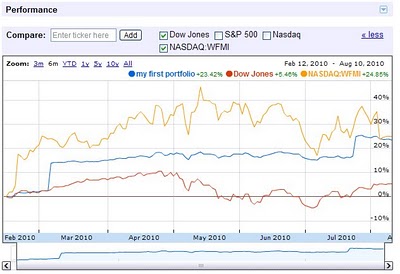
    investment portfolio charting from Google Finance
    Google finance has a nice new feature to let you chart your entire portfolio. You can then compare it to the S&P 500 or other stocks. This is a very nice feature. Yahoo Finance is about the only part of Yahoo I still use. I do use Google Finance some but they still fall short and I use Yahoo Finance much more. This feature will at least encourage me to put my portfolio in Google and start tracking it.

    It would be great if this could give you portfolio annual rates of return (including factoring in cash additions and withdraws and keeping track of sales over time to show a true view of the portfolio). It does look like it will factor in stock purchases and sales which is very nice. You can import csv files with transaction history – another nice feature.

    It also strikes me as a very smart move (as a Google stockholder that is nice to see) as advertising rates around investing are high. The more time Google can provide financial advertisers the more income they can make.

    Related: Lazy Portfolios Seven-year Winning StreakGoogle Posts Good Earning But Not Good Enough for Many (April 2010)Dollar Cost AveragingCurious Cat Investing Books