Category: Economics

  • Curious Cat Investing, Economics and Personal Finance Carnival #22

    Welcome to the Curious Cat Investing, Economics and Personal Finance Carnival: find useful recent personal finance, investing and economics blog posts and articles. The carnival is published twice each month.

    The new year starts with markets still highly uncertain due to the after affects of the too-big to fail credit crisis and the Euro-zone crisis. Job markets leave many people’s personal finances is trouble and those that are in good shape have a much greater challenge determining what are optimal personal financial strategies.

    And markets embody the uncertainty. Investing strategies are also made more difficult by the current uncertainties. Continuing with long held strategies seems wise, but less comforting in these troubled times.

    • 32 Best Dividend Stocks for 2012 by Shailesh Kumar – “The following table lists the best dividend stocks for 2012 based on dividend yields, dividend growth rate and dividend sustainability. All the stocks in this list have a P/E ratio of 15 or below.”
    • How I Switched to Long Term Thinking – “I started spending some time each day thinking about the decisions I made that day, particularly ones I would often see myself repeating. Outside of the moment, I’d look at the short term benefits of my options as well as the long term benefits and I’d decide independently what the best long-term choice was.”
    • A Country In Denial About Its Fiscal Future by Robert Samuelson – “Political leaders assume that financial markets won’t ever choke on U.S. debt and force higher interest rates, stiff spending cuts and tax increases. At best, this is wishful thinking. At worst, it’s playing Russian roulette with the country’s future.”
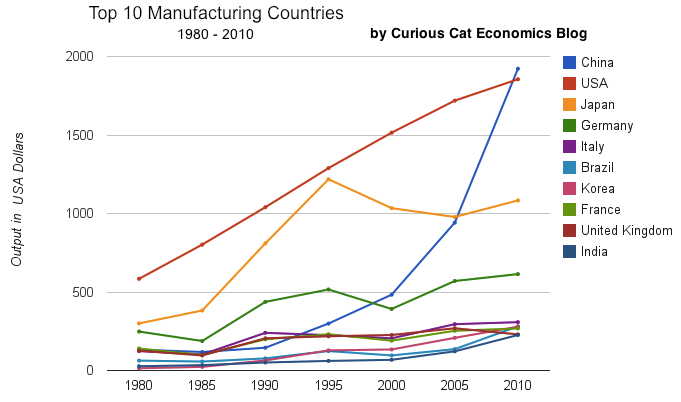
    • chart of output by top 10 manufacturing countries from 1980 to 2010

      Top 10 Countries for Manufacturing Production in 2010: China, USA, Japan, Germany… by John Hunter. China took over first place from the USA in manufacturing output in 2010. From 1980 to 2010 China increased output 1345%. The total top 10 group of countries increased output 302%. From 1995 to 2010 China increased output 543%. The group increased 64%.

    • (more…)

  • Simple Explanation of the Fractional Reserve Banking System

    The webcast is by the great Kahn Academy which produces simple educational content (like the above) on all sorts of topics. I find this too slow but I think it might be good for people that are not really sure how the banking system works. There is a group of people that are very apposed to fractional reserved banking, as a principle. I actually am fine with it, but it needs to be regulated much better than we have done.

    I suppose it might be true that our political leaders are much too subservient to those giving them lots of cash to regulate in a manner even close to acceptable: and therefore fractional reserve banking is dangerous. I am not sure that they are so hopeless that this is the case, though the more I see of how much they don’t know, and how often they seem to just vote based on what those giving them cash want it gets to be harder to believe they can be trusted to act close to properly (this is extremely sad). And it is mainly an indictment of ourselves: we keep putting people back in power that act mainly to reward those giving them cash and don’t seem interested in actually what is important for the long term interests of the country.

    I believe the FDIC actually does quite a good job of providing a solution to manage some issues with a fractional reserve banking system and people being able to rely on getting their money back.

    Related: Charlie Munger’s Thoughts on the Credit Crisis and RiskLeverage, Complex Deals and ManiaLobbyists Keep Tax Off Billion Dollar Private Equities Deals and On For Our Grandchildren

  • Curious Cat Investing, Economics and Personal Finance Carnival #21

    Welcome to the Curious Cat Investing, Economics and Personal Finance Carnival: find useful recent personal finance, investing and economics blog posts and articles.

    • Why Financial Literacy Fails (and What to Do About It) by JD Roth – “‘For years, I struggled with money,’ I told my interviewer today. ‘I knew the math, but I still couldn’t seem to defeat debt. It wasn’t until I started applying psychology to the situation that I was able to make changes.’”
    • Get ready for the three big financial crises of 2012 by Jim Jubak – “So in 2012 Ireland—and Greece and Portugal—are going to face a huge choice. They can either try to grind out more austerity in the midst of a EuroZone recession or they can try to renegotiate some of that debt. If you remember, the battle over Greek bank debt almost scuttled the euro this year. Well, we’re going to see the same problem again in 2012…”
    • How Long Would It Take To Build A $5000/Year Dividend Cash Flow? – John is able to investing $1000 per month in a portfolio now yielding 2.86% and dividends increasing 9% a year (under historical level for the stocks included)… a bit over 7 years…
    • Mark Cuban, invest in yourself. Keep your cash – wait to get a bargin based on the cash your have which allows you to take advantage of market opportunities.

    • (more…)

  • Relocating to Another Country

    There is an increasing trend to move from the USA to another country to work and live. This is not surprising to me. Recently this has picked up quite a bit; I am surprised by the velocity at which this interest in moving (I figured it would be a long term mega trend but not so drastic, so quickly). Economic changes are often quite surprising in how rapidly they move forward.

    An interesting survey shows USA investors have become much more interested in relocating in the last two years (the data they show though has tremendous volatility over time, so I am not really sure this means much). I wonder how much of it can be explained by investors wanting to get a deep understanding of very promising markets. I wouldn’t image the actual number that do this is huge, but maybe the number considering it is significant. Billionaire investor, Jim Rodgers moved to Asia because he sees Asia as key to the future. One of the reasons I moved to Malaysia this year was to get a in depth understanding of what South East Asia is like (it is not a deciding reason, at all but maybe the 4th or 5th reason).

    I believe the globalization of the employment market is a long term trend that will continue – especially for “knowledge workers.” The USA rested on the post WW II economic domination for nearly 50 years. The policies also helped this continue: investing in science and engineering, favoring entrepreneurship… But other countries have realized the value of these things (and the USA is slipping – not investing nearly as much in science and engineering and favoring large corporations that give politicians large amounts of cash over innovation – see things like the incredibly outdated “intellectual property” system, SOPA, favoring huge financial institutions…

    The combination of long term policy weakness, the inevitable decline in the USA to world ratio of economic wealth, and the financial crisis caused by the policy weaknesses have seemingly greatly accelerated the trend. The next 2 or 3 years will determine if that is a permanent acceleration or if we go back to a slower pace – but on the same path. My guess is that we will stay on this path but the pace will not follow the level surveys might indicate (showing interest in such a big change is far different from actually moving).

    There don’t seem to be any decent estimates of Americans living abroad. The US State Department claims releasing their estimates would be a national security risk? And the Census bureau says it would cost too much to try. Wild guesses seem to be between 4 and 6 million.

    Related: I want out (subreddit)Why Investing is Safer OverseasUSA Heath Care System Needs ReformCopywrong

  • We Need to be More Capitalist and Less Cronyist

    I am frustrated that we have largely allowed those that don’t believe in capitalism to claim their beliefs are capitalist. I believe capitalism is the best system to provide economic gain to human society. When we allow non-capitalist to claim their ideas are capitalist we often lose by allowing bad policies to be adopted and failing to adopt more capitalist ideas.

    Robber barons and their ilk are not capitalists. Those attacked today as capitalists are much more like European nobility that fought to let the nobility take most of the economic profit from everyone else.
    Capitalism is a wonderful thing.

    The foolish economic policies the politicians we have elected over and over again for decades are idiotic and not capitalist (they are somewhat capitalist but the things people are complaining about are not capitalism but the corruption of the system by those subverting capitalism). They are the result of favoring cronyism and bribery over capitalist regulated markets.

    What we need to do is not throw out the capitalists. We need to actually throw out those that say their cronyistic policies are capitalist.

    Capitalism is an economic system designed to achieve economic gain for a society. Adam Smith (and others) understood that if those with power to destroy the functioning of markets (for personal gain) were allowed to do so then the benefits capitalism can produce are reduced. And they definitely would try to (according to the believes fundamental to the capitalist model) so a capitalist system has to account for that.

    “Free” markets are good. But in capitalism “free” markets means markets where no entity has “market” power – that is the ability to move the market. This is the idea of perfect competition. In the real world this doesn’t happen but capitalist understand the weakness of unfree markets and that has to be dealt with. Things start to get messy here. There is no perfect way to do this and I don’t know of anyone (that I don’t think is naive) that thinks this can be done in some way that avoid economic friction (loss to the society from what is possible in some ideal state).

    Now those that like cronyism and letting whoever has the clout do whatever they want have tried to say capitalism means doing whatever you want to get as much capital as you want. It doesn’t. Capitalism isn’t about letting whoever has the gold get more. It is an economic system to provide gain to society by setting up rules that result in market forces brining benefit to society.

    Those thinking about setting up the rules for a capitalist system understood that many people are going to try and get away with taking what isn’t theirs. So you have to enforce the rule of law. You have to prevent those that seek to destroy markets and take personal gains they should not be able to (due to being allowed to collude with other market players, collude with politicians to gain political concessions that destroy market functions…).

    I happen to believe capitalism is the best economic system we have by far.

    I happen to believe those that have increasingly turned out system into one where croynism is destroying markets to give gains to a few parties dominates are creating great damage. But the problem is not that these people show capitalism is bad. Instead these people show the dangers of not putting in the effort to retain capitalist ideas: your economy suffers and people suffer.

    (more…)

  • Curious Cat Investing, Economics and Personal Finance Carnival #19

    Welcome to the Curious Cat Investing and Economics Carnival: find useful recent personal finance, investing and economics blog posts and articles.

  • Looking at the Value of Different College Degrees

    Georgetown University Center on Education and the Workforce has produced a new report looking at the value of different college degrees in the USA. I have seen a great increase in discussions of the “bubble” in education. Those articles often say a college degree doesn’t assure the success it used to. The data I review seems to show extremely large benefits for those with a college degree (higher salaries but, much more importantly, in my opinion, they also have much lower unemployment rates).

    Those benefits are greatest for several majors including science, math and engineering. The problem I see is not so much that significant benefits are lacking for college degrees but the huge increases in costs of getting a degree are so large that for some majors the cost is just so large that even with the benefits it is arguable whether it is worth the cost (while a few decades ago the benefits were universal and so large the economic benefit was not debatable).

    The authors of the report found that all undergraduate majors are worthwhile, even taking into account the cost of college and lost earnings. However, the lifetime advantage ranges from $1,090,000 for Engineering majors to $241,000 for Education majors. As I have written frequently on the Curious Cat Science and Engineering blog, engineering degrees are very financially rewarding.

    The top 10 majors with the highest median earnings for new graduates are:

    • Petroleum Engineer ($120,000)
    • Pharmacy/pharmaceutical Sciences and Administration ($105,000)
    • Mathematics and Computer Sciences ($98,000)
    • Aerospace Engineering ($87,000)
    • Chemical Engineering ($86,000)
    • Electrical Engineering ($85,000)
    • Naval Architecture and Marine Engineering ($82,000)
    • Mechanical Engineering, Metallurgical Engineering and Mining and Mineral Engineering (each with median earnings of $80,000)
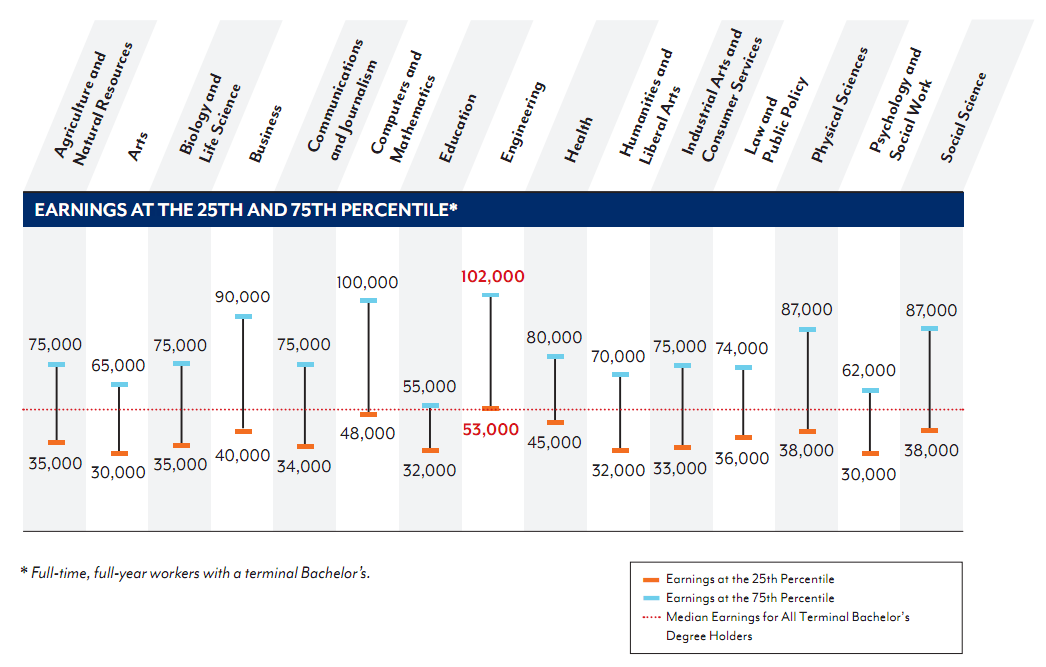
    chart showing the salaries by major in the USA (2009)
    Chart of salaries (25th and 75th percentile) by major in the USA based on data from 2009

    Related: 10 Jobs That Provide a Great Return on InvestmentMathematicians Top List of Best OccupationsNew Graduates Should Live Frugally

    (more…)

  • How Economic Inequality Harms Societies

    The increases in income inequality creates problems and increases serious risks. Some people have a political ideology that drives their thoughts on any economic policy. I instead, look to economic issues if they benefit society. The reason capitalism is great is because society benefits. The policies that create huge income inequality are bad for society and should be changed.

    Sadly the strong support for policies to elevate trust fund babies in the USA have created a society where economic wealth in the USA is now greatly defined by how rich your parents are instead of your ability and effort. The USA used to have great social mobility now we have changed society to become more like feudal Europe, while Scandinavia has become more like the USA used to be for social mobility.

    Related: Economic Fault, Income InequalityMiddle Class Families from 1970-2005Income Inequality in the USA (2006)The Widening “Marriage Gap” is Breeding Income Inequality

  • Curious Cat Investing, Economics and Personal Finance Carnival #18

    Welcome to the Curious Cat Investing, Economics and Personal Finance Carnival: find useful recent personal finance, investing and economics blog posts and articles. If you want to have an post considered for the next carnival please submit it to quixperito: money.

    • How I live on $7,000 per year by Jacob Lund Fisker – “If I had to venture a guess, I’d say I’m more frugal (the way your grandparents were frugal—in fact what I do wouldn’t be considered very extreme by your grandparents or great grandparents—I’d probably be average from their perspective) and I adhere more to a do-it-your-self ethics.”
    • Invest in Communities to Advance Capitalism by Howard Schultz (CEO of Starbucks) – “It is no longer enough to serve customers, employees, and shareholders. As corporate citizens of the world, it is our responsibility — our duty — to serve the communities where we do business by helping to improve, for example, the quality of citizens’ education, employment, health care, safety, and overall daily life, plus future prospects.” [similar to Dr. Deming ideas from decades ago on the purpose of organizations, which I share – John].
    • My dad taught me cashflow with a soda machine by Rob Fitzpatrick – “The vending machine didn’t magically make me want to be an entrepreneur. I wanted to be a video game designer, then an engineer, then a video game designer again, and then an academic. I get the impression kids are a bit slippery in that regard.
      But when I stumbled into the startup world two decades later, the dots began to connect. Cashflow wasn’t a new concept.”
    • photo of path up through the Forest Glen Preserve
      Forest Glen Preserve, Illinois, Illinois by John Hunter
    • Disability Insurance is Very Important by John Hunter – “When I would have had gaps in coverage from work, I have purchased disability insurance myself. I am all in favor of saving money. About the only 2 things I don’t believe in saving money being very important are health and disability insurance.”
    • What Other Dividend Lists Exist Besides the Dividend Aristocrats? – “companies that have increased their annual regular dividends for at least the past 10 consecutive years and have met specific liquidity screening criteria… The members of the Dividend Champions List include, those stocks (not limited to the S&P 500) that have increased their dividend for the past 25 years.”
    • Buying a New Home and Converting Your Current Home Into a Rental Property by Philip Taylor – “By refinancing our mortgage, we reduced our mortgage payment by enough to allow us to rent out the property by at least a hundred more per month than all of our expenses: mortgage, property taxes, insurance, home owners association dues, repairs, and property management fees.”
    • The perils of near monopoly by Joshua Gans – “Had Qantas had market shares akin to airlines in more competitive markets, the shut down would not have had the external spillovers, publicity and also the ability to shield Qantas — both managers and workers — from personal long-term consequences of such brinkmanship.”
    • (more…)

  • The USA Doesn’t Understand that the 1950s and 1960s are Not a Reasonable Basis for Setting Expectations

    After World War II essentially the only significantly large industrial base was in the USA. The USA was emerging as a national power in the early 1900’s. The wake of World War I and World War II left a very odd situation. You had many formerly very rich countries that were devastated and one rich country that wasn’t. Devastation is not easy to overcome in even 20 years. So for a good 2 decades the USA got wealthier and wealthier even while other formerly rich countries were re-developing their countries rapidly.

    This made the USA even richer as selling to all those around the world was pretty easy, just creating enough stuff was the hardest part. Almost none of the current emerging markets were doing much of anything economically. This resulted in the USA being able to live incredibly well and generate enormous wealth.

    The main legacy of this is a huge benefit to the USA – enormous wealth and experience. However, it seems to have left people thinking the USA is just suppose to be enormously wealthy always no matter if we throw away hundreds of billions a year on a broken health care system, provide huge benefits to political donors (farmers or bankers or phone oligopolists or robbers of the public domain [preventing innovation through repressive, outdated “intellectual property” regimes]), spending many hundreds of billions yearly on military expenditures far beyond those of any other country… It doesn’t work that way.

    You can waste huge amounts of economic benefit when you are the dominant economic power globally. And when you were as rich as the USA was in the 1950s and 1960s more and more people felt they deserved to be favored with economic gifts. So for a a few decades the USA used the excess wealth to pay off all sorts of special interests and still do very well economically. The only thing surprising is how long we have been able to keep this up.

    It isn’t rational to base expectations on periods when we were granted economic wealth largely by virtue of the world industrial production, other than ours, being destroyed. This isn’t the only reason we were wealthy, we do many things very well (compared to other countries) entrepreneurship, less corruption (still way too much but less than average), from 1950 to about 1990 an equitable distribution of economic gains, until recently a good advanced education system, a brilliant system to turn science and engineering breakthroughs into economic profit (that in the last few decades other countries are starting to do, but they are still way behind)…

    From 1970s until say the 2000s we could use our accumulated wealth to live off and allow huge inefficiencies to continue (lousy job of regulating banks, lousy job of subsidizing farming, lousy job of subsidizing lousy food [making it cheap to eat unhealthy food and expensive to eat healthy food], lousy job of controlling the costs of higher education, lousy job of getting people to realize they cannot expect to live far beyond most everyone else in the world just because they were born in the USA…
    (more…)